Securing Our Future
Mikko Hypponen (Chief Research Officer · F-Secure)
SecTor 2016 · Day 1 · Keynote Hall
Overview
In a compelling address at SecTor, Mikko Hypponen, Chief Research Officer at F-Secure, reflected on his 25-year journey in cybersecurity, highlighting the profound transformations in the threat landscape. Marking a quarter-century since his first virus analysis in September 1991, Hypponen distilled critical lessons learned, emphasizing that the foundational principles of security have been consistently challenged by evolving technology and increasingly sophisticated adversaries. The talk served as a stark reminder that as digital systems permeate every facet of human existence, the remit of cybersecurity professionals has expanded from merely securing computers to the far more critical task of securing society itself.
Key moments
- 0:00 Introduction and complexity as security's enemy
- 4:15 Ransomware: The biggest online crime problem
- 8:00 Ransomware-as-a-Service and Bitcoin's role
- 12:15 Fingerprint readers, phishing, and user password issues
- 19:40 USB Kill: Physical threat from unknown USB devices
- 21:20 IOT/ICS: Our job is to secure society
- 28:50 Largest DDoS attacks from IOT botnets
- 38:30 Resilience: Accepting breaches, focusing on recovery
Securing Our Future
Speakers: Mikko Hypponen, Chief Research Officer, F-Secure
Conference: SecTor
YouTube: https://www.youtube.com/watch?v=xNvp2O39Nkk
Overview
In a compelling address at SecTor, Mikko Hypponen, Chief Research Officer at F-Secure, reflected on his 25-year journey in cybersecurity, highlighting the profound transformations in the threat landscape. Marking a quarter-century since his first virus analysis in September 1991, Hypponen distilled critical lessons learned, emphasizing that the foundational principles of security have been consistently challenged by evolving technology and increasingly sophisticated adversaries. The talk served as a stark reminder that as digital systems permeate every facet of human existence, the remit of cybersecurity professionals has expanded from merely securing computers to the far more critical task of securing society itself.
Hypponen's presentation meticulously charted the evolution of cyber threats, from early floppy disk viruses to the modern scourges of Ransomware-as-a-Service (RaaS), Internet of Things (IoT) botnets, and nation-state cyber warfare. He underscored two immutable truths: complexity is the enemy of security, and a deep understanding of the adversary is paramount for effective defense. The discussion delved into the motivations and methodologies of contemporary attackers, from financially driven cybercriminals leveraging cryptocurrencies to nation-states aiming to erode public trust and destabilize geopolitical adversaries.
The article will explore Hypponen's insights into the current state of cybersecurity, examining the technical underpinnings of prevalent threats, the shifting paradigms in authentication, and the overlooked vulnerabilities introduced by ubiquitous connectivity. It will also provide actionable defensive implications for organizations and individuals, culminating in a redefinition of the cybersecurity mission in an interconnected world.
Background
▶ Watch: Introduction and complexity as security's enemy (0:00)
Hypponen commenced his talk by recounting a pivotal moment 25 years prior: his first encounter with a computer virus on a floppy disk in September 1991. This foundational experience in a nascent industry set the stage for a career spanning the entire modern history of cybersecurity. From this unique vantage point, he established two enduring lessons that continue to shape the industry's challenges.
First, complexity is the enemy of security. As systems grow in features, layers, protocols, and lines of code, the probability of vulnerabilities—which are fundamentally bugs, or human mistakes—increases exponentially. Despite this clear correlation, the industry's trajectory has been one of continuous addition, with new software releases consistently introducing more functionality rather than simplifying. This relentless pursuit of complexity creates an ever-expanding attack surface, making comprehensive defense an increasingly Sisyphean task.
Second, effective defense hinges on a precise understanding of the adversary. Hypponen stressed that the abstract notion of "evil hackers" is unhelpful; instead, organizations must identify who their enemies are, what their motivations are, and what techniques they employ. He provided concrete examples of prominent cybercriminals, such as Denis Kalauskis (Gozi botnet, Latvia), Willy Archipov (phishing, Estonia) who are now incarcerated, and Yevgeniy Bogachev (Zeus botnet, Russia) who remains at large. This distinction underscores that different attackers (e.g., financially motivated criminals, nation-states) require distinct defensive strategies and tools. This background frames the subsequent discussion of how these lessons apply to the modern threat landscape, particularly with the rise of ransomware and the Internet of Things.
Key Findings
▶ Watch: Ransomware-as-a-Service and Bitcoin's role (8:00)
Mikko Hypponen's talk unveiled several critical findings about the contemporary cybersecurity landscape, shaped by two and a half decades of observation:
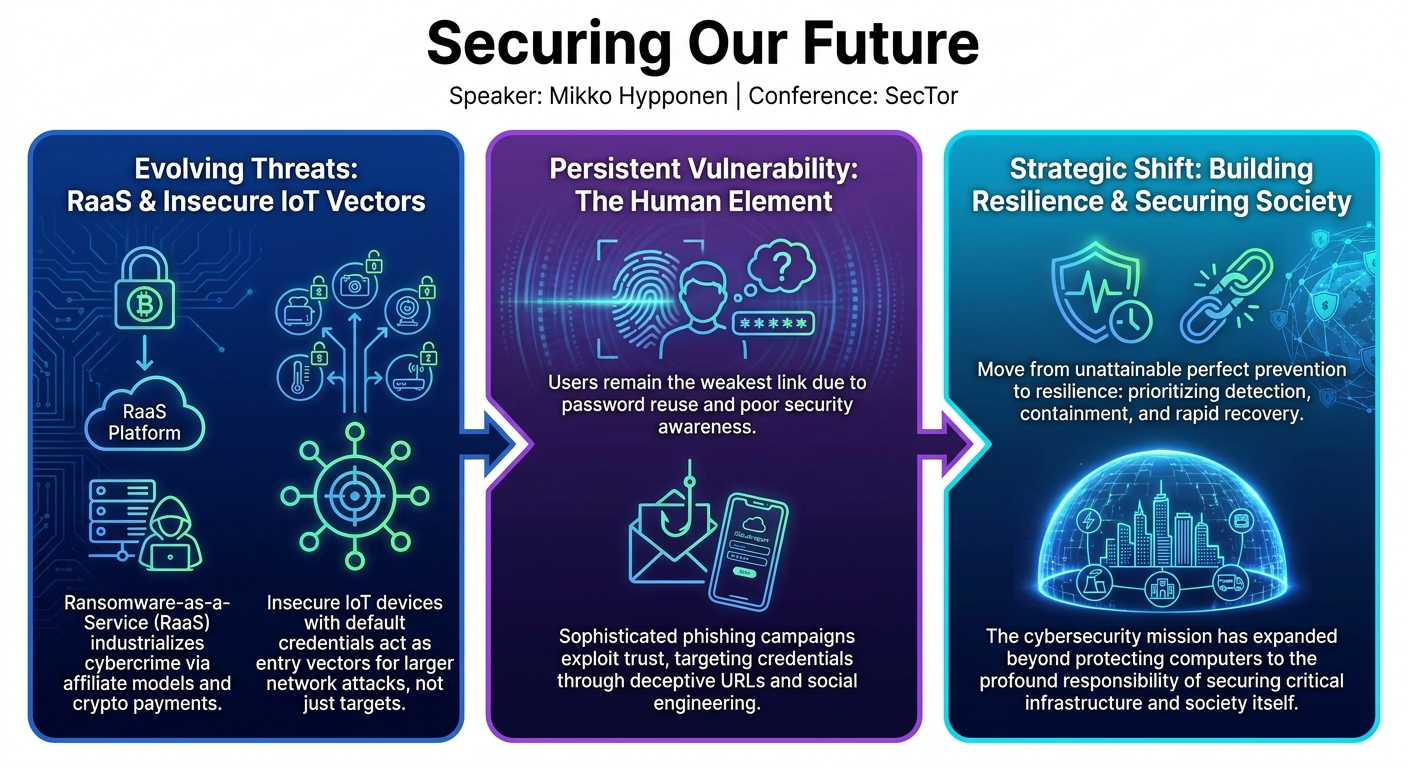
- Ransomware Dominance and Business Models: Ransomware has superseded banking Trojans, phishing, and botnets as the number one problem in online crime. Its impact is immediate and disruptive, halting operations by encrypting files and network shares without requiring administrative privileges. The rise of Ransomware-as-a-Service (RaaS), exemplified by the Shark ransomware project and the Janus Cybercrime Solutions operation (Petya ransomware), has democratized cybercrime, allowing individuals with no programming skills to launch attacks via franchise or revenue-sharing models. Bitcoin is the enabler, offering anonymity akin to real-world cash, leading to enterprises pre-emptively setting up Bitcoin wallets to pay ransoms.
- Authentication Shifts Attack Vectors: While stronger authentication methods like Apple's Touch ID (which uses one-way hashes of fingerprints) significantly enhance security against physical theft, they shift the attack vector. Thieves now target iCloud accounts through sophisticated phishing pages (e.g.,
iCloud.report,findmyiPhone.help,apple.findiphone.sexyusing new TLDs) to remotely wipe and unlock stolen devices. This illustrates that improving one security layer often redirects attackers to the next weakest link. - Persistent User Vulnerabilities: Despite technological advancements, users remain a primary vulnerability. Approximately 30% of users admit to reusing the same password across multiple services. Examples like posting credit card photos on social media highlight a fundamental lack of security awareness that attackers readily exploit, reinforcing the need for continuous user education.
- Physical USB Threats: The physical interface remains a potent attack vector. Beyond traditional Autorun exploits or BadUSB firmware attacks, devices like USB Kill can physically destroy hardware by accumulating and discharging 240 volts into a USB port, providing a stark demonstration of the dangers of plugging in unknown USB devices.
- IoT as an Attack Vector, Not a Target: The proliferation of Internet of Things (IoT) devices, from smart toasters to industrial control systems, is driven by cheap components and vendor data collection, often without tangible user benefit or explicit user knowledge of connectivity. These devices, frequently deployed with default credentials, are not typically the target of attacks but serve as easy entry points and vectors for larger network compromises.
- ICS and IoT Botnets: The widespread exposure of Industrial Control Systems (ICS) and IoT devices online, discoverable via platforms like Shodan and Riddler, creates massive vulnerabilities. This was dramatically demonstrated by the Mirai botnet, which launched the largest denial-of-service (DoS) attack on the internet to date, composed of compromised smart TVs, set-top boxes, routers, and Air Link 3G/LTE access points, primarily exploiting default credentials.
- Car Hacking for Profit: Real-world car hacking is driven by financial motivation, not random acts of violence. Thieves use tools like a MacBook connected to a car's On-Board Diagnostics (OBD) port to bypass security systems and steal vehicles, demonstrating a pragmatic approach to cybercrime.
- Nation-State Objectives: Nation-state cyber attacks, while less common for average companies, target specific high-value entities. Their objectives often extend beyond data theft to geopolitical destabilization, such as eroding trust in democratic processes (e.g., US presidential elections) or disrupting investigations (e.g., MH17 crash investigation via Outlook Web Access phishing).
- Shift from Prevention to Resilience: For large, globally networked organizations (e.g., Fortune 500 companies), breaches are an inevitability. The focus must shift from an unattainable goal of keeping all attackers out all the time to building resilience, emphasizing detection, containment, and rapid recovery to maintain operations despite intrusions.
- Securing Society: The ultimate finding is a redefinition of the cybersecurity mission. As virtually all aspects of modern society—from infrastructure and food production to governance and personal lives—are controlled by computers and software, the role of security professionals transcends securing individual computers to the profound responsibility of securing society itself.
Technical Deep Dive
▶ Watch: USB Kill: Physical threat from unknown USB devices (19:40)
Hypponen's presentation provided detailed technical insights across several critical areas, illustrating the evolving sophistication of cyber threats and the underlying mechanisms that enable them.
A significant portion of the talk focused on ransomware, which has become the dominant cybercrime threat. Modern ransomware, unlike earlier malware, does not require admin privileges or persistence mechanisms like surviving a reboot. Its efficacy stems from its ability to enumerate all network shares accessible by the infected user and then encrypt all files within those shares. This means a single workstation with standard user rights can encrypt gigabytes of data across an enterprise network. The business model of ransomware is crucial: over 110 different gangs are tracked, localizing their malware into over 25 languages to expand their victim pool. The emergence of Ransomware-as-a-Service (RaaS), exemplified by the Shark ransomware project on the dark web, allows aspiring criminals to license ransomware tools, encryption mechanisms, and payment gateways. The "dirty work" of infection (e.g., via exploit kits or phishing) is outsourced to partners, mitigating risk for the developers. The Janus Cybercrime Solutions operation, responsible for the Petya ransomware, introduced a revenue share model, splitting Bitcoin payments between the developers and their affiliates. Petya itself was notable for overwriting the Master Boot Record (MBR), rendering the system unbootable before file encryption. Bitcoin's anonymity is a technical enabler, acting as the digital equivalent of cash for online criminals.
On the front of authentication, Hypponen lauded Apple's implementation of Touch ID for its security. The system calculates a one-way hash of the user's fingerprint, ensuring Apple never stores the actual biometric data. This design prevents Apple from losing or compromising a user's fingerprint. However, this technical improvement shifted the attack vector. Thieves of iPhones, unable to bypass Touch ID, resort to sophisticated phishing attacks targeting iCloud credentials. These attacks involve sending notifications from spoofed "Find My iPhone" services, redirecting users to fake authentication pages with deceptive URLs (e.g., iCloud.report, findmyiPhone.help, apple.findiphone.sexy). The use of new Top-Level Domains (TLDs) (like .help, .report, .sexy, .trade, .review) makes these phishing sites appear more legitimate at a glance, allowing attackers to gain iCloud access and remotely reset stolen phones.
The talk also detailed various USB-based threats. Beyond historical issues like Autorun vulnerabilities and more advanced techniques like zeroday exploits or BadUSB (which alters a USB device's firmware to impersonate other device types), Hypponen highlighted the physical threat posed by devices like USB Kill. This device collects electrical power from the USB port's power lines, stores it until it reaches a lethal 240 volts, and then discharges it back into the port, physically frying the host computer's components. This demonstrates that physical access to a USB port can lead to catastrophic hardware damage, not just data compromise.
Hypponen extensively covered the vulnerabilities arising from IoT and Industrial Control Systems (ICS). He pointed to platforms like Shodan and Riddler, which can be used to discover thousands of inadvertently exposed ICS devices online, including power plants, generators, dams, and security cameras, often with no passwords or default credentials (e.g., open VNC instances). This accidental exposure is a critical security flaw. The IoT revolution, driven by the decreasing cost of adding network chips, leads to devices (like toasters) connecting to the internet not for user benefit but for vendor data collection. These unsecured IoT devices become prime attack vectors. The Mirai botnet served as a concrete example, comprising compromised smart televisions, set-top boxes, routers, and Air Link 3G/LTE access points. Mirai's simplicity was its strength: it scanned for IoT devices and attempted to log in using a list of common default credentials. Devices that had not changed these credentials were then enlisted into the botnet, which was responsible for the largest denial-of-service (DoS) attack on the internet at the time, with some components originating from remote locations like above the Arctic Circle. The ongoing availability of commercial DoS-for-hire services, openly advertised on platforms like YouTube for as little as five US dollars, further exacerbates this threat.
Finally, the talk touched on car hacking and nation-state attacks. Car hacking, in practice, is less about remote control and more about theft. Thieves use tools like a MacBook connected to the car's On-Board Diagnostics (OBD) port to exploit vulnerabilities, disable alarms, and start the vehicle, demonstrating a pragmatic and profitable application of cyber skills. Nation-state attacks, while targeting specific entities, employ sophisticated social engineering and phishing tactics. The example of the MH17 plane crash investigation team being targeted with phishing emails for their Microsoft Outlook Web Access credentials, linking to copycat sites, illustrated how nation-states seek to compromise sensitive information and disrupt critical operations to achieve geopolitical objectives, such as eroding trust in democratic institutions.
Demo / Proof of Concept
▶ Watch: IOT/ICS: Our job is to secure society (21:20)
While the talk did not feature a live, interactive demonstration in the traditional sense, Mikko Hypponen effectively utilized video and real-world examples to illustrate critical security concepts and threat capabilities.
A compelling proof of concept was the USB Kill device. Hypponen showed a video demonstrating a laptop being instantly "fried" and rendered inoperable after the USB Kill device was plugged into its USB port. He explained the technical mechanism: the device accumulates power from the USB power line until it reaches 240 volts, then discharges this lethal electrical surge back into the port, destroying internal components. This served as a visceral and unforgettable demonstration of why users should never plug unknown USB devices into their computers, emphasizing that the threat extends beyond data compromise to physical destruction. He also highlighted that this functionality can be embedded into innocuous-looking objects, not just traditional thumb drives.
Another potent "proof of concept" was the security camera footage depicting a car thief. Instead of traditional hot-wiring, the thief was shown connecting a MacBook via a USB cable to the car's On-Board Diagnostics (OBD) port. After a few minutes of interaction with the laptop, the car's alarm was disabled, and the thief was able to start the vehicle and drive away. This real-world example effectively countered the common misconception of car hacking as a remote, high-speed disabling of brakes, instead illustrating a practical, profit-driven application of cyber tools for physical theft. It underscored the importance of understanding attacker motivation to accurately assess threats.
The pervasive availability of Industrial Control Systems (ICS) and IoT devices online, discoverable via platforms like Shodan and Riddler, also served as a macro-level proof of concept. Hypponen cited examples of publicly accessible power plants, generators, dams, and security cameras (some even monitoring plant growth), often running open VNC without any passwords. These examples, frequently shared by researchers like Dan Templar, visually demonstrate the sheer scale of misconfigured and unsecured infrastructure readily exposed to potential attackers.
Finally, the Mirai botnet and its subsequent denial-of-service (DoS) attacks represented a large-scale, real-world proof of concept for the dangers of unsecured IoT. The fact that the largest DDoS attack on the internet at that time was launched by a botnet composed of smart TVs, set-top boxes, and routers, primarily exploiting default credentials, unequivocally demonstrated the threat posed by these devices when leveraged as vectors rather than targets.
Defensive Implications
▶ Watch: Resilience: Accepting breaches, focusing on recovery (38:30)
Mikko Hypponen's talk offers several critical defensive implications for individuals, organizations, and society at large, urging a shift in mindset and strategy.
- Prioritize Simplicity: Given that complexity is the enemy of security, defenders should actively advocate for simpler systems with fewer features and less code. While challenging in a market driven by feature growth, this principle encourages minimalist design, reduced attack surface, and easier vulnerability management.
- Know Your Enemy: Understanding the specific motivations and techniques of different adversaries (e.g., financially motivated cybercriminals, nation-states, opportunistic hackers) is fundamental. This enables targeted defenses, allocating resources where they are most effective against the most probable threats, rather than deploying generic, abstract security measures.
- Ransomware Preparedness: Organizations must implement robust backup and recovery strategies to mitigate ransomware impact. This includes regular, off-site, and immutable backups. The alarming trend of enterprises setting up Bitcoin wallets for ransom payments, while a pragmatic short-term solution for some, ultimately exacerbates the problem by funding criminal enterprises. The ideal defense remains prevention and effective recovery.
- Multi-Factor Authentication (MFA) and Phishing Awareness: While stronger authentication like biometrics improves security, defenders must anticipate and educate users about the shift in attack vectors. The rise of sophisticated phishing campaigns targeting iCloud and other cloud service credentials highlights the need for continuous user training on identifying fake URLs, scrutinizing new TLDs, and understanding social engineering tactics even when MFA is in place.
- USB Security Policies and Education: Strict policies against plugging in unknown USB devices are crucial. User education should emphasize the potential for both data compromise (e.g., Autorun, BadUSB) and physical destruction (e.g., USB Kill). Organizations should consider disabling USB ports where possible or implementing whitelist-based controls for authorized devices.
- Secure IoT and ICS Deployment: The proliferation of IoT and the exposure of ICS demand immediate attention. All IoT devices, whether for home or enterprise, must have their default credentials changed immediately upon deployment. Network segmentation should be employed to isolate IoT and ICS devices from critical corporate networks. Regular scanning (e.g., using Shodan or Riddler findings) to identify inadvertently exposed devices is essential.
- Network Segmentation and Monitoring for IoT Vectors: Recognize that IoT devices are often vectors, not targets. Enterprises must assume that employees will bring insecure IoT devices into the corporate environment (e.g., an IoT coffee machine leaking Wi-Fi passwords). Implement network segmentation, strict access controls, and continuous monitoring to detect anomalous behavior originating from these devices, preventing them from becoming the weakest link.
- Focus on Resilience, Detection, and Recovery: For large organizations, the notion of absolute prevention is unrealistic. Instead of solely trying to "keep everybody out all the time," the strategic focus must shift to resilience: being able to continue operations even when a breach occurs. This involves robust detection capabilities to identify intrusions early, effective containment strategies to limit damage, and rapid recovery plans to restore operations.
- Elevate the Cybersecurity Mission: Security professionals must recognize their expanded role. No longer merely safeguarding computers, their mission is to secure society itself, given the pervasive integration of software into critical infrastructure, governance, and daily life. This requires a broader perspective, engaging with policymakers, educators, and the public to foster a more secure digital future.
Key Takeaways
- Complexity is the Enemy of Security: The more features, layers, and code in our systems, the harder they are to defend, as vulnerabilities are inevitable human mistakes. Strive for simpler, more secure designs.
- Know Your Adversary: Effective defense requires understanding who is attacking, their motivations (e.g., financial gain, geopolitical destabilization), and their techniques, rather than relying on abstract notions of "evil hackers."
- Ransomware is a Business: The rise of Ransomware-as-a-Service (RaaS) and the use of Bitcoin have industrialized cybercrime, making ransomware the top threat. Robust backup and recovery strategies are paramount for mitigation.
- IoT Devices are Attack Vectors: The growing number of insecure Internet of Things (IoT) and Industrial Control Systems (ICS) devices, often with default credentials, are not usually the target but serve as easy entry points and vectors for large-scale attacks like the Mirai botnet.
- Users Remain the Weakest Link: Despite technological advancements, human factors like weak passwords, password reuse, and susceptibility to sophisticated phishing (e.g., targeting iCloud accounts via new TLDs) continue to be primary vulnerabilities.
- Shift to Resilience for Large Organizations: For large, globally networked entities, breaches are an inevitability. The strategic focus must shift from impossible perfect prevention to building resilience, emphasizing early detection, containment, and rapid recovery of operations.
- The Mission: Securing Society: As computers and software control nearly every aspect of modern life, the ultimate responsibility of cybersecurity professionals has expanded from securing individual machines to the critical task of securing society itself.
About the Speaker(s)
Mikko Hypponen is the Chief Research Officer at F-Secure, a leading European cybersecurity company. With a distinguished career spanning 25 years in the field, Hypponen is a globally recognized authority on cyber threats and the evolving landscape of information security. His journey began in September 1991 with the analysis of his first computer virus on a floppy disk, providing him with a unique, long-term perspective on the industry's development. He is known for his analytical insights into the motivations and methodologies of cybercriminals and nation-states, and for his ability to translate complex technical issues into understandable terms. Hypponen frequently speaks at major security conferences worldwide, sharing his expertise on topics ranging from malware and botnets to privacy and the future of cybersecurity.
Reviews
Dr. Zero (Offensive Security Researcher) — SOLID
Hypponen is a legend, and this is exactly the kind of well-executed victory lap you expect in a keynote slot. It's a beautifully delivered retrospective of the threat landscape, but if you're looking for net-new research or actionable intelligence, you're in the wrong room.
Heather Calloway (CISO) — SOLID
Hypponen is a master storyteller, but this is a primer, not a playbook. It is a great historical retrospective for grounding a new executive, but your leadership team won't find new operating mechanics here. Worth sharing for broad context, but it shouldn't change your risk register.