WiFi Exploitation: How Passive Interception Leads to Active Exploitation
Solomon Sonya (Assistant Professor of Computer Science · United States Air Force Academy)
SecTor 2016 · Day 1 · Tech 1 (701A)
Overview
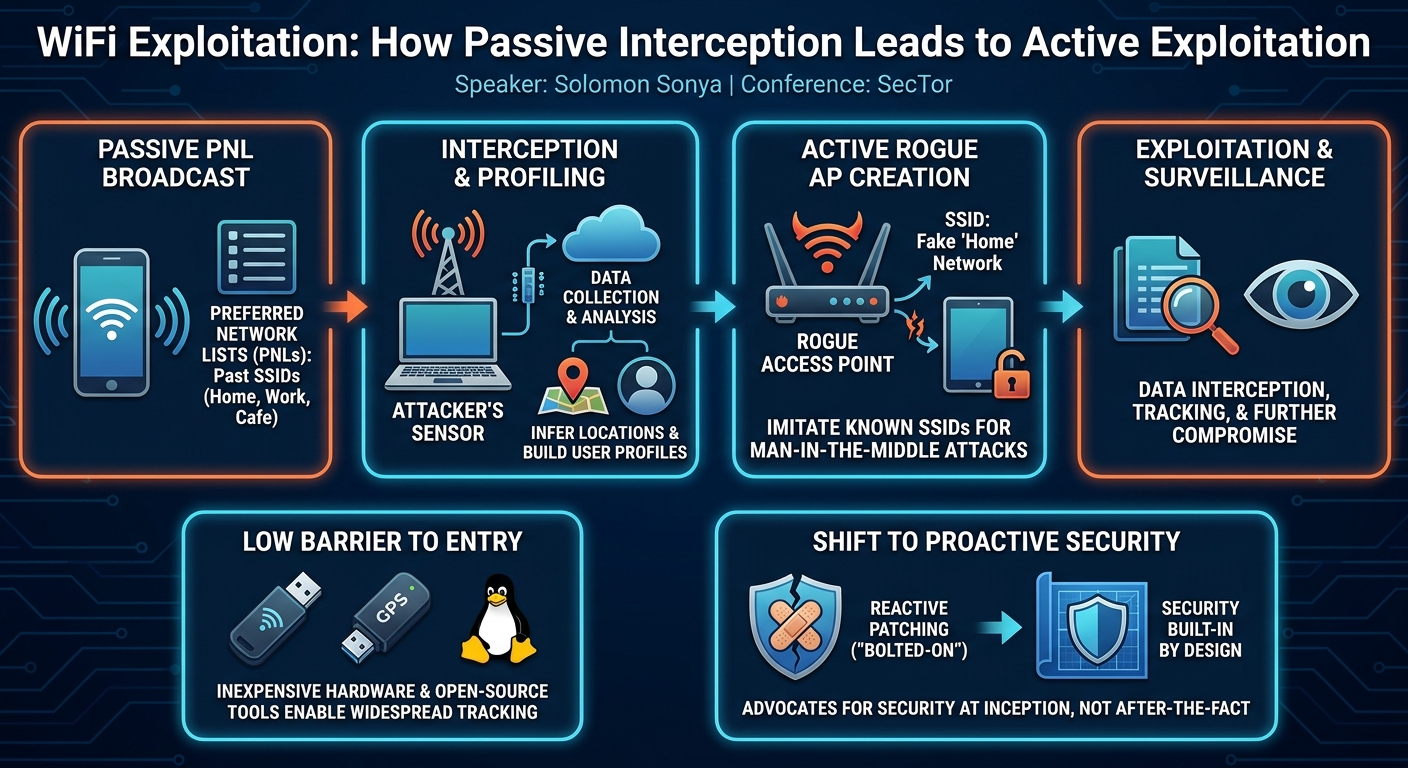
In this insightful SecTor talk, Assistant Professor Solomon Sonya from the United States Air Force Academy delved into the often-overlooked vulnerabilities inherent in Wi-Fi communication protocols and the smart devices that rely on them. Titled "WiFi Exploitation: How Passive Interception Leads to Active Exploitation," Sonya's presentation meticulously demonstrated how readily available tools can be leveraged for passive reconnaissance, leading to sophisticated active exploitation and pervasive surveillance. The talk emphasized a critical shift in security thinking, moving from reactive patching to proactive, built-in security, particularly in the age of pervasive smart devices and the Internet of Things (IoT).
Key moments
- 0:00 Introduction and talk overview
- 4:00 Challenging digitally signed software security
- 13:00 Smartphone app permissions: your country's greatest spy
- 16:00 Research motivation: Tracking people via WiFi probe requests
- 26:00 Building the WiFi sensor on the cheap
- 30:00 Live demo: Intercepting WiFi frames with T-shark
- 39:00 Exploiting unique WiFi SIDs for location tracking
- 54:00 Live demo: Fingerprinting individuals with unique SIDs
WiFi Exploitation: How Passive Interception Leads to Active Exploitation
Speakers: Solomon Sonya, Assistant Professor of Computer Science, United States Air Force Academy
Conference: SecTor
YouTube: https://www.youtube.com/watch?v=GmpFKBNDzHI
Overview
In this insightful SecTor talk, Assistant Professor Solomon Sonya from the United States Air Force Academy delved into the often-overlooked vulnerabilities inherent in Wi-Fi communication protocols and the smart devices that rely on them. Titled "WiFi Exploitation: How Passive Interception Leads to Active Exploitation," Sonya's presentation meticulously demonstrated how readily available tools can be leveraged for passive reconnaissance, leading to sophisticated active exploitation and pervasive surveillance. The talk emphasized a critical shift in security thinking, moving from reactive patching to proactive, built-in security, particularly in the age of pervasive smart devices and the Internet of Things (IoT).
Sonya challenged conventional notions of network security, arguing that the continuous broadcasting of Preferred Network Lists (PNLs) by our devices—a list of Wi-Fi networks they've connected to in the past—creates a significant attack surface. By intercepting these PNLs, attackers can not only profile individuals and determine their likely places of residence, work, or frequent travel but also establish Rogue Access Points for man-in-the-middle attacks. This research highlights that even when users are diligent about securing their personal devices, the underlying network protocols can expose a wealth of sensitive information, making it a crucial topic for cybersecurity professionals and the general public alike.
The presentation provided a compelling case for understanding the intricacies of the 802.11 protocol, illustrating how simple, off-the-shelf hardware and open-source software can be combined into a powerful, distributed sensor framework. This framework enables comprehensive tracking and profiling, underscoring the urgent need for a paradigm shift in how we approach security in an increasingly connected world.
Background
▶ Watch: Introduction and talk overview (0:00)
Solomon Sonya began by critically examining the current state of cybersecurity, which he characterizes as a reactive "whack-a-mole" game. For decades, the industry has focused on discovering vulnerabilities, patching them, detecting malware with signatures, and implementing anomaly-based intrusion detection systems. While these approaches have their merits, Sonya argued they are fundamentally flawed because they operate on the premise of detecting threats after they have emerged. He highlighted the failure of digitally signed software to prevent malware, demonstrating how easily an attacker can establish a legitimate-looking company, purchase certificates, and sign malicious code, thereby bypassing trust mechanisms. The core issue, Sonya posits, is the belief that security can be "bolted on" rather than "built in" from the inception of software and hardware development.
Sonya then challenged the traditional anatomy of a cyberattack—reconnaissance, enumeration/scanning, penetration, privilege escalation, stealth, and persistence. He asserted that modern enterprise networks are often robust enough to thwart direct scanning attempts via firewalls. Instead, attackers have evolved to an "updated anatomy," favoring indirect approaches like social engineering, phishing emails, and waterhole attacks. These methods bypass perimeter defenses by manipulating human behavior or exploiting trusted websites, demonstrating a shift towards more patient and stealthy tactics. This updated attack model underscores the difficulty of detection and the need for a more holistic security strategy.
A significant portion of his background discussion focused on the burgeoning threat posed by smart devices and the Internet of Things (IoT). Sonya controversially labeled smart devices as "your country's greatest spy," arguing that they collect vast amounts of personal data without users' full awareness or consent. He illustrated this by asking how many in the audience genuinely review application permissions before installing software on their phones, suggesting that most users blindly grant extensive access. He provided a stark example of a simple flashlight app requesting permissions for phone calls, memory access, microphone use, and network updates—privileges entirely disproportionate to its stated function. This casual disregard for permissions creates ubiquitous surveillance opportunities, setting the stage for his core research on Wi-Fi exploitation. The fundamental question Sonya posed was: "When was the last time you actually wondered, is the network communication protocol that these devices are using secure?" This question served as the impetus for his deep dive into 802.11 Wi-Fi vulnerabilities.
Key Findings
▶ Watch: Smartphone app permissions: your country's greatest spy (13:00)
The central premise of Solomon Sonya’s research, and the talk's key findings, revolved around the pervasive and exploitable nature of Wi-Fi communication, specifically the broadcasting of Preferred Network Lists (PNLs). Sonya definitively demonstrated that:
- Passive Interception of PNLs is Feasible: It is not only possible but straightforward to intercept the PNLs emanating from nearby smart devices (phones, laptops, PDAs). These PNLs contain the Service Set Identifiers (SSIDs) of every Wi-Fi network a device has ever connected to, constantly broadcasted as the device searches for known networks.
- Creation of Detailed User Profiles: By collecting these PNLs, attackers can build extensive profiles of individuals. Each unique SSID provides a clue about a person's past locations.
- Determination of Places of Interest/Habitation: Leveraging the unique nature of many SSIDs (e.g., "Home_Wi-Fi," "Office_Network," "Starbucks_Guest"), attackers can correlate intercepted PNLs with war-driving databases or publicly available Wi-Fi location data. This allows them to infer where a person lives, works, or frequently visits, effectively triangulating their movements and routines. Sonya explicitly stated, "If you have a unique name... if I ever saw somebody else with that unique serviced identifier, I can now tag you to that location."
- Establishment of Rogue Access Points for Man-in-the-Middle (MiTM) Attacks: Once a PNL is intercepted, an attacker can set up a rogue access point that mimics one of the SSIDs from the PNL. Since devices automatically connect to known networks, the target's device will likely connect to the attacker's rogue AP, enabling MiTM attacks, data interception, and further exploitation.
- Ubiquitous and Cheap Surveillance: The entire framework can be built using readily available, inexpensive hardware (e.g., an Alpha card, GPS receiver, high-gain antenna, totaling around $100) and free, open-source software (Kali Linux, t-shark, custom Java applications). This low barrier to entry makes the threat accessible to a wide range of actors.
Sonya's "spoiler alert" – "yes, you can" – at the beginning of this segment underscored the undeniable reality of these capabilities, setting a serious tone for the technical deep dive that followed.
Technical Deep Dive
▶ Watch: Building the WiFi sensor on the cheap (26:00)
The technical core of Sonya's talk centered on understanding and exploiting the 802.11 Wi-Fi protocol. He simplifies the protocol into three main frame types:
- Management Frames: These frames handle network setup and teardown. Key management frames include probe requests (sent by client devices searching for known SSIDs), beacon frames (sent by access points announcing their presence), and authentication/deauthentication messages. Sonya emphasized that a device continuously sends probe requests for its PNL, even when already connected to another network, describing this as an "unstable marriage."
- Control Frames: Used for medium access control, like Request to Send (RTS) and Clear to Send (CTS) messages, to manage shared airwaves.
- Data Frames: Carry the actual network traffic payload (e.g., HTTP messages, files).
The exploitation hinges on intercepting management frames, specifically probe requests, which reveal the client's PNL. Sonya explained that specific bits within these frames indicate their type, allowing for precise parsing.
To operationalize this, Sonya developed a distributed sensor framework called the Theia Sensor Suite, designed for scalability and wide-area monitoring. The framework leverages distributed computing principles, where multiple, geographically dispersed sensors collect data and send it to a central repository. This allows for triangulation of device locations and tracking of movements across an area. The framework relies on foundational programming concepts such as socket programming for inter-machine communication, multi-threading for near-simultaneous task execution within a single program, and wrappers—separate programs that automate and parse the output of existing tools.
The hardware requirements are minimal and budget-friendly:
- An Alpha card (around $30), a standard USB Wi-Fi adapter known for its ability to operate in monitor mode.
- A 12 dBi high-gain antenna (replacing the default 5 dBi) to significantly extend interception range, allowing the sensor to detect devices from "streets away." Sonya noted that one such antenna, deployed at his university, detected over 16,000 unique MAC addresses in a week, far exceeding the student and faculty population.
- A GPS receiver (around $30) for war driving, enabling the mapping of intercepted SSIDs to geographical coordinates.
- Kali Linux, a free, open-source penetration testing operating system, serves as the host environment.
The Theia Sensor Suite itself is a custom Java application comprising several modular components:
- GPS Collector: A wrapper around the GPS receiver, collecting location data and associating it with intercepted frames.
- Theia Sensor: The core interception module. It's a wrapper built around t-shark (the command-line packet analyzer underlying Wireshark). The sensor configures the Wi-Fi card into monitor (promiscuous) mode and uses
t-sharkwith specific flags (-i WLAN2 -T fields -e wlan.sa -e wlan.da -e wlan.mgt.ssid) to extract source MAC address, destination MAC address, and the SSID from 802.11 management frames. - OUI Agent: This module leverages the Organizationally Unique Identifier (OUI)—the first three bytes of a MAC address—to identify the manufacturer of a device. By maintaining a database of OUI-to-vendor mappings, the agent enriches intercepted MAC addresses with vendor information (e.g., Apple, Samsung, Lenovo), aiding in targeted exploitation.
- Geo Retrieval Agent: This crucial component processes the intercepted SSIDs. Sonya explained that "unique names on your access points" (a common practice) are a weakness. By correlating these unique SSIDs with a database of known Wi-Fi networks and their GPS coordinates (potentially built through war driving), the system can deduce the past geographical locations of a device and, by extension, its owner. This reduces the "entropy" or uncertainty about a person's movements.
- Theia Collector: The central aggregation point. It receives raw data from all distributed sensors and agents, parses it, and stores it in a hash table for efficient retrieval. Its multi-threaded architecture handles high volumes of incoming data.
- Theia Interface: A graphical user interface (GUI) for visualizing the collected and processed data. It displays charts, lists detected clients, shows Receive Signal Strength Indicator (RSSI) values (indicating proximity), and maps SSIDs to geographical locations using a Google Maps-based interface.
This modular architecture allows for independent development and deployment of each component, making the system robust and adaptable. The emphasis on using existing, widely available tools and open standards highlights the accessibility and pervasive nature of this exploitation technique.
Demo / Proof of Concept
▶ Watch: Live demo: Intercepting WiFi frames with T-shark (30:00)
Solomon Sonya's demonstration of the Theia Sensor Suite provided a compelling, real-time proof of concept for his research. He began by showcasing the fundamental step: setting a standard Alpha card into monitor mode using Kali Linux command-line tools (ifconfig wlan2 down, iwconfig wlan2 mode monitor, ifconfig wlan2 up). Once in monitor mode, he executed a t-shark command (sudo tshark -i wlan2 -T fields -e wlan.sa -e wlan.da -e wlan.mgt.fc.type -e wlan.mgt.ssid) to passively intercept raw 802.11 management frames. The terminal immediately filled with black and white text, displaying source and destination MAC addresses, frame types (e.g., probe requests), and SSIDs (if present) from devices in the conference room. This initial step visibly confirmed that the necessary information is constantly being broadcasted and is easily intercepted.
He then transitioned to the full Theia Sensor Suite, a Java-based application.
- Theia Sensor: He launched
TheaSensor.jar, which automatically detected and configured the Alpha card into monitor mode. It prompted for basic sensor identification (name, physical address, location), then began streaming raw, real-time Wi-Fi activity in a dedicated terminal window. This output included SSIDs like "Boingo Hotspot" and "SecTor 2016," confirming the capture of PNLs and active access points. - Theia Collector: Next, he started
TheaCollector.jar, which immediately spun up multiple threads to handle incoming data. He then connected the sensor to the collector viasensor_connect localhost 8080. The collector terminal began displaying parsed and analyzed information, demonstrating its role in aggregating and processing the raw data stream. - Theia Interface: To visualize this data, Sonya launched
TheaInterface.jar. After establishing a connection to the collector, the GUI populated with dynamic charts and lists.
- The RSSI (Receive Signal Strength Indicator) graph showed the signal strength of detected devices, illustrating how proximity can be inferred (lower numbers mean closer devices).
- The Detected Clients tab listed MAC addresses. Initially, it lacked vendor information.
- He then started the OUI Agent (
TheaOUI.jar) and connected it to the collector (oui_connect localhost 8081). After a brief delay, the "Detected Clients" list in the GUI began to display vendor information (e.g., "Apple," "Samsung," "Wistron") next to the MAC addresses, demonstrating the enrichment of data. At one point, the interface reported 58 Apple devices and 36 Samsung devices detected in the vicinity. - A critical part of the demo involved the Requested SIDs tab. Sonya described a "fingerprinting" technique: if he wanted to identify a specific person, he could ask them to manually add a unique, non-existent Wi-Fi network (e.g., "InterContinental") to their phone. As soon as the phone attempts to connect to this non-existent network, it broadcasts a probe request for that specific SSID, which the sensor immediately intercepts and displays, thereby uniquely identifying that device and its user. One participant's "InterContinental" probe request was indeed observed on screen.
- Finally, he demonstrated the Geolocation capabilities. After connecting the Geo Retrieval Agent (
Geo.jar) to the collector, he showed how SSIDs could be mapped to locations. Though the database was not fully populated for the conference location in real-time, he illustrated how clicking "map all SIDs" would bring up a Google Maps interface, plotting known locations associated with intercepted SSIDs. He showed one SSID linked to "Toronto, Ontario" and noted how a more complete database would reveal a person's travel history and frequent locations through their PNL.
Despite minor live demo gremlins (which he humorously predicted), the demonstration powerfully conveyed the ease and effectiveness of passive Wi-Fi interception for profiling and tracking.
Defensive Implications
▶ Watch: Live demo: Fingerprinting individuals with unique SIDs (54:00)
Solomon Sonya's talk presents significant defensive implications for individuals, organizations, and device manufacturers. The core message for defenders is to move beyond reactive security measures and adopt a proactive, "security built-in" mindset.
- Re-evaluate Smart Device Permissions: Users must be educated to scrutinize and restrict application permissions on their smartphones and IoT devices. The example of a flashlight app requesting microphone and network access highlights a pervasive threat vector. Devices should only be granted the minimum necessary permissions for their intended function.
- Disable Wi-Fi When Not in Use: The constant broadcasting of PNLs is the primary mechanism for exploitation. Simply turning off Wi-Fi on smart devices when not actively connected to a trusted network can significantly reduce exposure to passive interception. This prevents the device from sending out probe requests that betray its history.
- Implement MAC Address Randomization: While not explicitly discussed as a defense by Sonya, the reliance on stable MAC addresses for tracking implies that devices capable of MAC address randomization (a feature increasingly found in modern operating systems like iOS and Android) should utilize it. This makes it harder to track a single device over time and across different locations. However, even with randomization, PNLs are still broadcasted.
- Be Wary of Unique SSID Names: Sonya explicitly identified the practice of using unique, descriptive SSID names for home or office networks as a weakness. While convenient for identification, these unique identifiers become traceable breadcrumbs. Organizations should consider generic or frequently changed SSIDs, though this might impact user experience. For home users, the trade-off between convenience and privacy needs to be weighed.
- Understand 802.11 Protocol Vulnerabilities: Security professionals need a deeper understanding of the 802.11 protocol, particularly the management frames. Tools like the Theia Sensor Suite can be used defensively to audit network environments for unauthorized PNL broadcasting or to identify rogue access points.
- Secure Network Infrastructure: Organizations should implement robust Wi-Fi security, moving beyond simple WPA2-PSK to WPA3-Enterprise with strong authentication mechanisms (e.g., 802.1X). Network segmentation should also be employed to isolate devices and reduce the blast radius of any compromise.
- Manufacturers Must Prioritize Security by Design: The most impactful defensive measure, according to Sonya, is for device manufacturers and software developers to build security from inception. This includes minimizing unnecessary data broadcasting, implementing robust privacy controls by default, and designing protocols that do not inadvertently leak sensitive user information.
- Educate Users on Passive Surveillance: The general public often underestimates the extent of passive surveillance. Awareness campaigns highlighting how devices broadcast their network history and the implications for personal privacy are crucial.
In essence, defending against these passive interception techniques requires a multi-layered approach: individual user vigilance, robust enterprise security, and a fundamental shift in how technology is designed and secured.
Key Takeaways
- Passive Wi-Fi Monitoring is Powerful: Readily available, inexpensive hardware (Alpha card, high-gain antenna, GPS receiver) combined with open-source software (Kali Linux, t-shark, custom Java wrappers) enables highly effective passive interception of Wi-Fi traffic.
- Preferred Network Lists (PNLs) are a Privacy Goldmine: Devices constantly broadcast their PNLs (SSIDs of previously connected networks), offering attackers a rich source of information for profiling individuals, inferring past locations (home, work, travel), and identifying patterns of life.
- "Security Built-In" vs. "Bolted On": The talk strongly advocates for a paradigm shift from reactive security (patching, detection) to proactive, built-in security at the inception of software and hardware design, as current approaches are failing against evolving threats.
- Smart Devices are Pervasive Surveillance Tools: Our smartphones and IoT devices, often with excessive application permissions and insecure default Wi-Fi behaviors, act as ubiquitous spies, continuously leaking sensitive personal and location data.
- Exploitation Leads to Active Attacks: Intercepted PNLs can be directly leveraged to establish rogue access points, facilitating man-in-the-middle attacks and further exploitation of unsuspecting users. Unique SSID names, intended for convenience, become easily traceable identifiers.
- Defensive Measures are Crucial but Underutilized: Simple actions like disabling Wi-Fi when not in use, scrutinizing app permissions, and understanding the underlying 802.11 protocol are vital defensive steps that many users and organizations currently overlook.
About the Speaker(s)
Solomon Sonya is an Assistant Professor of Computer Science at the United States Air Force Academy. In this role, he teaches a range of subjects including computer science fundamentals, software development, cybersecurity, digital forensics, and reverse engineering to highly intelligent students. Prior to his academic career, Sonya gained significant practical experience as the equivalent of a Director of Intrusion Response for the entire Enterprise Air Force Network. His responsibilities included analyzing compromised systems, identifying and remediating malware, and ensuring the overall security of the vast Air Force network. This background provides him with a unique perspective, blending deep theoretical knowledge with hands-on experience in network operations, incident response, forensics, and reverse engineering.
Reviews
Dr. Zero (Offensive Security Researcher) — WEAK
Capturing 802.11 probe requests and parsing PNLs wasn't novel when Karma dropped in 2004, and wrapping tshark in Java doesn't make it novel now. The speaker built a functioning distributed tracker for a live demo, which shows competence, but presenting cleartext management frame interception as a groundbreaking revelation is a massive stretch. We've been exploiting this exact design flaw for over a decade.
Heather Calloway (CISO) — SOLID
This is a capable, if highly familiar, demonstration of how noisy mobile devices are when broadcasting their Wi-Fi history via probe requests. While the underlying mechanics of PNL leakage have been known for over a decade, it remains a crisp reminder of the physical tracking and rogue access point risks inherent in default device behaviors. It's worth a look for your mobility team, provided they understand we manage this through policy, not user education.