Security by Consent, or Peel's Principles of Security Operations
Brendan O'Connor (Security Researcher and Consultant · Malice Afterthought, Inc.)
SecTor 2016 · Day 1 · Management (701B)
Overview
In his thought-provoking SecTor talk, "Security by Consent, or Peel's Principles of Security Operations," Brendan O'Connor dissects the pervasive image problem plaguing the security industry. Often perceived as an obstructionist force, unresponsive, and even abusive of its inherent power, security teams frequently find themselves at odds with the very users and organizations they are tasked to protect. O'Connor argues that this adversarial relationship undermines effective security, leading to phenomena like shadow IT and a general distrust that prevents crucial information from reaching security professionals.
Key moments
- 0:00 Security's image problem and power dynamics
- 9:00 Introducing Peel's principle: The people are the police
- 13:30 Framework: Applying Peel's principles to security operations
- 18:00 Guiding conversations about risk tolerance and management
- 25:00 The password clipboard story: The cost of breaking trust
- 30:00 Using 'Yes, And...' for security requests
- 42:00 Get in there and pull: Understanding developer workflows
- 54:50 Call to action: Speak up and be inclusive
Security by Consent, or Peel's Principles of Security Operations
Speakers: Brendan O'Connor, Security Researcher and Consultant, Malice Afterthought, Inc.
Conference: SecTor
YouTube: https://www.youtube.com/watch?v=KwDgTK3J0S8
Overview
In his thought-provoking SecTor talk, "Security by Consent, or Peel's Principles of Security Operations," Brendan O'Connor dissects the pervasive image problem plaguing the security industry. Often perceived as an obstructionist force, unresponsive, and even abusive of its inherent power, security teams frequently find themselves at odds with the very users and organizations they are tasked to protect. O'Connor argues that this adversarial relationship undermines effective security, leading to phenomena like shadow IT and a general distrust that prevents crucial information from reaching security professionals.
O'Connor, a security researcher, consultant, and attorney with a deep academic computer science background, proposes a radical yet historically grounded solution: applying the Peelian Principles of Policing to modern security operations. Developed in 19th-century London to guide the nascent Metropolitan Police Force, these nine principles emphasize community consent, transparency, and a service-oriented approach over coercion and fear. By drawing a compelling parallel between the challenges faced by early police forces and contemporary security teams, O'Connor offers a structured framework for security professionals to rebuild trust, foster cooperation, and ultimately achieve their mission more effectively.
This talk is critical for any security professional grappling with user resentment, organizational friction, or the struggle to demonstrate value beyond merely "saying no." It provides not just theoretical concepts but actionable strategies for navigating complex interpersonal dynamics within an organization, transforming security from a feared gatekeeper into an indispensable, integrated partner that operates by consent rather than compulsion. The insights shared are fundamental to shifting the cultural narrative around security, making it an enabler of business goals rather than a perpetual roadblock.
Background
▶ Watch: Security's image problem and power dynamics (0:00)
The premise of O'Connor's talk is rooted in a fundamental challenge: security's inherent power and its often-negative perception. He highlights how security is frequently seen as a "roadblock," with compliance teams specifically viewed as "obstructionist pedants." This image problem is exacerbated by a perceived unresponsiveness to user questions, leading to a "chilling effect" where users avoid security teams even when they genuinely need help. The consequence is rampant shadow IT solutions, where users bypass official channels to get their jobs done, inadvertently introducing significant risk.
A deeper issue, O'Connor explains, is the vast access and authority wielded by security and IT staff. While often exercised with good intentions, this power is frequently perceived by users as a "perk" of the job, leading to fears of surveillance and abuse. Tools like Wi-Fi Pineapple (a rogue access point for man-in-the-middle attacks) or even simple network monitoring can be "terrifying" to non-technical users, creating a generalized apprehension towards security personnel. This mirrors a society's fear of a powerful, unaccountable police force.
To address this, O'Connor introduces a historical precedent: the establishment of the London Metropolitan Police Force in the 1820s by then-Home Secretary Sir Robert Peel. London, a rapidly urbanizing metropolis, faced policing challenges stemming from a fragmented system of local constables. Public sentiment was strongly against a unified police force, largely due to the negative perception of the Parisian police, who functioned more as "secret political police" known for "intrigue and terror." Peel and his commissioners, Charles Rowan and Richard Mayne, understood that a police force could not operate effectively without the "consent" and "respect" of the public. They developed a set of guiding principles – the Peelian Principles – which articulated a philosophy where "the people are the police and the police are the people," with officers simply paid to give full-time attention to maintaining societal order. These principles emphasized prevention, public cooperation, minimal use of force, and a service-oriented approach.
O'Connor argues that the issues faced by 19th-century London police – a powerful group needing to interact peaceably with a larger, distrustful society, tasked with keeping the peace while remaining largely invisible – are strikingly similar to those faced by modern security organizations. Just as the police "are not the point" of society, security "is not the mission" of an organization; it is a critical support function that needs the cooperation of the larger entity to succeed. The Peelian Principles thus offer a time-tested, ordered framework for security teams to integrate effectively, build trust, and gain the necessary cooperation from their users and leadership.
Key Findings
▶ Watch: Framework: Applying Peel's principles to security operations (13:30)
The core contribution of O'Connor's talk is the re-interpretation and application of the Peelian Principles to modern security operations, offering a structured approach to overcome the industry's image problem and enhance effectiveness.
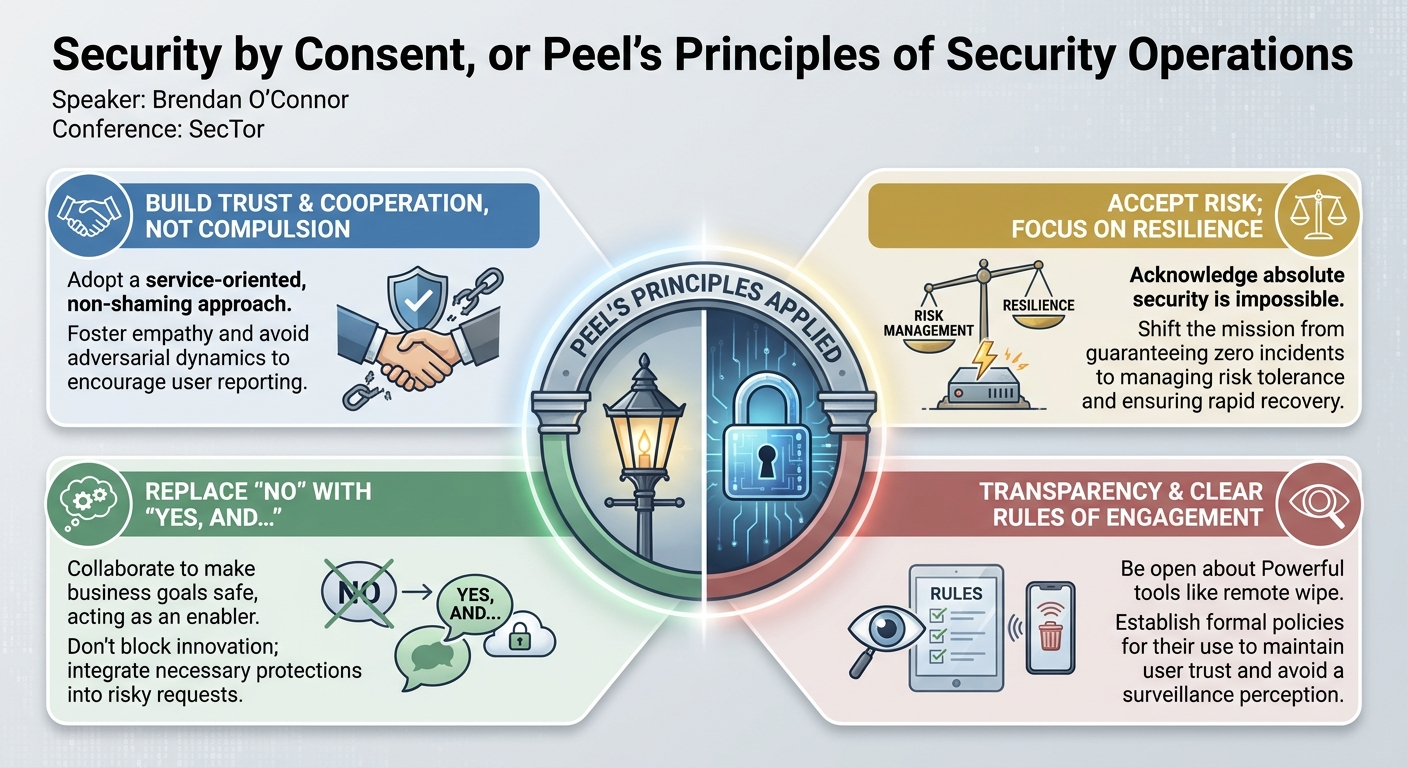
- Prevention is Primary, but Risk Acceptance is Essential: The first principle emphasizes prevention as the basic mission. However, O'Connor critically notes that security often operates under an unrealistic expectation of "no attacks, no breaches, no insider threats, no nothing" at "no costs." He argues that defense and cleanup are alternatives, and while more defense reduces cleanup, it doesn't eliminate it. Organizations must understand and accept that some risk is inevitable, much like aiming for "nine nines of uptime" requires exponential investment but still allows for rare, complex failures (e.g., AWS datacenter outages from inexplicable lightning strikes or battery room explosions). The goal is to guide the conversation towards risk tolerance and management, acknowledging that security makes you "right" when bad things happen, not that it prevents all bad things from ever happening.
- Public Approval and Respect are Non-Negotiable: Security's ability to do its job is directly tied to the approval and respect of the organization's users and leadership. Security is a support organization; it's critical to making the mission happen, but it's not the mission itself. Losing the respect of internal stakeholders leads to faster failure than any technical vulnerability. This extends to the broader industry, where "drinking first, conference second" attitudes or sexist behaviors at prominent events damage the industry's claim to a "seat at the adults table."
- Cooperation, Not Compulsion or Shaming: Shaming users for not being "paranoid" or for making mistakes (e.g., plugging in a seemingly legitimate, but malicious, USB key) is counterproductive. Such an "abusive relationship" erodes trust, making users less likely to report incidents or ask questions. O'Connor highlights the importance of empathy and keeping "rants to your friends." He shares an anecdote of a financial institution uncovering a major Gramm-Leach-Bliley Act violation and reportable breach, not through security audits, but from a low-level, non-technical employee who felt comfortable asking a "dumb" question about their manager's password practices.
- "Yes, And..." as a Guiding Principle: Directly related to cooperation, the fourth principle (cooperation diminishes proportionately to physical force) is reinterpreted as "compulsion." Instead of always saying "no" to user requests or ideas, security should adopt the improv technique of "yes, and..." When confronted with a "dangerous" idea, the response should be "yes, you can do this dangerous thing, and let's talk about how to make it safe." This approach helps users achieve their goals while embedding necessary protections, transforming security from a dream-crusher to an enabler.
- Individual Service, Friendship, and Sacrifice: Security professionals must strive for "individual service and friendship and courtesy and good humor and sacrifice." This means not being a "jerk," even when dealing with difficult situations or individuals. "Individual sacrifice" translates to going the "extra mile" – doing the research, reaching out to contacts (e.g., someone who understands IPv5 for a weird network setup), and helping beyond the immediate scope of one's job to enable others.
- Judicious Use of Coercive Tools: Security and IT possess powerful, often "creepy" tools (e.g., Driftnet for live network image viewing, IT watching hostnames, Exchange remote wipe for phones). While necessary, their use must be transparent and governed by clear "rules of engagement" or policy. Presenting human eyes "constantly watching" is resented. O'Connor describes clarifying remote wipe capabilities to users, outlining the circumstances of its use and offering alternatives (e.g., using IMAP instead of Exchange Activesync for personal devices), thereby building trust.
- Security is Everyone's Job, and Security Teams Should Reflect "Everyone": The security team is part of the organization, not superior to it. To foster this, security professionals should "get in there and pull," actively working with other teams (e.g., helping developers fix bugs, threat modeling). This helps security understand other teams' workflows and pain points, like the risks introduced by tools such as Vagrant Share. Furthermore, the security industry must embrace diversity, ending discrimination based on race, gender, appearance, education (e.g., hatred of CISSP, CISA, college, or liberal arts degrees), or background.
- Do Not Usurp Other Powers: Security should not overstep its bounds, particularly by dictating HR decisions (e.g., demanding someone be fired for a policy violation). The ultimate authority for culture and strategy rests with the CEO or Board of Directors. Security's role is to make its case and earn a seat at that table, not to run the organization.
- Efficiency Measured by Absence of "Crime," Not Security's Visibility: The ultimate test of security's efficiency is the absence of incidents, not its constant presence or visibility. Users should ideally go about their days without constantly thinking about security. When security becomes an obvious roadblock (e.g., hospital staff putting Dixie cups over passive IR sensors to prevent automatic workstation logouts), it fails. The goal is to enable users to do their jobs effectively, which is the best way to demonstrate value to management and shift the "security as roadblock" narrative.
Technical Deep Dive
▶ Watch: The password clipboard story: The cost of breaking trust (25:00)
While O'Connor's talk is primarily philosophical, it grounds its principles in concrete technical scenarios and the tools security professionals interact with daily. The application of Peelian Principles fundamentally alters how technical solutions are implemented, managed, and communicated.
One of the most significant technical implications arises from the first principle: prevention as the mission, balanced with the acceptance of inevitable risk. O'Connor deconstructs the unrealistic expectation of absolute security, illustrating it with the concept of achieving "nine nines of uptime" for infrastructure. This level of availability, often seen in services like Amazon Web Services (AWS), demands immense investment. Yet, even with extensive prevention, complex, unpredictable failures occur. He cites specific AWS post-mortems: a ground fault interrupter tested a week prior failing during a clear-day lightning strike, or a battery room explosion in Calgary in 2011 that severed the connection between mains and backup power, causing a datacenter shutdown. These are not failures of negligence but of inherent complexity and chance. The technical deep dive here is in communicating this reality to management: "you can spend enough money to prevent all the preventable things, and what will remain will not be nothing; it will be chance occurrences." This reorients the technical discussion from absolute prevention to risk tolerance and building resilience that accounts for unpredictable "cascading failures." Security's technical role shifts from promising invincibility to ensuring the organization is "at least right" and has "every backup system reasonably available" when a breach or outage occurs.
The fourth principle, "cooperation diminishes proportionately to physical force," translates into a "yes, and..." approach for technical requests. Instead of outright banning a risky technical solution proposed by an engineer, O'Connor suggests: "Yes, you can do this dangerous thing, and let's talk about how to make it safe." For instance, if an engineer wants to implement a high-risk feature, security's response isn't "no, that's stupid." It's "yes, you can try to achieve that, and here are the goggles and body armor you'll need, and perhaps we can redesign this feature to avoid the 'shooting your eye out' part entirely." This technique facilitates a collaborative technical design process, where security provides expertise to mitigate risks rather than simply blocking innovation.
The use of "coercive tools" is another area ripe for technical re-evaluation. O'Connor mentions tools like Wi-Fi Pineapple and Driftnet (which displays live images loaded on a network), highlighting their "terrifying" nature to non-technical users. Even simpler IT practices, such as passively monitoring hostnames scrolling across a firewall log, can be perceived as "creepy." A particularly potent example is the Exchange remote wipe feature on mobile phones. Technically powerful, this capability allows IT to erase an employee's personal device. The speaker recounts an organization's solution: clarifying the circumstances under which remote wipe would be used (e.g., only for devices accessing Exchange, not IMAP), offering alternatives (e.g., a work phone), and formalizing these "rules of engagement" into policy. Technically, this means auditing and documenting the capabilities of such tools, defining triggers for their use, and potentially implementing controls to restrict their application to specific scenarios, ensuring they are used coercively only after all other persuasive and advisory steps have failed.
Finally, the principle that "security is everyone's job" necessitates a technical integration with other teams, particularly developers. O'Connor emphasizes "getting in there and pull," suggesting security professionals help fix bugs or contribute to feature design. This hands-on approach exposes security to the realities of developer workflows and tools. A prime example is Vagrant and its feature Vagrant Share. Vagrant is a common developer tool for spinning up local virtual machines using configuration files (like a Chef recipe or Puppet configuration file). Vagrant Share "punches a hole in your firewall" to expose the developer's virtual machine to the internet, allowing SSH access or port 443 access from a public URL. While solving a legitimate developer problem (e.g., sharing a local development environment), it creates a "raging ball of pain" from a security perspective due to its direct exposure of internal systems. A security professional embedded in the development workflow would understand the need for Vagrant Share and could propose alternative, more secure technical solutions, such as spinning up a dedicated, isolated QA or testing environment, rather than simply blocking the tool outright. This integration allows security to proactively address technical risks at the design phase, rather than reactively enforcing policies that disrupt productivity.
Demo / Proof of Concept
▶ Watch: Using 'Yes, And...' for security requests (30:00)
This particular conference talk, "Security by Consent, or Peel's Principles of Security Operations," does not feature a traditional technical demonstration or a proof of concept in the sense of live code execution or exploit showcasing. Instead, Brendan O'Connor's presentation is conceptual and philosophical, focusing on the application of historical principles to modern organizational behavior and communication.
The "demonstrations" within the talk are primarily anecdotal examples and thought experiments, designed to illustrate the speaker's points about security's image, user interaction, and the practical implications of adopting the Peelian Principles. For instance, he uses the example of the Wi-Fi Pineapple to demonstrate how security tools can be perceived as terrifying, and the Exchange remote wipe feature to highlight the need for transparency around coercive technical capabilities. While these are vivid illustrations of technical concepts, they are presented verbally as part of his narrative rather than through a live, interactive demo. The talk's intent is to shift mindsets and operational strategies, not to unveil new technical vulnerabilities or tools.
Defensive Implications
▶ Watch: Call to action: Speak up and be inclusive (54:50)
Brendan O'Connor's application of the Peelian Principles to security operations offers several crucial defensive implications for organizations and security professionals:
- Shift from "No" to "Yes, And...": Defenders must abandon the "security as roadblock" mentality. Instead of outright denying user requests or new technologies due to perceived risk, adopt the "yes, and..." approach. This means collaborating with teams to understand their goals and then helping them achieve those goals securely, by integrating protections (e.g., adding security controls to a risky application rather than blocking it). This fosters innovation while minimizing risk.
- Transparent Risk Communication and Management: Security teams need to educate management and users on the realities of risk. Accept and communicate that absolute security is impossible at any cost. Focus on building resilience and ensuring the organization is "right" when incidents occur, rather than promising an unattainable "no breaches" future. This involves moving beyond the "heckler's veto" where any solution with risk is dismissed, and instead, engaging in mature discussions about risk tolerance and risk management.
- Build Trust through Empathy and Cooperation: Actively work to counter the image of security professionals as "obstructionist pedants" or "abusive." This means fostering empathy for users' mistakes (e.g., falling for phishing, plugging in a malicious USB drive) and avoiding public shaming. When users trust security, they are more likely to report suspicious activities or ask questions before a major breach occurs, as illustrated by the Gramm-Leach-Bliley Act violation discovered by a non-technical employee.
- Establish "Rules of Engagement" for Coercive Tools: Many security and IT tools possess significant power (e.g., network monitoring, Driftnet, Exchange remote wipe). Defenders should clarify when and how these tools are used through formal "rules of engagement" or policy. Transparency around these capabilities, alongside offering alternatives (e.g., using IMAP for personal devices instead of Exchange Activesync), can transform perceived surveillance into managed trust. Abusing these powers should be treated as a serious policy violation.
- Integrate Deeply with Development and Other Business Units: To prevent shadow IT and proactively secure systems, security teams must "get in there and pull." This means understanding the workflows and tools of other departments, especially development. For example, understanding why developers use tools like Vagrant Share (which punches firewall holes) can lead to collaborative solutions (e.g., setting up secure test/QA environments) rather than simply banning useful, albeit risky, tools. Security should act as an enabling engineer, not just a gatekeeper.
- Champion Diversity and Inclusivity in the Security Workforce: The principle "the security organization should be like all of the people" has direct defensive implications. A diverse security team brings varied perspectives, experiences, and problem-solving approaches, leading to more robust and comprehensive security solutions. Eliminating biases against candidates based on educational background (e.g., college degrees, liberal arts, CISSP, CISA, GEDs) or previous career paths broadens the talent pool and strengthens defensive capabilities.
- Focus on Measurable Outcomes (Absence of Incidents) vs. Visibility: The ultimate measure of security's success is the absence of "crime" (incidents), not how visible or intrusive security measures are. Defensive strategies should aim to be as seamless and invisible as possible, enabling users to do their jobs without constant friction (e.g., avoiding solutions like passive IR sensors that lead to users disabling security features). This also helps demonstrate value to leadership by highlighting business enablement and reduced risk exposure.
- Ethical Responsibility and Speaking Up: Security professionals have a duty to protect the trust of employees and users. This extends beyond technical implementation to ethical conduct. Defenders must be prepared to "speak up" if they see their company engaging in practices that are wrong, negligent, illegal, or unethical, especially concerning user privacy or well-being. This requires courage but is fundamental to maintaining the integrity and long-term effectiveness of the security function.
Key Takeaways
- Embrace "Yes, And..." for Collaboration: Shift from a default "no" to a collaborative "yes, and..." approach when addressing user requests or new technologies. Help other teams achieve their goals securely by integrating protections rather than simply blocking.
- Communicate Risk, Don't Promise Perfection: Recognize that absolute security is unattainable and expensive. Clearly articulate risk tolerance and the inevitability of some residual risk, framing security's role as making the organization "right" and resilient when incidents occur.
- Build Trust Through Transparency and Empathy: Foster an environment of trust by being empathetic to user mistakes, avoiding public shaming, and providing clear "rules of engagement" for powerful security tools like Exchange remote wipe or network monitoring.
- Integrate and Understand Other Workflows: Actively engage with development and other business units to understand their needs and tools (e.g., Vagrant Share). Proactively suggest secure alternatives and solutions, becoming an enabler rather than a gatekeeper.
- Champion Diversity and Inclusivity: Broaden the security talent pool by eliminating biases related to educational backgrounds (e.g., CISSP, liberal arts degrees) or non-traditional career paths. A diverse team leads to more robust and comprehensive security.
- Measure Success by Absence of Incidents, Not Intrusiveness: Strive for security measures that are seamless and invisible, allowing users to perform their jobs without friction. The ultimate measure of effectiveness is a reduction in security incidents, not the overt presence of security controls.
- Uphold Ethical Responsibility and Speak Up: Security professionals have a profound duty to protect user trust and privacy. Be prepared to speak up against unethical, negligent, or illegal company practices that harm users, even when it's difficult.
About the Speaker(s)
Brendan O'Connor is a security researcher and consultant with Malice Afterthought, Inc. He possesses a distinctive blend of expertise, being an attorney with a deep academic computer science background. O'Connor is admitted to the bar in his home state of Montana, although he currently resides in Seattle. His diverse professional experience allows him to approach security challenges from both a technical and a legal/ethical perspective, making him a compelling voice on the intersection of technology, policy, and human behavior. He is actively seeking new opportunities in the field.
Reviews
Dr. Zero (Offensive Security Researcher) — STRONG ACCEPT
Brendan O'Connor actually managed to give a security culture talk without sounding like a corporate HR brochure. Applying 19th-century policing principles to modern security operations sounds like a gimmick, but it perfectly diagnoses why users hate us and bypass our controls. If your security team is drowning in shadow IT because you keep playing the angry gatekeeper, this is required viewing.
Heather Calloway (CISO) — STRONG ACCEPT
This talk is mandatory viewing for anyone stepping into a security leadership role. O'Connor translates 19th-century policing principles into a highly functional operating model for modern security programs. It gives leaders a precise language for why obstructionist security fails and how to run a program by consent rather than coercion.