Start at the Finish Line (Demystifying the Tech Career Path)
Kirsten Renner (Vice President of Talent · Silver Edge Government Solutions)
ShmooCon XX (Final) · Day 1 · One Track Mind
Overview
Kirsten Renner, widely known as Krenner, delivered a compelling talk at ShmooCon, "Start at the Finish Line (Demystifying the Tech Career Path through Reverse Engineering)," offering a pragmatic and empowering framework for navigating career progression in the technology and cybersecurity sectors. As the Vice President of Talent at Silver Edge Government Solutions and a prominent figure in the community, Krenner brought a unique perspective, blending her experience as a former help desk manager and recruiter with her deep involvement in initiatives like the Car Hacking Village and ICS Village. The talk challenges conventional wisdom around job searching and career development, particularly addressing the pervasive and often misleading statistics about "millions of open cybersecurity jobs."
Key moments
- 0:00 Introduction and speaker's diverse background
- 2:00 Why you should start your career planning at the end
- 2:50 The truth about inflated job posting numbers
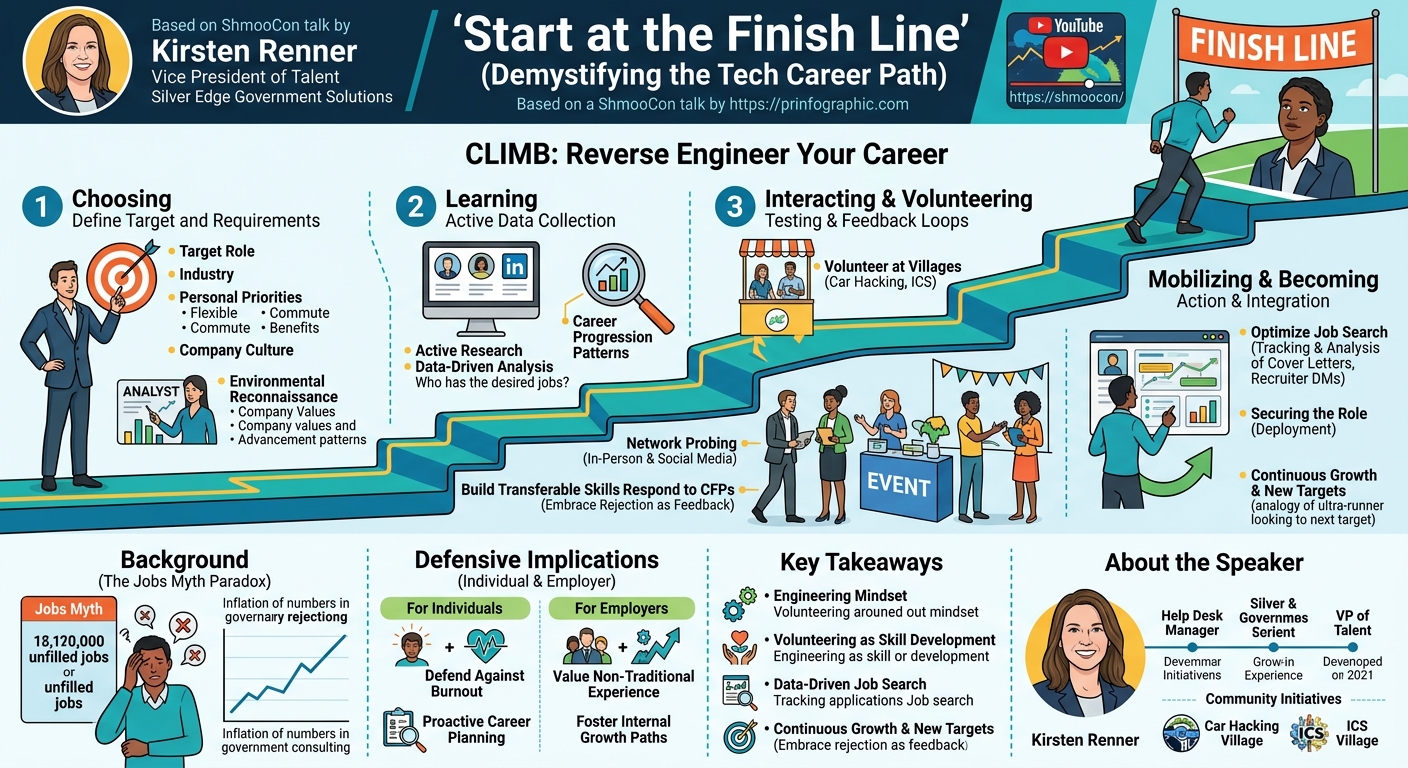
- 4:08 Overview of the CLIMB career reverse engineering framework
- 5:40 Defining your target role and personal career requirements
- 6:30 Understanding how your career priorities will change
- 7:30 Effective research strategies for your desired career path
Start at the Finish Line (Demystifying the Tech Career Path)
Speakers: Kirsten Renner, Vice President of Talent, Silver Edge Government Solutions
Conference: ShmooCon
YouTube: https://www.youtube.com/watch?v=wXbnUm88IJw
Overview
Kirsten Renner, widely known as Krenner, delivered a compelling talk at ShmooCon, "Start at the Finish Line (Demystifying the Tech Career Path through Reverse Engineering)," offering a pragmatic and empowering framework for navigating career progression in the technology and cybersecurity sectors. As the Vice President of Talent at Silver Edge Government Solutions and a prominent figure in the community, Krenner brought a unique perspective, blending her experience as a former help desk manager and recruiter with her deep involvement in initiatives like the Car Hacking Village and ICS Village. The talk challenges conventional wisdom around job searching and career development, particularly addressing the pervasive and often misleading statistics about "millions of open cybersecurity jobs."
Krenner's core message revolves around applying an engineering mindset—specifically reverse engineering—to one's career trajectory. Instead of passively applying to jobs and hoping for the best, she advocates for defining a clear end goal and systematically working backward. This approach not only demystifies the often-frustrating job search process but also equips individuals with an actionable strategy to take control of their professional journey. The talk is particularly relevant in an industry frequently characterized by rapid change, specialized roles, and a perceived scarcity of entry-level opportunities, providing a much-needed antidote to feelings of helplessness and stagnation among job seekers and those looking to advance.
The significance of Krenner's framework lies in its practicality and psychological impact. By providing a structured method, the talk empowers individuals to analyze the market, identify genuine opportunities, and cultivate the necessary skills and connections. It underscores the importance of community engagement, continuous learning, and strategic self-assessment, shifting the focus from simply "getting a job" to actively "becoming" the professional one aspires to be. This proactive stance is crucial for fostering resilience and sustained growth in a competitive and dynamic field.
Background
▶ Watch: Introduction and speaker's diverse background (0:00)
The landscape of cybersecurity and technology careers is frequently portrayed with a stark dichotomy: on one hand, a desperate need for talent, often cited as "500,000," "300,000," or "150,000" unfilled jobs; on the other, a palpable frustration among job seekers who apply repeatedly without success. This paradox forms the crucial backdrop for Krenner's talk. She directly confronts this "jobs myth," explaining that the numbers are often inflated, particularly in sectors like government consulting where a single open position might be posted by dozens of different companies. This creates a deceptive impression of abundant opportunities, leading to burnout and self-doubt among applicants who receive no replies.
The traditional approach to career development often involves reactive job searching, where individuals respond to advertised roles without a clear long-term strategy. This can leave professionals feeling stuck, unable to pivot into new technologies, or struggling to advance despite their efforts. The lack of clear guidance on how to navigate this complex environment contributes to a sense of helplessness, particularly for those new to the industry or attempting to transition into specialized cybersecurity roles.
Krenner's framework draws inspiration from an engineering principle: starting at the finish line and working backward. In problem-solving or network penetration testing, an engineer first defines the desired outcome (e.g., exploiting a vulnerability, gaining access to a target system) and then reverse-engineers the steps required to achieve that goal. This analytical, requirements-driven approach stands in contrast to a more haphazard, trial-and-error method. By applying this structured thinking to career planning, Krenner provides a robust methodology for professionals to define their ideal career state and systematically build a path towards it, rather than being swept along by market trends or generalized advice. Her personal journey from help desk manager to Vice President of Talent, alongside her extensive community contributions, further contextualizes the practical application of these principles in a real-world setting.
Key Findings
▶ Watch: The truth about inflated job posting numbers (2:50)
Kirsten Renner's talk presents several key findings and insights that challenge conventional career advice and provide a structured pathway for professional growth:
- The "Jobs Myth" is Pervasive and Misleading: A central finding is the debunking of the widely cited statistic regarding hundreds of thousands of open cybersecurity jobs. Krenner asserts that these numbers are significantly inflated, especially in areas like government consulting, where a single position can be advertised by multiple companies. This leads to a skewed perception of opportunity and contributes to applicant frustration when their applications go unanswered. Understanding this reality helps job seekers manage expectations and avoid self-blame.
- Reverse Engineering Your Career is Essential: The core contribution is the CLIMB framework (Choosing, Learning, Interacting, Mobilizing, Becoming). This framework encourages individuals to define their ultimate career goal (the "finish line") and then systematically work backward, much like a network engineer reverse-engineers a system. This proactive, goal-oriented approach replaces passive job searching with strategic planning.
- Choosing Requires Deep Self-Analysis and Market Research: The initial step emphasizes defining the target role, industry, and, critically, personal priorities. Krenner highlights that career satisfaction isn't solely about salary; factors like commute, flexibility, and benefits change over time and must be considered. This "requirements gathering" phase, akin to an engineering project, involves researching company values, advancement patterns, and the profiles of individuals already in desired roles.
- Learning is an Active, Data-Driven Process: Beyond formal education, continuous learning involves analyzing data on who has the desired jobs, where they work, and how they advanced. This research helps identify growth opportunities within companies versus those that require external moves for promotion. The information age provides abundant data for this analysis.
- Interacting and Volunteering are Crucial for Skill Development and Networking: Engaging with the community through networking events (like ShmooCon), social media, joining groups, and especially volunteering, is highlighted as a vital "testing" phase. Volunteering, whether at the front desk or organizing logistics, provides invaluable transferable skills (vendor management, problem-solving, communication) that are highly attractive to employers and recruiters. Responding to Calls for Papers (CFPs), even if rejected, offers significant learning opportunities through feedback.
- Mobilizing Requires Data-Driven Application Strategies: The application and interview process should be treated as an experiment. Krenner advises using an "engineering mind" to track what works (e.g., short cover letters, direct messages to recruiters) and what doesn't. Analyzing these results over time allows for optimization of the job search strategy.
- Securing a Role is Not the End, But a New Beginning: The "Becoming" stage emphasizes that landing a job is not the finish line. Continuous growth within the role, embracing challenges, and setting new targets are fundamental for long-term career satisfaction and advancement. Krenner uses the analogy of ultra-running, constantly identifying the next visible target to push forward.
Technical Deep Dive
▶ Watch: Overview of the CLIMB career reverse engineering framework (4:08)
While Krenner's talk does not delve into traditional security exploits or system architectures, its "technical deep dive" lies in the methodological rigor applied to career development. The entire framework is a direct application of engineering principles to a human-centric problem, treating a career path like a complex system to be reverse-engineered.
The core "technical" component is the CLIMB framework, an acronym for Choosing, Learning, Interacting, Mobilizing, and Becoming. This iterative process mirrors the structured phases of a technical project:
- Choosing (Defining the Target System and Requirements):
- Target Identification: Analogous to identifying a target system in a network scan, this involves clearly defining the desired role, industry, and specific responsibilities. This is the "finish line."
- Stakeholder Requirements Gathering: Just as engineers gather requirements from all stakeholders before designing a system, individuals must analyze their personal requirements. These are not static and include factors beyond salary, such as commute flexibility, benefits, work-life balance, and company culture. Krenner emphasizes that these priorities will change throughout one's life.
- Environmental Reconnaissance: This involves researching potential "target" companies. Instead of just looking at job postings, Krenner advises examining their "footprints": what they say about themselves, their impact, their participation in community events, and their advancement patterns (e.g., do employees grow internally or need to leave to get promoted?). This is akin to gathering intelligence on a target's infrastructure and operational patterns.
- Learning (Data Collection and Analysis):
- Information Gathering: Leveraging the "information age," individuals are encouraged to actively research those who already hold their desired roles. This involves analyzing their public profiles (e.g., LinkedIn, professional bios) to understand their career progression, skill sets, and the types of organizations they work for.
- Pattern Recognition: By observing career trajectories, one can identify patterns in advancement. Did individuals achieve senior roles within a single company, or did they frequently move between organizations? This data provides critical insights into the growth potential within specific companies or industries, informing strategic career decisions. This phase is about collecting and analyzing data points to understand the "system's" behavior.
- Interacting (Testing and Feedback Loops):
- Network Probing: This phase is described as the "testing part of the process." Networking with professionals, both in-person (like at ShmooCon) and on social media, serves as a form of network probing to gain insights, build relationships, and test assumptions about roles and industries.
- Vulnerability Assessment (Self-Improvement): Engaging in activities like volunteering and responding to Calls for Papers (CFPs) acts as a self-assessment mechanism. Krenner highlights that even rejection from a CFP is a valuable learning experience, providing feedback that can be used to refine presentation skills, technical understanding, and communication. This iterative feedback loop is crucial for identifying areas for improvement, much like a vulnerability assessment identifies weaknesses in a system. Skills gained through volunteering, such as logistics management, vendor negotiation, and problem-solving, are valuable and transferable, akin to developing new tools or techniques.
- Mobilizing (Action and Performance Analysis):
- Execution and Monitoring: This involves the active steps of applying for jobs and undergoing interviews. Krenner encourages treating these actions as experiments.
- Performance Metrics and Analysis: Individuals should track the effectiveness of their application strategies. Did a short cover letter yield more responses? Did a direct message to a recruiter result in an interview? This is analogous to monitoring system performance after deploying a change. By keeping track of what works and analyzing results over time, individuals can refine their approach, optimizing their "attack vectors" for securing roles. This data-driven approach helps to move beyond guesswork and into informed decision-making.
- Becoming (Continuous Integration and Deployment):
- Securing the Role (Deployment): This is the successful acquisition of the desired position. However, Krenner explicitly states this is not the end of the journey.
- Continuous Growth and Adaptation: The "Becoming" phase emphasizes that growth within the role is continuous. Challenges are viewed as opportunities for further development, akin to continuous integration and deployment (CI/CD) in software development, where systems are constantly updated and improved. The analogy of an ultra-runner focusing on the next visible target reinforces the idea of sustained effort and continuous goal-setting, adapting to new "terrains" and challenges throughout a long career "journey." This ensures the "system" (the individual's career) remains robust and evolves.
The talk effectively reframes career development from a passive, reactive search into an active, analytical, and iterative engineering process, empowering individuals to design and execute their professional future with precision.
Demo / Proof of Concept
▶ Watch: Understanding how your career priorities will change (6:30)
Kirsten Renner's talk did not feature a traditional technical demonstration of software, exploits, or hardware. Instead, the CLIMB framework itself serves as the primary "proof of concept" for a structured and effective approach to career development. The efficacy of this methodology is implicitly demonstrated through Krenner's own career trajectory, from a help desk manager to the Vice President of Talent at Silver Edge Government Solutions, alongside her instrumental role in founding and running the Car Hacking Village for a decade, and her involvement in the ICS Village and Hack the Capital Workforce Development Day. These achievements exemplify how proactive engagement, strategic learning, and community involvement can lead to significant professional advancement.
Furthermore, Krenner offered a direct, real-world application of her framework by announcing that she would be available in the lobby to review resumes and provide career guidance. This act of offering personalized resume guides and one-on-one feedback serves as a practical, hands-on "demo" of how the principles discussed in the talk—particularly those related to "Mobilizing" and "Interacting"—can be immediately applied by attendees to improve their job search outcomes. This commitment to tangible support underscores the actionable nature of her advice.
Defensive Implications
▶ Watch: Effective research strategies for your desired career path (7:30)
While Krenner's talk doesn't discuss defending computer systems, it offers critical "defensive implications" for individuals navigating their careers in the cybersecurity and technology industries, and even for organizations looking to attract and retain talent. These implications focus on defending against career stagnation, misinformation, and the mental health toll of job searching.
For Individuals (Defending Your Career Path and Mental Health):
- Defend Against the "Jobs Myth": Recognize and internalize that the often-cited figures of "500,000" or "150,000" open cybersecurity jobs are frequently inflated. This defense mechanism protects against feelings of inadequacy or frustration when applications go unanswered. Understanding the true market dynamic—where multiple companies might post for a single role—helps manage expectations and prevents self-blame.
- Proactive Career Planning as a Defense: Adopt the CLIMB framework as a robust defense against aimless job searching. By starting with a defined end goal and reverse-engineering the path, individuals can proactively steer their careers rather than reactively applying to whatever is available. This strategic approach minimizes wasted effort and increases the likelihood of achieving desired outcomes.
- Build a Resilient Skillset Through Interaction and Volunteering: Actively engaging in networking, joining professional groups, and especially volunteering (e.g., at events like ShmooCon, Car Hacking Village, ICS Village) builds a diverse and resilient skillset. These experiences, which include soft skills like logistics, vendor management, and problem-solving, are invaluable and act as a buffer against narrow specialization. They provide demonstrable experience often overlooked by traditional job descriptions.
- Embrace Rejection as a Learning Opportunity: Viewing rejected Calls for Papers (CFPs) or job applications as opportunities for feedback and learning is a crucial psychological defense. Instead of allowing rejection to demotivate, individuals can use it to refine their skills, presentation, and application strategies, turning setbacks into growth opportunities.
- Data-Driven Job Search (Defensive Optimization): Treat the job application process as an engineering experiment. By tracking what works (e.g., specific cover letter styles, direct outreach to recruiters) and analyzing the results, individuals can optimize their approach. This data-driven "defensive optimization" prevents endless, ineffective application cycles and focuses effort on strategies with proven success rates.
- Continuous Growth as a Long-Term Defense: Understand that securing a role is not the end but the beginning of continuous growth. This mindset defends against stagnation and disillusionment that can occur when a "dream job" doesn't live up to expectations. Embracing challenges within a role and consistently identifying new growth targets ensures long-term career vitality and adaptability.
For Employers and Recruiters (Defending Talent Acquisition and Retention):
- Transparent Job Postings: Companies should strive for greater transparency in job postings, avoiding the practice of multiple entities posting the same role, which contributes to market confusion and applicant frustration. This defends against a negative employer brand perception.
- Value Non-Traditional Experience: Recruiters and hiring managers should recognize and value skills gained through volunteering, community involvement, and non-traditional learning paths. By looking beyond conventional resumes and recognizing the transferable skills developed in these roles, organizations can tap into a wider, often highly motivated talent pool.
- Provide Constructive Feedback: Offering constructive feedback to applicants, especially for CFPs or interview processes, can significantly enhance the candidate experience. This not only helps individuals improve but also builds goodwill and a positive reputation for the organization within the community, aiding in future talent acquisition.
- Foster Internal Growth Paths: Companies should actively promote and support internal career growth and advancement. Krenner's observation that some companies require employees to leave to advance highlights a systemic issue. Robust internal development programs defend against talent churn and foster loyalty.
By applying these defensive strategies, individuals can navigate the complex career landscape with greater confidence and effectiveness, while organizations can improve their ability to attract, develop, and retain valuable talent.
Key Takeaways
- The widely cited statistics on "millions of open cybersecurity jobs" are often inflated and misleading, contributing to applicant frustration and self-doubt.
- Adopt an engineering mindset to your career by reverse-engineering your desired end goal and systematically working backward using the CLIMB framework (Choosing, Learning, Interacting, Mobilizing, Becoming).
- Volunteering and active participation in community events are powerful tools for gaining transferable skills (e.g., logistics, vendor management) and building essential professional networks.
- Treat your job search like a scientific experiment: collect data on what works (e.g., cover letter length, recruiter outreach), analyze the results, and iterate on your strategies to optimize your success.
- Securing a job is not the finish line; continuous growth, embracing challenges, and setting new targets within your role are vital for long-term career satisfaction and advancement.
- Your personal priorities (e.g., flexibility, commute, benefits) are dynamic and should guide your career choices as much as, if not more than, salary alone.
About the Speaker(s)
Kirsten Renner, affectionately known as Krenner, is a prominent and highly respected figure in the cybersecurity and technology community. She currently serves as the Vice President of Talent at Silver Edge Government Solutions, where she leverages her extensive experience in recruitment and talent management. Krenner's career journey is a testament to the principles she advocates, having transitioned from a help desk manager into a recruiter role before ascending to her current leadership position.
Beyond her corporate responsibilities, Krenner is deeply committed to community building and workforce development. She is widely recognized for her instrumental role in co-founding the Car Hacking Village ten years ago, an initiative she helped run for approximately nine years. Her dedication extends to other significant community efforts, including her involvement with the ICS Village and running Hack the Capital Workforce Development Day. Additionally, she contributes to the Charm Hiring Village and Higher Ground, consistently working to connect talent with opportunities and demystify career paths for aspiring and current professionals. Her volunteer work and active presence at conferences like ShmooCon underscore her passion for mentoring and supporting the growth of others in the industry.
Reviews
Dr. Zero (Offensive Security Researcher) — SOLID
This session, "Start at the Finish Line," attempts to frame career pathing using a 'reverse engineering' metaphor. While the speaker, a known figure in the community, delivers a competent and actionable framework for career development, it fundamentally lacks the technical depth and novel research that defines a strong conference submission. It's practical career advice, but not the kind of deep dive into systems or exploits that makes a talk memorable for a technical audience.
Heather Calloway (CISO) — STRONG ACCEPT
Kirsten Renner’s talk offers a clear-eyed, unsentimental approach to career development, directly challenging the pervasive "jobs myth" that distorts our understanding of the cybersecurity talent market. By applying an engineering mindset—reverse engineering one's career path—she provides a practical framework (CLIMB) for individuals to take ownership of their professional journey. While aimed at job seekers, the implications for security leaders are profound: understanding the true dynamics of talent acquisition is critical for building resilient security programs and holding institutions accountable for their staffing strategies. This isn't just career advice; it's a diagnostic tool for…