Is this /s/C/F/ake? Content Provenance Tech to Fight Online Disinformation
Christian Paquin (Microsoft Research)
ShmooCon XX (Final) · Day 2 · Belay It
Overview
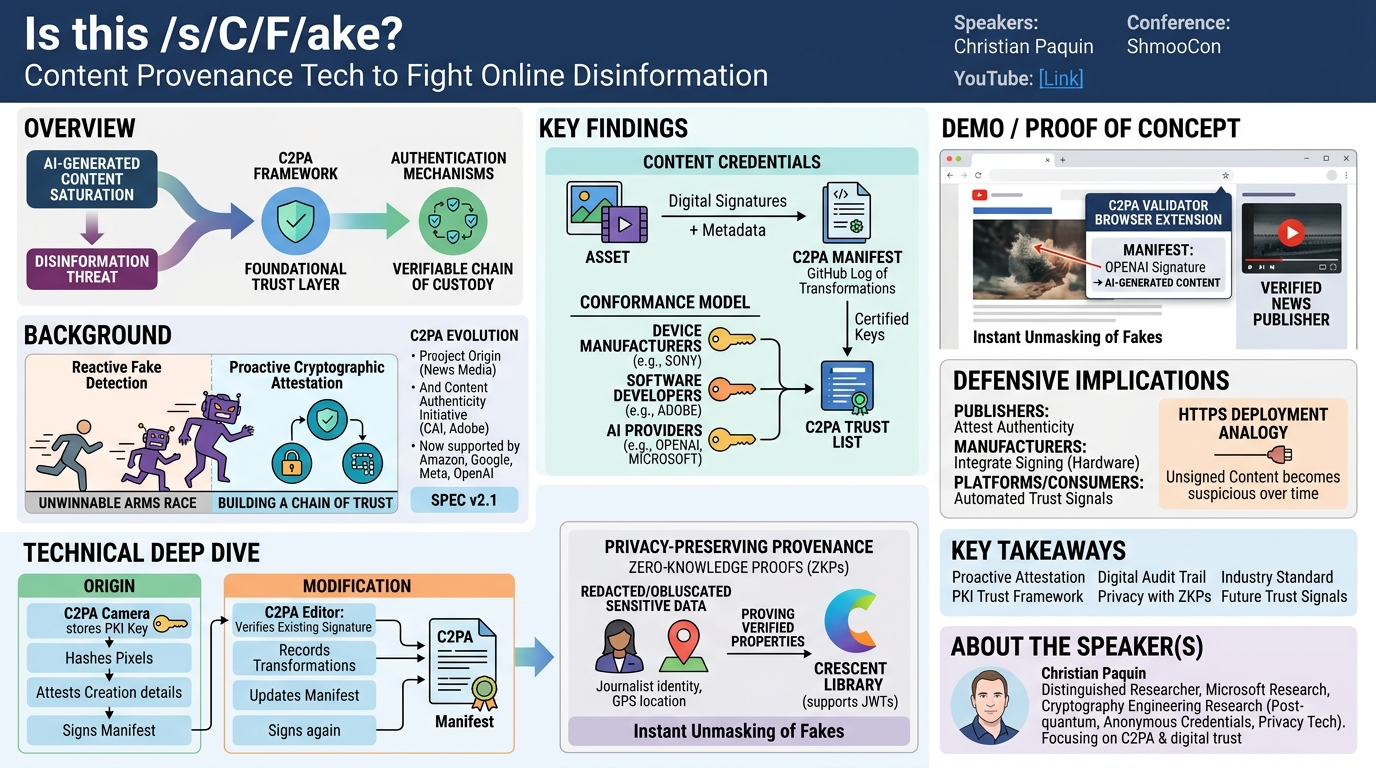
In an era increasingly saturated with AI-generated content, discerning truth from fabrication has become a paramount challenge. Christian Paquin from Microsoft Research presented a compelling talk at ShmooCon, addressing the escalating threat of online disinformation through the lens of Content Provenance Technologies. The core of his presentation revolved around the Coalition for Content Provenance and Authenticity (C2PA), an industry-wide initiative designed to cryptographically attest to the origin and modification history of digital assets.
Key moments
- 0:00 Introduction and the deepfake problem
- 2:10 The 'is it fake?' problem with generative AI
- 3:00 Introducing C2PA: Content Provenance and Authenticity
- 4:20 C2PA content credentials and manifest concept
- 5:15 C2PA workflow: camera to image editor example
- 7:35 Building trust framework and PKI for C2PA
- 8:35 C2PA application for news media publishers
Is this /s/C/F/ake? Content Provenance Tech to Fight Online Disinformation
Speakers: Christian Paquin
Conference: ShmooCon
YouTube: https://www.youtube.com/watch?v=5YHcw-qj094
Overview
In an era increasingly saturated with AI-generated content, discerning truth from fabrication has become a paramount challenge. Christian Paquin from Microsoft Research presented a compelling talk at ShmooCon, addressing the escalating threat of online disinformation through the lens of Content Provenance Technologies. The core of his presentation revolved around the Coalition for Content Provenance and Authenticity (C2PA), an industry-wide initiative designed to cryptographically attest to the origin and modification history of digital assets.
Paquin highlighted how sophisticated generative AI systems have democratized the creation of hyper-realistic fake content, from images of the Pope in outlandish fashion to deepfake videos of public figures and even sports coaches. While photo manipulation tools like Photoshop have existed for decades, AI's ability to automate and scale this process at an unprecedented rate has created an urgent need for robust authentication mechanisms. This talk makes a critical case for shifting from reactive fake detection, a perpetual cat-and-mouse game, to proactive cryptographic attestation, providing a verifiable chain of custody for digital content.
The significance of C2PA lies in its potential to establish a foundational trust layer for digital media. By embedding verifiable "content credentials" directly into assets, the technology aims to empower users, platforms, and news organizations to distinguish authentic content from manipulated or AI-generated material. Paquin's work at Microsoft Research, particularly in integrating privacy-enhancing technologies like zero-knowledge proofs, further underscores the commitment to developing a comprehensive and responsible framework for content authenticity in a complex digital landscape.
Background
▶ Watch: Introduction and the deepfake problem (0:00)
The problem of online disinformation is not entirely new, with image manipulation and fabricated stories predating the digital age. However, the advent of powerful generative AI systems has dramatically escalated its scale and sophistication. As Christian Paquin eloquently put it, we are entering a phase where "our lives become a daily life of is it not is it cake but is it fake?" The ability of AI to produce convincing deepfakes—fake audio clips, videos, and images—at an accelerated pace and unprecedented scale makes traditional detection methods increasingly ineffective. Detection is inherently a reactive measure, always lagging behind the latest advancements in generative AI, creating an unwinnable arms race.
Recognizing this fundamental limitation, the focus has shifted towards a proactive approach: cryptographic attestation of genuine content. This paradigm aims to provide an irrefutable, digital signature of an asset's origin and subsequent modifications, thereby establishing a "chain of trust" rather than relying on after-the-fact detection of fakes. This need spurred the formation of the C2PA (Coalition for Content Provenance and Authenticity).
The C2PA emerged from the merger of two significant prior initiatives: Project Origin, co-funded by Microsoft and various news media organizations to create a trust framework for media content, and the Content Authenticity Initiative (CAI), led by Adobe. Both recognized the shared problem and the need for a unified, industry-standard solution. The merger solidified their efforts, culminating in the C2PA specification. A crucial milestone occurred last year when major technology companies—including Amazon, Google, Meta, and OpenAI—joined the C2PA steering committee. This broad industry buy-in has cemented C2PA's position as the leading standard for content provenance, paving the way for its widespread deployment in the coming months and years. The evolution of the specification, including the release of version 2.1, has also addressed early critiques and refined its approach to trust establishment and deployment.
Key Findings
▶ Watch: Introducing C2PA: Content Provenance and Authenticity (3:00)
The central finding and contribution of the C2PA framework, as articulated by Christian Paquin, is the concept of Content Credentials. These are essentially digital signatures and associated metadata that can be attached to or embedded within virtually any digital asset—images, videos, audio clips, text documents, or web pages. They serve as a cryptographic attestation of the content's origin and all subsequent transformations.
Paquin likens a C2PA manifest to a "GitHub log of transformations" for a digital asset. When content is first created, whether by a camera, a recording device, or an AI system, a cryptographic signature is applied, attesting to its creation. This initial signature records who created it and how. Any subsequent modifications—editing, filtering, resizing, or even AI enhancements—are then recorded and appended to the manifest, each with its own cryptographic signature from the modifying entity (e.g., editing software, a social media platform). This process creates an immutable, verifiable audit trail of everything that has been done authoritatively to an asset.
The underlying cryptography for C2PA leverages the same Public Key Infrastructure (PKI) technology used to secure the web (e.g., X.509 certificates). This means that the trust in C2PA-signed content relies on a robust framework of certified keys and entities. Establishing this trust framework is one of the most significant engineering and organizational challenges. The C2PA is actively working on a conformance model where manufacturers (like Sony), software developers (like Adobe's Photoshop), and AI service providers (like OpenAI or Microsoft) can have their cryptographic keys certified. These certified keys are then listed in a C2PA trust list, ensuring that signatures can be reliably traced back to known and audited entities. This structured approach aims to prevent malicious actors from simply fabricating a chain of facts without access to legitimate private keys.
Technical Deep Dive
▶ Watch: C2PA content credentials and manifest concept (4:20)
The technical foundation of C2PA revolves around its Content Credentials and manifests, which are designed to provide a comprehensive, cryptographically verifiable history of a digital asset.
At the point of origin, a C2PA-compliant device, such as a camera, securely stores a cryptographic key within its hardware. When an image is captured, the camera performs several critical actions:
- It calculates a cryptographic hash of the image pixels, similar to how file integrity is verified on a computer.
- It attaches attestations about the image's creation. This metadata can include details like the type of software used, whether any initial AI touch-ups were applied, GPS location data (if available), and a secure timestamp.
- All this information—the hash and the attestations—is bundled into a C2PA manifest and digitally signed using the camera's private key. This initial signature establishes the first point of trust and provenance.
When this asset undergoes subsequent modifications, the C2PA framework ensures that these changes are also recorded and signed, creating an unbroken chain of custody. For instance, if an image editor like Photoshop (which would be C2PA-compliant) opens the picture:
- It first verifies the existing C2PA signature to ensure the asset hasn't been tampered with since its last signing.
- Any transformations applied by the editor (e.g., applying filters, converting to black and white, cropping) are meticulously recorded.
- A new thumbnail or representation of the modified image is added to the manifest.
- This updated manifest, including the new transformations, is then signed with the digital signature of the editing software (e.g., Photoshop's key).
This process ensures that anyone examining the final asset can view a complete history of its transformations, with each step cryptographically signed by the responsible entity. This makes it incredibly difficult for malicious actors to invent a fake history without access to the legitimate private keys of the original creator or subsequent editors.
The cryptographic underpinning of C2PA is robust, relying on established Public Key Infrastructure (PKI) technology, akin to the X.509 certificates that secure HTTPS on the web. This means trust is built upon a hierarchy of certificate authorities and verified identities. The C2PA actively manages a conformance model and audit process to certify the keys of various entities—device manufacturers (e.g., Sony), software vendors (e.g., Adobe), and cloud service providers (e.g., OpenAI, Microsoft's AI systems). These certified keys populate a C2PA trust list, which allows validators to confirm the legitimacy of signatures. Beyond hardware and software vendors, the C2PA also accommodates other contributors, such as news media organizations through initiatives like Project Origin, which creates a trust list of verified publishers. The goal is not to certify "truth" but to identify known entities and their keys, attesting to who created or modified content.
A critical area of ongoing research highlighted by Paquin is the integration of Zero-Knowledge Proofs (ZKPs) to address privacy concerns. While signing every piece of content provides excellent provenance, it also creates a "digital wake" of activity, potentially compromising the privacy of individuals like journalists reporting from authoritarian regimes, whistleblowers, or pseudonymous artists. ZKPs allow entities to prove certain properties about themselves or their content without revealing the underlying sensitive information.
For example, a journalist using a C2PA-compliant camera could have their certificate from a reputable news organization (like the BBC) embedded with precise timestamps and GPS coordinates. When publishing, ZKPs could redact this sensitive information, proving only that "this content was taken by one of our journalists" at a "general location" and "on this day," without revealing the exact time or pinpointing the precise location that could endanger them.
To facilitate this, Microsoft Research has released the Crescent Library, an open-source zero-knowledge library designed to present conventional credentials with enhanced privacy. Currently supporting mobile driver's licenses and JSON Web Tokens (JWTs), with plans to add X.509 certificates, Crescent allows users to attach identity statements to C2PA manifests. This enables scenarios like proving current employment (e.g., using a Microsoft JWT) without revealing the specific employer to a health clinic, or proving age (using a mobile driver's license) to join a social network without disclosing other personal details. This integration of ZKPs is vital for balancing robust content provenance with essential user privacy.
Demo / Proof of Concept
▶ Watch: Building trust framework and PKI for C2PA (7:35)
Christian Paquin demonstrated the practical application of C2PA using a browser extension and real-world examples. The demonstration effectively illustrated how content credentials can reveal the true origin of digital assets, contrasting human-created content with AI-generated fakes.
The first example involved a video from the BBC website depicting the Ukraine war. Paquin explained that while viewing the video directly on the BBC's platform provides inherent trust, the challenge arises when the content is re-shared. He simulated a scenario where a user, "Alice," posts this video on her social media feed. Without C2PA, it would be impossible to know if Alice had modified the video in any way, potentially altering its context or meaning.
The second, more illustrative example, was a picture Alice claimed to have taken at a Taylor Swift concert, showing her in the front-row VIP section. This picture was presented alongside the BBC video. Paquin then revealed his open-source content validator browser extension, a tool designed to inspect web page assets for C2PA manifests.
Upon reloading the page with the extension active, the validator immediately flagged the Taylor Swift concert photo as having a C2PA manifest. When inspected, the manifest revealed a signature from OpenAI, indicating that the image was generated by an AI system, rather than being a genuine photo taken by Alice. This instantly exposed Alice's claim as false, demonstrating the power of C2PA in unmasking AI-generated disinformation. Paquin noted that OpenAI, by default, signs all its generated images with C2PA credentials.
Conversely, the BBC Ukraine video, when validated, showed a signature linked to the verified news publisher trust list, confirming it as an authentic and unmodified video from the BBC. This live demonstration highlighted the stark difference between verifiable, human-originated content and AI-generated fakes.
Paquin acknowledged that currently, such verification requires specialized software like his browser extension. However, he projected a future, within five to ten years, where this technology would be seamlessly integrated into browsers, social media platforms, and other digital ecosystems. This widespread integration would provide "trust signals" directly to users, allowing them to effortlessly differentiate between real and unverified content, fundamentally altering how we consume and trust online media.
Defensive Implications
▶ Watch: C2PA application for news media publishers (8:35)
The C2PA framework offers significant defensive implications for individuals, organizations, and the broader digital ecosystem in the fight against online disinformation. The core shift from detection to attestation provides a proactive defense mechanism that can be adopted at various levels.
For content creators and publishers, particularly news organizations and media outlets, C2PA provides a robust mechanism to cryptographically attest to the authenticity and integrity of their work. By signing their content (images, videos, articles), they can establish an undeniable chain of provenance, differentiating their verified reporting from fabricated content. Initiatives like Project Origin, which creates a trust list of verified news publishers (e.g., the BBC), are crucial for this. This allows newsrooms to vouch for content authenticity, even for contributions from field journalists, by verifying geolocation and context.
Device manufacturers (e.g., camera makers like Sony) and software developers (e.g., image editors like Adobe Photoshop, AI generative tools like OpenAI) play a critical role by integrating C2PA signing capabilities directly into their products. This ensures that content is signed at its point of creation or modification, establishing the initial and subsequent links in the provenance chain. The broad industry adoption by major tech companies joining the C2PA steering committee indicates a growing commitment to this integration.
For platforms and consumers, the deployment of C2PA will enable transparent verification of content. As demonstrated by the open-source validator browser extension, users can already inspect content credentials. In the future, this functionality is envisioned to be built directly into browsers and social media platforms, providing automated "trust signals" that instantly inform users about the provenance of the content they encounter. This empowers individuals to make informed decisions about what to trust online, reducing the effectiveness of disinformation campaigns.
Furthermore, the integration of zero-knowledge proofs (ZKPs), as exemplified by the Crescent Library, addresses a crucial defensive challenge: protecting the privacy of content creators while maintaining provenance. This is particularly vital for journalists, whistleblowers, and activists operating in sensitive environments. ZKPs allow them to attest to the authenticity of their content (e.g., "taken by a verified journalist from this organization") without revealing personally identifiable information (e.g., exact GPS coordinates or precise timestamps) that could put them at risk. This balance between transparency and privacy is essential for fostering broad adoption and protecting vulnerable contributors.
Christian Paquin drew an apt analogy to the deployment of HTTPS: initially, websites transitioning from HTTP looked "weird," but over time, HTTPS became the norm, and non-HTTPS sites became "very suspicious." He envisions a similar trajectory for C2PA. While the initial phase involves establishing the trust framework, conformance models, and widespread integration, the long-term vision is a digital landscape where unsigned or unverifiable content is viewed with skepticism, ultimately making it harder for disinformation to proliferate. This widespread adoption will make it significantly more difficult and resource-intensive for malicious actors to create and disseminate convincing fake content that lacks a verifiable, trusted origin.
Key Takeaways
- Proactive Attestation Over Reactive Detection: C2PA shifts the paradigm from trying to detect fake content after it's created to cryptographically attesting to the authenticity of real content at its origin and throughout its lifecycle.
- Content Credentials as a Digital Audit Trail: C2PA defines "content credentials" embedded in a manifest, acting like a "GitHub log" that records who created content and all subsequent transformations, each step cryptographically signed.
- Industry-Wide Standard: Formed from the merger of Project Origin and Content Authenticity Initiative, C2PA has gained significant traction with major tech companies (Amazon, Google, Meta, OpenAI) joining its steering committee, cementing its position as the leading provenance standard.
- PKI-Based Trust Framework: The system relies on established Public Key Infrastructure (PKI) similar to web security, with a conformance model to certify keys of device manufacturers, software vendors, and news publishers, building a verifiable chain of trust.
- Privacy-Preserving Provenance with ZKPs: Microsoft Research's work with the Crescent Library integrates Zero-Knowledge Proofs (ZKPs) to allow verifiable content attribution while protecting the privacy of creators, crucial for journalists and whistleblowers.
- Future of Trust Signals: The long-term vision is for C2PA integration into browsers and social media platforms, providing automated "trust signals" that empower users to instantly differentiate authentic, verifiable content from unverified or AI-generated material.
About the Speaker(s)
Christian Paquin is a distinguished researcher at Microsoft Research, specializing in cryptography engineering research. His work spans a variety of critical security and privacy topics, with a particular focus on areas such as post-quantum cryptography, anonymous credentials, and other privacy-enhancing technologies. In the year leading up to his ShmooCon talk, Paquin dedicated a significant portion of his efforts to the development and promotion of content provenance technologies, specifically the C2PA framework, reflecting his commitment to combating online disinformation and enhancing digital trust. He is an experienced speaker, having presented at various conferences, and brings a deep technical understanding to the complex challenges of securing digital content in the age of advanced AI.
Reviews
Dr. Zero (Offensive Security Researcher) — STRONG ACCEPT
This talk delivers a clear, technically grounded overview of the Coalition for Content Provenance and Authenticity (C2PA) standard, presenting it as a vital cryptographic defense against the escalating threat of AI-generated disinformation. The speaker effectively demonstrates how content credentials establish an auditable, signed history for digital assets, shifting the focus from reactive fake detection to proactive authentication. The introduction of zero-knowledge proofs (ZKPs) to enhance privacy within this framework is a particularly insightful and novel research direction, addressing a critical challenge for widespread adoption.
Heather Calloway (CISO) — STRONG ACCEPT
Paquin's presentation on C2PA offers a critical shift in how we approach online disinformation, moving from reactive detection to proactive cryptographic attestation. By establishing a verifiable chain of custody for digital content, C2PA provides a foundational layer of trust that directly addresses significant business and societal risks. While the immediate operational 'how-to' for frontline defenders is still evolving, the strategic implications for governance, accountability, and platform integrity are profound and demand executive attention.