Overcoming Resistance with Purpose-Driven Security. A Lesson in Practical Socio-Dynamics
Ida Hameete (Product Owner)
Swiss Cyber Storm 2024 · Day 1 · Scenario
Overview
In an era where organizations annually invest millions, sometimes tens of millions, in cybersecurity, a critical question remains: why does traditional security often fall short? Ida Hameete, a Product Owner with a background as a physiotherapist, brings a unique perspective to this challenge, arguing that the missing link isn't more tools, training, or compliance, but rather purpose and socio-dynamics. Her talk, "Overcoming Resistance with Purpose-Driven Security," delivered at Swiss Cyber Storm, dissects the inherent human and organizational barriers that prevent security measures from being truly effective.
Key moments
- 0:00 Introduction to purpose-driven security and speaker's background
- 2:30 Why traditional security fails: 'Awareness doesn't mean action'
- 6:15 Purpose: The missing link for effective security
- 8:00 Powerful kitchen analogy: Compliance vs. purpose-driven action
- 12:10 Epic's 'patient at heart' culture drives security
- 18:00 Applying Golden Circle: Company, department, employee purpose
- 24:45 Q&A: Dangers of missing company purpose
- 28:00 Q&A: Best communication strategy for purpose
Overcoming Resistance with Purpose-Driven Security: A Lesson in Practical Socio-Dynamics
Speakers: Ida Hameete, Product Owner
Conference: Swiss Cyber Storm
YouTube: https://www.youtube.com/watch?v=nld7w57cZZo
Overview
In an era where organizations annually invest millions, sometimes tens of millions, in cybersecurity, a critical question remains: why does traditional security often fall short? Ida Hameete, a Product Owner with a background as a physiotherapist, brings a unique perspective to this challenge, arguing that the missing link isn't more tools, training, or compliance, but rather purpose and socio-dynamics. Her talk, "Overcoming Resistance with Purpose-Driven Security," delivered at Swiss Cyber Storm, dissects the inherent human and organizational barriers that prevent security measures from being truly effective.
Hameete posits that mere awareness or compliance-driven mandates fail to translate into consistent secure behavior. Instead, she advocates for embedding a deep, intrinsic "why" behind every security measure, aligning individual and departmental goals with the overarching company purpose. By harnessing positive social dynamics, this purpose-driven approach transforms security from a burdensome obligation into a collective, second-nature commitment, ultimately fostering resilience and protecting the organization's core mission. This article delves into Hameete's compelling framework, exploring how a profound understanding of human motivation can revolutionize cybersecurity implementation.
Background
▶ Watch: Introduction to purpose-driven security and speaker's background (0:00)
The landscape of modern cybersecurity is characterized by significant financial investment, yet persistent vulnerabilities and breaches. Hameete highlights data from EY indicating that companies globally spend anywhere from under one million to over 50 million Swiss Francs annually on cyber defense. Despite these substantial expenditures, a fundamental disconnect often prevents these investments from yielding their full potential.
The common approach to cybersecurity typically relies on three pillars:
- Awareness Training: Organizations conduct various forms of awareness training, often mandated and generic. While these efforts might inform employees about risks, Hameete emphatically states, "awareness doesn't mean action because I'm aware does not mean I do care and only when I care I act." This crucial distinction underscores the limitation of knowledge without motivation.
- Skills and Abilities Development: Employees are provided with guidelines and procedures, such as how to manage passwords securely. However, the mere provision of instructions does not guarantee adherence, especially when tasks are perceived as cumbersome or irrelevant to their primary roles.
- Tool Implementation: Millions are spent on advanced security tools. Yet, the most sophisticated technology is ineffective if employees bypass it, misconfigure it, or simply fail to integrate it into their daily workflows. The assumption that "trained employees just because you train them will act securely" is a dangerous fallacy.
Hameete also touches upon the concept of nudges, citing the famous example of a fly etched into a urinal to improve aim. While effective for simple, non-complex behaviors, security in a corporate environment is far more intricate than a public restroom. Complex tasks, requiring sustained attention and skill, are easily ignored when the motivation is external or superficial.
Beyond these traditional shortcomings, Hameete identifies three critical socio-dynamic barriers that actively undermine security efforts:
- Resource Scarcity: When employees are overwhelmed and stressed by an excessive workload, security tasks are often the first to be deprioritized or ignored. The mindset shifts from "I should do this" to "I can't do that anyway, so why bother?"
- Leadership Gap: A significant disconnect exists at the management level. A questionnaire in Switzerland revealed that 60% of managers perceive cybersecurity as solely an IT task, not a management responsibility. This lack of top-down ownership translates into insufficient resources, unclear strategic direction, and a failure to embed security into the organizational culture.
- Unclear Accountabilities: When security incidents occur, the question of "who is responsible?" often leads to a blame game. Is it IT for not implementing correctly, management for not providing resources, or legal for not setting clear policies? This ambiguity fosters apathy and prevents proactive engagement.
These factors combine to erect barriers, ensuring that the inherent social dynamics of an organization work against, rather than for, robust cybersecurity.
Key Findings
▶ Watch: Purpose: The missing link for effective security (6:15)
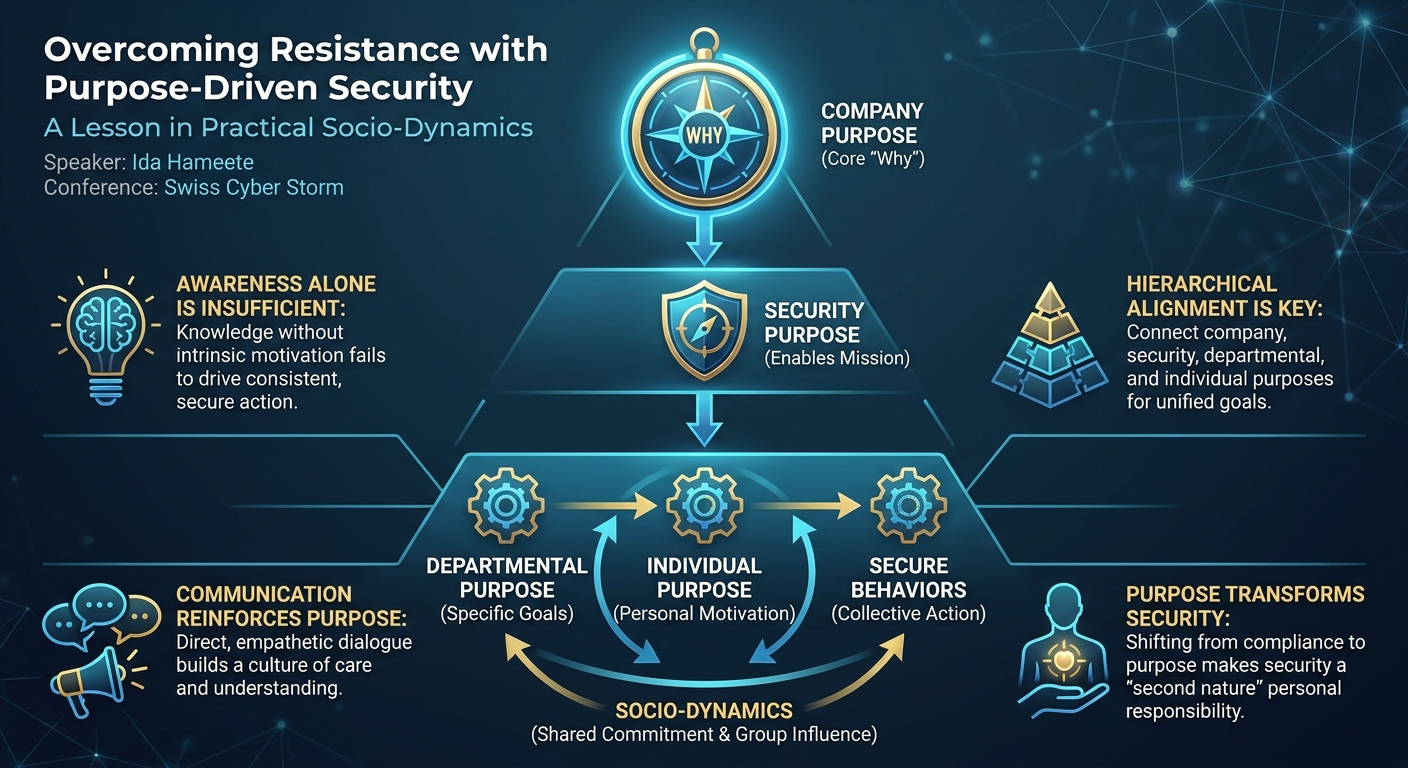
Ida Hameete's central thesis is that purpose is the "missing link" that can overcome the resistance inherent in traditional security approaches. Purpose, she argues, provides the "why" behind every security measure, bridging the critical gap between awareness and action. Once individuals understand and internalize this purpose, positive socio-dynamics naturally reinforce secure behaviors through group influence and collective action.
To illustrate this profound difference, Hameete employs a compelling kitchen analogy:
- "Clean the kitchen because it's required." In this scenario, compliance is the sole driver. Most people would likely do the bare minimum, perhaps signing a checklist without actually cleaning, or only cleaning superficially when an "auditor" is present. The motivation is external, leading to resistance and superficial adherence. This mirrors the ineffectiveness of compliance-driven security, such as adhering to ISO 27001 requirements without understanding their deeper significance.
- "Clean the kitchen to keep your child healthy." Here, the motivation is deeply personal and intrinsic. Imagine a two-year-old child with a compromised immune system, vulnerable to dangerous bacteria known to thrive in kitchens. The risk isn't just a minor illness but potentially a life-threatening one. In this context, individuals wouldn't just clean; they would clean diligently, consistently, and without needing external oversight. The purpose – protecting their child's life – transforms the chore into a deeply meaningful act.
This analogy directly translates to cybersecurity:
- Companies are constantly exposed to "bacteria" (attackers).
- While not every attack is "lethal," there's always the chance of a "really, really bad attacker which takes us down and kills the company."
- By understanding the profound impact of security on the company's existence and its ability to deliver its core value (its "child"), employees move beyond mere compliance. They internalize the purpose, making security a personal responsibility.
When employees understand "why our company exists, what is the good we are doing for the world," and connect that to security, resistance dissipates. This understanding fosters:
- Purpose-driven attitudes: Individuals align their personal values with the company's mission.
- Reinforced secure behaviors: Group dynamics shift from enabling shortcuts to encouraging best practices.
- Enhanced overall security: Collective action becomes a powerful force, making security a "second nature."
Hameete concludes that organizations hold the power to fundamentally change how security is perceived and practiced by embedding a clear, compelling purpose at its core.
Technical Deep Dive
▶ Watch: Epic's 'patient at heart' culture drives security (12:10)
While Hameete's talk isn't "technical" in the traditional sense of code or protocols, it provides a robust conceptual framework for integrating human psychology and organizational structure into security strategy. Her "technical deep dive" is into the socio-dynamics of purpose-driven security, building on Simon Sinek's Golden Circle concept of "Why, How, What."
The Golden Circle, usually applied to marketing and leadership, is adapted for security:
- Why (Purpose): At the core is the Company Purpose – the fundamental reason the organization exists, its impact on the world. For security, this translates into a Security Purpose, which is a direct articulation of how security enables the company's core mission. For example, if the company's purpose is "to save lives," the security purpose might be "to maintain the integrity and availability of systems to ensure patient safety and care." This is the critical, often missing, element that drives genuine engagement.
- How (Consciousness & Communication): This layer addresses how the purpose is achieved. It involves fostering consciousness, effective communication, threat modeling, and secure software development practices. These are the processes and methodologies that facilitate secure operations. Hameete emphasizes that true awareness ("how") only emerges when individuals "care" ("why").
- What (Tools & Actions): The outermost layer represents the tangible actions and tools – the millions spent on security technologies, awareness programs, and specific workflows. Without a strong "why" and a clear "how," these "what" components often fail to integrate effectively into daily operations. Hameete argues that the substantial investments in security tools and training only become truly effective when rooted in a clear purpose.
The power of this framework lies in its hierarchical alignment of purpose across the organization:
- Company Purpose: This is the overarching "why." (e.g., "Patient at the heart" for a healthcare tech company).
- Company Security Purpose: This directly supports the company purpose. (e.g., "Protecting patient data and system availability to ensure continuous, high-quality care").
- Departmental Purpose: Each department defines its own purpose, aligned with the company's.
- HR: Its purpose might be "to recruit and retain the right talent to save lives." Its security purpose would then be "to ensure secure onboarding/offboarding and data handling to protect the company's ability to save lives."
- Billing: "To ensure financial stability so the company can continue its mission." Its security purpose: "To protect financial data and systems to prevent disruption of services."
- Software Development: "To create innovative and reliable solutions that save lives." Its security purpose: "To write secure code, preventing vulnerabilities that could compromise patient care."
- Employee Purpose: Finally, every individual employee is encouraged to identify their personal "why" for coming to work, beyond just a paycheck. This individual purpose, when aligned with departmental and company purpose, creates an unparalleled level of intrinsic motivation and commitment to security.
This multi-layered alignment ensures that "everybody is thriving to the same direction." It moves beyond abstract policies to foster a tangible security mindset, where individuals proactively consider security implications because they understand its direct link to their purpose and the company's mission. This holistic approach transforms security from a top-down mandate into a deeply embedded security culture, where commitment is not forced but organically cultivated. Hameete eloquently summarizes this by stating that when "purpose meets positive group dynamics, the resistance devolves and there is no problem anymore because culture and strategy will be on the same line."
Demo / Proof of Concept
▶ Watch: Applying Golden Circle: Company, department, employee purpose (18:00)
While Ida Hameete's presentation does not include a traditional technical demonstration or a live proof of concept, she provides a powerful real-world case study that exemplifies the principles of purpose-driven security: Epic Systems.
Hameete shares her personal experience working for Epic Systems, a major healthcare software company, highlighting how its deeply ingrained purpose of "patient at the heart" permeates every aspect of the organization. This isn't just a marketing slogan; it's a living philosophy that shapes daily operations and individual mindsets. The purpose is visible everywhere, even on signs in the bathrooms, constantly reinforcing the ultimate "why."
She uses several compelling examples to illustrate this:
- Cafeteria Staff: Even employees working in the kitchen at Epic's Madison, Wisconsin campus understand that by providing good, nourishing food, they are indirectly supporting developers who, in turn, write code that saves lives. This connection imbues even seemingly peripheral roles with a sense of purpose directly linked to patient well-being.
- Inselspital (Bern): Hameete extends the example to a client hospital, Inselspital in Bern, which uses Epic software. She explains that every child born, every ambulance ride, every patient interaction in such hospitals relies on systems like Epic. This means that every Epic employee, from developers to security personnel, contributes to keeping people in Bern alive and healthy.
A particularly insightful example focuses on the Admission, Discharge, and Transition (ADT) department within a hospital. These are individuals who manage patient flow, far removed from direct patient care. Traditionally, they might view security workflows as cumbersome and irrelevant. However, Hameete explains that if an ADT system is compromised by a virus or a hacker, it can halt the entire patient intake process. She cites her sister, an ER worker, confirming that if ADT software fails, emergency rooms often have to close down.
This scenario vividly demonstrates how a seemingly distant department's adherence to security directly impacts patient lives. If the ADT staff at Inselspital truly understand that their diligent adherence to security protocols prevents the ER from closing, ensuring ambulances can continue bringing in patients, their resistance to security measures will be "very, very low." The purpose – saving lives by keeping the hospital operational – becomes their intrinsic motivator.
This case study effectively serves as a "proof of concept" for Hameete's framework, showing how a deeply embedded, clearly communicated purpose can transform organizational culture and drive secure behavior across all levels, even in roles far removed from traditional cybersecurity functions.
Defensive Implications
▶ Watch: Q&A: Best communication strategy for purpose (28:00)
Ida Hameete's framework offers profound implications for cybersecurity defenders seeking to move beyond reactive, compliance-driven strategies to build truly resilient organizations. The core defensive implication is a paradigm shift: security must be purpose-driven, not merely compliance-driven.
Here's how defenders can operationalize these insights:
- Articulate and Embed the Company's Core Purpose: Security leaders must work with executive leadership to clearly define and widely communicate the organization's fundamental "why." What good does the company do for the world? What mission does it serve? This purpose must be authentic and deeply believed by leadership, not just a marketing slogan.
- Translate Company Purpose into Security Purpose: Once the company purpose is clear, security teams must articulate a specific Security Purpose that directly supports it. For example, if a company's purpose is "to empower innovation," its security purpose might be "to provide a secure foundation that enables rapid, protected innovation without fear of disruption." This connection makes security relevant and meaningful.
- Cascade Purpose Hierarchically: Security leaders should guide departments and teams in defining their own purposes and security purposes, ensuring they align with the overarching company mission. This involves helping HR understand its security role in protecting talent, billing in safeguarding financial stability, and development in building secure products, all linked back to the company's ultimate good.
- Foster Employee Purpose Alignment: Encourage individual employees to reflect on their personal "why" for working at the company and connect it to the broader organizational purpose. This can be facilitated through team discussions, workshops, or even one-on-one conversations. When employees see how their daily actions, including security tasks, contribute to a meaningful goal, their commitment increases dramatically.
- Prioritize Direct and Bottom-Up Communication: As highlighted in the Q&A, effective communication of purpose is crucial. Instead of top-down mandates via email, security leaders should engage in direct, personal conversations. This involves actively listening to employees' concerns, understanding their resistance, and explaining the "why" in a way that resonates with their specific roles and motivations. Emulate leaders like Judy Faulkner, who was accessible and engaged directly with employees.
- Address the Leadership Gap: Security must be positioned as a management responsibility, not just an IT task. CISOs and security leaders need to educate executives on the strategic importance of security, linking it directly to the company's ability to achieve its purpose and manage existential risks. This helps secure necessary resources and buy-in.
- Reframe Awareness and Training: Move beyond generic awareness. Tailor training to specific departmental and individual purposes. Instead of just "do this because it's policy," explain "do this because it protects [specific company value/mission] and enables [your department's purpose]."
- Cultivate a Culture of Care, Not Just Compliance: The goal is to build a security culture where secure behaviors are a "second nature." This requires consistent positive reinforcement, celebrating secure actions, and integrating security into performance metrics in a way that aligns with purpose.
- Engage with Resistance (Especially from "Older" Employees): Acknowledge that resistance to change, particularly from long-tenured employees, is human nature. Instead of dismissing it, engage with empathy. Listen to their experiences and concerns. By understanding the root cause of their resistance, security leaders can frame the purpose in a way that addresses their specific anxieties and demonstrates the benefits of new approaches. This requires patience, time, and genuine dialogue.
By proactively embedding purpose at every level, defenders can transform security from a perceived impediment into an integral, valued component of the organization's success, overcoming resistance and fostering genuine resilience.
Key Takeaways
- Purpose is the Foundation of Effective Security: Traditional approaches like awareness training, skills development, and tool implementation are often insufficient because they lack an intrinsic "why." Security must be rooted in a clear, compelling purpose that resonates with all employees.
- Awareness Does Not Equal Action: Simply making people aware of risks or requirements does not guarantee secure behavior. True action stems from care and personal investment, which are driven by a deeper understanding of purpose.
- Align Purpose Hierarchically: For security to be effective, the company's overarching purpose must cascade down to a specific security purpose, departmental purposes, and individual employee purposes. This alignment ensures everyone is working towards a shared, meaningful goal.
- Harness Positive Socio-Dynamics: When purpose is clearly understood and embraced, group dynamics shift from creating barriers to reinforcing secure behaviors. This collective action significantly enhances overall organizational security.
- Communication is Paramount: Effective implementation of purpose-driven security relies on direct, empathetic, and often bottom-up communication. Leaders must actively listen to employees, understand their resistance, and frame security in terms of its direct contribution to the company's mission.
- Build a Security Culture, Not Just Compliance: A genuine security culture emerges when employees intrinsically understand and commit to the "why" behind security. This transforms security from a burdensome obligation into a second nature, making the organization truly resilient.
About the Speaker(s)
Ida Hameete is a Product Owner specializing in purpose-driven security. Her professional focus lies at the intersection of the human and strategic aspects of cybersecurity, encompassing areas such as resilience, social dynamics, and management. Hameete's unique perspective is significantly informed by her "other job" as a physiotherapist, which has cultivated her deep interest in human resilience. She leverages this understanding to bridge the often-present gaps between management and security, advocating for security as a fundamental management responsibility. Her work aims to inspire and motivate individuals, demonstrating how purpose and social dynamics are critical factors in making security truly effective within any organization.
Reviews
Dr. Zero (Offensive Security Researcher) — WEAK
The speaker applies Simon Sinek's 'Start With Why' to security awareness training. It's well-intentioned, but trying to convince an overworked billing clerk that not clicking a phishing link saves lives is just HR theater. If you're looking for actionable organizational change, you won't find it here.
Heather Calloway (CISO) — WEAK
A well-intentioned but naive attempt to solve structural security failures with HR motivation theory. The diagnosis of why awareness training fails is correct, but the proposed solution relies on corporate purpose rather than aligned executive incentives.