Law Beats Code: Enforcing a Legal Base for a Safe and Human-Centric AI
Monica Amgwerd (General Secretary · Pirate Party in Zurich)
Swiss Cyber Storm 2024 · Day 1 · Scenario
Overview
In a thought-provoking address at Swiss Cyber Storm, Monica Amgwerd, General Secretary of the Pirate Party in Zurich, challenged the prevailing notion that "code beats law" by asserting that "law beats code" in the pursuit of a safe and human-centric artificial intelligence. The talk underscored the critical interplay between rapid technological innovation and the often-lagging pace of societal regulation, emphasizing that how we choose to regulate AI reflects fundamental questions about how humanity desires to live with this transformative technology. Amgwerd positioned law not merely as a set of rules, but as a dynamic social contract—a collective agreement, especially pertinent in Switzerland's direct democracy, that requires the active participation of all citizens, including cybersecurity specialists.
Key moments
- 0:00 Introduction: Law beats code, innovation vs. regulation.
- 4:00 Pirate Party's initiative for digital integrity rights.
- 6:15 Comparing democracy systems to cyber security systems.
- 10:00 Call to action: Engage everyone in digital discourse.
- 14:00 Q&A: Concerns about proprietary AI and data scraping.
- 20:00 Q&A: The critical need for youth awareness campaigns.
- 26:00 Q&A: Suggestion for regular public AI discussions.
Law Beats Code: Enforcing a Legal Base for a Safe and Human-Centric AI
Speakers: Monica Amgwerd, General Secretary, Pirate Party in Zurich
Conference: Swiss Cyber Storm
YouTube: https://www.youtube.com/watch?v=pDrWh1B92aY
Overview
In a thought-provoking address at Swiss Cyber Storm, Monica Amgwerd, General Secretary of the Pirate Party in Zurich, challenged the prevailing notion that "code beats law" by asserting that "law beats code" in the pursuit of a safe and human-centric artificial intelligence. The talk underscored the critical interplay between rapid technological innovation and the often-lagging pace of societal regulation, emphasizing that how we choose to regulate AI reflects fundamental questions about how humanity desires to live with this transformative technology. Amgwerd positioned law not merely as a set of rules, but as a dynamic social contract—a collective agreement, especially pertinent in Switzerland's direct democracy, that requires the active participation of all citizens, including cybersecurity specialists.
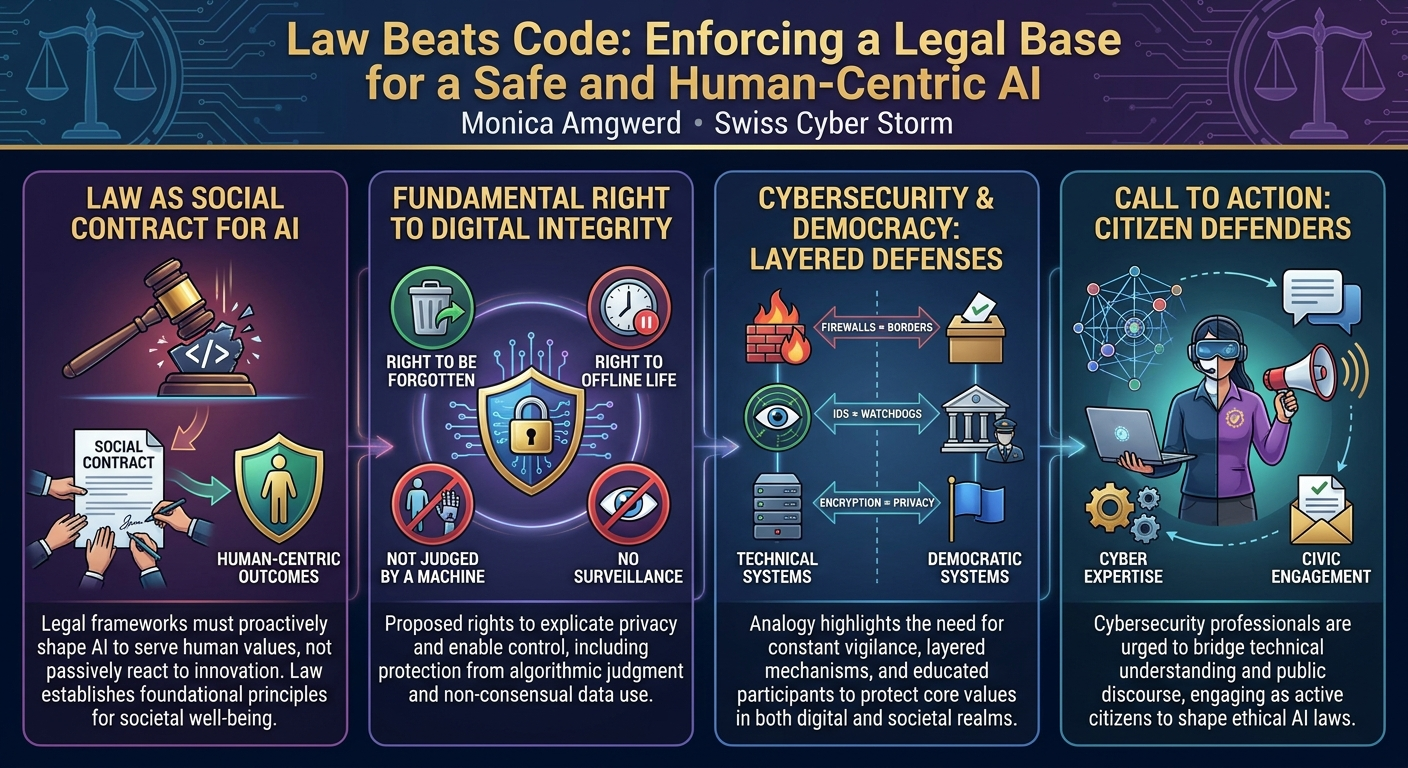
Amgwerd's central argument revolved around the necessity of establishing a robust legal framework, or "legal groundwork," to guide AI development and deployment. She highlighted the Pirate Party Zurich's initiative for a Fundamental Right to Digital Integrity, which aims to explicate existing privacy rights for the complexities of the digital age. By drawing parallels between the defense mechanisms of computer systems and democratic societies, Amgwerd made a compelling case for cybersecurity experts to engage as citizens in shaping the legal and ethical landscape of AI, urging them to recognize their unique position in bridging the gap between technical understanding and public discourse.
Background
▶ Watch: Introduction: Law beats code, innovation vs. regulation. (0:00)
The rapid acceleration of Artificial Intelligence (AI) capabilities has ushered in an era where technological innovation frequently outpaces the capacity of existing legal and ethical frameworks to adapt. This creates a significant challenge for societies grappling with the implications of AI on privacy, autonomy, and fundamental human rights. The speaker, Monica Amgwerd, frames this as a constant tension between innovation and regulation, where the question of "how do we want to live?" becomes paramount. Historically, attempts to pre-emptively define the ethical boundaries of emerging technologies have been rare but influential. A notable early example, cited by Amgwerd, is Isaac Asimov's Three Laws of Robotics, introduced in his 1950 short story collection I, Robot. These laws—designed to prevent robots from harming humans, ensure obedience, and preserve their own existence (in that order of priority)—represented a foundational, albeit fictional, attempt to embed common-sense ethical principles into technological design. Amgwerd uses Asimov's work to illustrate that lawmaking, at its core, is about formalizing common sense for collective benefit.
In the contemporary context, the problem is exacerbated by the opaque nature of many advanced AI systems, particularly proprietary Large Language Models (LLMs) like ChatGPT. These models often operate as black boxes, ingesting massive datasets without clear transparency regarding their internal mechanisms, data sources, or potential biases. This lack of transparency, coupled with the pervasive collection of personal data, fuels concerns about surveillance capitalism and the erosion of individual privacy. The Pirate Party Zurich's initiative arises from this specific challenge, seeking to translate the abstract concept of privacy into concrete, actionable rights tailored for the digital realm, thereby empowering citizens and providing a much-needed legal basis to steer AI development towards human-centric outcomes.
Key Findings
▶ Watch: Comparing democracy systems to cyber security systems. (6:15)
The talk's key findings center on the critical need for proactive legal and societal intervention in the development and deployment of AI, rather than allowing technological advancement to dictate ethical norms.
Firstly, Amgwerd posits that while "code beats law" in terms of speed and immediate impact, ultimately "law beats code" by establishing the foundational principles and societal contract that govern how technology can and should be used. This isn't about stifling innovation but about ensuring it serves human well-being. The speaker emphasizes that this is an ongoing, dynamic interplay, not a one-time resolution.
Secondly, the talk highlights the Pirate Party Zurich's Initiative for a Fundamental Right to Digital Integrity as a concrete step towards achieving this legal groundwork. This initiative redefines and expands traditional privacy rights to address the specific challenges posed by digital technologies, particularly AI. The proposed rights include:
- A right to be forgotten, enabling individuals to have their data erased.
- A right to an offline life, acknowledging the need for respite from constant digital presence.
- A right to informational security, ensuring protection of personal data.
- A right not to be judged by a machine, challenging algorithmic decision-making that impacts individuals without human oversight.
- A right not to be surveilled, measured, and analyzed, pushing back against pervasive data collection.
- A right to protection from the use of our data without consent, re-establishing explicit user control over personal information.
These rights, while fundamental, are presented as non-absolute, requiring a weighing of goods against other societal benefits like economic development or the provision of essential services, much like the right to physical integrity can be temporarily waived for medical procedures.
Thirdly, Amgwerd effectively illustrates the necessity of robust societal defenses against the threats posed by unchecked technology through a compelling analogy between cybersecurity systems and democratic systems. This comparison reveals that both systems require constant vigilance, layered defenses, and educated participants to remain secure and functional. This analogy serves as a powerful call to action for cybersecurity professionals to apply their analytical skills and expertise to the "system" of democracy.
Technical Deep Dive
▶ Watch: Call to action: Engage everyone in digital discourse. (10:00)
While the talk is not technical in the traditional sense of detailing code or system architectures, it delves into the "technical" aspects of legal and societal frameworks as a form of system design for human-centric AI. Amgwerd's approach can be seen as an attempt to architect a "legal operating system" for the digital age, much like a software engineer designs a secure application.
The core "technical" contribution is the detailed articulation of the Fundamental Right to Digital Integrity. This initiative can be viewed as a protocol specification for human-AI interaction, designed to ensure ethical and privacy-preserving operations. Each of the six proposed rights acts as a distinct security control or access control mechanism:
- Right to be forgotten: Analogous to a data deletion API call, ensuring data lifecycle management and user control over persistent information.
- Right to an offline life: A conceptual "disconnect switch" or "rate limiter" for digital engagement, recognizing the human need for non-digital existence.
- Right to informational security: Directly aligns with confidentiality, integrity, and availability (CIA) principles in data security, mandating robust protection for personal data.
- Right not to be judged by a machine: A "human override" or "algorithmic transparency" requirement, preventing automated systems from making critical decisions about individuals without human accountability and explanation. This directly addresses concerns about algorithmic bias and lack of recourse.
- Right not to be surveilled, measured, and analyzed: A "data minimization" and "purpose limitation" directive, restricting the pervasive collection and processing of personal data without explicit, narrowly defined purposes.
- Right to protection from the use of our data without consent: Reinforces explicit consent mechanisms, functioning as a strict permission model where data processing is only permitted after clear user authorization, similar to granting specific permissions to an application.
These rights are not absolute but require a "risk-benefit analysis" or "weighing of goods," a concept akin to security trade-offs in system design where the benefits of a service (e.g., medical operation, economic growth) are balanced against the potential infringement of a right.
Further, Amgwerd's cybersecurity-democracy analogy provides a meta-level architectural comparison:
- Firewall (Borders): Regulates ingress/egress, protecting the system from external threats.
- Intrusion Detection System (Watchdog groups, investigative journalists, whistleblowers): Monitors for anomalous activities and alerts stakeholders, ensuring early detection of threats to democratic processes.
- User Authentication (Voting rights, representation): Verifies legitimate actors and controls who can modify system parameters or participate in governance.
- Open Source (Freedom of speech, public scrutiny): Enables transparency and collaborative improvement through community review and shared knowledge, enhancing system resilience.
- Encryption (Privacy): Protects sensitive internal data (personal thoughts, family life) from unauthorized access, preventing repercussions and fostering free thought.
- Training (Education): A continuous process to update defenses against evolving threats, ensuring citizens are equipped to protect the democratic system.
This analogy serves as a system design pattern for societal resilience, illustrating that just as technical systems require layered defenses, legal and democratic systems need similar, robust mechanisms to protect their core values against evolving digital threats. The Q&A further highlights concerns about the proprietary nature of LLMs like ChatGPT, which operate as closed systems, contrasting sharply with the transparency advocated by the open-source analogy. The lack of visibility into their training data, algorithms, and data handling practices raises significant "technical" concerns about data sovereignty, algorithmic accountability, and the potential for surveillance capitalism through "deep data mining" and "prolific profiling." The speaker argues that an "ethical AI" would necessitate alternative models of data ownership and transparency, moving away from centralized, profit-driven control.
Demo / Proof of Concept
▶ Watch: Q&A: The critical need for youth awareness campaigns. (20:00)
This talk was a conceptual and advocacy presentation focusing on legal and ethical frameworks for AI, rather than a technical demonstration. Therefore, no live demo or proof of concept was presented. The speaker's "proof of concept" is the ongoing initiative by the Pirate Party Zurich to enshrine a Fundamental Right to Digital Integrity into law, representing a real-world attempt to implement the principles discussed.
Defensive Implications
▶ Watch: Q&A: Suggestion for regular public AI discussions. (26:00)
The defensive implications derived from Monica Amgwerd's talk extend beyond traditional cybersecurity measures to encompass a broader societal and legal defense strategy against the potential harms of unchecked AI. For defenders—whether they are cybersecurity professionals, policymakers, or active citizens—the key takeaways are multifaceted:
- Advocate for Robust Legal Frameworks: The most crucial defensive implication is the need to actively support and push for comprehensive legal frameworks that codify digital rights. This includes initiatives like the Fundamental Right to Digital Integrity, which provides specific legal protections against algorithmic judgment, pervasive surveillance, and non-consensual data use. Defenders should engage with legislative processes, providing expert input to ensure these laws are technically informed and effective.
- Prioritize Privacy by Design: The proposed rights, particularly the right to protection from data use without consent and the right not to be surveilled, imply a strong mandate for Privacy by Design and Data Minimization in AI systems. Developers and organizations deploying AI should architect their systems from the ground up to collect only necessary data, process it transparently, and provide robust user controls over personal information.
- Demand Algorithmic Transparency and Accountability: The "right not to be judged by a machine" directly challenges the opacity of many AI systems. Defenders should advocate for mechanisms that ensure algorithmic transparency, explainability, and human oversight in automated decision-making processes, especially those impacting individuals' lives. This might involve mandating impact assessments, audit trails, and human review loops for critical AI applications.
- Educate and Raise Awareness: Amgwerd repeatedly emphasized the role of education. Cybersecurity experts, given their understanding of digital complexities, have a responsibility to demystify AI and its implications for the general public, particularly young people. Awareness campaigns are critical to empower citizens to understand their digital rights and the importance of participating in democratic processes to defend them. This is a vital "training" component for societal resilience, analogous to cybersecurity training for employees.
- Support Open Source and Ethical AI Initiatives: The concerns raised about proprietary LLMs like ChatGPT highlight the dangers of centralized control over powerful AI. Defenders should explore and support open-source AI models and ethical AI development paradigms where data ownership, transparency, and accountability are prioritized. Initiatives like Hugging Face's transparency reports or ethical prompting guides are steps in this direction, fostering a more secure and equitable AI ecosystem.
- Foster Public Discourse and Engagement: The analogy between cybersecurity and democracy underscores that active citizen participation is a core defense mechanism. Defenders should participate in public discussions, forums, and political processes (e.g., voting on initiatives) to ensure that the regulation of AI remains a matter of public interest and collective decision-making, rather than being left solely to tech companies or a small group of experts.
In essence, the defensive posture advocated by Amgwerd is a holistic one: integrating technical security practices with legal mandates, ethical considerations, and broad public engagement to build a resilient and human-centric digital future.
Key Takeaways
- Law as a Social Contract for AI: The talk fundamentally argues that legal frameworks, understood as a societal social contract, must actively shape AI development to ensure it serves human values, rather than passively reacting to technological advancements.
- Fundamental Right to Digital Integrity: The Pirate Party Zurich's initiative proposes concrete rights (e.g., right to be forgotten, not to be judged by a machine, protection from data use without consent) to explicate and enforce privacy in the digital age, acting as essential safeguards against unchecked AI.
- Cybersecurity Experts as Citizen Defenders: Professionals in cybersecurity are uniquely positioned to bridge the gap between technical understanding and public discourse, and are urged to engage as active citizens in shaping the legal and ethical landscape of AI.
- Transparency and Data Ownership are Paramount: Concerns about proprietary LLMs like ChatGPT highlight the dangers of opaque systems and centralized data ownership, advocating for more ethical AI models where data privacy and algorithmic transparency are core tenets.
- Education is a Core Defense Mechanism: Broad public education, especially for young people, is crucial for citizens to understand their digital rights and the importance of participating in democratic processes to defend against the threats posed by AI.
- Layered Defenses for Democracy and Digital Rights: Analogies between computer system defenses (firewalls, IDS, encryption) and democratic mechanisms (borders, watchdogs, privacy) illustrate the necessity of multi-faceted, continuous protection against evolving threats in both realms.
About the Speaker(s)
Monica Amgwerd is the General Secretary of the Pirate Party in Zurich. She is described as an opinion leader and highly active in the field of digital integrity of services. Her work focuses on the intersection of technology, law, and human rights, advocating for policies that ensure a safe and human-centric digital environment. Her expertise lies in translating complex technological challenges into accessible legal and societal discourse, emphasizing the role of direct democracy and citizen participation in shaping the future of technology like AI.
Reviews
Dr. Zero (Offensive Security Researcher) — WEAK
A political stump speech dressed up as a cyber policy briefing. It pitches a set of digital rights that sound great on a campaign flyer but completely ignore the technical reality of how modern machine learning systems actually function.
Heather Calloway (CISO) — SOLID
This is an early warning system for the next wave of European AI regulation. Amgwerd outlines a proposed 'Right to Digital Integrity' that effectively acts as GDPR for algorithmic decision-making. It won't change your architecture today, but it signals major compliance headwinds for automated business processes.