Don’t Forget the Human
Gregor Wegberg (Oneconsult)
Swiss Cyber Storm 2024 · Day 1 · Panorama
Overview
In an era dominated by discussions around Artificial Intelligence and advanced cyber threats, Gregor Wegberg, leading Oneconsult’s International Computer Security Incident Response Team (Caeser), delivered a poignant and critical talk at Swiss Cyber Storm titled "Don’t Forget the Human." This presentation serves as a stark reminder that despite the sophistication of modern cyberattacks and the technical prowess required to combat them, the human element—both within the responding teams and among the affected individuals—is consistently overlooked, often with devastating consequences. Wegberg argues that incident response plans, traditionally focused on technical processes and asset recovery, frequently neglect the psychological, emotional, and practical needs of people, leading to prolonged recovery times, erosion of trust, and significant moral failures.
Key moments
- 0:00 The human side of cyber incidents: personal motivation.
- 2:50 Why do organizations respond to incidents? Define your purpose.
- 8:00 Employee fears and lost trust during a major cyber attack.
- 10:00 Transparent communication: Explain attack impact to all stakeholders.
- 13:00 Prioritizing the welfare and breaks of incident responders.
- 16:30 Moral impact of published sensitive data: the healthcare example.
- 22:00 Homework: Define purpose, communicate, ensure welfare, review data impact.
Don’t Forget the Human
Speakers: Gregor Wegberg, Oneconsult
Conference: Swiss Cyber Storm
YouTube: https://www.youtube.com/watch?v=-Py1ubeCXUs
Overview
In an era dominated by discussions around Artificial Intelligence and advanced cyber threats, Gregor Wegberg, leading Oneconsult’s International Computer Security Incident Response Team (Caeser), delivered a poignant and critical talk at Swiss Cyber Storm titled "Don’t Forget the Human." This presentation serves as a stark reminder that despite the sophistication of modern cyberattacks and the technical prowess required to combat them, the human element—both within the responding teams and among the affected individuals—is consistently overlooked, often with devastating consequences. Wegberg argues that incident response plans, traditionally focused on technical processes and asset recovery, frequently neglect the psychological, emotional, and practical needs of people, leading to prolonged recovery times, erosion of trust, and significant moral failures.
The impetus for this talk stemmed from a deeply personal experience during a ransomware incident involving Netcet and CH Media. Wegberg recounted reading an article about an IT worker, a new father with a three-month-old daughter, who was unable to be with his family due to the relentless demands of incident recovery. This anecdote powerfully illustrates the human cost of cyberattacks and the inadequacy of current incident management frameworks to account for such scenarios. The talk challenges organizations to look beyond mere operational continuity and consider the fundamental "why" of their existence, re-evaluating their responsibilities to employees, customers, and the broader community in the face of cyber crisis.
Why this talk matters is multifaceted. Firstly, it addresses a critical blind spot in cybersecurity: the human factor. While social engineering targets humans as vulnerabilities, Wegberg shifts the focus to humans as responders and victims, highlighting their resilience and fragility. Secondly, it underscores that effective incident response is not solely a technical problem but a complex interplay of technology, process, and human well-being. By neglecting the latter, organizations risk not only operational failure but also severe reputational damage, legal ramifications, and a profound loss of internal and external trust. Ultimately, "Don’t Forget the Human" advocates for a paradigm shift, urging the cybersecurity community to embed empathy, clear communication, and robust human welfare provisions into the very fabric of their incident preparedness and response strategies.
Background
▶ Watch: The human side of cyber incidents: personal motivation. (0:00)
The problem addressed by Gregor Wegberg is deeply rooted in the prevailing mindset of incident response (IR) and crisis management. Historically, and even in many contemporary practices, IR plans are predominantly designed around technical procedures. They meticulously detail "who to call," "what systems to isolate," and "how to rebuild infrastructure," often following standard phases like identification, containment, eradication, recovery, and post-incident analysis. While these technical steps are undeniably crucial, Wegberg highlights a glaring omission: the human beings who execute these plans and those who are ultimately impacted by the cyber incidents.
This oversight creates a significant gap, as humans are not only the primary responders but also the primary stakeholders affected by cyberattacks. The speaker, drawing from his extensive experience leading Oneconsult's CIRT, observes that organizations frequently struggle to answer fundamental questions like, "Why are we even responding to this incident?" or "Why should we recover?" This lack of a clear, articulated purpose—a North Star or mission—leaves responders without sufficient motivation beyond their paycheck and makes it incredibly difficult to prioritize recovery efforts effectively. Without understanding why an organization must exist or what its core purpose is, decisions about which systems to restore first or which data is truly critical become arbitrary, leading to prolonged downtimes and inefficient resource allocation.
Prior work in incident response has largely focused on technical tooling, threat intelligence, and procedural playbooks. While valuable, this emphasis often treats human responders as interchangeable cogs in a machine, neglecting their emotional, physical, and psychological needs during high-stress, prolonged events. Similarly, the impact on employees and customers is frequently relegated to legal or public relations departments, with communication often being reactive, defensive, and devoid of genuine empathy or actionable advice. The problem persists because the "easy questions" in IR are technical ("How do we rebuild Active Directory?"). The "hard questions" – those concerning human impact, trust, and welfare – are often sidestepped, dismissed as non-technical, or simply ignored due to their complexity and the discomfort they evoke. The catalytic Netcet/CH Media ransomware case served as a stark, personal illustration for Wegberg of how this systemic neglect can manifest in profound human suffering, motivating his call for a more human-centric approach to cybersecurity.
Key Findings
▶ Watch: Employee fears and lost trust during a major cyber attack. (8:00)
Gregor Wegberg's talk unveils several critical findings that challenge conventional incident response paradigms:
- The "Why" Deficit: A significant number of organizations lack a clear, articulated understanding of why they exist or why they should continue to operate after a catastrophic cyber incident. This fundamental deficit directly impacts their ability to prioritize recovery efforts, motivate their incident response teams, and make sound strategic decisions under pressure. Without a defined mission or purpose, recovery becomes a purely technical exercise devoid of strategic direction, leading to unnecessary delays and inefficiencies.
- Neglect of Responder Welfare: Incident response plans overwhelmingly fail to address the well-being of the human responders. These plans focus on technical tasks but overlook essential provisions like adequate rest, nutrition, and psychological support. The expectation that individuals can work 24/7 for extended periods without structured breaks or proper care leads to burnout, reduced efficiency, increased errors, and ultimately, prolonged recovery times. Wegberg stresses that human responders are "not robots" or "AI LLMs" and require deliberate planning for their welfare.
- Communication Breakdown and Trust Erosion: During a cyber crisis, internal and external communication often falls short. Employees are frequently the last to be informed, leading to fear, anxiety about job security and salaries, and a profound loss of trust in their employer. This vacuum of information can lead employees to share their own, often inaccurate, narratives with the public or press, exacerbating reputational damage. Similarly, external communication to customers and partners often consists of generic, legalistic statements ("it was an APT") rather than empathetic explanations of impact and actionable advice, further eroding trust and potentially leading to legal action.
- Underestimated Personal Data Impact: Organizations frequently assess the impact of data breaches from a purely business or legal standpoint, often concluding that the publication of stolen data (even intellectual property) is "not a big deal." However, this perspective catastrophically ignores the severe personal impact on individuals. The exposure of sensitive personal information—such as passport copies, HR records detailing health problems, performance reviews (MBOs), or even internal chat messages and personal emails—can lead to identity theft, reputational harm, psychological distress, and even more severe consequences like the AlphaV ransomware case involving sensitive healthcare data, or the potential for child abuse material being exposed in specific scenarios. This moral blind spot represents a significant ethical failure.
- The "Easy vs. Hard Questions" Dichotomy: The cybersecurity industry, including incident responders, tends to gravitate towards "easy" technical problems (e.g., rebuilding Active Directory, re-segmenting networks). The "hard" questions, which involve understanding human impact, fostering trust, ensuring welfare, and navigating complex ethical dilemmas, are often avoided. This preference for technical solutions over human-centric considerations perpetuates the problem, as the human dimension is fundamental to both preventing and recovering from cyber incidents effectively.
Technical Deep Dive
▶ Watch: Transparent communication: Explain attack impact to all stakeholders. (10:00)
While "Don’t Forget the Human" isn't a technical deep dive in the traditional sense of exploring code vulnerabilities or network protocols, it offers a profound architectural blueprint for human-centric incident response. It details critical processes and considerations that must be integrated into any robust cybersecurity framework, emphasizing that the "technical" aspects of IR are ultimately executed by, and impact, humans.
Central to Wegberg's argument is the concept of a clearly defined organizational purpose. This isn't a philosophical exercise but a practical requirement for effective incident response. Organizations must formally articulate their mission, vision, and North Star—the fundamental reason for their continued existence. This strategic clarity directly informs Business Continuity Management (BCM) and Disaster Recovery (DR) planning, guiding decisions on what systems, data, and processes are truly critical to restore first. Without this, even the most technically proficient team will struggle with prioritization, leading to wasted effort and extended outages. For instance, knowing that the primary mission is to provide life-saving healthcare dictates that patient data systems and critical medical device networks take precedence over, say, internal HR portals, even if both are compromised.
The talk implicitly critiques the architecture of traditional IR plans, which often resemble checklists of technical tasks rather than comprehensive operational frameworks. Wegberg advocates for an IR architecture that explicitly includes a human welfare protocol. This involves:
- Shift Planning and Rotation: Moving beyond ad-hoc responses to formal shift work planning, ensuring responders get adequate rest and breaks. This requires designated individuals responsible for scheduling and enforcing these rotations, preventing burnout.
- Sustenance and Environment: Providing healthy food, hydration (water over sugary drinks), and a conducive working environment. This moves beyond the stereotypical "pizza and Red Bull" culture, acknowledging that sustained cognitive function requires proper nourishment.
- Psychological Support: Recognizing the emotional toll of prolonged incidents. While not explicitly detailed as a technical system, integrating access to counseling or peer support mechanisms becomes a crucial, often overlooked, component of the IR "stack."
Communication, often treated as a separate public relations function, is reframed as an integral protocol within the incident response architecture. This demands:
- Pre-defined Communication Templates: Developing templates for various scenarios (e.g., ransomware, data theft, service outage) for different audiences (employees, customers, partners, regulators). These templates should go beyond legalistic disclaimers to include empathetic language, clear explanations of impact, and actionable guidance (e.g., "what to do if your data might be stolen and how to protect against identity theft").
- Designated Communication Channels: Establishing clear channels and responsibilities for internal and external communications. This includes leveraging existing management structures (upper management has "idle minutes" for communication) and ensuring consistent messaging.
- Transparency and Trust Building: Moving away from generic "nation state attack" narratives towards a more transparent, albeit legally vetted, explanation of events. This protocol aims to rebuild and maintain trust, especially with partners in the supply chain, preventing them from becoming secondary victims or seeking legal recourse.
Finally, the talk introduces a critical data impact assessment methodology that extends beyond legal and business risk. This requires organizations to evaluate data not just for its monetary or regulatory value, but for its personal and moral implications. This involves:
- Inventorying Sensitive Personal Data: Identifying all data categories that, if exposed, would cause significant personal harm (e.g., passport copies, health records, HR performance reviews, private internal communications like Slack/Teams chats, personal emails stored on business accounts).
- Moral Hazard Analysis: Conducting a "what if" scenario analysis from a human perspective: "What does it really mean to an individual if their sensitive health information, or even a casual internal joke taken out of context, is publicly exposed?" The AlphaV ransomware case, where a healthcare provider's data was published, leading to potential exposure of highly sensitive patient information, serves as a stark example of this failure.
- Informed Consent and Responsibility: Acknowledging that organizations have a moral, if not always legal, responsibility to inform affected individuals about the nature of the exposed data and provide guidance on mitigation, especially when the data's publication could lead to identity theft, reputational damage, or even more severe consequences like the hypothetical exposure of child abuse material.
In essence, Wegberg advocates for an incident response "system" that is not just technically sound but also human-aware, empathetic, and ethically grounded. This means integrating human factors into every layer of the IR architecture, from strategic planning to operational execution and post-incident communication.
Demo / Proof of Concept
▶ Watch: Moral impact of published sensitive data: the healthcare example. (16:30)
This talk did not feature a traditional technical demonstration or a proof of concept in the sense of showcasing code, tools, or exploit techniques. Instead, Gregor Wegberg's presentation served as a proof of concept for the problem itself, demonstrating the profound human impact of neglecting the human element in cyber incident response through compelling real-world anecdotes and case studies.
The primary "demonstration" was the Netcet/CH Media ransomware incident, which catalyzed Wegberg's entire talk. His recounting of the IT worker with a three-month-old daughter, unable to be home with his family due to the relentless demands of incident recovery, powerfully illustrated the personal cost. This anecdote served as a tangible example of how technical incident response, when devoid of human welfare considerations, can lead to severe personal hardship for the very individuals working tirelessly to restore operations.
Further, Wegberg highlighted the AlphaV ransomware attack on a healthcare provider. In this case, the threat actor published stolen data to pressure the victim into paying the ransom. This scenario demonstrated how organizations often assess data breaches solely from a business or legal perspective, failing to comprehend the devastating personal impact of exposing sensitive information like patient health records, passports, or HR data. The healthcare provider's failure to even inform affected individuals about the publication of their highly personal data underscored a critical moral and ethical lapse, proving that the lack of human-centric planning can lead to profound societal harm.
These examples, drawn from actual incidents, functioned as powerful, real-world "demos" of the talk's core thesis: that overlooking the human side of cyberattacks has tangible, negative consequences for employees, customers, and the organization's long-term viability and reputation.
Defensive Implications
▶ Watch: Homework: Define purpose, communicate, ensure welfare, review data impact. (22:00)
The insights from "Don’t Forget the Human" offer crucial, actionable defensive implications for organizations looking to bolster their cybersecurity posture beyond mere technical controls:
- Define Your Organizational Purpose (The "Why"): Cybersecurity leaders must collaborate with executive management to clearly articulate the organization's core mission and reason for continued existence. This "North Star" is not just for marketing; it's a critical defensive measure that informs incident response priorities, resource allocation, and strategic decision-making during a crisis. Integrating this into your Business Continuity Management (BCM) and Disaster Recovery (DR) plans ensures that recovery efforts are aligned with true business value, rather than ad-hoc technical restoration.
- Embed Human Welfare into IR Plans: Incident Response Plans should be revised to explicitly include provisions for the well-being of responders. This means:
- Designated Welfare Role: Appoint a specific individual or team responsible for employee welfare during a crisis. This role should manage shift schedules, enforce breaks, ensure adequate nutrition (healthy food, water), and monitor for signs of burnout.
- Structured Shift Planning: Implement formal shift work protocols, similar to emergency services, to prevent fatigue and maintain efficiency over prolonged incidents.
- Psychological Support: Consider integrating access to mental health support or counseling services for responders who experience high-stress, traumatic events.
- Develop Proactive and Empathetic Communication Strategies: Move beyond reactive, legalistic press releases.
- Comprehensive Communication Plans: Create detailed plans outlining what information will be communicated, when, through which channels, and to whom (employees, customers, partners, regulators, public).
- Pre-approved Templates: Develop templates for various incident scenarios, focusing on clear, empathetic language that explains the impact and provides actionable advice for affected parties (e.g., guidance on identity theft protection).
- Internal Communication First: Prioritize informing employees honestly and transparently to maintain trust and prevent misinformation from spreading. Empower upper management to communicate regularly and directly.
- Partner Communication: Be proactive in communicating with supply chain partners, offering guidance on how they can protect themselves, thereby strengthening the collective security posture.
- Conduct a Human-Centric Data Impact Assessment: Beyond legal and business risk, organizations must assess the personal and moral implications of data exposure.
- Sensitive Data Inventory: Identify all categories of data that, if exposed, could cause significant personal harm or distress (e.g., health records, HR performance reviews, personal communications, passport copies).
- Moral Responsibility Framework: Establish a framework for determining the organization's moral responsibility to inform and support individuals whose sensitive personal data has been compromised, even if not legally mandated.
- "What If" Scenarios: Engage in tabletop exercises that specifically explore the human impact of data breaches, forcing decision-makers to confront the ethical dilemmas posed by publishing highly personal information.
- Leverage Existing Roles: Consider integrating existing roles like Environmental Health and Security (EHS) officers or Business Continuity Management (BCM) managers into the incident response framework. These individuals often possess the experience and mandate to care for employee welfare and manage crisis situations across various domains, making them natural champions for the human element in cyber incidents.
By integrating these human-centric defensive measures, organizations can move towards a more resilient, ethical, and ultimately more effective incident response capability, ensuring that while technology protects systems, humanity protects people.
Key Takeaways
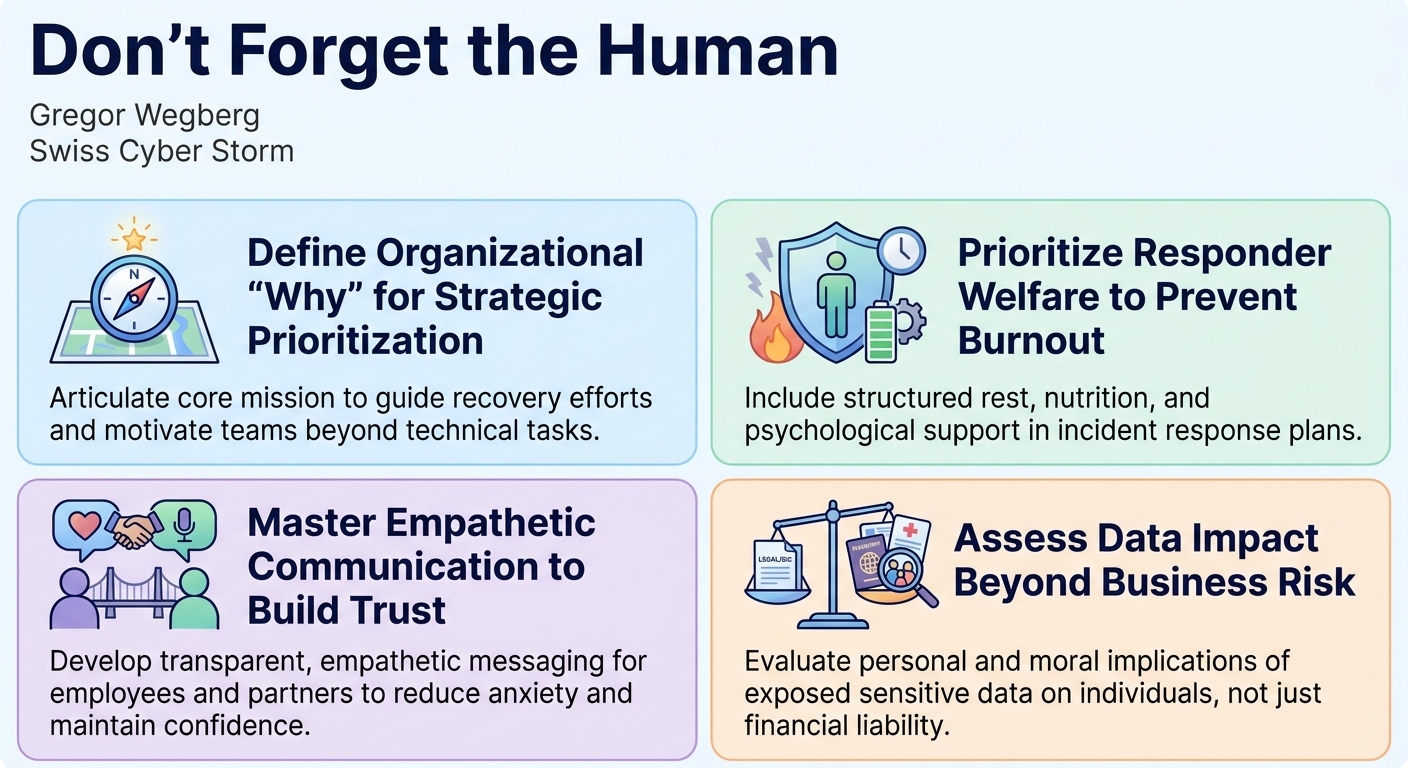
- Define Your Organizational "Why": Clearly articulate your organization's core purpose and mission. This foundational understanding is crucial for prioritizing recovery efforts, motivating responders, and making strategic decisions during a cyber crisis, ensuring that technical actions align with overall business objectives.
- Prioritize Responder Welfare: Incident response plans must explicitly include provisions for the physical and psychological well-being of human responders. Implement structured shift planning, ensure adequate rest and nutrition, and designate a welfare lead to prevent burnout and maintain efficiency over extended periods.
- Master Empathetic Communication: Develop comprehensive communication strategies with pre-approved templates for employees, customers, and partners. Focus on transparent, empathetic messaging that explains impact and provides actionable advice, rather than just legalistic disclaimers, to build and maintain trust.
- Assess Data Impact Morally: Go beyond legal and business risk assessments for data breaches. Evaluate the personal and moral implications of exposed sensitive data (e.g., health records, HR reviews, personal communications) and establish a clear responsibility to inform and support affected individuals.
- Integrate Human-Centric Roles: Leverage existing roles such as Environmental Health and Security (EHS) officers or Business Continuity Management (BCM) managers to champion employee welfare and holistic crisis management within the cyber incident response framework.
About the Speaker(s)
Gregor Wegberg is a leading expert in cybersecurity and incident response. He heads the Caeser (Oneconsult International Computer Security Incident Response Team) at Oneconsult, a prominent cybersecurity firm. His role involves guiding organizations through complex cyber incidents, particularly ransomware attacks and business email compromises. With extensive experience in the field, Wegberg possesses a deep understanding of both the technical intricacies of cyberattacks and the often-overlooked human and organizational challenges involved in recovery and crisis management. His insights are drawn from direct experience in the trenches of major cyber incidents, giving him a unique perspective on the critical need to integrate human factors into cybersecurity strategies.
Reviews
Dr. Zero (Offensive Security Researcher) — SOLID
A necessary dose of reality for CIRT leads who think an IR playbook is just a list of technical commands. Wegberg correctly points out that burning out your responders to rebuild systems without a business justification isn't dedication, it's an architectural failure. It won't drop zero-days, but it might stop your senior team from quitting mid-engagement.
Heather Calloway (CISO) — STRONG ACCEPT
Wegberg argues that incident response plans fail because they treat human responders as infinite resources and treat victims as PR problems. It is a necessary reminder that running a major breach response on heroism and adrenaline is a governance failure. Worth your leadership team's time to read before the next tabletop exercise.