AI Compliance Essentials: Standards and Emerging Regulations
Bruno Blumenthal (Member of the Board · tamit)
Swiss Cyber Storm 2024 · Day 1 · Panorama
Overview
In an era defined by the rapid integration of Artificial Intelligence (AI) across all sectors, understanding the complex landscape of AI compliance, standards, and emerging regulations has become paramount for security professionals. Bruno Blumenthal, a seasoned cybersecurity expert and Member of the Board at tamit, delivered a critical talk at Swiss Cyber Storm, dissecting these essential components from an information security and cybersecurity perspective. His presentation, "AI Compliance Essentials: Standards and Emerging Regulations," aimed to provide clarity on what existing and forthcoming frameworks mean for organizations and the professionals tasked with securing their digital ecosystems.
Key moments
- 0:00 Introduction: AI Compliance from a Cybersecurity View
- 4:00 Key ISO Standards for AI Risk Management
- 7:00 NIST AI Risk Management Framework Functions
- 11:00 Defining Trustworthy AI Properties: Beyond Security
- 16:00 EU AI Act: Prohibited & High-Risk Systems
- 26:00 Swiss FINMA's Supervisory Expectations for AI
- 27:50 Conclusion: Apply Existing InfoSec to AI Risks
- 31:00 Q&A: Challenges in Measuring Trustworthy AI
AI Compliance Essentials: Standards and Emerging Regulations
Speakers: Bruno Blumenthal, Member of the Board, tamit
Conference: Swiss Cyber Storm
YouTube: https://www.youtube.com/watch?v=N4-WaRp40M
Overview
In an era defined by the rapid integration of Artificial Intelligence (AI) across all sectors, understanding the complex landscape of AI compliance, standards, and emerging regulations has become paramount for security professionals. Bruno Blumenthal, a seasoned cybersecurity expert and Member of the Board at tamit, delivered a critical talk at Swiss Cyber Storm, dissecting these essential components from an information security and cybersecurity perspective. His presentation, "AI Compliance Essentials: Standards and Emerging Regulations," aimed to provide clarity on what existing and forthcoming frameworks mean for organizations and the professionals tasked with securing their digital ecosystems.
Blumenthal’s central premise is that while AI presents novel challenges, many of the core principles of effective risk management and cybersecurity remain relevant. The talk emphasized that AI is not an entirely new paradigm requiring a complete overhaul of security strategies, but rather another technology that must be understood and integrated into existing robust frameworks. For anyone involved in information security, cyber security, or data protection, this deep dive offers crucial insights into navigating the burgeoning regulatory environment and leveraging established standards to manage AI-related risks effectively.
The significance of this talk lies in its pragmatic approach, cutting through the hype and legal complexities to offer actionable intelligence. As AI systems become more sophisticated and pervasive, their potential impact on individuals, organizations, and society at large necessitates a structured approach to governance and risk. Blumenthal's analysis serves as a vital guide for professionals seeking to ensure the safe, secure, and ethical deployment of AI technologies within their organizations, highlighting the critical interplay between technical security measures and broader compliance obligations.
Background
▶ Watch: Introduction: AI Compliance from a Cybersecurity View (0:00)
The proliferation of AI technologies, from large language models (LLMs) to automated decision-making systems, has introduced a new frontier of risks that existing regulatory and standardization frameworks were not initially designed to address. The rapid pace of AI innovation often outstrips the ability of governing bodies to establish clear guidelines, leading to a complex and often ambiguous compliance environment. This gap creates significant challenges for organizations that wish to harness AI's potential while simultaneously safeguarding against its inherent risks, such as algorithmic bias, lack of transparency, data privacy concerns, and novel attack vectors.
Historically, information security and data protection have relied on well-established standards like ISO/IEC 27001 and frameworks such as the NIST Cybersecurity Framework. However, AI's unique characteristics—its learning capabilities, probabilistic outputs, and often opaque internal workings—demand a re-evaluation and extension of these traditional approaches. The problem is not merely technical; it encompasses ethical, societal, and legal dimensions that necessitate a holistic concept of "trustworthy AI." Without clear guidance, organizations risk deploying AI systems that could inadvertently cause harm, violate privacy, or be exploited maliciously, leading to significant reputational, financial, and legal repercussions.
Blumenthal’s talk emerged from the recognition that cybersecurity professionals need practical tools and understanding to manage these evolving risks. The speaker assumed the audience was already familiar with the general concept of AI and its importance, choosing instead to focus on the "what now" from a risk management and compliance perspective. The goal was to bridge the gap between abstract AI concepts and concrete actions for security practitioners, contextualizing AI within the existing landscape of information security and data protection. This background underscores the urgent need for a structured, standardized, and legally informed approach to AI governance that complements, rather than replaces, established security practices.
Key Findings
▶ Watch: NIST AI Risk Management Framework Functions (7:00)
Bruno Blumenthal's presentation highlighted several key findings regarding AI compliance and risk management:
- AI as a Distinct Standardization Domain: International standardization bodies like ISO/IEC have established dedicated committees (e.g., JTC 1/SC 42) for AI, positioning it as a field on its own, distinct from traditional information security (SC 27). This signifies that while AI interacts with cybersecurity, it requires its own set of governance and management standards.
- Emergence of AI-Specific Frameworks: Both ISO/IEC and NIST are actively developing comprehensive standards and frameworks tailored to AI. Key examples include ISO/IEC 42001:2023 for AI management systems and the NIST AI Risk Management Framework (AI RMF), which provides structured guidance for addressing AI-related risks.
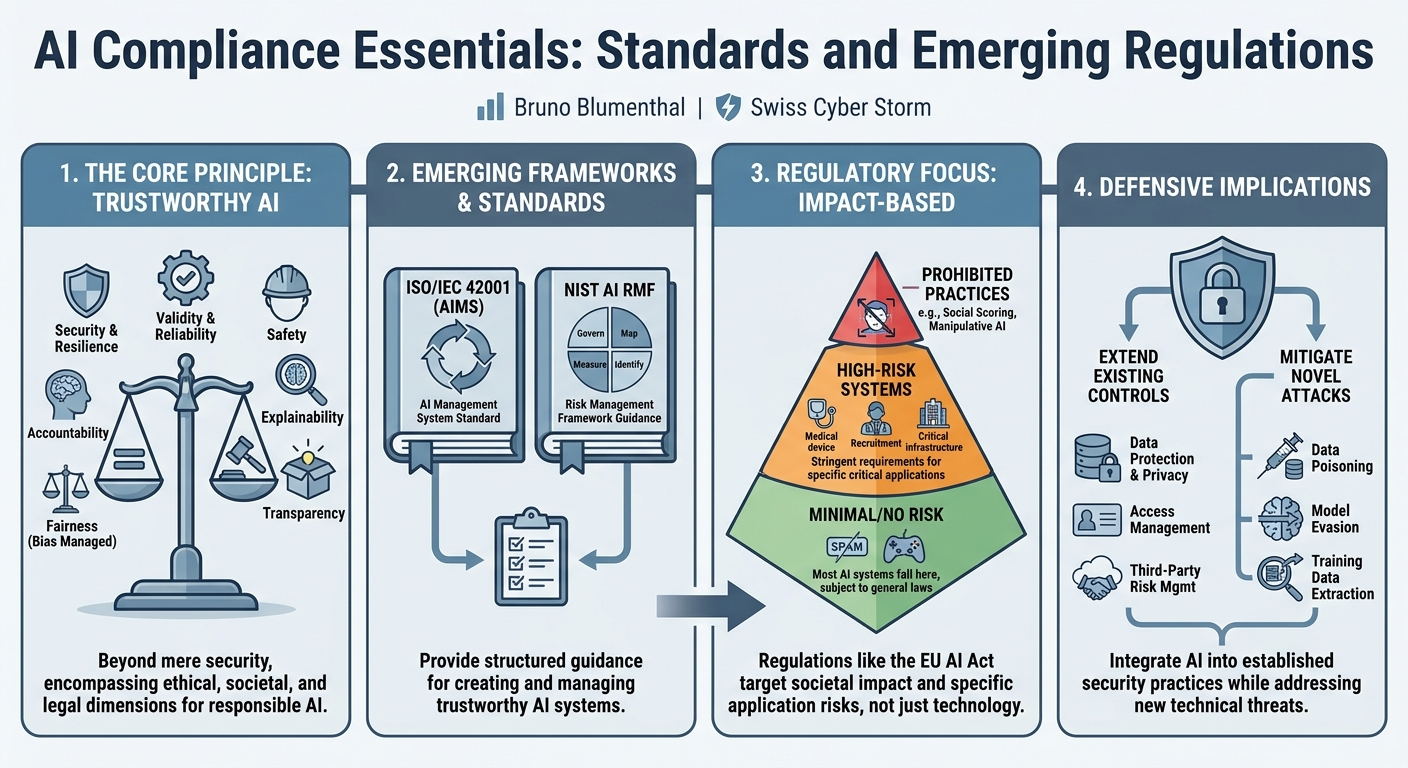
- The "Trustworthy AI" Imperative: A central concept driving global AI regulation and standards is Trustworthy AI. This goes beyond mere security to encompass properties such as validity, reliability, safety, explainability, privacy enhancement, fairness (managing harmful biases), accountability, and transparency. Security and resilience are just two components of this broader concept.
- Regulatory Focus on Impact: Emerging regulations, notably the EU AI Act, primarily focus on the societal and individual impact of AI systems. They target specific applications deemed high-risk, such as automated decision-making (e.g., credit scoring, recruitment), recognition technologies (e.g., facial recognition), and manipulative/deceptive uses (e.g., deepfakes).
- Complexity of AI Regulation: The EU AI Act, a landmark regulation, is extensive (over 400 pages) and complex, introducing prohibited AI practices and stringent requirements for "high-risk" AI systems. However, its direct applicability might initially be limited to a smaller subset of companies developing or deploying such systems.
- Extension of Existing Security Practices: A critical takeaway is that AI risk management is not entirely novel. Many existing information security and data protection frameworks, processes, and controls (e.g., data protection, information classification, access management, third-party risk management) can and should be extended to cover AI technologies. Understanding how AI systems work with data is key.
- Swiss Approach to AI Regulation: Switzerland, while observing international developments, is taking a cautious, potentially sector-specific approach to AI regulation, as exemplified by FINMA's supervisory expectations for the financial industry, which align closely with the principles of Trustworthy AI.
- Fuzziness in Definitions: The talk acknowledged the ongoing challenge of defining concepts like "trustworthy AI," "explainability," and even "what constitutes an AI system" itself, which can be a continuum rather than a clear-cut category, posing difficulties for precise compliance.
Technical Deep Dive
▶ Watch: EU AI Act: Prohibited & High-Risk Systems (16:00)
The technical deep dive into AI compliance revolves around the frameworks and standards being developed by leading international bodies, primarily ISO/IEC and NIST, and how they define and address the multifaceted risks associated with AI.
ISO/IEC Standardization for AI
Blumenthal highlighted the crucial role of ISO/IEC Joint Technical Committee 1 (JTC 1), specifically its Subcommittee 42 (SC 42), which is dedicated to Artificial Intelligence. The speaker humorously noted its number, 42, referencing "the answer to the ultimate question of life, the universe, and everything," underscoring the broad scope of AI. Crucially, SC 42 operates on the same level as SC 27 (Information Security), indicating that AI is viewed as a distinct domain rather than merely a subset of information security. This organizational structure emphasizes the unique governance and risk management considerations AI demands.
SC 42 has approved over 30 standards, technical reports, or specifications. Blumenthal focused on five key standards for risk management and governance:
- ISO/IEC 22989:2022 – Artificial intelligence – Concepts and terminology: This foundational standard provides a common vocabulary for AI, defining terms like "AI system" and "machine learning." It's notable for being freely available, acting as a crucial starting point for anyone delving into AI standardization.
- ISO/IEC 42001:2023 – Information technology – Artificial intelligence – Management system: Analogous to ISO/IEC 27001 for information security management, ISO/IEC 42001 is an AI Management System (AIMS) standard. It provides a structured approach (similar to a PDCA cycle) for organizations to establish, implement, maintain, and continually improve an AI management system. This is particularly relevant for organizations building or extensively using AI systems.
- ISO/IEC TR 42005 (Draft) – AI systems impact assessment: This technical report is designed to support the implementation of ISO/IEC 42001 by providing guidance on conducting impact assessments for AI systems, helping organizations understand and mitigate potential risks.
- ISO/IEC 38507:2022 – Information technology – Governance of IT – Governance implications of the use of artificial intelligence by organizations: Geared towards boards of directors and C-level executives, this standard offers guidance on how to ensure AI is used efficiently, effectively, and acceptably within an organization, emphasizing ethical and responsible deployment.
- ISO/IEC 23894:2023 – Information technology – Artificial intelligence – Guidance on risk management: This standard provides specific guidance on managing risks associated with AI, complementing broader risk management frameworks.
NIST AI Risk Management Framework (AI RMF)
The National Institute of Standards and Technology (NIST) is also highly active, having released its AI Risk Management Framework (AI RMF) in January 2023. Its overarching goal is to advance the safe, secure, and trustworthy development and use of AI. Similar to the well-known NIST Cybersecurity Framework (CSF), the AI RMF is structured around functions, categories, and subcategories, providing an outcome-based approach.
The AI RMF features four core functions:
- Govern: Placed at the center, this function influences all others, establishing policies, procedures, and oversight for AI risk management.
- Map: Focuses on understanding the context of AI systems, their intended use, and potential impacts.
- Identify: Involves recognizing, assessing, and tracking AI-related risks.
- Measure: Pertains to managing and mitigating the identified risks.
NIST also develops profiles to tailor the AI RMF to specific use cases. One profile published by NIST focuses on generative AI systems, offering guidance on applying the framework's 69 subcategories to this rapidly evolving technology. Another profile, developed by the U.S. State Department, addresses human rights considerations in AI use. Furthermore, NIST provides an AI RMF Playbook, offering practical implementation guidance for the framework's subcategories, akin to ISO/IEC 27002's control catalog.
The Concept of Trustworthy AI
A cornerstone of both standardization and regulation is the concept of Trustworthy AI. Blumenthal elaborated on NIST's definition, which outlines several key properties:
- Valid and Reliable: The AI system must function as expected and produce consistent, accurate results. This forms the foundational layer.
- Safe: AI should not cause harm to people, the environment, or animals.
- Secure and Resilient: AI systems must be protected against malicious attacks, vulnerabilities, and failures, maintaining their intended functionality. This is the domain traditionally covered by cybersecurity.
- Explainable and Interpretable: Users should be able to understand why an AI system arrives at a particular conclusion, even if the underlying mechanisms are complex. The speaker acknowledged the "fuzziness" and ongoing debate around what truly constitutes explainability.
- Privacy Enhanced: AI systems must incorporate privacy-enhancing technologies (e.g., aggregation, anonymization) to protect personal data.
- Fair with Harmful Biases Managed: AI systems must be developed and deployed in a way that minimizes and manages biases, ensuring equitable outcomes for all users.
- Accountable and Transparent: These are overarching properties. Accountability means clear responsibility for AI decisions (e.g., a human officer), while transparency means users are aware they are interacting with an AI and how it influences decisions.
Emerging Regulations: The EU AI Act
The EU AI Act, approved in Summer 2023 and enforceable over the next two years, is a landmark piece of legislation. Blumenthal highlighted its two critical chapters:
- Chapter 2: Prohibited AI Practices: This section explicitly bans certain AI applications deemed unacceptable, primarily those that exploit, discriminate, manipulate, or deceive individuals. Examples include AI systems designed to impersonate humans without transparency or non-targeted biometric recognition in public spaces. Exemptions exist for law enforcement under specific conditions.
- Chapter 3: High-Risk AI Systems: This chapter defines categories of AI systems that, while not prohibited, pose significant risks to individuals and society. These include systems used in biometrics, safety components, "gatekeeper" functions (e.g., recruitment, loan applications), law enforcement, justice, and democracy. Organizations deploying high-risk AI systems face stringent requirements, including a third-party conformity assessment and a robust risk management system. Article 15 specifically addresses accuracy, robustness, and cybersecurity, mandating that systems be resilient against malicious attacks such as data poisoning or training data extraction.
Blumenthal also briefly mentioned the Council of Europe's Framework Convention on Artificial Intelligence, Human Rights, Democracy and the Rule of Law, which, while the "first ever internationally legally binding treaty in this field," faces uncertainty regarding ratification and practical impact, especially for the private sector.
Swiss Regulatory Landscape
Switzerland's approach is characterized by observation and cautious planning. The Federal Council has tasked a working group to prepare an overview of possible regulatory approaches by the end of 2024. Blumenthal speculated on five potential outcomes: doing nothing, government-only measures, comprehensive overarching regulation (like the EU AI Act), delegation to sector-specific authorities (e.g., FINMA, OFCOM), or amendments to existing laws. He personally anticipated a delegation to sector-specific authorities.
This was exemplified by FINMA's (Swiss Financial Market Supervisory Authority) 2023 annual report, which outlined supervisory expectations for AI in the financial sector. These expectations align directly with the principles of Trustworthy AI, covering robustness, reliability, non-discrimination (bias management), governance, responsibility (accountability for decisions), transparency, and explainability. FINMA plans to engage with financial institutions on their AI usage, potentially leading to enforceable guidelines.
Demo / Proof of Concept
▶ Watch: Swiss FINMA's Supervisory Expectations for AI (26:00)
This technical article is based on a conference talk that focused on theoretical frameworks, regulatory landscapes, and strategic implications of AI compliance. As such, the presentation did not include a live demonstration or a proof of concept of any specific AI system or security tool. The content was primarily analytical and informative, providing an overview of standards and regulations rather than showcasing practical implementations.
Defensive Implications
▶ Watch: Q&A: Challenges in Measuring Trustworthy AI (31:00)
For cybersecurity and information security professionals, the emerging landscape of AI standards and regulations, though complex, offers clear defensive implications that largely build upon existing best practices. Bruno Blumenthal emphasized that AI, at its core, is another technology that requires integration into established risk management processes, rather than a completely new domain demanding an entirely separate security paradigm.
- Prioritize Understanding AI Mechanics: The most fundamental defensive step is to understand how AI systems work. This includes knowing how data is used for training, how models make decisions, and how they interact with sensitive information. For instance, understanding whether a system like Co-pilot ingests proprietary data into a public model is critical for data protection. This knowledge is essential for identifying potential vulnerabilities and misconfigurations.
- Extend Existing Risk Management Frameworks: Organizations should not wait for specific AI regulations to apply. Instead, they should extend their current risk management frameworks (e.g., ISO 27001, NIST CSF) to encompass AI. This means identifying AI systems as assets, assessing their unique risks (including those related to bias, explainability, and data privacy), and implementing appropriate controls.
- Reinforce Foundational Security Controls: Many AI-related risks can be mitigated by strengthening existing security controls:
- Data Protection and Privacy: AI systems often process vast amounts of data, making robust data protection and privacy-enhancing technologies (e.g., anonymization, aggregation) crucial. Compliance with regulations like GDPR remains paramount.
- Information Classification: Knowing the sensitivity of data used by and generated by AI systems is critical for applying appropriate security measures and preventing unauthorized access or disclosure.
- Access Management: Strict access controls are necessary to prevent unauthorized access to AI models, training data, and inference outputs, especially in multi-user or cloud-based AI environments.
- Third-Party Risk Management: When integrating third-party AI services (e.g., cloud-based LLMs), organizations must scrutinize vendor security practices, data handling policies, and compliance with AI-specific requirements. The speaker explicitly noted that using tools like Co-pilot often boils down to third-party risk management.
- Address AI-Specific Technical Attacks: While general cybersecurity principles apply, AI introduces novel attack vectors that defenders must be aware of. As highlighted in Article 15 of the EU AI Act, AI systems need to be robust against malicious attacks such as:
- Data Poisoning: Maliciously altering training data to influence the AI's behavior or introduce backdoors.
- Model Evasion: Crafting inputs that cause the AI to misclassify or make incorrect decisions.
- Training Data Extraction: Inferring sensitive information from the model itself, potentially exposing proprietary or personal data used during training.
- Model Inversion Attacks: Reconstructing training data from the model's outputs.
- Adversarial Attacks: Intentionally crafted inputs designed to fool AI models.
- Implement AI Governance and Accountability: Defenders must advocate for clear governance structures. This includes defining roles and responsibilities for AI system oversight, ensuring accountability for AI-driven decisions, and establishing processes for internal and external transparency about AI use.
- Manage Bias and Promote Fairness: While often seen as an ethical concern, managing harmful biases is a defensive measure against reputational damage, legal challenges, and societal harm. Security professionals can contribute by ensuring data quality, auditing models for bias, and implementing technical controls to mitigate discriminatory outcomes.
- Leverage AI-Specific Standards: Actively adopt and implement emerging standards like ISO/IEC 42001 for an AI management system or the NIST AI RMF to systematically manage AI risks. These frameworks provide structured guidance for building trustworthy AI.
- Prepare for Regulatory Scrutiny: Even if an organization's AI systems don't immediately fall into "high-risk" categories under regulations like the EU AI Act, understanding these regulations' principles is crucial. Proactive adherence to Trustworthy AI principles can preempt future compliance challenges and demonstrate responsible AI deployment.
In essence, the defensive posture for AI involves a continuous process of learning, adapting, and integrating new knowledge into existing robust security and risk management frameworks. It's about recognizing that the "new" in AI often requires applying the "old" (proven security principles) in a more informed and nuanced way.
Key Takeaways
- AI Compliance Extends Beyond Cybersecurity: The concept of Trustworthy AI is central to emerging standards and regulations, encompassing not just security and resilience, but also validity, reliability, safety, explainability, privacy, fairness, accountability, and transparency.
- New Standards Provide Critical Guidance: Organizations can leverage specific AI management system standards like ISO/IEC 42001:2023 and risk management frameworks such as the NIST AI RMF to systematically address AI-related risks and build trustworthy systems.
- Regulatory Focus on Impact, Not Just Technology: Emerging laws like the EU AI Act primarily regulate AI based on its potential for harm to individuals and society, classifying systems as "prohibited" or "high-risk" based on their application and impact, rather than solely their technical complexity.
- AI is Another Technology, Not a Paradigm Shift for Security: For most companies, AI risk management is an extension of existing cybersecurity, information security, and data protection practices. Core principles like data classification, access management, and third-party risk management remain foundational.
- Understanding AI Mechanics is Crucial: Security professionals must invest in understanding how AI systems work, how they process data, and their specific vulnerabilities (e.g., data poisoning, training data extraction) to implement effective controls.
- Governance, Accountability, and Transparency Are Paramount: Regardless of specific technical controls, clear governance, defined accountability for AI-driven decisions, and transparent communication about AI use are essential for responsible and compliant AI deployment.
About the Speaker(s)
Bruno Blumenthal is a highly experienced cybersecurity professional with over 20 years in the field, primarily working as a consultant. He serves as a Member of the Board at tamit. His expertise lies in approaching complex technological landscapes, such as AI standards and regulations, from an information security and cybersecurity perspective. Throughout his talk, Blumenthal emphasized this viewpoint, aiming to provide practical and relevant insights for fellow security, data protection, and information security professionals navigating the challenges and opportunities presented by Artificial Intelligence.
Reviews
Dr. Zero (Offensive Security Researcher) — WEAK
A high-level recitation of ISO and NIST AI frameworks that you could get from reading their respective public FAQs. It completely ignores the actual operational friction of trying to make a probabilistic model fit into a deterministic compliance checklist.
Heather Calloway (CISO) — SOLID
A grounded, unromantic mapping of AI compliance frameworks like ISO 42001, the NIST AI RMF, and the EU AI Act. It correctly frames AI adoption not as a metaphysical crisis, but as a standard third-party risk and data classification problem that leadership teams already know how to solve.