Artificial Intelligence and Cybersecurity: A New Era of Defense
Sandro Bachmann (Senior Incident Responder · infog guard)
Swiss Cyber Storm 2024 · Day 1 · Panorama
Overview
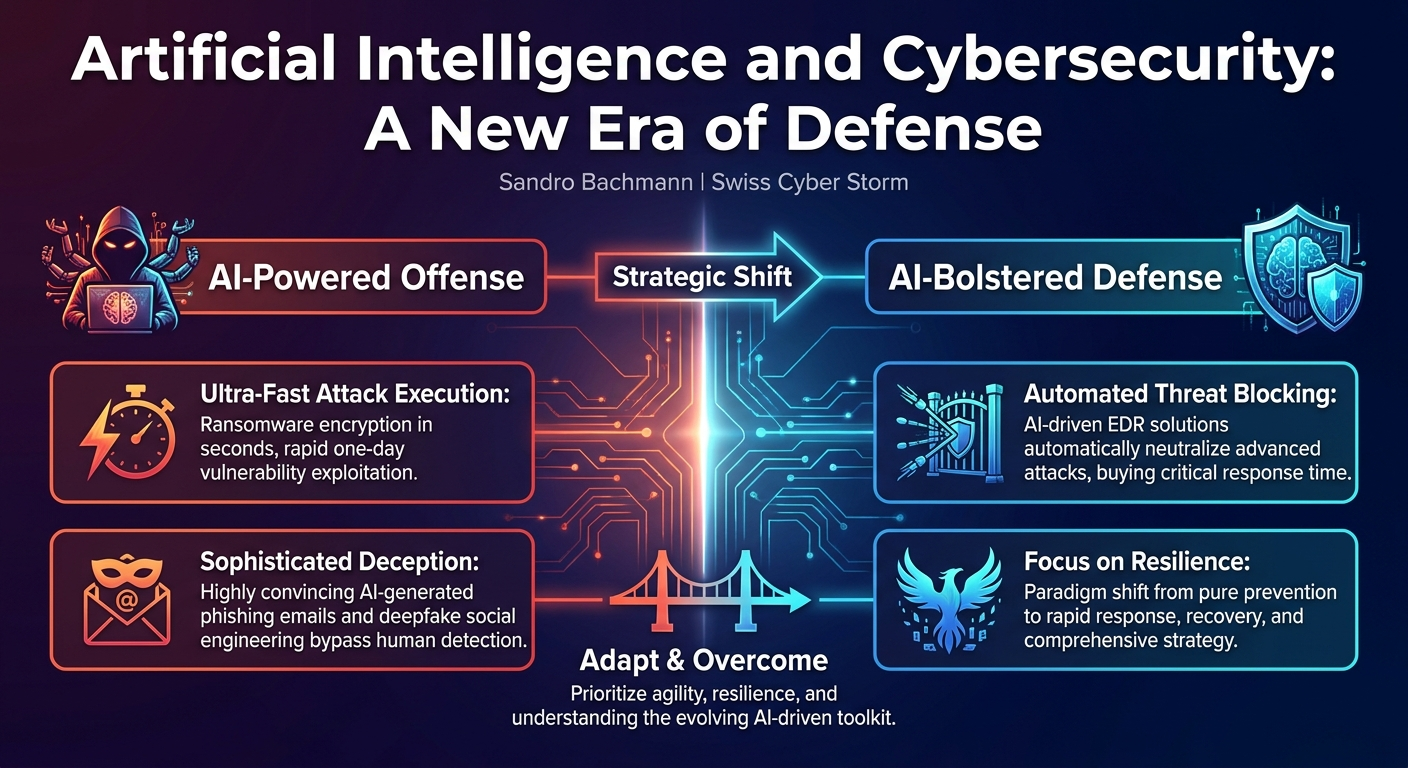
Sandro Bachmann, a Senior Incident Responder at infoguard, delivered a compelling presentation at Swiss Cyber Storm on the dual impact of artificial intelligence in cybersecurity. Titled "Artificial Intelligence and Cybersecurity: A New Era of Defense," his talk meticulously explored how AI tools are simultaneously empowering threat actors and bolstering defensive capabilities. Bachmann leveraged his extensive experience, transitioning from a Security Operations Center (SOC) role to red teaming and ultimately to incident response, to provide a holistic view of the evolving threat landscape. The core message of the presentation underscored the critical shift in cybersecurity paradigms: while AI-driven tools like Endpoint Detection and Response (EDR) can significantly slow down attackers, the sheer speed and sophistication of AI-powered offensives necessitate a renewed focus on rapid response, recovery, and proactive prevention.
Key moments
- 2:00 Explaining the MDR service and alert triage process
- 5:00 Attacker's lateral movement attempts blocked by EDR
- 13:00 Generative AI improves phishing email quality and success
- 14:00 Emergence of deepfake calls for financial fraud
- 18:50 Server encrypted in 8 seconds by AI-accelerated ransomware
- 23:50 Shifting cybersecurity focus to rapid response and recovery
- 25:30 Cloud exit strategy and mixed environments cybersecurity challenges
Artificial Intelligence and Cybersecurity: A New Era of Defense
Speakers: Sandro Bachmann, Senior Incident Responder, infoguard
Conference: Swiss Cyber Storm
YouTube: https://www.youtube.com/watch?v=xi6LI2rzvXw
Overview
Sandro Bachmann, a Senior Incident Responder at infoguard, delivered a compelling presentation at Swiss Cyber Storm on the dual impact of artificial intelligence in cybersecurity. Titled "Artificial Intelligence and Cybersecurity: A New Era of Defense," his talk meticulously explored how AI tools are simultaneously empowering threat actors and bolstering defensive capabilities. Bachmann leveraged his extensive experience, transitioning from a Security Operations Center (SOC) role to red teaming and ultimately to incident response, to provide a holistic view of the evolving threat landscape. The core message of the presentation underscored the critical shift in cybersecurity paradigms: while AI-driven tools like Endpoint Detection and Response (EDR) can significantly slow down attackers, the sheer speed and sophistication of AI-powered offensives necessitate a renewed focus on rapid response, recovery, and proactive prevention.
The talk is particularly relevant in today's cybersecurity climate, where the proliferation of generative AI models has democratized advanced attack techniques. Bachmann illustrated this with real-world case studies from infoguard's Managed Detection and Response (MDR) service and Computer Emergency Response Team (CERT), demonstrating how AI facilitates more effective phishing campaigns, accelerates ransomware deployment, and enables autonomous exploitation of vulnerabilities. However, he also highlighted the indispensable role of AI in defense, showcasing how modern security products can block previously successful attack vectors. This new era demands that organizations not only adopt AI-driven defenses but also fundamentally rethink their security strategies to prioritize agility, resilience, and a comprehensive understanding of the attacker's evolving toolkit.
Background
▶ Watch: Explaining the MDR service and alert triage process (2:00)
Sandro Bachmann, with a background in computer science and extensive experience at infoguard since 2017, provided a foundational understanding of the challenges and solutions discussed. His career trajectory from a SOC analyst onboarding customers and triaging alerts, to a brief stint in red teaming, and finally to a Senior Incident Responder, offers a unique perspective on both offensive and defensive strategies. This experience forms the bedrock of infoguard's MDR service, which acts as a crucial first line of defense for its customers.
The infoguard MDR service operates through a tiered approach, starting with Tier 1 SOC analysts who initially triage alerts generated by customer sensors. If an alert's nature isn't immediately clear, it escalates to Tier 2 analysts for deeper investigation. Should the SOC analysts lack the authority or capability to implement necessary remediation measures, the case is then handed over to the CERT/Incident Response team. Bachmann shared compelling statistics from infoguard's operations, noting approximately 22,000 detections from customer sensors in the past year. Of these, 875 required further attention, indicating potential true positives or instances where AI-driven security tools had blocked an attack but required human verification. Ultimately, 53 critical cases landed with the CERT team, underscoring the effectiveness of the layered defense but also the persistent challenge of sophisticated threats.
A striking case study presented by Bachmann illustrated the efficacy of this layered defense. In this scenario, an attacker initially breached a customer's customer environment, which lacked an EDR solution, exploiting the absence of Multi-Factor Authentication (MFA). The attacker performed local reconnaissance using tools like net scan and PC Haunter and established a command and control (C2) beacon. Crucially, at this stage, infoguard had no visibility into the unprotected environment. Nine days later, the attacker attempted to laterally move into the service provider's environment (infoguard's customer), which was protected by an EDR. The attacker's attempts, including a DC sync (which failed), dropping a vulnerable driver, and trying to run remote services like Cobalt Strike, were all automatically blocked by the EDR platform. This immediate and automated blocking prevented a significant breach and highlighted the indispensable role of AI-driven EDRs in mitigating advanced persistent threats. Without such tools, the attacker would have likely succeeded, leading to a much more severe incident.
Bachmann also detailed the evolving entry points for attackers. Historically, vulnerability exploitation (e.g., the infamous HAFNIUM cases in 2021-2022) was a dominant vector. However, the landscape has shifted, with phishing and Business Email Compromise (BEC) now accounting for a staggering 64% of observed entry points, up from 22% in 2021. Other common vectors include insecure services exposed to the internet (especially those without MFA) and supply chain compromises. This surge in phishing success is directly attributed to the capabilities of generative AI, which allows attackers to craft highly convincing, contextually relevant, and grammatically flawless phishing emails, making them significantly harder for human targets to detect.
Furthermore, Bachmann touched upon the changing dynamics of ransomware. While previously, organizations would often face total network encryption, modern EDRs are increasingly capable of blocking these threats. This has shifted the focus of incident response from managing widespread encryption to dealing with compromised servers, workstations, or user accounts. Interestingly, infoguard's data revealed that only 15% of ransomware victims paid the ransom, while 58% opted not to, suggesting a growing resilience or improved recovery strategies among affected organizations. Despite these advancements in defense, Bachmann emphasized that AI-driven tools, while powerful, do not eliminate the need for manual intervention and expert incident response. Automation alone cannot fully control a complex breach; human analysts are still vital for ultimate resolution and control.
Key Findings
▶ Watch: Generative AI improves phishing email quality and success (13:00)
The talk underscored several pivotal findings regarding the intersection of AI and cybersecurity, illustrating a paradigm shift in both offensive and defensive strategies.
Firstly, AI-driven security products, particularly EDR solutions, have dramatically improved defensive capabilities. As demonstrated by the case study where an attacker's lateral movement attempts were repeatedly blocked, these tools can automatically detect and neutralize sophisticated threats that would have previously led to successful breaches. This proactive blocking capability buys critical time for human responders.
Secondly, and more alarmingly, AI is significantly empowering threat actors, making attacks faster, more scalable, and more sophisticated. Generative AI models enable attackers to craft highly convincing phishing emails, bypass traditional detection methods, and even generate deepfake audio for social engineering attacks. Bachmann cited a real-world case where a deepfake call nearly tricked a finance employee into transferring funds, highlighting the emerging and potent threat of AI-generated social engineering.
Thirdly, ransomware attacks are reaching unprecedented speeds due to AI integration. A shocking example revealed a server being infiltrated and encrypted within a mere 8 seconds. This rapid execution, often facilitated by automated tools or LLM agents, leaves virtually no window for traditional human-led intervention. Research cited in the talk indicated that Large Language Models (LLMs) like GPT-4 can autonomously exploit one-day vulnerabilities with an 87% success rate when given only a CVE description, signaling a future where mass exploitation of newly discovered flaws becomes highly automated.
Fourthly, the evolving threat landscape necessitates a fundamental shift in cybersecurity frameworks. Bachmann emphasized that the focus is moving beyond mere protection and identification towards rapid response and recovery. Organizations must be prepared to react swiftly to breaches and possess robust strategies to recover data and operations, aligning with the "Respond" and "Recover" functions of frameworks like NIST.
Finally, the talk highlighted that threat actors are increasingly operating like professional businesses, employing sophisticated strategies such as triple extortion and even filing complaints against their victims. This professionalization, coupled with AI-driven efficiencies, allows them to maximize revenue and adapt quickly to defensive measures. The use of AI for communication and exploitation further streamlines their operations, making them formidable adversaries. However, Bachmann also speculated that reliance on LLMs might inadvertently create new avenues for law enforcement to trace and apprehend these actors through digital footprints.
Technical Deep Dive
▶ Watch: Emergence of deepfake calls for financial fraud (14:00)
Sandro Bachmann's talk provided a comprehensive technical overview of how AI is reshaping the cybersecurity landscape, illustrated through practical examples and statistics from infoguard's operations. The core of infoguard's defensive strategy lies in its Managed Detection and Response (MDR) service, which integrates various security sensors, machine learning, and human expertise. Alerts from customer endpoints and networks are first triaged by Tier 1 SOC analysts. If an alert is ambiguous or requires deeper investigation, it is escalated to Tier 2 analysts. Critical incidents that demand direct intervention or cannot be resolved by SOC teams are forwarded to the CERT (Computer Emergency Response Team), which forms part of the MDR offering. This structured approach, augmented by AI, allows for efficient processing of a high volume of alerts, filtering down from 22,000 initial detections to 53 critical CERT cases in the past year.
A detailed case study exemplified the power of modern EDR solutions. An attacker gained initial access to a customer's customer environment, which critically lacked an Endpoint Detection and Response (EDR) solution. The attacker logged in without encountering Multi-Factor Authentication (MFA), performed local reconnaissance using utilities like net scan to map the local network and PC Haunter for local privilege escalation checks, and established a Command and Control (C2) beacon. This initial phase, lasting several hours, remained undetected due to the absence of EDR. Nine days later, the attacker attempted to pivot into the service provider's environment (infoguard's actual customer), which was protected by a robust EDR. The attacker's attempts included:
- Running
net scanactivities on the service provider's network. - Attempting a DC sync attack against domain controllers, which was blocked by the EDR platform.
- Trying to drop a vulnerable driver onto the domain controllers, also automatically blocked.
- Attempting to start remote services, specifically Cobalt Strike, as a service on remote systems, which was again blocked.
These repeated blocks, facilitated by the EDR's AI-driven detection capabilities, prevented lateral movement and a potential compromise of the domain controllers. The case was then escalated to CERT, who engaged with the customer to manage the incident, highlighting the EDR's role in buying crucial response time.
The talk also delved into the evolution of attack entry points. While vulnerability exploitation (classified as A1) was a significant vector in 2021, particularly with the HAFNIUM attacks targeting Exchange servers, its prevalence has somewhat decreased. Instead, phishing and Business Email Compromise (BEC) have surged dramatically, accounting for 64% of entry points, up from 22% in 2021. Other persistent vectors include insecure services exposed without MFA and supply chain attacks. The primary driver behind the heightened success of phishing is generative AI. Attackers now use tools like ChatGPT to craft highly convincing, contextually relevant, and grammatically perfect phishing emails. This eliminates common red flags like typos and awkward phrasing, making detection significantly harder for human recipients.
Beyond emails, AI is enabling even more sophisticated social engineering. Bachmann described a recent incident involving a deepfake call, where a finance employee was almost tricked into transferring funds by a caller impersonating their boss. He noted that creating such deepfakes is becoming increasingly accessible, requiring only a notebook and an investment of 2,000-3,000 Swiss Francs for appropriate software and processing power. This scalability allows threat actors to launch mass phishing campaigns, targeting thousands of users with the expectation that even a 0.1% success rate (e.g., one successful compromise out of 1,000 emails) yields valuable access.
Once an attacker compromises an email account, AI further aids their objectives. They often upload malware to SharePoint and use its legitimate sharing features to spread it to other users, making the delivery appear legitimate. Alternatively, they focus on financial fraud by implementing inbox rules to filter emails containing keywords like "bill" or "invoice." These emails are then redirected to attacker-controlled mailboxes, allowing the threat actor to intercept and manipulate payment details, such as changing IBAN numbers, before the legitimate recipient sees them. Attackers also harvest address book entries to launch further, highly targeted phishing campaigns, creating a cascading effect. Infoguard often finds multiple compromised mailboxes (5-10 or more) within an organization, with some serving as "backup" access points for future attacks.
In the realm of ransomware, AI is accelerating attack timelines. Bachmann mentioned seeing red teamers use OpenAI to research and refine exploitation techniques. He presented a chilling case where an attacker infiltrated a server and initiated encryption within a mere 8 seconds. This extreme speed, facilitated by automated tools, left no time for traditional manual intervention, especially since the compromised endpoint lacked an EDR. This incident involved a low ransom demand of $2,000 in Bitcoin, suggesting a "mass business" model where automated tools, potentially driven by LLMs, identify and exploit vulnerabilities on a large scale for smaller, but cumulative, payouts. This aligns with research by Fang, Bindu, Gup, and Kung, which demonstrated that an LLM agent using GPT-4 could autonomously exploit one-day vulnerabilities with an 87% success rate when provided with only a CVE description. In one specific case, a CVE published on October 31st was exploited five days later, with a webshell dropped in 64 seconds and ransomware initiated in just 45 seconds.
The talk concluded with an emphasis on defensive shifts. Bachmann highlighted the evolution of the NIST framework, moving beyond traditional "Identify" and "Protect" functions to a stronger focus on "Respond" and "Recover." This means organizations must be prepared for breaches and have robust plans for rapid containment and data restoration. Challenges in this new era include the increased emphasis on data exfiltration over encryption (as many organizations now have working backups), stricter insurance policies requiring specific security postures, and the complexities of mixed environments (hybrid, cloud-only, BYOD). The risks associated with users mixing personal and business devices, leading to company credential theft from unprotected personal computers, further complicate incident response due to restrictions on investigating private devices. A crucial point was the need for a cloud exit strategy, as demonstrated by a customer who lost their entire ERP system for ten days due to their cloud provider being ransomed.
Demo / Proof of Concept
▶ Watch: Shifting cybersecurity focus to rapid response and recovery (23:50)
While Sandro Bachmann's talk did not include a live technical demonstration or a proof of concept performed by the speaker, it extensively utilized real-world case studies and observations from infoguard's incident response activities to illustrate the concepts discussed. The most compelling "proof of concept" presented was the real-world deepfake call incident, where threat actors successfully generated a convincing audio deepfake of a CEO to trick a finance employee. This example served as a powerful illustration of how easily accessible technology, costing as little as 2,000 to 3,000 Swiss Francs for the necessary setup, can be leveraged to create highly effective social engineering attacks in practice. Additionally, the detailed breakdown of the 8-second ransomware attack, from initial infiltration to full encryption, provided a stark, data-driven "proof" of the accelerating speed of AI-driven attacks in the wild.
Defensive Implications
▶ Watch: Cloud exit strategy and mixed environments cybersecurity challenges (25:30)
The insights shared by Sandro Bachmann carry significant defensive implications, urging organizations to adapt their cybersecurity strategies to counter the evolving, AI-driven threat landscape.
Firstly, the accelerated pace of attacker operations demands faster patching processes. With LLM agents capable of exploiting one-day vulnerabilities within days of their public disclosure, the window for patching is shrinking dramatically. Organizations must ensure their vulnerability management and patching cycles are highly efficient and agile to minimize exposure.
Secondly, to effectively counter AI-driven attacks, defenders must also embrace AI in their security tools. As highlighted, AI-powered EDR (Endpoint Detection and Response) and EPP (Endpoint Protection Platform) solutions are crucial for automatically blocking sophisticated attacks, buying precious time for human incident responders. This necessitates investing in advanced security tools that leverage machine learning and AI for anomaly detection, threat intelligence, and automated response.
Thirdly, there must be a renewed and substantial investment in prevention. While AI-driven EDRs are excellent for slowing down attackers, the ultimate goal is to prevent initial compromise. This includes rigorous system hardening, implementing robust Multi-Factor Authentication (MFA) across all services (especially internet-exposed ones), enforcing strong password policies, and regularly auditing for insecure configurations. By increasing the effort required for attackers to breach defenses, organizations can significantly reduce their attack surface and the likelihood of successful initial access.
Fourthly, the shift in the NIST framework towards "Respond" and "Recover" functions underscores the critical need for robust incident response and recovery capabilities. Organizations must develop and regularly test comprehensive incident response plans. This includes having a dedicated or outsourced CERT/MDR service for rapid detection, containment, and eradication of threats. Furthermore, establishing a resilient backup and recovery strategy is paramount, ensuring that critical data and systems can be restored quickly and reliably, even in the face of ransomware or data corruption. This also extends to having a cloud exit strategy to mitigate risks associated with a compromised cloud service provider.
Finally, addressing the "mixed environment" challenge is crucial. Organizations need clear policies and technical controls for Bring Your Own Device (BYOD) scenarios and the use of personal devices for company business. This includes educating users about the risks of synchronizing company passwords with unprotected personal devices and exploring solutions that provide adequate security for company data accessed on non-corporate assets, while respecting user privacy. Awareness training for employees, especially regarding advanced phishing techniques and deepfake social engineering, is also more vital than ever.
Key Takeaways
- Accelerated Attacker Response: Threat actors are leveraging AI to respond faster to new vulnerabilities, drastically reducing the window for organizations to patch and secure their systems.
- Faster Attack Execution: AI tools enable attackers to execute attacks, from initial access to achieving objectives, with unprecedented speed, necessitating AI-driven defensive counterparts.
- Expanded Attack Surface: AI allows threat actors to explore and target new objectives and attack vectors that they might not have previously understood, broadening the scope of potential threats.
- Critical Role of AI in Defense: AI-driven EPP and EDR solutions are essential for slowing down attackers, providing valuable time for human defenders to respond and mitigate threats.
- Dual Focus on Prevention and Response: Organizations must increase investment in proactive prevention (system hardening, patching) to deter initial attacks, while simultaneously enhancing their capabilities for rapid and effective incident response and recovery.
About the Speaker(s)
Sandro Bachmann is a Senior Incident Responder at infoguard, a position he has held since 2020. His career in cybersecurity began in 2017 when he joined infoguard after completing a bachelor's degree in computer science. He initially served in a Security Operations Center (SOC) role, where he was responsible for onboarding new customers and triaging security alerts. In 2020, Bachmann briefly transitioned to infoguard's red team, gaining valuable insights into offensive security techniques. This diverse experience across blue team, red team, and incident response roles provides him with a comprehensive understanding of the modern threat landscape and the evolving strategies required for effective cybersecurity. He holds various security certificates, complementing his academic background.
Reviews
Dr. Zero (Offensive Security Researcher) — WEAK
This is an Infoguard MDR sales pitch dressed up in an 'AI is scary' costume. The threat intel consists of citing other people's academic papers on GPT-4 and claiming standard ransomware is 'potentially' driven by LLMs because it executed in eight seconds. We don't need a keynote to tell us that a modern EDR blocks unmodded Cobalt Strike.
Heather Calloway (CISO) — STRONG ACCEPT
This is the incident response briefing you want your security leadership to review before you ask the CFO for an expanded EDR budget. Bachmann uses real MDR data to quantify exactly how fast AI is accelerating exploitation, providing the empirical backing you need to force organizational change around patching and automation.