An Insider Perspective on Cyber Insurance – Yes or No?
Maya Bundt (President of the Steering Committee for the National Cyber Strategy), Fabian Willi (Swiss Re)
Swiss Cyber Storm 2024 · Day 1 · Arena
Overview
In a captivating debate-style presentation at Swiss Cyber Storm, Maya Bundt and Fabian Willi tackled the contentious question of cyber insurance: is it a necessary safeguard or an unreliable last resort? The talk, titled "An Insider Perspective on Cyber Insurance – Yes or No?", offered a nuanced exploration of the cyber insurance landscape, challenging common misconceptions and highlighting its evolving role in modern risk management. Bundt, formerly instrumental in establishing Swiss Re's cyber insurance program and now President of the Steering Committee for the National Cyber Strategy, brought a strategic, distanced perspective, while Willi, her successor at Swiss Re, provided current, in-depth industry insights.
Key moments
- 1:40 Cyber insurance doesn't pay: War exclusion debate
- 4:30 Economic vs. insured loss: Why the gap?
- 8:00 Does insurance fuel cybercrime by paying ransom?
- 13:00 Can insurers cover systemic cyber catastrophes?
- 19:00 Should every company buy cyber insurance?
- 23:00 Insurance: A catalyst for better cyber security?
- 32:00 How to assess cyber risks, especially for SMEs?
An Insider Perspective on Cyber Insurance – Yes or No?
Speakers: Maya Bundt, President of the Steering Committee for the National Cyber Strategy; Fabian Willi, Swiss Re
Conference: Swiss Cyber Storm
YouTube: https://www.youtube.com/watch?v=ICcBQJuBs1A
Overview
In a captivating debate-style presentation at Swiss Cyber Storm, Maya Bundt and Fabian Willi tackled the contentious question of cyber insurance: is it a necessary safeguard or an unreliable last resort? The talk, titled "An Insider Perspective on Cyber Insurance – Yes or No?", offered a nuanced exploration of the cyber insurance landscape, challenging common misconceptions and highlighting its evolving role in modern risk management. Bundt, formerly instrumental in establishing Swiss Re's cyber insurance program and now President of the Steering Committee for the National Cyber Strategy, brought a strategic, distanced perspective, while Willi, her successor at Swiss Re, provided current, in-depth industry insights.
The speakers meticulously dissected key arguments against cyber insurance, such as its perceived failure to pay out during major events and its potential to fuel cybercrime through ransom payments. They also addressed the industry's capacity to handle systemic events and whether cyber insurance should be a mandatory product. Their discussion underscored the complexity of cyber risk, the critical need for robust risk management processes, and the often-overlooked benefits of cyber insurance in enhancing an organization's overall cyber security maturity. This talk is vital for any organization grappling with the escalating threat of cyberattacks, offering clarity on what cyber insurance truly covers, its limitations, and its strategic utility.
Background
▶ Watch: Cyber insurance doesn't pay: War exclusion debate (1:40)
The premise for this critical discussion stems from the ever-growing threat of cybercrime, which, according to the talk, is projected to cost the global economy approximately $10.5 trillion by 2025. This staggering figure underscores why cyber risk consistently ranks as the number one concern for businesses of all sizes in Allianz's annual risk parameter survey for 2024. Despite this pervasive threat, many companies remain confused or skeptical about the role and efficacy of cyber insurance.
A significant part of this skepticism arises from high-profile incidents where insurance payouts were disputed or fell short of total economic losses. The 2017 NotPetya attack, for instance, caused an estimated $10 billion in worldwide losses, with several large companies facing hundreds of millions in damages. Yet, many found their claims denied due to war exclusion clauses. As Fabian Willi clarified, this confusion often arises because companies mistakenly believe their traditional property insurance or liability insurance policies should cover cyber risks, when in fact, dedicated cyber insurance is essential. The concept of war exclusion itself is fundamental; as Willi explained, war is inherently uninsurable due as it has the potential to wipe out the entire capital base of the insurance industry.
Furthermore, the gap between economic loss and insured loss, exemplified by the recent CrowdStrike event (estimated $5.4 billion economic loss vs. only $300 million insured payout), fuels the perception that insurance fails when truly needed. This disparity is attributed to several factors: low insurance penetration (around 10% for SMEs), policy limits, deductibles (retentions), and specific exclusions like system failure, which is not always a default inclusion in cyber policies. The evolution of cyber insurance products, with extensions now available for system failure, demonstrates the industry's response to new threats and needs, but it also highlights the necessity for buyers to understand the specific scope of their coverage.
Key Findings
▶ Watch: Does insurance fuel cybercrime by paying ransom? (8:00)
The talk delivered several critical insights that challenge common assumptions about cyber insurance and illuminate its true value proposition:
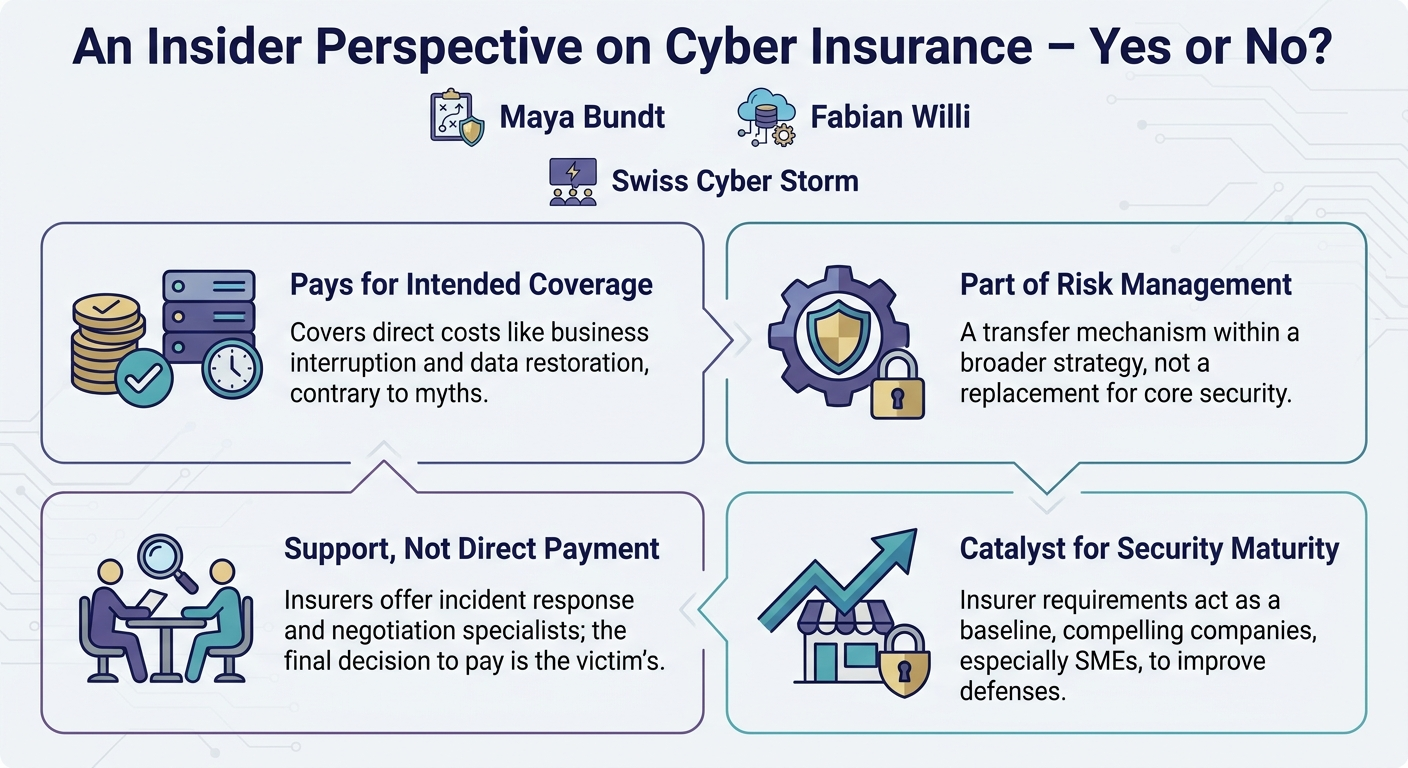
- Cyber Insurance Pays for Intended Coverage: Contrary to the popular belief that "if you really need it, it won't pay," the speakers asserted that cyber insurance does pay out for its intended scope. They cited the ransomware trend of 2019-2020, during which insurers paid out "tons and tons of losses," demonstrating its efficacy in covering direct costs like business interruption and data restoration.
- War Exclusions are Fundamental and Necessary: The war exclusion clause, often a point of contention in major cyber events like NotPetya, is a non-negotiable aspect of modern cyber policies. It prevents the insurance industry from being wiped out by catastrophic, state-sponsored attacks, underscoring the distinction between insurable risks and acts of war.
- Economic vs. Insured Loss Disparity is Normal but Addressable: The significant difference between overall economic losses and insured payouts (e.g., CrowdStrike) is not unique to cyber insurance. It stems from low insurance penetration, insufficient policy limits, and specific exclusions. However, this gap highlights the need for companies to purchase adequate coverage and understand policy specifics.
- Insurers Facilitate, Not Directly Fuel, Ransom Payments: Insurers do not directly pay ransoms or interact with cybercriminals. Instead, they offer crucial support to victims, including incident response services, IT forensics, backup recovery attempts, and negotiation specialists to reduce demands. The final decision to pay rests with the victim company, often driven by a fight for survival.
- Ransomware Gangs Target Financial Strength, Not Insurance Limits: The idea that cybercriminals hack insurers to identify policy limits is largely dismissed. Instead, gangs are "super clever" and tailor ransom demands to the victim company's financial strength to optimize the chances of payment, indicating a sophisticated understanding of their targets' ability to pay.
- Systemic Cyber Events are Manageable to an Extent: While large-scale events like WannaCry pose a significant threat, factors such as time zone differences (day/night cycles), diverse technologies across industries, and continuous learning effects help prevent a complete global accumulation of losses. For truly extreme "Cybergeddon" scenarios, public-private partnerships may be necessary, similar to those for nuclear or terrorism risks.
- Cyber Insurance is a Catalyst for Security Maturity: A key positive finding is that the hardening cyber insurance market, particularly over the last three years, has compelled many companies, especially small and medium-sized enterprises (SMEs), to improve their cybersecurity posture. The baseline requirements set by insurers for coverage act as a "quasi-standard," driving investment in security measures and staff.
- Insurance is Part of Risk Management, Not a Replacement: Ultimately, cyber insurance is presented as a tool within a broader risk management process. Companies must first understand, avoid, mitigate, and accept their risks before deciding what portion to transfer to an insurer. It is not a substitute for fundamental cybersecurity hygiene.
Technical Deep Dive
▶ Watch: Can insurers cover systemic cyber catastrophes? (13:00)
The technical aspects of cyber insurance coverage and risk management were thoroughly explored, detailing what policies entail, how they function, and the mechanisms insurers employ to manage their exposure.
At its core, dedicated cyber insurance is designed to address three primary needs following a cyberattack:
- First-party losses: This covers direct losses to the company itself, including business interruption costs (loss of revenue due to system downtime) and data restoration costs (expenses to recover or rebuild compromised data and systems).
- Third-party liabilities: This covers the company's legal and financial obligations to third parties, such as customers or partners, in the event of a data breach where their sensitive information is compromised.
- Incident Response Services: A crucial feature, this provides access to specialized support services, including IT forensics to investigate the breach, legal counsel, and reputational support to manage public perception and restore trust.
A critical point of clarification involved exclusions. The war exclusion is a standard, non-negotiable clause in almost all modern cyber policies. It is not designed to deny legitimate claims but to protect the entire insurance industry from catastrophic losses that could arise from state-sponsored cyber warfare, which is fundamentally uninsurable due to its potential scale. Another common exclusion is system failure, which covers outages due to technical malfunction rather than malicious attack. While not typically included by default, many broader cyber products now offer system failure as an optional extension for an additional premium, demonstrating the product's evolution to meet emerging needs.
When it comes to ransomware attacks, the process is nuanced. Insurers do not directly pay the ransom to criminal gangs. Instead, they work with the victim company, providing incident response services to first attempt mitigation, such as recovering data from backups. If payment is considered, insurers bring in specialists skilled in negotiating The Ransom demand down to a lower amount. The insurer may then reimburse the company for the ransom payment if ransom coverage is included in the policy, but the final decision to pay always rests with the victim company.
The discussion also delved into how insurers manage systemic events – large-scale, widespread cyberattacks like WannaCry, which infected over 3,000 workstations in over 150 countries. While the potential for vast accumulation of losses is clear, insurers leverage several factors to manage this risk:
- Diversification: Differences in technology stacks, industries, company sizes, and even time zones (day/night cycles) prevent every organization from being affected simultaneously or in the same way.
- Reinsurance: Insurers themselves purchase reinsurance to offload portions of their risk exposure, particularly for large, catastrophic events, thereby protecting their own capital base.
- Active Risk Management: Insurers actively help their policyholders improve their cybersecurity posture, reducing the likelihood of incidents.
Risk assessment for underwriting is another key technical area. For routine policies, companies typically complete a self-declaration questionnaire detailing their cybersecurity setup. For larger, more complex risks, an in-depth risk dialogue takes place. This involves the insurer (often a panel of 10 or more) meeting with the potential insured's CISO, management, and technical staff to conduct a thorough assessment of their defenses. Furthermore, the talk highlighted an emerging trend: modern cyber insurers are beginning to real-time scan the digital footprints of their insured companies, both "inside out and outside in," to continuously monitor their risk posture and identify changes throughout the policy's lifespan. This proactive approach aims to provide a more dynamic understanding of risk, although policy conditions agreed on day one still apply.
Demo / Proof of Concept
▶ Watch: Insurance: A catalyst for better cyber security? (23:00)
This particular talk was structured as a dynamic debate and discussion rather than a traditional technical presentation involving a live demonstration or proof of concept. The "pro and con" format, with Maya Bundt and Fabian Willi challenging each other's viewpoints and engaging in a spirited exchange, served as the primary mechanism for exploring and illustrating the complex realities of cyber insurance. Instead of showcasing a tool or a hack, the speakers "demonstrated" the intricate interplay of policy language, market dynamics, and real-world cyber threats through their detailed arguments and counter-arguments. This format effectively highlighted the multifaceted nature of the cyber insurance industry and its impact on cybersecurity.
Defensive Implications
▶ Watch: How to assess cyber risks, especially for SMEs? (32:00)
The insights shared in this talk offer crucial guidance for organizations seeking to bolster their defenses against cyber threats and make informed decisions about cyber insurance.
- Prioritize Holistic Risk Management: Cyber insurance is explicitly stated as part of the risk management process, not a replacement. Companies must first undertake a thorough assessment to understand their specific cyber risks, decide which risks to avoid, mitigate through robust cybersecurity measures, or accept internally. Only then can they determine what portion of the remaining risk to transfer to an insurer. Investing in core cybersecurity controls should always precede or accompany insurance procurement.
- Read the Fine Print and Understand Coverage: The importance of understanding policy language cannot be overstated. Companies must meticulously review what their dedicated cyber insurance policies cover (e.g., business interruption, data restoration, third-party liabilities, incident response services) and, critically, what they exclude (e.g., war exclusion, system failure). If system failure is a concern, investigate if it's available as an extension. This prevents unwelcome surprises during a crisis.
- Leverage Insurance Requirements to Boost Maturity: The hardening cyber insurance market has led insurers to impose stricter baseline cybersecurity requirements. Organizations, particularly SMEs with limited resources, should view these requirements as a valuable "quasi-standard." Meeting these criteria not only makes them insurable but also significantly enhances their overall cyber security maturity and resilience. This can include investing in better security staff, controls, and processes.
- Develop Robust Incident Response Capabilities: Even with insurance, the immediate aftermath of an attack relies on internal readiness. Companies should have well-defined incident response plans and ensure their backups are secure and unencrypted to avoid paying ransoms. Insurers provide support, but an organization's internal capacity to respond will dictate the speed and effectiveness of recovery.
- Be Prepared for Ransomware Negotiations: While insurers offer negotiation specialists, the decision to pay a ransom ultimately rests with the victim company. Organizations should understand the complexities involved, the ethical considerations, and the potential for financial reimbursement if ransom coverage is part of their policy. The focus should always be on preventing the need to pay through strong defenses.
- Cultivate Awareness at All Levels: A recurring theme was the lack of awareness among board members, CEOs, and C-suite executives regarding cyber risk as a fundamental business risk. Defensive strategies must start with educating leadership, ensuring they understand the digital dependencies of their business models and the potential for catastrophic impact if systems or data are compromised. This awareness drives budget allocation and strategic investment in cybersecurity.
- Improve Risk Assessment for SMEs: Small and medium-sized enterprises often struggle to assess their complex cyber risks. The industry needs to develop more accessible tools and simplified assessment processes that resonate with non-technical buyers. SMEs should actively seek guidance and leverage any available resources to get a clearer picture of their digital footprint and vulnerabilities.
Key Takeaways
- Cyber insurance effectively pays out for its intended coverages, such as business interruption and data restoration, but policy exclusions (like war exclusion) and low market penetration contribute to a significant gap between economic and insured losses in major events.
- Insurers do not directly pay ransoms; they support victim companies with incident response services, backup recovery, and negotiation to reduce demands, with the final decision and potential reimbursement resting with the insured.
- While systemic cyber events pose a significant challenge, insurers manage this risk through diversification, reinsurance, and active risk management; however, truly extreme "Cybergeddon" scenarios may necessitate public-private partnerships.
- Cyber insurance is a vital component of a comprehensive risk management process, not a standalone solution; companies must first understand, mitigate, and accept their risks before transferring a portion to an insurer.
- The hardening cyber insurance market has positively influenced cyber security maturity, particularly among SMEs, by requiring baseline security measures for coverage, effectively acting as a "quasi-standard" for improvement.
- Companies must meticulously read their policies, understand inclusions (e.g., malicious attacks, third-party liabilities) and exclusions (e.g., system failure without extensions), and continuously invest in awareness campaigns and cybersecurity to make informed decisions.
About the Speaker(s)
Maya Bundt is a distinguished figure in the cybersecurity and insurance sectors. She currently serves as the President of the Steering Committee for the National Cyber Strategy, a role that places her at the forefront of Switzerland's efforts to enhance national cyber resilience. Prior to this, Maya Bundt was instrumental in the creation and operation of the cyber insurance program at Swiss Re, demonstrating her deep expertise in the practical application and strategic development of cyber insurance products. She has since transitioned to a career as a professional board member, bringing her extensive experience to various important committees and organizations.
Fabian Willi is a prominent expert deeply immersed in the cyber insurance business at Swiss Re. As Maya Bundt's successor in managing Swiss Re's cyber insurance initiatives, he continues to drive the company's efforts in this rapidly evolving field. His current role provides him with an up-to-the-minute understanding of market trends, policy intricacies, and the challenges faced by both insurers and clients in the cyber risk landscape.
Reviews
Dr. Zero (Offensive Security Researcher) — SOLID
This is an insurance industry defense panel that says the quiet part out loud: the only thing forcing SMEs to adopt basic security controls is the threat of an un-underwritten policy. Bundt and Willi know the mechanics, even if their defense of the ransomware reimbursement loop is a bit self-serving.
Heather Calloway (CISO) — STRONG ACCEPT
This is a necessary reality check on the cyber insurance market from two veterans who actually built the underwriting models. It strips away the emotional arguments about whether insurance 'works' and forces a sober look at war exclusions, systemic risk, and policy limits. Mandatory viewing for your CFO, General Counsel, and risk committee before the next renewal cycle.