Opening Keynote: How to Run Your Security Program with AI Before Someone Else Does
Daniel Miessler
Swiss Cyber Storm 2024 · Day 1 · Arena
Overview
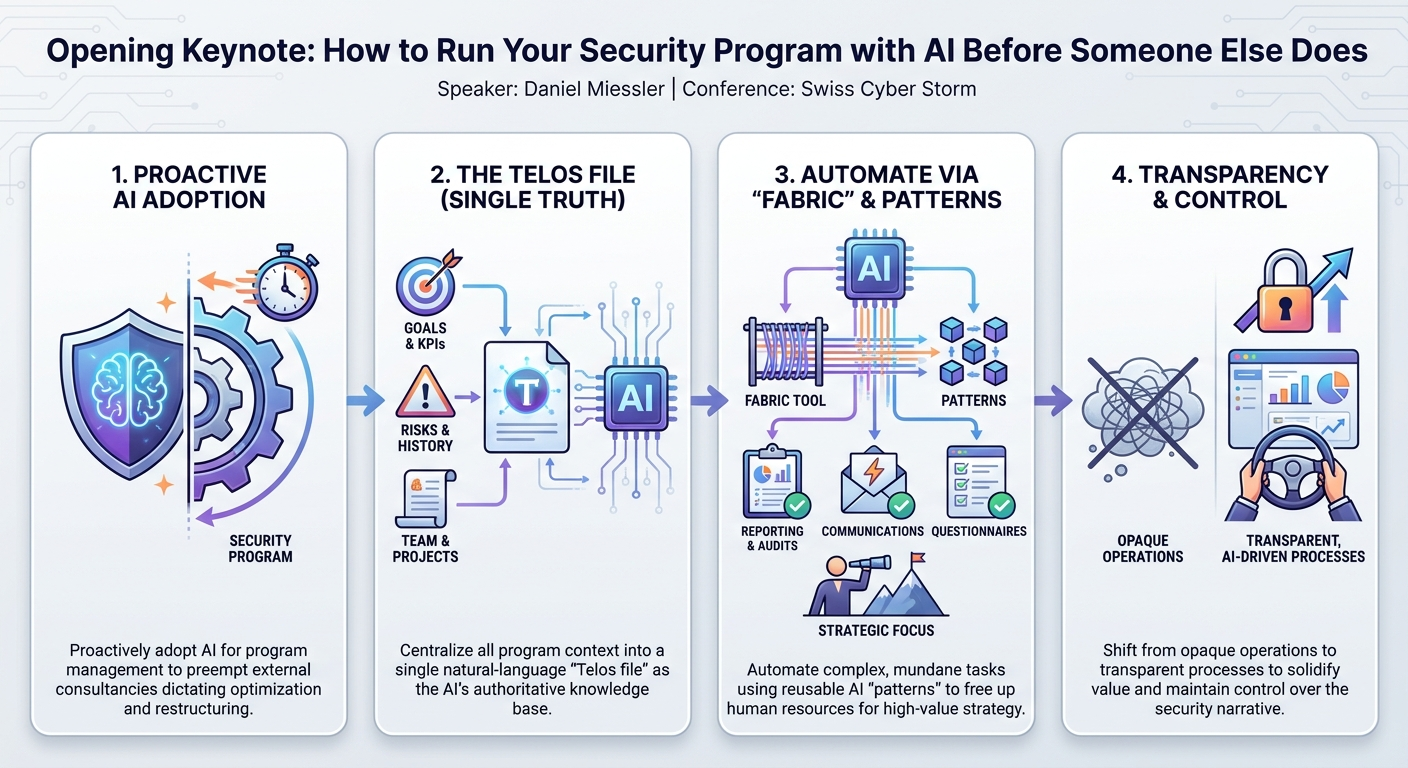
Daniel Miessler's keynote at Swiss Cyber Storm addresses a critical, often overlooked, risk in the era of Artificial Intelligence: the impending disruption of how organizations manage their security programs, not just by internal AI initiatives, but by external consultancies leveraging AI to optimize and reshape business processes. Miessler argues that many security teams currently operate without a consistently clear vision, constantly shifting goals, and struggle to articulate their value effectively. This lack of structured narrative and demonstrable impact creates a vulnerability that AI is perfectly positioned to exploit.
Key moments
- 0:00 AI's disruptive risk to security programs
- 3:45 The 'Tlos File' for AI context capture
- 10:10 AI mapping metrics to projects and generating visuals
- 15:00 AI auto-generates auditor and executive updates
- 17:00 Automating security questionnaires with AI
- 23:00 AI's broader impact on all business processes
- 26:30 Actionable takeaways for using AI in your business
- 33:50 Q&A: Ensuring AI explainability and trust
Opening Keynote: How to Run Your Security Program with AI Before Someone Else Does
Speakers: Daniel Miessler, Security Expert, Independent
Conference: Swiss Cyber Storm
YouTube: https://www.youtube.com/watch?v=bZmhRVRECQo
Overview
Daniel Miessler's keynote at Swiss Cyber Storm addresses a critical, often overlooked, risk in the era of Artificial Intelligence: the impending disruption of how organizations manage their security programs, not just by internal AI initiatives, but by external consultancies leveraging AI to optimize and reshape business processes. Miessler argues that many security teams currently operate without a consistently clear vision, constantly shifting goals, and struggle to articulate their value effectively. This lack of structured narrative and demonstrable impact creates a vulnerability that AI is perfectly positioned to exploit.
The core of Miessler's presentation centers on a proactive strategy: for security leaders to implement AI-driven program management before external forces dictate the terms. He demonstrates a working system that uses AI to organize, explain, and dynamically respond to inquiries about a security program, transforming opaque operations into transparent, data-driven narratives. This isn't a theoretical future; Miessler highlights that major consulting firms are already deeply invested in AI, with one prominent example being McKinsey, which attributes 40% of its business to AI-related services, signaling that this transformation is actively underway.
The talk serves as both a warning and a practical guide, urging security professionals to embrace AI for program management as an immediate imperative. By adopting these methodologies, organizations can gain a significant competitive advantage, solidify their value proposition, and navigate the profound shift towards AI-centric business operations on their own terms, rather than having it imposed upon them. Failure to adapt, Miessler suggests, could lead to external consultancies uncovering inefficiencies and redundancies, potentially resulting in unwanted structural changes or headcount reductions within security teams.
Background
▶ Watch: AI's disruptive risk to security programs (0:00)
The genesis of this overlooked AI risk lies in a pervasive challenge within many organizations: the struggle of teams and leaders to consistently articulate their vision, goals, and tangible value. Miessler confesses to having experienced this "winging it" approach in his own past roles, where objectives were fluid, and proving worth often devolved into a scramble of manual data compilation to construct a defensive narrative. This reactive posture leads to several detrimental outcomes: a constant need for teams to defend their existence, difficulty in generating enthusiasm, repetitive explanations, talent attrition, and a general lack of trust from other departments, ultimately culminating in C-suite scrutiny over budget allocation.
This inherent organizational opacity and the human-driven, often inconsistent, nature of program management create an ideal opening for Artificial Intelligence. AI's core strength lies in its ability to impose structure on unstructured data, clarify complex information, and explain intricate systems. It excels at defining success metrics, tracking progress, and communicating these insights with unparalleled efficiency and consistency. Miessler underscores that this isn't a nascent trend but a rapidly accelerating phenomenon, citing the astonishing statistic that 40% of McKinsey's business is already driven by AI, a clear indicator that the disruption of traditional business processes by AI is not a future projection but a present reality. The problem, therefore, isn't just that AI can do this, but that it is doing this, and those who fail to adopt similar capabilities risk being outmaneuvered by more agile, AI-powered external entities.
Key Findings
▶ Watch: AI mapping metrics to projects and generating visuals (10:10)
The central finding of Miessler's talk is the profound capability of AI to revolutionize security program management by instilling clarity, structure, and dynamic responsiveness. He demonstrates that by centralizing all relevant program context into a single, natural-language document – what he calls a Telos file – AI can effectively act as an intelligent program manager, capable of answering complex questions, generating reports, and automating routine tasks that typically consume significant human effort.
Key discoveries and contributions include:
- The Power of the Telos File: This single, comprehensive context file, written in plain, conversational language, serves as the authoritative source for all aspects of a security program, from high-level company goals to granular project details and historical activity logs. It transforms disparate information into an interconnected, AI-digestible knowledge base.
- Dynamic Program Interrogation: The AI system can dynamically answer a vast array of questions about the program, cross-referencing information to provide insights into project alignment with KPIs and risks, progress on critical initiatives (e.g., vulnerability remediation), and resource allocation.
- Automation of Mundane Tasks: The system significantly streamlines time-consuming activities such as generating project lists, mapping metrics to initiatives, producing auditor responses, crafting executive updates, and efficiently answering detailed security questionnaires. This automation frees up security professionals to focus on higher-value strategic work.
- The Fabric Tool: Miessler introduces Fabric, an open-source tool that enables the creation and execution of reusable AI patterns – essentially advanced, structured prompts – against the Telos file. Fabric democratizes access to these AI capabilities, allowing for consistent and repeatable automation of complex tasks.
- Shift from Opaque to Transparent Operations: The adoption of this AI-driven approach fundamentally shifts business processes from being largely human-based and opaque to becoming transparent and AI-centric. This provides an unprecedented level of visibility and accountability into program activities and outcomes.
- The Imminent Consultative Threat: Miessler highlights that this AI transformation is not merely an internal opportunity but also an external threat. Consultancies are already deploying AI to dissect and optimize client businesses, meaning organizations that don't proactively adopt these methods risk having their processes analyzed and potentially restructured by external parties, often with cost-cutting implications.
Technical Deep Dive
▶ Watch: Automating security questionnaires with AI (17:00)
The technical core of Miessler's proposed system revolves around two primary components: the Telos file and the Fabric AI orchestration tool, which interacts with large language models (LLMs).
The Telos file, named after the Greek word for "purpose," is the single source of truth for the entire security program. It is a massive, plain-text document designed to capture comprehensive context in natural, conversational language. Miessler emphasizes that this is not a database with a rigid schema but rather a flexible, human-readable narrative. For the demonstration, Miessler uses a fictional company called Alma Security, a bio-authentication security company based in Redwood City, California. The structure of Alma Security's Telos file includes:
- High-Level Metadata: Company history, mission, and overarching goals. This establishes foundational context, allowing the AI to understand the broader organizational objectives that the security program supports.
- Security Program Specifics: Clearly labeled security team goals (e.g., SG1: "secure customer data," SG2: "secure the company's own intellectual property"), Key Performance Indicators (KPIs), and a comprehensive risk register. The labeling allows the AI to cross-reference and connect these elements.
- Historical and Narrative Content: This includes summaries of past events (e.g., a breach that led to budget increases), team documentation, wiki content, and free-form notes. Miessler deliberately uses conversational language, such as "we're logging most stuff to CloudTrail and we kind of use GuardDuty but we don't really monitor it closely," to make the context easily digestible for the AI.
- Team and Project Details: Information about team members, their skill sets, and the projects they are currently working on. While more detail is better, Miessler notes it doesn't need to be exhaustively granular to be effective.
- Rolling Activity Log: A chronological record of significant program changes, infrastructure updates, and critical events, also described in plain language (e.g., "criticals are now being fixed in nine days").
This extensive context allows the AI to build an extraordinary internal representation of the program. When a user asks a question, the AI leverages this context to generate dynamic, relevant, and comprehensive answers. For instance, a query like "What are we working on?" will return a list of projects with descriptions. More complex questions, such as "How do our metrics relate to our projects?" or "How do risks relate to our projects?", yield sophisticated mappings that explain the rationale behind current efforts. The system can even track progress on metrics like critical vulnerability remediation times, showing historical trends and current performance based on the activity log.
To facilitate these interactions, Miessler developed Fabric, an open-source command-line tool released in January of this year. Fabric allows users to execute predefined AI commands, called patterns, which are essentially highly structured and advanced prompts. These patterns are written in Markdown, making them human-readable and easily editable. Each pattern is designed to perform one task exceptionally well, such as "visualizing graph data" or "generating an auditor response." Instead of manually crafting complex prompts every time, users can invoke a pattern against their Telos file.
The system's power is evident in its automation capabilities:
- Auditor and Executive Communications: The AI can generate polished emails responding to auditors about, for example, critical vulnerability remediation times. It not only crafts a professional narrative but also accurately intersperses data from the Telos file, performing calculations (e.g., comparing old and new metric versions) to provide current numbers. It can also tailor the narrative for different audiences, such as the C-team, understanding their specific communication preferences if provided in the context file.
- Security Questionnaires: By adding IT progress over multiple years (e.g., "rolled out SentinelOne on 50% of corporate laptops in August of 2020," migration to AWS, endpoint updates) to the Telos file, the AI can automatically answer detailed customer questions like "What percentage of endpoints are protected by endpoint protection?" or "How much of our infrastructure is US-based (on-prem/cloud)?". This transforms a typically arduous task into a near-instantaneous process.
Miessler highlights that the system's accuracy has significantly improved, noting that with recent LLM versions like GPT-4 and Anthropic's Claude 3.5 Sonnet, it "hardly mak[es] any mistakes at this point." Furthermore, for organizations concerned about data privacy or cloud reliance, Fabric supports running with local open-source models like Llama 3.1, achieving "very similar results" as they are "catching up and some argue they might even pass the the Pinnacle models." For sensitive data, a local model can even be used to perform data masking or obfuscation before sending data to a cloud-based LLM. The system's ability to "articulate its reasoning" and point to specific sections of the context file also helps in verifying AI outputs.
Demo / Proof of Concept
▶ Watch: AI's broader impact on all business processes (23:00)
The entirety of Daniel Miessler's keynote serves as a compelling demonstration and proof of concept for his AI-driven security program management system. He explicitly states, "what I'm about to show is an actual working thing, it's not like a mockup, this is a working system and I'm already using it to help myself and to help other people."
The demonstration unfolds using a simulated company, Alma Security, a fictional bio-authentication firm, providing a realistic context for the system's application. Miessler walks the audience through the construction and content of the Telos file, displaying screenshots of its various sections. This includes the high-level company mission and goals, specific security team goals (SG1, SG2), labeled KPIs, a detailed risk register, and a historical narrative that explains the team's formation and budget allocation following a past breach. He also highlights the inclusion of conversational text, team skill sets, projects, and a rolling log of program activities, emphasizing the plain language used throughout.
The core of the demo showcases live interactions with the AI system. Miessler presents examples of free-form questions (depicted in yellow text) and the AI's generated responses. These include:
- Project Listing: A simple query about "what exactly are the projects" yields a clear list of projects with concise descriptions.
- Metric-to-Project Mapping: A question about "how our metrics relate to our projects" results in a visual breakdown and explanation of how different projects contribute to specific KPIs.
- Risk-to-Project Alignment: Demonstrating how the system justifies resource allocation, Miessler asks how risks relate to projects, receiving a response that clearly links ongoing work to identified risks.
- Progress Reporting: The AI generates a clean narrative and data on the "progress on remediating critical vulnerabilities," showing a trend of decreasing remediation times. It also produces data in a CSV format that can be directly piped into visualization tools to create graphs for presentations.
- Resource Management: A more advanced scenario involves a team member, Nadia, leaving the team. The AI dynamically recommends how to reassign her work to other team members based on their skill sets and current projects.
- Automated Communications: The system drafts a "perfect email" response to an external auditor regarding critical vulnerability remediation times, interspersing calculated data. It then produces a distinct update for the executive team, demonstrating its ability to tailor narratives based on the audience.
- Security Questionnaire Automation: By integrating IT progress and infrastructure details into the Telos file, the AI effortlessly answers complex customer questions like "what percentage of endpoints are protected by endpoint protection" (e.g., "rolled out SentinelOne on 50% of corporate laptops in August of 2020") and "how much of our infrastructure is US-based" (on-prem/cloud split), providing ready-to-use narrative responses.
Throughout the demo, Miessler references the Fabric tool, which he developed, as the engine for running these complex AI commands or patterns. He explains that these patterns are reusable, structured prompts that allow for consistent and efficient execution of tasks that would otherwise take hours, weeks, or even months to assemble manually. The demonstration effectively illustrates how this integrated system can provide continuous, dynamic insights into a security program, making it transparent, accountable, and highly efficient.
Defensive Implications
▶ Watch: Q&A: Ensuring AI explainability and trust (33:50)
The implications of Miessler's talk for security defenders are profound and urgent, demanding a proactive shift in how security programs are conceived and managed. The primary defensive strategy is proactive adoption and integration of AI into security operations, rather than waiting for external forces to impose it.
Firstly, security leaders must immediately begin to view every business process as a graph of algorithms. This analytical lens is crucial for identifying areas where AI can bring structure, transparency, and efficiency. This applies not just to security-specific tasks but to how the security team interacts with and understands the broader organization.
Secondly, the creation of context files, specifically Telos files, for every aspect of the security program is paramount. This involves meticulously documenting company goals, security objectives, KPIs, risk registers, team structures, projects, and historical activities in natural language. This comprehensive, centralized repository becomes the "super Crown Jewel" of the security program, requiring robust protection given the sensitive nature of the information it contains (e.g., actual risks, internal metrics). Defenders should consider strategies like running AI models locally (e.g., using Llama 3.1) or employing data masking techniques (e.g., using a local model to obfuscate data before sending it to a cloud LLM) to protect confidentiality.
Thirdly, security teams must rapidly acquire proficiency in using AI tools in conjunction with these context files. This involves understanding how to formulate effective queries and, more importantly, how to create and leverage reusable AI patterns within tools like Fabric. The skill required isn't deep AI programming but rather a strong ability to articulate problems clearly, which is well within the capabilities of most engineers after some practice.
Fourthly, when constructing Telos files, it is crucial to orient them around the mission, strategy, and goals of the organization and the security program. Miessler emphasizes these as the most "human parts" of any operation and, consequently, the hardest for AI to fully replicate or replace. By anchoring the AI system to these foundational, human-driven elements, security teams can ensure that AI augments, rather than completely dictates, their strategic direction.
Finally, the talk serves as a stark warning about the risk of inaction. If security teams fail to embrace these AI-driven methodologies, external consultancies, driven by C-suite directives to find efficiencies and reduce costs, will inevitably step in. These consultancies, armed with their own AI tools, will dissect and optimize existing business processes, potentially uncovering "redundancies" and leading to headcount reductions or undesirable structural changes within security departments. While there might be initial human resistance to providing transparent data due to fears of job displacement, Miessler predicts that the organizational pressure for efficiency will be "overwhelming," making cooperation inevitable. Therefore, the defensive imperative is to take control of this transformation now, leveraging AI to enhance the security program's value and demonstrate its indispensable role, rather than allowing it to be redefined by external parties.
Key Takeaways
- Proactive AI Adoption is Critical: Security teams must immediately embrace AI for program management to avoid being outmaneuvered by external consultancies already leveraging AI to optimize business processes.
- The Telos File as the Central Brain: A single, natural-language "Telos file" serves as the comprehensive context for the entire security program, enabling AI to understand, explain, and manage complex operations.
- Automation of Mundane Tasks: AI, powered by context files, can automate time-consuming activities such as generating project reports, mapping KPIs, aligning risks, drafting auditor responses, and completing security questionnaires, freeing up human resources for strategic work.
- Fabric Empowers Pattern-Based AI: Tools like Fabric allow security professionals to create and execute reusable AI "patterns" (structured prompts) against their context files, ensuring consistent, efficient, and repeatable automation of complex queries.
- Embrace Transparency for Control: The shift towards transparent, AI-driven business processes is inevitable. By proactively building these systems, security teams gain control over their narrative, demonstrate value, and shape their future role.
- Focus on Human-Centric Strategy: When building AI context, prioritize articulating the mission, strategy, and goals, as these human-driven elements are the most resilient to AI replacement and ensure the technology serves strategic objectives.
About the Speaker(s)
Daniel Miessler is a highly respected security expert, known for his broad "security wide horizon" and practical expertise, particularly in the realm of Artificial Intelligence. He maintains a popular newsletter that reaches a large network of professionals. Having been on the Swiss Cyber Storm conference's speaker wish list for several years, Miessler's recent focus has significantly shifted to AI, especially after his "AI thing got big." He is the creator of the open-source Fabric tool, which was released in January of the presentation year and has garnered significant community interest with over 24,000 stars on GitHub, demonstrating his practical contributions to the field of AI-driven security.
Reviews
Dr. Zero (Offensive Security Researcher) — SOLID
Miessler's keynote boils down to using a massive text file and some structured prompts to automate the GRC drudgery that normally eats your week. Calling it a 'Telos file' is a bit pretentious, but the underlying premise of automating your own program management before McKinsey does it for you is a highly accurate read of the current consulting landscape.
Heather Calloway (CISO) — STRONG ACCEPT
Miessler argues that if security leaders don't use AI to map their programs to business value, external consultancies will use AI to do it for them—and cut their budgets in the process. The proposed technical implementation is a proof-of-concept toy, but the strategic warning is dead on and requires immediate leadership attention.