Swiss Hacking Challenge
Marc Bollhalder, Manuel Bürge
Swiss Cyber Storm 2024 · Day 1 · Arena
Overview
The "Swiss Hacking Challenge" talk, delivered by Marc Bollhalder and Manuel Bürge at Swiss Cyber Storm, provides a compelling narrative about the cultivation of cybersecurity talent in Switzerland. The presentation details the journey from grassroots Capture The Flag (CTF) competitions to elite international events like the European Cyber Security Challenge (ECSC) and WorldSkills. Marc Bollhalder, who now leads the Swiss Hacking Challenge, shares his personal transformation from an 18-year-old participant to a key organizer, highlighting the profound impact such initiatives have on young individuals. Manuel Bürge, a coach for the WorldSkills team, further elaborates on the rigorous training and remarkable achievements of Swiss competitors on the global stage.
Key moments
- 0:55 Speaker's personal journey: CTF to European competition
- 3:30 Swiss Hacking Challenge: Pathways to international competitions
- 5:15 Meet Edward and Philip: World Skills champions
- 6:40 Extensive training and mental preparation for World Skills
- 8:00 Switzerland's historic victory at World Skills 2024
- 8:40 Coach's challenge: selecting future winning teams
- 9:40 How to participate in the Swiss Hacking Challenge
Swiss Hacking Challenge
Speakers: Marc Bollhalder, Lead of Swiss Hacking Challenge; Manuel Bürge, WorldSkills Coach
Conference: Swiss Cyber Storm
YouTube: https://www.youtube.com/watch?v=xWrFOGjusI8
Overview
The "Swiss Hacking Challenge" talk, delivered by Marc Bollhalder and Manuel Bürge at Swiss Cyber Storm, provides a compelling narrative about the cultivation of cybersecurity talent in Switzerland. The presentation details the journey from grassroots Capture The Flag (CTF) competitions to elite international events like the European Cyber Security Challenge (ECSC) and WorldSkills. Marc Bollhalder, who now leads the Swiss Hacking Challenge, shares his personal transformation from an 18-year-old participant to a key organizer, highlighting the profound impact such initiatives have on young individuals. Manuel Bürge, a coach for the WorldSkills team, further elaborates on the rigorous training and remarkable achievements of Swiss competitors on the global stage.
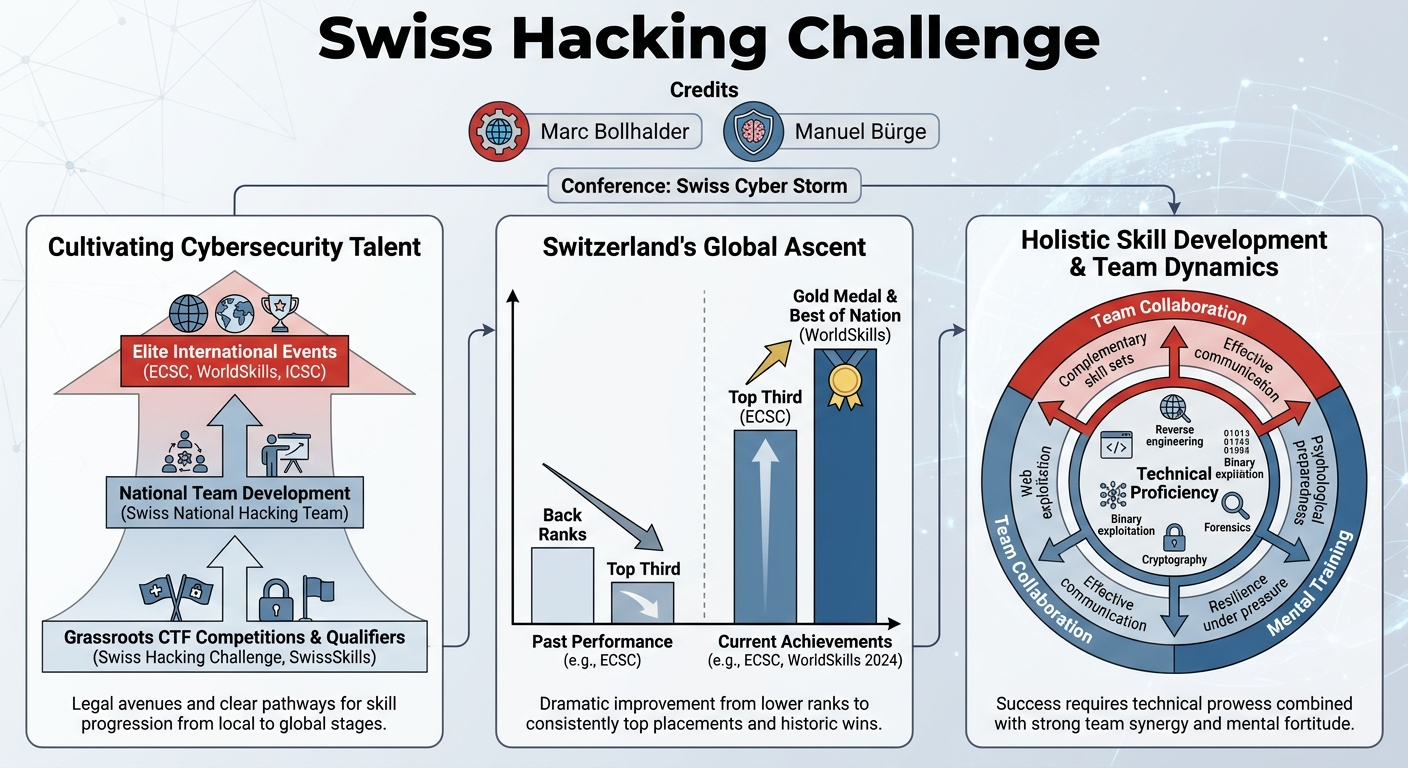
This talk is not merely a recounting of competition results; it is a testament to the power of structured youth development programs in cybersecurity. It underscores the critical importance of creating legal, stimulating environments where young minds can hone their hacking skills, discover their passion, and connect with like-minded peers. The speakers emphasize how these challenges serve as vital pipelines for identifying and nurturing future cybersecurity professionals, ultimately bolstering national security and digital resilience. Switzerland's impressive ascent from "back ranks" to consistently placing among the top nations, including a second-place finish at ECSC and a gold medal at WorldSkills, demonstrates the efficacy of their approach.
The significance of this talk extends beyond national pride. It offers a blueprint for how other nations or organizations can foster a robust cybersecurity workforce. By detailing the structure of their competitions, the scope of skills covered, the emphasis on team dynamics, and the inclusion of mental training, the Swiss Hacking Challenge provides valuable insights into building a successful talent development ecosystem. It champions the idea that competitive hacking, when properly channeled, is a powerful educational tool that prepares individuals for the complex and evolving challenges of the real-world cybersecurity landscape.
Background
▶ Watch: Speaker's personal journey: CTF to European competition (0:55)
The foundation of the Swiss Hacking Challenge, and indeed many national cybersecurity talent programs, lies in the concept of Capture The Flag (CTF) competitions. As explained by Marc Bollhalder, a CTF is essentially a cybersecurity game where participants solve various challenges to find "flags"—secret strings of text that signify a successful exploit or solution. Crucially, these competitions often involve finding zero-days in new software specifically written for the event, meaning the vulnerabilities are previously unknown and have never been seen before. This format demands genuine skill, creativity, and a deep understanding of computer systems, as participants cannot rely on pre-existing exploits or publicly documented vulnerabilities.
CTF challenges typically span a wide array of categories, reflecting the diverse domains within cybersecurity. Common categories include web exploitation, reverse engineering, binary exploitation, cryptography, and sometimes even hardware challenges. This multidisciplinary approach ensures that participants develop a broad skill set, ranging from understanding common web application flaws to dissecting complex compiled binaries or breaking sophisticated encryption schemes. The challenges are designed to be novel and complex, pushing participants to think critically and adapt their knowledge to new scenarios.
Marc Bollhalder's personal story serves as a powerful illustration of the program's impact. At 18, the Swiss Hacking Challenge was his very first CTF. His success in a few web challenges propelled him into the Swiss National Hacking Team, affording him the opportunity to compete at the European Cyber Security Challenge (ECSC) in London. This experience was a "game changer," blowing his mind and opening up a career path he hadn't previously imagined. He noted the stark contrast with traditional schooling, where interest in cybersecurity was minimal. The Swiss Hacking Challenge provided a crucial environment where he found "the exact same people with the same interest," fostering a sense of community and purpose. Beyond career pathways, these challenges offer a vital "legal opportunity" for young individuals to test their skills, channeling their natural curiosity and drive into productive and ethical endeavors, thus mitigating the risk of them exploring illicit activities.
The growth of the Swiss Hacking Challenge itself is indicative of the increasing interest and recognition of cybersecurity talent. When Marc first competed, only seven to ten people vied for qualification. Today, the qualifier attracts over 400 participants, including more than 100 juniors and over 70 seniors (with "senior" referring to the upper age limit of the youth support organization, typically under 25). This immense growth underscores the burgeoning talent pool and the program's expanding reach. The Swiss Hacking Challenge qualifier serves as a gateway to multiple prestigious events: it acts as a regional qualifier for SwissSkills in cyber security, potentially leading to WorldSkills, and simultaneously qualifies participants for the Swiss Hacking Challenge Final. The top ten young hackers from this final are then selected for the Swiss National Hacking Team, which represents Switzerland at the ECSC. Furthermore, two candidates from the ECSC are chosen to join Team Europe, competing at the International Cyber Security Challenge (ICSC), a worldwide event. This structured progression provides a clear, aspirational pathway for young cybersecurity enthusiasts, from local competitions to the global stage.
Key Findings
▶ Watch: Meet Edward and Philip: World Skills champions (5:15)
The talk highlights several compelling findings, primarily centered on Switzerland's remarkable rise in the global cybersecurity competition landscape and the underlying factors contributing to this success. One of the most significant findings is the dramatic improvement in Switzerland's performance at international events. Marc Bollhalder proudly notes that while Switzerland historically "always in the back ranks" at the ECSC, they have now massively improved, consistently placing in the first third of all participating countries. This includes an impressive top 10 finish in the recent competition and an outstanding second place in the preceding year. This upward trajectory demonstrates the effectiveness of the Swiss Hacking Challenge and its associated programs in developing elite cybersecurity talent.
Manuel Bürge further reinforces this narrative with the exceptional achievements at WorldSkills. For the first time, Switzerland competed in cyber security at WorldSkills 2024, and their team, composed of Edward and Philip, not only secured first place but also became the "first European team to be under the top three teams." On top of this, they received the prestigious Best of Nation Award, an accolade given only once per nation, underscoring their unparalleled performance. These results are not merely about winning; they signify Switzerland's emergence as a leading nation in cybersecurity skill development.
Another key finding is the profound importance of youth support organizations like the Swiss Hacking Challenge. These organizations provide crucial platforms for young talent, offering legal and structured environments for skill development that are often lacking in traditional educational systems. Marc Bollhalder's personal account exemplifies this, as the challenge opened up a career path and connected him with a community that was otherwise absent in his schooling. The rapid growth in participant numbers, from a handful to over 400, further attests to the critical need and positive reception of such initiatives.
The talk also underscores the vital role of team dynamics and diverse skill sets. Manuel Bürge's selection of Edward and Philip for WorldSkills was based on their "unique skill sets" and "different personality traits" that "complemented each other perfectly." He instantly recognized their "Team Dynamics was so great," making them an undeniable choice. This highlights that raw technical skill, while essential, is often not sufficient; the ability to collaborate, communicate, and leverage complementary strengths within a team is paramount for success in complex, high-pressure environments like international competitions and, by extension, real-world cybersecurity operations.
Finally, the talk implicitly identifies mental training as a critical component for success at elite levels. Manuel mentions that the WorldSkills team underwent "a lot of mental training" over their six-month preparation period. This included general team-building events organized by SwissSkills, motivational talks from figures like a Zen monk and an Olympic medalist, and a dedicated budget for candidates to independently seek out mental trainers. This emphasis on psychological preparedness, alongside technical prowess, suggests a holistic approach to athlete development, recognizing that peak performance in high-stakes competitions requires resilience, focus, and strategic thinking under pressure.
Technical Deep Dive
▶ Watch: Extensive training and mental preparation for World Skills (6:40)
While the talk primarily focuses on the organizational and human aspects of the Swiss Hacking Challenge, it implicitly delves into the technical skills cultivated through these competitions. The core of a CTF, as described, is about "finding zero days in new software" across various categories, which demands a deep and practical understanding of numerous cybersecurity domains.
In web exploitation, participants encounter challenges designed to mimic real-world web application vulnerabilities. This can include SQL injection (SQLi), where carefully crafted input manipulates database queries to extract sensitive information or bypass authentication. Cross-Site Scripting (XSS) challenges involve injecting malicious scripts into web pages viewed by other users. Remote Code Execution (RCE) vulnerabilities allow attackers to execute arbitrary code on the server, often through insecure deserialization, command injection, or file upload flaws. Other common web challenges involve authentication bypasses, session hijacking, Server-Side Request Forgery (SSRF), and exploiting logic flaws in application design. Success in this category requires proficiency in web technologies (HTML, CSS, JavaScript, various server-side languages), understanding of web protocols (HTTP/S), and familiarity with common web vulnerability classes.
Reverse engineering challenges typically involve analyzing compiled programs or obfuscated code to understand their functionality, uncover hidden logic, or extract flags. This requires skills in using disassemblers like Ghidra or IDA Pro, debuggers (e.g., GDB, x64dbg), and understanding assembly languages (x86, ARM). Participants might need to reverse-engineer custom protocols, crack license checks, or bypass anti-tampering measures. This domain tests a competitor's ability to deconstruct complex software without access to source code, a crucial skill for malware analysis and vulnerability research.
Binary exploitation is a highly technical category focused on finding and exploiting vulnerabilities in compiled executables, often to achieve arbitrary code execution. Common vulnerabilities include buffer overflows, where exceeding allocated memory bounds can overwrite critical data or control flow. Return-Oriented Programming (ROP) is a sophisticated technique used to bypass modern defenses like Data Execution Prevention (DEP) and Address Space Layout Randomization (ASLR) by chaining together small snippets of existing code (gadgets) within the program. Other challenges involve heap exploitation, format string bugs, and exploiting integer overflows. This category demands a deep understanding of memory management, processor architecture, operating system internals, and exploit development techniques.
Cryptography challenges test participants' ability to break weak cryptographic implementations, analyze custom encryption schemes, or understand cryptographic protocols. This can involve exploiting flaws in classic ciphers (Caesar, Vigenère), identifying and exploiting weaknesses in modern algorithms (e.g., small key sizes, incorrect modes of operation), or performing side-channel attacks if hardware is involved. Understanding mathematical concepts, number theory, and common cryptographic pitfalls is essential.
While less frequently mentioned, hardware challenges can involve analyzing firmware, exploiting vulnerabilities in IoT devices, or even performing physical attacks like fault injection or power analysis to extract secrets. This requires knowledge of embedded systems, circuit boards, and specialized tools.
Manuel Bürge also outlined the broader skill sets required for WorldSkills, which extend beyond pure offensive CTF tactics to encompass more defensive and enterprise-focused disciplines. These include securing enterprise infrastructure, which involves understanding network segmentation, access controls, identity management, and hardening operating systems and applications. Digital forensics focuses on investigating cyber incidents, recovering evidence from compromised systems, and analyzing artifacts to reconstruct attack timelines. Incident response involves the systematic process of preparing for, detecting, analyzing, containing, eradicating, recovering from, and post-incident analysis of cybersecurity breaches. Threat hunting is a proactive approach to security, involving searching for undiscovered threats within a network that have evaded existing security controls. Finally, offensive security, while overlapping with CTF skills, applies these techniques in a controlled, ethical manner to assess an organization's security posture through penetration testing and vulnerability assessments. The comprehensive nature of these skills, from deep technical exploitation to strategic defensive operations, underscores the holistic talent development fostered by these programs.
Demo / Proof of Concept
▶ Watch: Coach's challenge: selecting future winning teams (8:40)
This talk focused on the organizational aspects and remarkable achievements of the Swiss Hacking Challenge and its participants, rather than demonstrating a specific technical exploit or proof of concept. The "demo" was the success stories of the teams themselves and the pathways created for young cybersecurity talent. There was no live demonstration of hacking techniques, specific tools, or a detailed walkthrough of an exploit during the presentation.
Defensive Implications
▶ Watch: How to participate in the Swiss Hacking Challenge (9:40)
While the Swiss Hacking Challenge is rooted in offensive security—finding vulnerabilities and exploiting them—its implications for defensive cybersecurity are profound and far-reaching. The core mission of these competitions is to cultivate highly skilled individuals who inherently understand the attacker's mindset, which is an invaluable asset for any defender.
Firstly, these programs serve as a critical talent pipeline for future cybersecurity defenders. Participants who excel in identifying and exploiting vulnerabilities in CTFs are uniquely positioned to become expert penetration testers, security architects, incident responders, and threat hunters. Their hands-on experience in dissecting systems, understanding attack vectors, and developing exploits gives them an unparalleled perspective on how to build resilient defenses. Manuel Bürge's mention of WorldSkills training encompassing "securing Enterprise infrastructure, digital forensics, incident response, and threats hunting" directly correlates to essential defensive roles.
Secondly, by training individuals to find zero-days in "new software," the challenge instills a proactive security mindset. Participants learn to scrutinize code, identify subtle flaws, and anticipate potential exploitation paths. This skill set is directly transferable to vulnerability research, secure code review, and security testing within organizations. A defender who can think like an attacker is far better equipped to identify and mitigate risks before they can be exploited in the wild, thus contributing to a more robust proactive security posture.
Thirdly, the broad range of skills developed in CTFs directly feeds into specific defensive capabilities. Expertise in reverse engineering is crucial for malware analysis and understanding sophisticated threats. Knowledge of binary exploitation helps in analyzing patches, understanding exploit mitigations, and forensics investigations involving compromised binaries. Understanding web exploitation techniques enables security engineers to build more secure web applications and conduct effective web application penetration tests. Digital forensics and incident response, explicitly mentioned in the WorldSkills training, are cornerstones of reactive defense, enabling organizations to detect, contain, and recover from cyberattacks efficiently.
Moreover, the emphasis on team dynamics and mental training within these programs has direct defensive benefits. Cybersecurity is rarely a solo endeavor; effective defense requires coordinated efforts from diverse teams under pressure. The ability to collaborate, communicate complex technical information, and maintain composure during high-stress incidents, all fostered through competitive training, are essential for effective Security Operations Center (SOC) teams and incident response teams.
In essence, the Swiss Hacking Challenge and similar initiatives are not just about creating hackers; they are about forging comprehensive cybersecurity professionals. By providing a legal and stimulating environment for offensive skill development, these programs inadvertently strengthen the defensive capabilities of nations and industries, creating a generation of security experts who understand the enemy from the inside out.
Key Takeaways
- Cultivating Cybersecurity Talent: The Swiss Hacking Challenge and similar CTF programs are vital for identifying, nurturing, and promoting young cybersecurity talent, providing legal avenues for skill development.
- Pathways to Excellence: A clear progression exists from regional qualifiers (Swiss Hacking Challenge, SwissSkills) to national teams (Swiss National Hacking Team) and elite international competitions (ECSC, WorldSkills, ICSC), offering aspirational goals for participants.
- Switzerland's Global Ascent: Switzerland has significantly improved its standing in international cybersecurity competitions, moving from "back ranks" to consistently placing in the top third at ECSC, achieving 2nd place one year, and winning gold at WorldSkills 2024.
- Holistic Skill Development: Competitions cover a broad spectrum of cybersecurity domains, including web exploitation, reverse engineering, binary exploitation, cryptography, digital forensics, incident response, threat hunting, and enterprise infrastructure security.
- Importance of Team Dynamics and Mental Fortitude: Success at the highest levels relies not only on individual technical prowess but also on effective team collaboration, complementary skill sets, and dedicated mental training to perform under pressure.
- Impact on National Security and Industry: By fostering a deep understanding of offensive techniques, these programs indirectly strengthen national cybersecurity defenses, creating a pipeline of professionals who can effectively identify, mitigate, and respond to cyber threats.
About the Speaker(s)
Marc Bollhalder is the current leader of the Swiss Hacking Challenge. His personal journey is a testament to the program's impact, as he began his CTF career at the age of 18 with the Swiss Hacking Challenge. This experience was transformative, leading him to qualify for the Swiss National Hacking Team and compete in the European Cyber Security Challenge (ECSC). Now 24, he plays a pivotal role in organizing and advancing the very challenge that ignited his passion and career in cybersecurity, overseeing its immense growth and success.
Manuel Bürge served as the coach for the Swiss team that competed in the WorldSkills 2024 cyber security competition. He was responsible for selecting and training the team, specifically highlighting his strategic choice of Edward and Philip based on their unique, complementary skill sets and strong team dynamics. His role involved overseeing their six-month training regimen, which included extensive technical and mental preparation, ultimately guiding them to a historic gold medal victory and the Best of Nation Award at WorldSkills.
Reviews
Dr. Zero (Offensive Security Researcher) — SOLID
A well-deserved victory lap about how Switzerland built a legitimate CTF-to-industry talent pipeline that just took gold at WorldSkills. It's not a technical talk, but as a blueprint for national cyber talent development, it proves their model works. I just wish they spent less time admiring the medals and more time breaking down the actual training curriculum that got them there.
Heather Calloway (CISO) — SOLID
This is a talent pipeline and workforce development talk disguised as a competition recap. If you are struggling to hire entry-level SOC and IR analysts who can actually perform under pressure, the Swiss model of combining offensive CTFs with rigorous team and mental training is worth your attention.