When Physics Meets (Reverse) Engineering: Understanding Cyber-Physical Attacks Against Nuclear Reactors
Ruben Santamarta
Swiss Cyber Storm 2024 · Day 1 · Arena
Overview
Ruben Santamarta's talk, "When Physics Meets (Reverse) Engineering: Understanding Cyber-Physical Attacks Against Nuclear Reactors," delivered at Swiss Cyber Storm, delves into the critical and often overlooked realm of cybersecurity within nuclear power generation. Santamarta, a seasoned security researcher known for his work on Swiss Post's e-voting program and other high-profile findings, presents a comprehensive analysis of hypothetical cyber-physical attacks targeting the digital instrumentation and control (I&C) systems of nuclear reactors. This research, an extended version of which is available in a freely published paper, focuses specifically on the Teleperm XS platform, a widely deployed digital reactor protection system.
Key moments
- 0:00 Introduction and nuclear comeback relevance
- 4:30 Nuclear power plant fundamentals and defense-in-depth
- 7:50 Reverse engineering Teleperm XS modules via eBay
- 10:10 Teleperm XS architecture and Service Unit vulnerability
- 17:00 Simulating a cyber-physical core melt attack
- 20:10 Conclusions: education, SMRs, and geopolitical targets
- 26:30 Q&A: Bypassing digital safety interlocks
When Physics Meets (Reverse) Engineering: Understanding Cyber-Physical Attacks Against Nuclear Reactors
Speakers: Ruben Santamarta
Conference: Swiss Cyber Storm
YouTube: https://www.youtube.com/watch?v=auj2kKfIK_g
Overview
Ruben Santamarta's talk, "When Physics Meets (Reverse) Engineering: Understanding Cyber-Physical Attacks Against Nuclear Reactors," delivered at Swiss Cyber Storm, delves into the critical and often overlooked realm of cybersecurity within nuclear power generation. Santamarta, a seasoned security researcher known for his work on Swiss Post's e-voting program and other high-profile findings, presents a comprehensive analysis of hypothetical cyber-physical attacks targeting the digital instrumentation and control (I&C) systems of nuclear reactors. This research, an extended version of which is available in a freely published paper, focuses specifically on the Teleperm XS platform, a widely deployed digital reactor protection system.
The timing of this research is particularly pertinent, as Santamarta highlights the "nuclear comeback" driven by the energy demands of the AI revolution. As major technological companies increasingly turn to nuclear power to sustain their operations, the potential for cyber incidents in this sector becomes a pressing concern. The talk emphasizes education and transparency, aiming not to instill fear, but to foster a deeper understanding of nuclear technology's cyber dimensions. For the Swiss audience, the relevance is immediate: the Teleperm XS system is currently operational in the reactor protection systems of Swiss nuclear power plants like Gösgen and Beznau, underscoring the direct applicability of Santamarta's findings to national infrastructure security.
The core of Santamarta's work addresses the complex nature of these systems and the extreme implications of their compromise. He argues that while opportunistic attacks against isolated nuclear safety systems are highly improbable, the threat of nation-state or state-sponsored cyber-physical attacks, particularly during geopolitical confrontations, cannot be entirely dismissed. By reverse engineering Teleperm XS modules acquired from public marketplaces, Santamarta uncovers architectural vulnerabilities and proposes attack scenarios that could lead to severe operational incidents, ultimately advocating for enhanced preparedness and awareness within the nuclear industry.
Background
▶ Watch: Introduction and nuclear comeback relevance (0:00)
Nuclear power plants (NPPs) operate on principles similar to other thermal power plants, utilizing the Rankine cycle to generate electricity. The fundamental difference lies in the heat source: NPPs leverage nuclear fission within a reactor core to heat water and produce steam, as opposed to burning fossil fuels. This distinction leads to a clear architectural division within an NPP: the conventional island, which comprises non-safety-related components common to other power plants (e.g., turbines, generators), and the nuclear island, which houses the critical safety structures, systems, and components specifically designed for nuclear fission, including the nuclear reactor, core, and steam generators.
A foundational principle in nuclear plant design is defense-in-depth. This concept involves multiple, independent, and consecutive layers of protection to mitigate failures and prevent accidents from escalating. Typically, up to four levels of defense are implemented. If a failure occurs at one level, the provisions in the subsequent level are designed to intervene and prevent the incident from progressing into a severe accident. This layered approach is evident in how reactor parameters like pressure and temperature are monitored; deviations trigger a series of systems to restore values to safe limits. These systems are categorized into non-safety systems, such as reactor control and limitation systems (which aim to prevent accident progression), and critically, Protection Systems, which represent the ultimate line of defense before catastrophic events can unfold.
Ruben Santamarta's research specifically targets this third level of defense, where the safety instrumentation and control (I&C) functions are located. The particular digital platform under scrutiny is Teleperm XS, which implements the Reactor Protection System (RPS) and the Engineered Safety Features Actuation System (ESFAS). These systems are paramount for ensuring the safe operation and shutdown of a nuclear reactor. The genesis of this research was an unexpected discovery: a significant number of Teleperm XS modules became available on eBay from German vendors, likely a consequence of Germany's nuclear phase-out. This presented a unique opportunity to delve into the typically closed and proprietary world of nuclear safety I&C systems, allowing Santamarta to acquire and analyze key modules that form the backbone of these critical protective functions.
Key Findings
▶ Watch: Reverse engineering Teleperm XS modules via eBay (7:50)
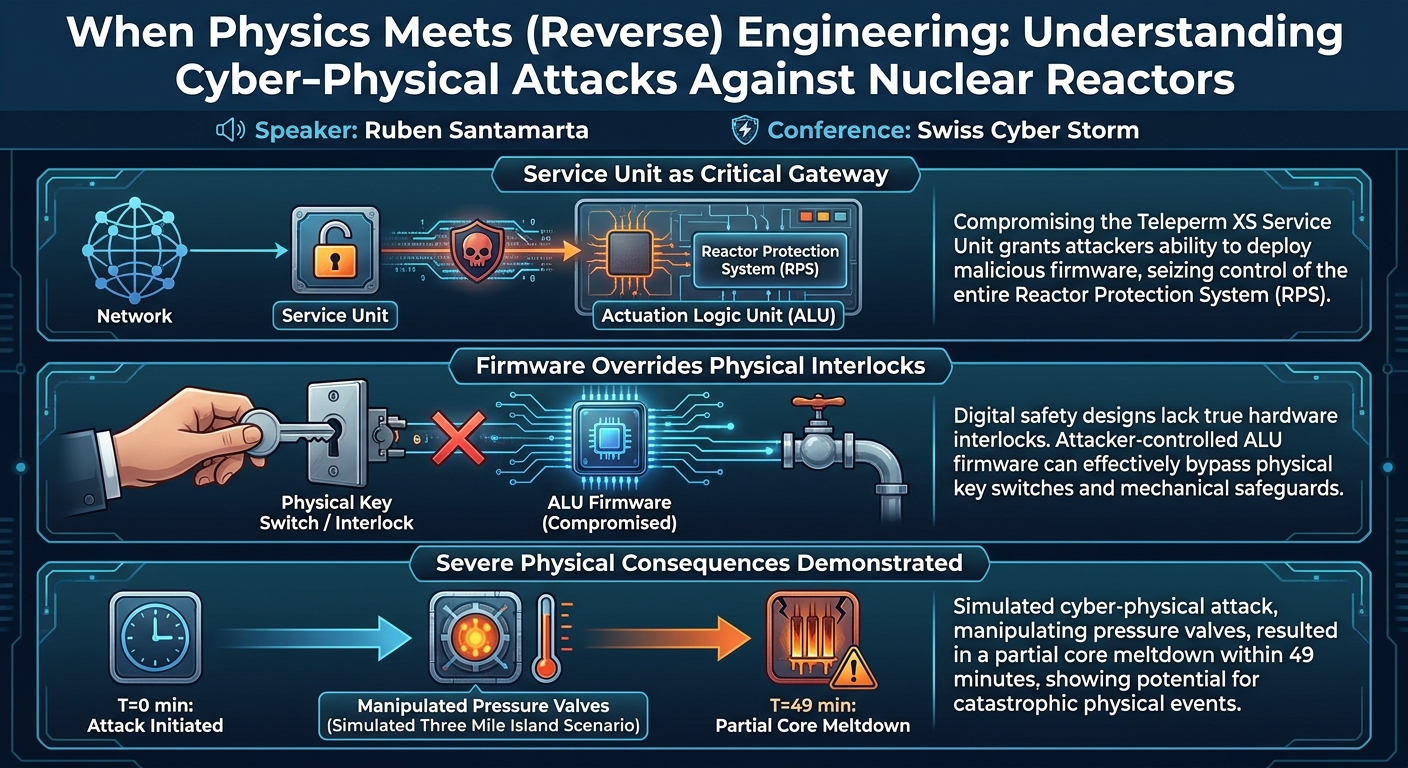
Santamarta's investigation into the Teleperm XS platform yielded several critical findings regarding its architecture, potential vulnerabilities, and the implications for cyber-physical attacks. The research established that the Service Unit is the primary target for any remote, malware-based attack, a scenario considered the most plausible given the isolated nature of these systems. Compromising the Service Unit effectively grants an attacker the "keys to the kingdom," enabling the deployment of new firmware or user applications to the functional units, thereby allowing control over the entire reactor protection system and the issuance of actuation orders.
A significant discovery relates to the operational modes of industrial controllers and PLCs, which are also present in Teleperm XS. The platform features four distinct modes: Operation, Parameters, Diagnosis, and potentially others. While changing from "Operation" to "Parameters" or "Diagnosis" typically requires a physical key switch and a Service Unit command, Santamarta points out that these modes are ultimately controlled by firmware. This is a crucial insight: "if you control the firmware, it doesn't matter if you use the key switch or not because you will have total control over the logic." This implies that the physical key switches, often perceived as robust hardware interlocks, can be bypassed if the underlying firmware is compromised. The speaker explicitly states that there are "no hardware interlocks" in the design of the digital reactor protection system, meaning permissives and interlocks are primarily handled by the Actuation Logic Unit (ALU) firmware.
The talk then details a simulated cyber-physical attack scenario, replicating aspects of the Three Mile Island accident. By gaining control over the reactor protection system, an attacker could manipulate critical components, such as the pressurizer pressure safety relief valves, to vent coolant from the reactor coolant system. This action would lead to the uncovering of the reactor core, causing the fuel to overheat and potentially melt down. Santamarta's simulation, conducted using a commercial tool, demonstrated that within 49 minutes, the core was partially uncovered and began to melt. While he acknowledges that the reactor containment would likely mitigate a catastrophic release, such an event would still constitute a "very serious situation," highlighting the profound physical consequences of a successful cyber attack against these systems.
Technical Deep Dive
▶ Watch: Teleperm XS architecture and Service Unit vulnerability (10:10)
The technical deep dive into Teleperm XS begins with the hardware acquired by Santamarta: a common Teleperm XS rack populated with several modules. Key among these was the main processing module, described as a microprocessor-based board utilizing a Meed KE6-2 processor. This module contains flash memory intended to store the Teleperm XS core software. However, the brand-new modules obtained did not contain any firmware, which is typically loaded just before deployment in a plant. Another crucial component was the communication module, providing Ethernet connectivity to the platform via a local extension bus.
The architectural layout of Teleperm XS deployments, illustrated with examples from the Tainwan 1 plant in China and the Beznau nuclear power plant in Switzerland, reveals five main functional units on the safety side:
- Acquisition and Processing Unit (APU): This unit is responsible for collecting inputs from various sensors throughout the plant. Based on these inputs and the current state of the plant, the APU processes the data and determines the necessary course of action.
- Actuation Logic Unit (ALU): Receiving information from the APU, the ALU is responsible for issuing actuation orders to field devices. These orders control critical components such as valves, pumps, and the control rods drive mechanism, directly influencing the reactor's operation and safety functions.
On the non-safety side, but with critical links to the safety system, are:
- Service Unit: This unit holds a bidirectional connection to the Monitoring and Service Interface (MSI). As previously highlighted, the Service Unit is the primary target for remote attacks. Its compromise allows attackers to deploy new firmware or user applications to the APUs and ALUs, effectively gaining control over the entire reactor protection system. The MAC address of the Service Unit is also used as an access control mechanism, suggesting that an attacker could either compromise the existing unit or deploy an alternative implant impersonating its MAC address within the network.
- Monitoring and Service Interface (MSI): Acting as a router and firewall, the MSI serves as the crucial point of contact between the non-safety and safety parts of the system. It filters unwanted traffic and routes messages originating from the Service Unit to the safety-related functional units.
- Gateway: This unit provides a one-way link, typically for OPC (OLE for Process Control) data, allowing plant operators to monitor the system's status without introducing a direct communication path back into the safety network.
The attack vector hinges on compromising the Service Unit. Once compromised, an attacker can exploit the system's operational modes. The Teleperm XS functional units (APU, ALU) can operate in modes like "Operation," "Parameters," and "Diagnosis." To change parameters or upgrade firmware (in "Diagnosis" mode), a physical key switch is typically required, followed by a command from the Service Unit. However, Santamarta's crucial finding is that these modes and their associated interlocks are fundamentally controlled by firmware. This means that if an attacker gains control over the Service Unit and can push malicious firmware, they can bypass the physical key switch mechanisms, gaining "total control over the logic."
For a successful attack, an implant acting as an alternative Service Unit would need to receive specific messages (signaling, data, commands) from the safety network to understand the system's state and detect "permissive" conditions for infection. The speaker notes that even manual controls for actuation orders often route through the digital protection system (ALU and APU), meaning an attacker could potentially override or manipulate these as well. The chosen attack sequence, mimicking Three Mile Island, involved manipulating the pressurizer pressure safety relief valves to cause a loss of coolant accident (LOCA), leading to core uncover and melt. This specific sequence bypasses the inherent safety features of pressurized water reactors (PWRs), which are otherwise designed to be extremely resilient. The core issue remains the ability to control the ALU, which dictates permissives and interlocks in a purely digital system, thereby enabling an attacker to orchestrate events that would otherwise be prevented by multiple layers of defense.
Demo / Proof of Concept
▶ Watch: Conclusions: education, SMRs, and geopolitical targets (20:10)
While the presentation did not feature a live, real-time demonstration, Ruben Santamarta detailed a powerful proof of concept through a simulated cyber-physical attack. This simulation was conducted using a commercial tool, allowing for the realistic modeling of nuclear reactor dynamics and responses to control system manipulations.
The core of the demonstration involved replicating a scenario akin to the infamous Three Mile Island accident. In this historical event, a combination of mechanical failure, design flaws, and human error led to a partial core meltdown. Santamarta's simulated attack aimed to achieve a similar outcome by manipulating the pressurizer pressure safety relief valves. The objective was to intentionally vent coolant from the reactor coolant system, a critical action that, if sustained, would lead to the uncovering of the reactor core.
The results of this simulation were stark and specific: within 49 minutes, the reactor core was partially uncovered, and the fuel began to melt. This outcome vividly illustrates the potential for a sophisticated cyber attack to transition from the digital realm to severe physical consequences within a nuclear power plant. Santamarta emphasized that while the reactor containment building is designed to mitigate the release of radioactive materials in such a severe accident, a core meltdown remains a "very serious situation" with profound environmental, economic, and safety implications. The simulation serves as a compelling testament to the destructive potential of compromising safety-critical I&C systems like Teleperm XS.
Defensive Implications
▶ Watch: Q&A: Bypassing digital safety interlocks (26:30)
The findings from Ruben Santamarta's research carry significant defensive implications for the nuclear industry and cybersecurity professionals. Foremost among these is the critical need for education and transparency. Santamarta argues that dispelling myths and fostering a greater public understanding of nuclear technology, including its cyber aspects, is vital. This proactive approach can enhance preparedness and enable better identification and response to potential cyber-related nuclear incidents, such as the fabricated radiation spikes detected near the Chornobyl exclusion zone during the 2022 Russian invasion of Ukraine.
The emergence of Small Modular Reactors (SMRs) as the "next big thing" in nuclear power also presents a new frontier for defense. These smaller, often standardized reactors will require robust cybersecurity strategies from their inception, learning from the vulnerabilities identified in existing large-scale plants. While nuclear power plants are inherently complex and designed with extensive safety features, they remain valuable targets during armed conflicts or profound geopolitical confrontations. Although such attacks are considered "extremely rare," the potential consequences necessitate a high level of vigilance and preparedness.
A key technical takeaway for defenders relates to the Service Unit and its network connectivity. While ideally, safety systems and their connected computers should operate in an isolated, air-gapped environment with point-to-point connections, Santamarta's review of some designs revealed that Service Units might still connect to other components like test computers and certain network devices. This expanded attack surface, even if seemingly minor, could be exploited to impersonate the Service Unit, bypassing its MAC address-based access control without direct compromise of the unit itself. Defenders must rigorously enforce strict network segmentation and monitor all connections to and from the Service Unit.
Perhaps the most profound defensive implication stems from the revelation that digital reactor protection systems, such as Teleperm XS, lack hardware interlocks in their design. Instead, permissives and interlocks are primarily handled by the Actuation Logic Unit (ALU) firmware. This means that if an attacker can compromise the Service Unit and subsequently load malicious firmware onto the ALU, they gain complete control over these safety mechanisms, effectively rendering physical key switches and other mechanical safeguards ineffective. This underscores the paramount importance of firmware integrity and secure update processes for all safety-critical I&C systems. Rigorous supply chain security, robust firmware authentication, and continuous vulnerability assessments targeting the software stack of these systems are indispensable.
Finally, while targeting non-safety systems (e.g., turbine control systems) could lead to a reactor trip (scram), causing physical damage to the NPP requires compromising the safety systems. Defenders must prioritize the security of the RPS and ESFAS, acknowledging that their compromise can lead to lasting damage. The inherent safety features of modern reactors are strong, but they can be systematically bypassed through a sequence of events controlled by a compromised digital safety system. Therefore, a holistic defense strategy must encompass not only network and host security but also deep understanding and protection of the underlying I&C logic and firmware.
Key Takeaways
- Critical Infrastructure Target: Nuclear Instrumentation and Control (I&C) systems, exemplified by Teleperm XS, are highly complex and critical infrastructure components whose security is paramount, especially given the "nuclear comeback" driven by new energy demands.
- Service Unit as Gateway: The Service Unit in the Teleperm XS architecture is a primary target for sophisticated attackers; its compromise grants the ability to deploy malicious firmware and applications, effectively taking control of the entire Reactor Protection System (RPS).
- Firmware Overrides Hardware: A significant vulnerability lies in the absence of hardware interlocks in digital RPS designs. Physical key switches and other mechanical safeguards can be bypassed if an attacker controls the underlying firmware of the Actuation Logic Unit (ALU), enabling manipulation of safety logic and permissives.
- Severe Physical Consequences: Cyber-physical attacks against nuclear safety systems can lead to severe operational incidents, as demonstrated by the simulated Three Mile Island-like scenario resulting in a partial core meltdown within 49 minutes.
- Nation-State Threat: While opportunistic attacks are unlikely due to system isolation, the complexity and potential impact of compromising an NPP make it a valuable target for well-resourced nation-state or state-sponsored actors, particularly in times of geopolitical conflict.
- Education and Transparency are Key: Proactive education, transparency, and increased awareness within the nuclear industry and among the public are crucial for identifying, understanding, and mitigating potential cyber-related nuclear incidents, including those affecting future Small Modular Reactors (SMRs).
About the Speaker(s)
Ruben Santamarta is a distinguished security researcher with a notable career in cybersecurity. He has been actively involved in Swiss security for several years, gaining recognition for his significant findings, including reports on the Swiss Post e-voting program. Santamarta's expertise spans a wide range of security topics, often involving in-depth analysis of complex systems. This particular research marks a new focus on nuclear power plants and cyber-physical attacks, culminating in a freely available research paper that expands upon the concepts presented in this talk. His work aims to educate and raise awareness about the potential cyber threats to critical infrastructure.
Reviews
Dr. Zero (Offensive Security Researcher) — MUST SEE
Ruben Santamarta bought decommissioned nuclear reactor safety gear on eBay and reverse-engineered it to prove the physical safety interlocks are a lie. This is exactly the kind of deep-weeds hardware research that conferences were built for. No hype, just a masterclass in why trusting firmware to enforce physical boundaries is a recipe for a meltdown.
Heather Calloway (CISO) — STRONG ACCEPT
Santamarta reverse-engineered the digital safety systems used in modern nuclear reactors and found that their physical safety switches are just firmware logic. If your company is banking on nuclear power or SMRs for its AI data centers, this is a sobering look at how digital convenience undermines physical defense-in-depth.