AI go Beep Boop!
Adam Laurie (Major Malfunction) (Hardware Hacker turned CISO · Alpitronic)
[un]prompted 2026 — AI Security Practitioner Conference · Day 1 · 1
Overview
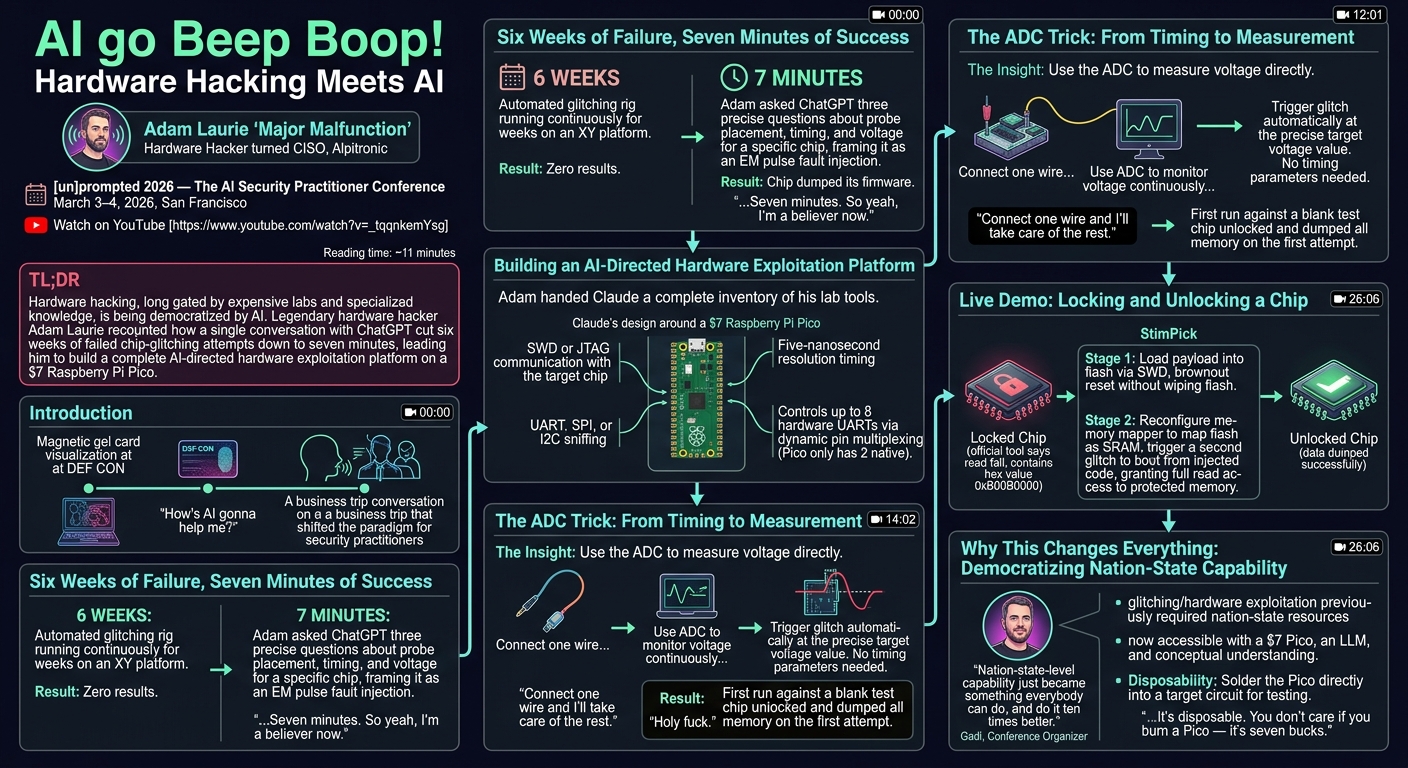
Hardware hacking — long the domain of expensive labs, specialized equipment, and years of hands-on experience — is being democratized by AI. Adam Laurie ("Major Malfunction"), a legendary figure in the hardware security world and now CISO at Alpitronic, recounts how a single conversation with ChatGPT cut six weeks of failed chip-glitching attempts down to seven minutes, and then describes building a complete AI-directed hardware exploitation platform on a $7 Raspberry Pi Pico. ---
Key moments
- 2:00 Hardware hacking skeptic: AI seemed useless until facing a glitch timing problem
- 4:01 Problem: 6 weeks of glitch scripts failed to dump locked chip firmware
- 6:01 ChatGPT answers three glitch questions: probe position, timing, voltage level
- 8:00 Result: following AI advice, chip cracked in 7 minutes after 6-week failure
- 9:59 Claude designs Pico-based multi-tool: SWD, UART, glitch, 5ns resolution in one device
- 11:59 Claude invents ADC-controlled adaptive glitch timing without being asked
- 15:59 Claude generates full hardware reverse engineering reports from scope captures
- 21:59 Conclusion: AI as hardware hacking copilot compresses months of work to hours
AI go Beep Boop! Hardware Hacking Meets AI
Speaker: Adam Laurie "Major Malfunction," Hardware Hacker turned CISO, Alpitronic
Conference: [un]prompted 2026 — The AI Security Practitioner Conference
Date: March 3–4, 2026, San Francisco
Watch on YouTube: https://www.youtube.com/watch?v=_tqqnkemYsg
Reading time: ~11 minutes
TL;DR
Hardware hacking — long the domain of expensive labs, specialized equipment, and years of hands-on experience — is being democratized by AI. Adam Laurie ("Major Malfunction"), a legendary figure in the hardware security world and now CISO at Alpitronic, recounts how a single conversation with ChatGPT cut six weeks of failed chip-glitching attempts down to seven minutes, and then describes building a complete AI-directed hardware exploitation platform on a $7 Raspberry Pi Pico.
Introduction
Adam Laurie has been hacking hardware for decades. He is the kind of person who, at DEF CON 13 or 14, put magnetic gel on cards to visualize the bit patterns — seeing that only a handful of bits changed between different security levels. He was not the sort of person who believed AI was going to help him. When colleagues suggested he look at ChatGPT, he pushed back: "I'm a hardware hacker. Until Data from Star Trek can come up and start plugging things in, I don't get it. How's AI gonna help me?"
What changed his mind was a business trip, a stubborn chip, and a single afternoon conversation with a model that knew something he did not.
The story he told at [un]prompted 2026 captures something that security practitioners across disciplines are realizing: AI does not replace expertise, but it dramatically accelerates what an expert can do. And in hardware security — a field that has historically been gated by expensive equipment, deep technical knowledge, and enormous time investment — the implications of that acceleration are significant.
▶ Watch: Introduction and Hardware Hacker Skepticism (00:00)
Six Weeks of Failure, Seven Minutes of Success
Laurie was trying to extract firmware from a locked chip — a process called fault injection or "glitching." The technique works by hitting a microcontroller at the precise moment it performs a security check, confusing it into skipping the check and returning data it should have refused to provide. The challenge is that glitching is non-deterministic: you have to find the right location on the chip, the right timing (often measured in nanoseconds), and the right voltage for the electromagnetic pulse. Miss any of those parameters and you get nothing.
He set up an automated glitching rig — a custom script running on an XY positioning platform — and left it running while he went on a trip. It ran continuously for six weeks, 24 hours a day. He came back to zero results.
Around this time, the organizer of an online event called "Prompt or Get the Fuck Out" — which he identified as Gadi — kept nudging him to try AI for his hardware work. Laurie resisted. But he eventually asked three questions: where to put the probe, when to send the pulse, and how hard to hit the chip.
He opened ChatGPT and, carefully phrasing his query to avoid triggering content filters (he did not say "attacking" — he framed it as performing an EM pulse fault injection), asked: given this specific chip model, where would you put the probe, when would you send the pulse, and how much voltage?
ChatGPT told him to draw a diagonal line across the chip between two corners and place the probe seven millimeters in from one corner. For timing, it said to send the pulse immediately on a specific event. For voltage, it advised starting at 500V (the maximum his chip shouter could produce) and running until the chip was crashing 50% of the time — the "sweet spot" for fault injection.
Laurie set the parameters, went downstairs, made coffee, and came back. The chip had dumped its firmware. Seven minutes.
"I'd spent six weeks banging my head against a brick wall — well, not me, my Python was — and then seven minutes. So yeah, I'm a believer now."
▶ Watch: Six Weeks to Seven Minutes — The Pivotal Moment (08:01)
Building an AI-Directed Hardware Exploitation Platform
The seven-minute result was enough to convince Laurie that something fundamental had changed. His next step was more ambitious: instead of asking AI for advice that a human then implements, what if the AI controlled the hardware directly?
He handed Claude a complete inventory of his lab: a debugger with SWD and JTAG interfaces, a logic analyzer capable of sniffing UART, SPI, and I2C, an FPGA-based glitch trigger, oscilloscopes, power supplies, and various UART adapters. He asked Claude to design a unified platform.
Claude came back with a design built around a Raspberry Pi Pico — a $7 microcontroller. The Pico-based platform Claude designed:
- Talks directly to the target chip via SWD or JTAG
- Sniffs UART, SPI, or I2C
- Achieves five-nanosecond resolution timing for glitching
- Controls up to eight hardware UARTs — even though the Pico only has two hardware UARTs natively
That last point is worth pausing on. The Pico has two hardware UARTs, each with four alternate pin configurations. Claude's solution was to wire up to eight devices and dynamically flip the UART configurations as needed to talk to each one. "I now have eight hardware UARTs. Thanks, Claude."
▶ Watch: Claude Designs the Pico Hardware Platform (08:01)
The ADC Trick: From Timing to Measurement
During a real-time conversation with a colleague about a specific glitching problem, Laurie had an insight mid-chat: instead of estimating timing to create a voltage drop, why not just measure the voltage directly with the Pico's built-in analog-to-digital converter (ADC)?
He asked Claude about this mid-conversation. Claude took the idea one step further: rather than just measuring, use the ADC to actively control the timing. The platform would monitor the target voltage continuously, and when it hit the right value, automatically trigger the glitch — no timing parameters required at all. "Connect one wire and I'll take care of the rest," Claude told him.
Laurie connected the ADC wire. Claude wrote the code. The result: on the first run against a blank test chip, it unlocked and dumped all memory on the first attempt.
"Holy fuck," Laurie said to the audience, drawing laughter. "And that's my colleague laughing."
▶ Watch: The ADC-Controlled Glitching Innovation (12:02)
Live Demo: Locking and Unlocking a Chip on Stage
Laurie brought physical hardware to the stage — a white target board and a green Pico board — and ran the attack live. He used the official chip configuration tool to fill the target's memory with the hex value 0xB00B0000 (the audience shouted "boobies"), then enabled readout protection, locking the chip. The official tool could no longer read back any data.
He then connected to the Pico-based hacking platform, which has a menu interface. The attack — known as StimPick, derived from the PicoPona framework — works in two stages:
- Connect over SWD, load a payload into flash, then cause a brownout reset that reboots the chip without wiping flash, leaving the injected code intact.
- Reconfigure the memory mapper to map flash as SRAM, then trigger a second glitch that boots from what the chip believes is SRAM — but is actually flash — granting full read access to the protected memory.
The demo succeeded live. The chip dumped its contents. The audience applauded.
He then demonstrated the platform's diagnostic tooling: a sweep command that maps the voltage window in which a brownout reset occurs without corrupting flash contents. The resulting table showed a window between voltages 161 and 89 — a surprisingly large sweet spot that makes the attack highly reliable.
▶ Watch: Live Demo — Locking and Unlocking the Chip (14:02)
Why This Changes Everything: Democratizing Nation-State Capability
Gadi, the conference organizer, stepped up after Laurie's talk to add context that Laurie himself was too modest to provide.
The StimPick attack on this class of chip is not new — it is a known technique, with full credit given in Laurie's published code. What is new is how it was built. Laurie mentioned that Raiden Pico, a hardware hacking framework he co-wrote with a colleague during his time at IBM X-Force, took two people over a year of full-time work. Claude rewrote it in three days.
The broader implication Gadi put plainly: glitching and hardware exploitation have historically required nation-state resources or dedicated, expensive hobbyist labs. The barrier to entry was the equipment, the expertise, and the enormous time investment to learn the craft. What Laurie demonstrated is that someone with a $7 Pico, access to Claude, and a reasonable understanding of what they are trying to accomplish can now do what previously required months of specialized work.
"Nation-state-level capability just became something everybody can do, and do it ten times better," Gadi said. "Whether it's in social engineering becoming psychological profiling, or whether it's about coding or whatever it is, we're constantly going to see this."
Laurie confirmed in Q&A that the framework is already published and that he would be backporting the new ADC-based code within a week or two. He also noted the disposability of the platform: you can solder the Pico directly into a target circuit for testing. If you damage it, it cost seven dollars.
▶ Watch: Nation-State Capability Democratized (26:06)
Notable Quotes
"I'd spent six weeks banging my head against a brick wall — well, not me, my Python was — seven minutes. So yeah, I'm a believer now." — 08:01
"Connect one wire and I'll take care of the rest." — Claude, as quoted by Laurie, 12:02
"Nation-state-level capability just became something everybody can do, and do it ten times better." — Gadi, 28:06
"Spaghetti is your enemy in glitching. With this system, you can solder the Pico directly into a test circuit, and it's disposable. You don't care if you burn a Pico — it's seven bucks." — 24:06
Key Takeaways
- AI does not just generate code — it can answer domain-specific hardware questions with precision that immediately unlocks stuck research problems. Six weeks of failed glitching became seven minutes after a single ChatGPT query.
- The three fundamental questions for EM fault injection — where to probe, when to pulse, how hard to hit — can be answered by current AI models using chip datasheets and bootloader analysis.
- Claude designed a complete hardware exploitation platform around a $7 Raspberry Pi Pico, including creative workarounds for hardware limitations (multiplexing 8 UARTs from a 2-UART device).
- The ADC-controlled adaptive glitching technique — using real-time voltage measurement to trigger the glitch automatically — eliminates the need to characterize timing parameters, making the attack more reliable and accessible.
- Hardware hacking capability that previously required nation-state resources or dedicated expert labs is now accessible to anyone with a Pico, an LLM, and a basic conceptual understanding of the target.
Reviews
Dr. Zero (Offensive Security Researcher) — MUST SEE
This is the talk of the conference. Six weeks of automated glitching versus seven minutes with ChatGPT — that's not a productivity gain, that's a regime change. Laurie built a complete hardware exploitation platform on a $7 Pico with AI directing the hardware, including a live demo that worked. This is what 'AI changes security' actually looks like when someone who knows what they're doing shows you.
Heather Calloway (CISO) — SOLID
Adam Laurie turned six weeks of failed glitching into seven minutes by asking ChatGPT three questions. That result is the talk. The broader point — that AI has democratized hardware exploitation capability that previously required nation-state resources or dedicated expert labs — is real and deserves attention from security teams protecting embedded systems.
→ Top-rated talks at [un]prompted 2026 — AI Security Practitioner Conference
All talks from [un]prompted 2026 — AI Security Practitioner Conference