Three Phases of AI Adoption: From GPU Lottery to Enterprise Agreements
Chase Hasbrouck (Chief of Forensics/Malware Analysis · U.S. Army Cyber Command)
[un]prompted 2026 — AI Security Practitioner Conference · Day 1 · 2
Overview
Lt. Colonel Chase Hasbrouck spent two years trying to get U.S. Army cybersecurity personnel to adopt AI tools — and largely failed. His talk traces three distinct phases of military AI adoption: a shadow-usage era with no approved tools, a centralized-but-inadequate first deployment, and a new enterprise agreement phase that finally delivers access but runs headlong into a culture problem. The takeaway for enterprise security teams: access is the easy problem; culture is the hard one. ---
Key moments
- 1:59 US Army: 1M+ workforce, part-time Guard/Reserve, multiyear ATO procurement cycle
- 4:00 Space Force memo 2023: 'No enterprise use of AI, period' — most services followed
- 7:59 Shadow AI: power users running home to query ChatGPT with CUI-adjacent questions
- 9:59 Camo GPT: Army's Llama 2-based tool gets ATO but lacked doc parsing and web browsing
- 11:59 Adoption failure: 95% of users abandoned tool when PDF required copy-paste into text file
- 13:59 Phase 2: enterprise procurement wins — real GPU access and better models obtained
- 16:59 Key lesson: technical capability gap between approved tools and commercial tools drives shadow AI
- 19:59 Phase 3: agents and MCP servers for Ghidra being explored for reverse engineering workflows
Three Phases of AI Adoption: From GPU Lottery to Enterprise Agreements
Speaker: Chase Hasbrouck, Chief of Forensics/Malware Analysis, U.S. Army Cyber Command (Lt. Colonel, U.S. Army)
Conference: [un]prompted 2026 — The AI Security Practitioner Conference
Date: March 3–4, 2026, San Francisco
Watch on YouTube: https://www.youtube.com/watch?v=UOtVmYR0mRg
Reading time: ~9 minutes
TL;DR
Lt. Colonel Chase Hasbrouck spent two years trying to get U.S. Army cybersecurity personnel to adopt AI tools — and largely failed. His talk traces three distinct phases of military AI adoption: a shadow-usage era with no approved tools, a centralized-but-inadequate first deployment, and a new enterprise agreement phase that finally delivers access but runs headlong into a culture problem. The takeaway for enterprise security teams: access is the easy problem; culture is the hard one.
Introduction
Chase Hasbrouck has run forensics and malware analysis for the U.S. Army, led the Army's SolarWinds Orion incident response, spent time at DARPA as part of their Service Chiefs Fellows program, and advised on Task Force Lima — the DoD's initial attempt to understand what ChatGPT actually was and why it mattered. He is also, by his own description, someone who "for two years tried to drag government cybersecurity personnel into using chatbots and largely failed."
That framing set the tone for a talk that was more useful for its candor about failure than for any story of success. The [un]prompted 2026 audience got a ground-level view of what AI adoption looks like when you operate inside an organization of over a million people, with procurement cycles measured in years, security accreditation workflows that don't begin until after procurement is complete, and a workforce where a third of the people are part-time.
Disclaimer: Hasbrouck presented in a personal capacity. The views expressed were his own and do not represent official positions of the U.S. Army, Army Cyber Command, or the Department of Defense.
▶ Watch: Speaker background and context-setting (00:00)
The Scale Problem: One Million People, Part-Timers and All
Before the three-phase story, Hasbrouck established the institutional context that makes military AI adoption categorically different from enterprise adoption in the private sector.
The Army counts over one million people when combining active duty, National Guard, Army Reserve, and civilian employees. Roughly a third of that workforce is part-time. Implementing security controls for a part-time workforce at million-person scale is a problem that most enterprise security frameworks weren't designed for. Hasbrouck invited anyone who has solved this to come find him afterward.
Getting new technology into that environment is also genuinely hard. The Silicon Valley norm — get an API key, spin up an environment, you're running — does not apply. There is a formal Authority to Operate (ATO) process. But the ATO doesn't begin until after procurement. Procurement itself can take multiple years. And the teams doing security accreditation may reach a different conclusion than the teams who specified the original requirement. The result: four-year cycles are not unusual, and by the time accreditation completes, the tool, the team, and the threat landscape may all have changed.
Classification requirements compound everything. Everything Hasbrouck discussed applied only to unclassified systems or Controlled Unclassified Information (CUI). The classified environment is a separate and even more complex problem.
▶ Watch: Scale, procurement cycles, and the ATO process (04:00)
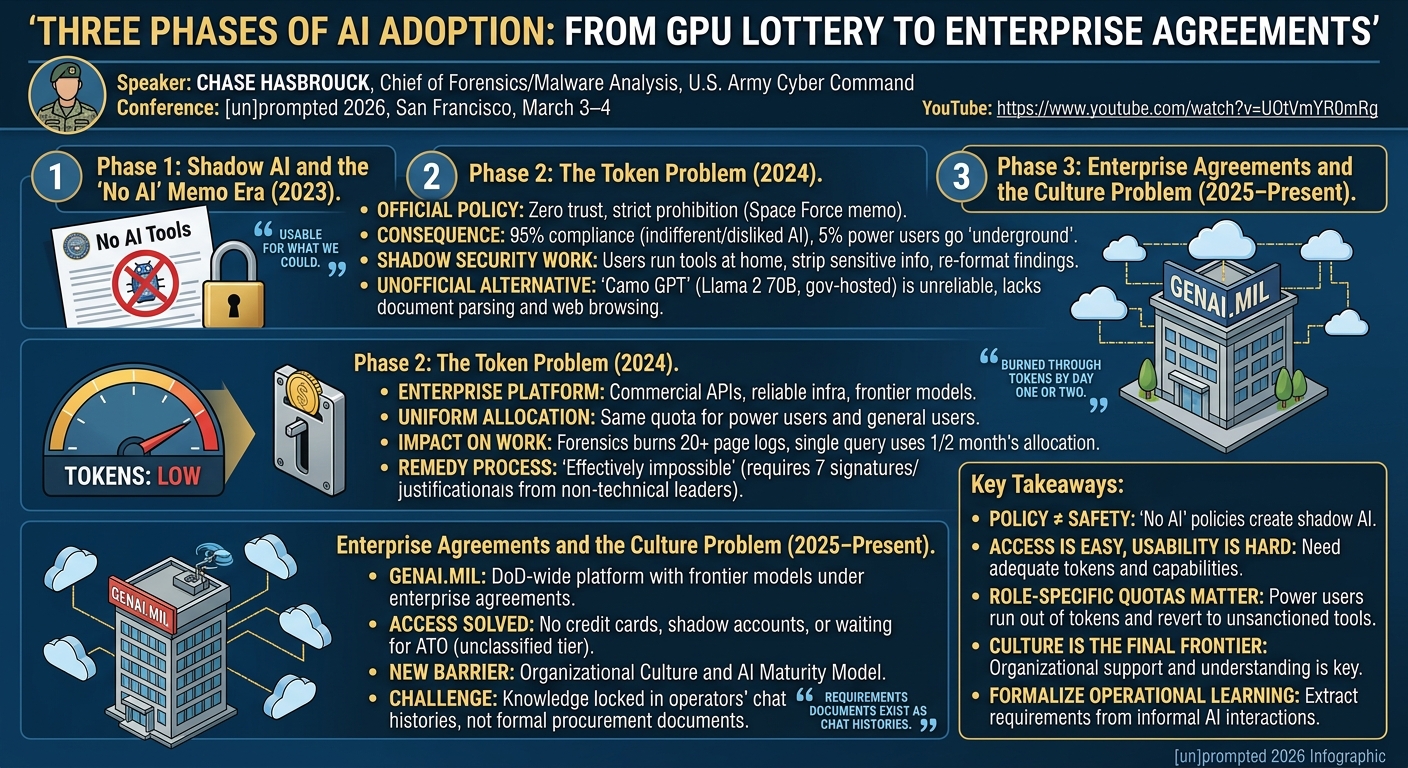
Phase One: Shadow AI and the "No AI" Memo Era (2023)
When ChatGPT arrived, the official response from military leadership was swift and restrictive. Space Force was first with an enterprise memo: no AI tools, no exceptions. Most other services followed, formally or informally.
The predictable result: about 95% of the workforce complied easily, because they already didn't care about AI or actively disliked it. The 5% who were actively experimenting — power users like Hasbrouck and his forensics team — went underground. They used AI tools at home on personal devices, carefully avoided passing any sensitive information, and then translated their findings back into work-appropriate formats. "You had a lot of this shadow security work going on," Hasbrouck said.
The official alternative offered during this period was the Army's "Camo GPT" deployment — a government-hosted instance running Llama 2 70B. This addressed the official access problem but created new ones. Llama 2 70B was reasonable for its time, but power users who had been using GPT-4 Turbo or Gemini Pro at home found stepping back to Llama 2 a significant capability regression. The tool also lacked document parsing and web browsing — features that commercial tools had shipped and that made the difference between a useful tool and a research curiosity. And infrastructure reliability was poor: queries to the government-hosted system sometimes came back in hours rather than minutes, and RAG-type queries were especially slow. In practice, the approved tool was "usable for what we could" — and the shadow usage continued.
▶ Watch: Phase one — the "No AI" era and Camo GPT (08:00)
Phase Two: The Token Problem (2024)
Phase two brought a significant improvement: a new enterprise platform using commercial APIs, reliable infrastructure, and access to frontier models. "Problem solved, right?" Hasbrouck said. "Yeah, no — tokens."
The platform came with per-user token allocations. For bureaucratic and political reasons, there was no distinction between power users and general users. Everyone received the same allocation. For general users doing email drafting or simple summarization, the allocation was adequate. For forensics analysts doing what forensics analysts do — loading 20-page log files, diffing them against earlier captures, looking for meaningful behavioral differences — a single serious query could burn half a month's allocation.
The remedy process required seven signatures and seven written justifications from senior officials who, in Hasbrouck's description, did not understand what an LLM was. "In practice, the process was, let's call it effectively impossible." The forensics team burned through their tokens on day one or two of the month and returned to using AI Studio — which they "don't talk about."
The token problem illustrates a recurring failure mode in enterprise AI rollouts: platform access is not the same as practical usability. A tool that can't handle the actual workload of its power users will either drive those users to unsanctioned alternatives or fail to deliver value at all.
▶ Watch: Phase two — token scarcity and the enterprise platform gap (12:01)
Phase Three: Enterprise Agreements and the Culture Problem (2025–Present)
The current phase centers on genai.mil, the DoD-wide AI platform. Several major commercial AI vendors are connecting enterprise versions of their tools to it. A DoD worker can now go to genai.mil and access frontier models through the enterprise agreement — no personal credit cards, no shadow accounts, no waiting for ATO. The access problem is, at least at the unclassified tier, largely solved.
What isn't solved is culture. Hasbrouck described three levels of AI maturity across the organization:
The "AI in a box" crowd. Leadership has designated one person — "the AI guy" — to own AI questions and handle demos for senior officials. This is a reasonable starting point. But whether it becomes the permanent model matters enormously. Technologies like VR and niche space applications can reasonably stay in a box with a specialist. GPS and computers should have been generalized as fast as possible once the utility became clear. Hasbrouck's view: AI is closer to GPS than to VR.
The tool-first adopters. These are teams that got access to a specific AI tool, figured out how to use it for one task, and stopped there. The tool is part of the workflow, but there's no broader understanding of what AI can do or how to apply it differently.
The genuinely curious. The smallest group — people who are systematically exploring what AI can and cannot do, finding new applications, and thinking about how the technology changes their work. These are the people Hasbrouck describes as having actual AI literacy, and they're rare.
The deeper culture problem is that many of the requirements documents the Army needs — specifications for procurement decisions that will take years to execute — currently exist as chat histories in various LLM platforms. The people doing the work have figured out what they need, but that knowledge is locked in informal interactions rather than formal procurement documents. "How do we extract the knowledge out of those chat histories and actually get it from the operators down at the lower tactical levels and get it to the enterprise procurement folks?" Hasbrouck asked. There is no clean answer yet.
▶ Watch: Phase three — genai.mil and the culture challenge (14:01)
Q&A Highlights
On National Guard and Reserve access: Hasbrouck acknowledged that mobile and BYOD solutions are in development, but that the challenges for part-time personnel are not fully addressed. He invited anyone who has solved the part-time workforce AI access problem to discuss it afterward.
On advice for future forensics professionals: For those training the next generation of military cyber talent, Hasbrouck emphasized the "so what" skill over raw technical proficiency — the ability to take a technical finding and explain why it matters to a non-technical stakeholder. AI can assist with translation, but you need enough domain knowledge to judge whether the output is accurate and meaningful.
On fine-tuning: The Army has found little net benefit from fine-tuning or specializing models. By the time procurement, fine-tuning, and evaluation complete, the general frontier model has advanced enough to make the specialized model uncompetitive. More value comes from building task-specific workflows than from model customization.
▶ Watch: Q&A — Guard and Reserve access, future talent, fine-tuning (18:01)
Notable Quotes
"How I, for two years, tried to drag government cybersecurity personnel into using chatbots and largely failed."
— Chase Hasbrouck (alternate subtitle for the talk), 00:00
"In practice, the process was effectively impossible. So fundamentally, we were still burning our tokens by day one or two, and then everybody was still going and using AI Studio — though we don't talk about that."
— Chase Hasbrouck, 12:01
"Things like GPS and computers clearly should not have been left in a box. The faster we can get those out there, the better."
— Chase Hasbrouck, 16:01
"A lot of our requirements documents right now exist as people's chat histories on various LLM platforms."
— Chase Hasbrouck, 18:01
Key Takeaways
- "No AI" policies create shadow AI, not safety. The 5% of power users who need the tools will find ways to use them regardless. The question is whether those ways include appropriate security controls.
- Access is the easy problem; usability is harder. Platform access without adequate token allocations, document processing capabilities, or reliable infrastructure fails the users who would get the most value.
- Token allocation without role differentiation kills power user adoption. Applying uniform quotas across a diverse workforce means the highest-value users run out first and revert to unsanctioned tools.
- Culture is the phase-three problem. After access and cost are solved, the remaining barrier is whether people understand what AI can do and have the organizational support to use it effectively.
- Requirements knowledge is being lost in chat histories. Organizations need a mechanism to extract operational AI learnings from informal channels and translate them into formal procurement and governance inputs.
Slides Reference
Slides are available from the conference: 2026-04-04-D1-S2-10-46-Three-Phases-of-AI-Adoption-From-GPU-L.pdf. The slides cover the three phases of military AI adoption, the organizational scale and procurement cycle constraints, the Camo GPT and genai.mil deployments, the culture maturity model, and the speaker's background at DARPA and Task Force Lima.
Reviews
Dr. Zero (Offensive Security Researcher) — ACCEPTABLE
Hasbrouck's military AI adoption story is uniquely candid and the institutional failure modes he describes — token scarcity, ATO process lag, cultural inertia — are real and underreported. The 'largely failed' framing is more useful than a hundred success story talks. But this is an adoption talk, not a security talk.
Heather Calloway (CISO) — STRONG ACCEPT
Lt. Colonel Hasbrouck spent two years trying to get Army cybersecurity personnel to use AI tools and largely failed. His three-phase account — shadow AI, inadequate platform, and now access-without-culture — is the most honest institutional AI adoption story I've heard, and the failure modes he documents are happening in every large organization regardless of uniform.
→ Top-rated talks at [un]prompted 2026 — AI Security Practitioner Conference
All talks from [un]prompted 2026 — AI Security Practitioner Conference