Killing AI Slop: Building an Agentic DAST Scanner That Only Reports What It Can Prove
Armaan Pathan (Application Security Engineer · TACTICA AI), Rajanish Pathak (Security Researcher · TACTICA AI)
[un]prompted II 2026 — The AI Security Practitioner Conference
Overview
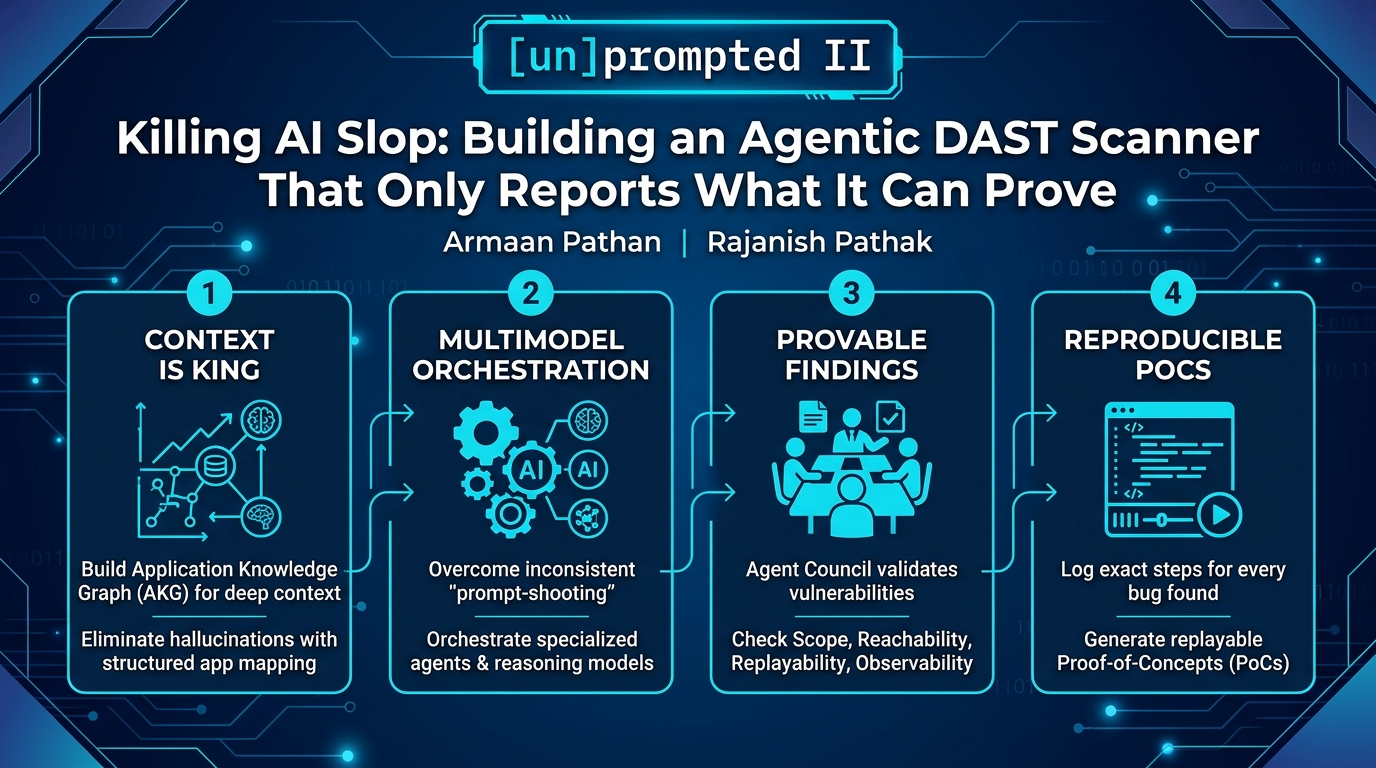
In an era increasingly dominated by artificial intelligence, the security industry faces a paradoxical challenge: leveraging AI for advanced threat detection while combating the very "slop" it can generate—hallucinations, false positives, and non-reproducible findings. This talk, "Killing AI Slop: Building an Agentic DAST Scanner That Only Reports What It Can Prove," presented by Armaan Pathan and Rajanish Pathak of TACTICA AI, introduces "Jir," a novel multimodel orchestration framework designed to overcome these limitations. Jir is an agentic DAST scanner that prioritizes context, reproducibility, and rigorous validation, aiming to deliver security findings with the same confidence and depth as a seasoned human bug bounty hunter.
Key moments
- 0:45 The core problem: AI 'slop' and non-reproducible findings
- 2:20 Introducing AKG: a custom crawler for application context
- 4:00 Threat modeling using AKG to generate specific test cases
- 6:30 Specialized agents and orchestrator for targeted vulnerability testing
- 7:40 Proving findings: leveraging an agent council for validation
- 8:50 Validated, reproducible findings with solid evidence and PoCs
Killing AI Slop: Building an Agentic DAST Scanner That Only Reports What It Can Prove
Speakers: Armaan Pathan (Application Security Engineer, TACTICA AI); Rajanish Pathak (Security Researcher, TACTICA AI)
Conference: [un]prompted II
YouTube: https://www.youtube.com/watch?v=6Yrikx43UWU
Overview
In an era increasingly dominated by artificial intelligence, the security industry faces a paradoxical challenge: leveraging AI for advanced threat detection while combating the very "slop" it can generate—hallucinations, false positives, and non-reproducible findings. This talk, "Killing AI Slop: Building an Agentic DAST Scanner That Only Reports What It Can Prove," presented by Armaan Pathan and Rajanish Pathak of TACTICA AI, introduces "Jir," a novel multimodel orchestration framework designed to overcome these limitations. Jir is an agentic DAST scanner that prioritizes context, reproducibility, and rigorous validation, aiming to deliver security findings with the same confidence and depth as a seasoned human bug bounty hunter.
The core premise of Jir is to move beyond mere prompt-shooting to models, which often lack application context and lead to unreliable outputs. Instead, the framework integrates a sophisticated understanding of the target application with a multi-agent validation process. This approach ensures that every reported vulnerability is not only identified but also thoroughly proven and accompanied by a concrete, reproducible proof-of-concept. The speakers, drawing from over 30 years of combined experience in bug bounties and security research, underscore the critical importance of replicating human security workflows to build truly effective and trustworthy AI-powered security tools.
This presentation matters significantly because it tackles one of the most pressing issues in AI-driven security: the credibility gap. By demonstrating a methodology for building an AI scanner that can "only report what it can prove," TACTICA AI offers a blueprint for developing robust, reliable, and actionable security intelligence. It sets a new standard for AI-powered DAST, emphasizing the need for deep technical context and a multi-stage validation process to filter out the noise and deliver high-fidelity security insights.
Background
▶ Watch: The core problem: AI 'slop' and non-reproducible findings (0:45)
The recent surge in AI capabilities has spurred a widespread adoption of AI models across various domains, including cybersecurity. Many security researchers and engineers, including the team at TACTICA AI, began experimenting with these frontier models to automate and enhance their security workflows. However, this early enthusiasm quickly revealed significant limitations, which the speakers collectively termed "AI slop." These challenges formed the foundational problem statement that Jir was built to address.
The primary issues identified were multifaceted. Firstly, simply "shooting prompts" at AI agents often resulted in non-reproducible and inconsistent outputs. The same prompt could yield different results, making it impossible to verify findings reliably. Secondly, a critical deficiency was the lack of application context. Without a deep understanding of the target application's architecture, functionality, and specific nuances, AI models struggled to produce genuine, deep insights. Instead, they would often hallucinate, generating findings that were not only invalid but also completely detached from the application's reality. This led to a proliferation of false positives and a significant waste of time for security teams attempting to validate them.
Another major pain point was the quality of Proof-of-Concepts (PoCs) generated by early AI harnesses. These PoCs were frequently broken, incomplete, or fundamentally flawed, rendering them useless for developers attempting to remediate vulnerabilities. Finally, a significant oversight was the absence of coverage tracking. AI models would declare an assessment complete without any verifiable mechanism to confirm whether all parts of the application—all routes, parameters, and input fields—had been thoroughly examined. This left critical blind spots and undermined the trustworthiness of the entire scanning process. The TACTICA AI team, with their extensive bug bounty experience, recognized that these issues stemmed from a fundamental disconnect between how AI models operate and the meticulous, context-aware approach of human security analysts. Their goal with Jir was to bridge this gap, automating the sophisticated workflow they themselves employed while ensuring the same level of depth and reproducibility.
Key Findings
▶ Watch: Threat modeling using AKG to generate specific test cases (4:00)
The core contribution of the TACTICA AI team through their Jir framework is the demonstration that AI-driven DAST can be rendered highly reliable and effective by integrating deep application context with a sophisticated, multi-agent validation process. This directly counters the pervasive "AI slop" problem, proving that AI models can move beyond mere pattern matching to perform nuanced security analysis.
One of the central discoveries is the indispensable role of a comprehensive Application Knowledge Graph (AKG). By meticulously mapping and understanding the target application's entire surface area, the AKG provides the essential context that traditional AI prompts lack. This context, when converted into a vectorized form, enables reasoning models to perform intelligent threat modeling and generate highly relevant test cases, significantly reducing irrelevant noise and focusing on actual attack surfaces.
Furthermore, the implementation of a multimodel agent council represents a pivotal finding. This unique architectural component allows different specialized agents to "debate amongst themselves" and rigorously validate potential findings. This internal peer review mechanism is crucial for filtering out hallucinations and ensuring that only provable findings are reported. The council's ability to assess criteria such as scope, reachability, replayability, and observability transforms raw "hits" into validated vulnerabilities, elevating the confidence in AI-generated reports to an unprecedented level.
Ultimately, the most significant finding is the successful generation of reproducible Proof-of-Concepts (PoCs). By documenting the exact sequence of actions, clicks, and inputs an agent took to discover a vulnerability, Jir ensures that every reported finding is backed by solid evidence and can be easily replayed by developers for verification and remediation. This capability fundamentally shifts AI-powered DAST from a tool that merely suggests vulnerabilities to one that proves them, thereby killing "AI slop" and delivering actionable security intelligence.
Technical Deep Dive
▶ Watch: Specialized agents and orchestrator for targeted vulnerability testing (6:30)
The Jir framework is an intricate multimodel orchestration harness designed to mimic and automate the sophisticated workflow of experienced bug bounty hunters. Its architecture is built upon several interconnected components, each addressing a specific challenge in traditional AI-driven security testing.
The foundation of Jir is its custom-built Application Knowledge Graph (AKG) crawler. Unlike generic crawlers, the AKG is engineered for deep context acquisition. When given a target, it spawns a headless browser to interact with the application dynamically. This browser takes detailed snapshots of each page, processing both visual elements and the underlying source code. From these snapshots, the crawler generates lightweight models of the pages, intelligently identifying interactive elements such as buttons, navigation links, and input forms. It then programmatically fills forms, performs actions, and navigates through the application, ensuring comprehensive exploration. Crucially, the AKG doesn't just scrape visible content; it delves into JavaScript files, brute-forces endpoints, and captures all reachable application data. This structured representation of the application's entire surface area is then stored and converted into a vectorized form, making it efficiently queryable by subsequent AI models. This vectorized database serves as the "brain" of Jir, providing unparalleled context that eliminates the need for models to operate blindly.
With the application context firmly established, Jir moves into threat modeling, leveraging advanced reasoning models. These models query the vectorized database to understand the application's functionality and potential attack vectors. The framework explicitly adopts the STRIDE methodology (Spoofing, Tampering, Repudiation, Information Disclosure, Denial of Service, Elevation of Privilege) as a standard for generating a comprehensive threat model. Based on this model and the deep application context (e.g., identifying a shopping cart with a specific ID), the reasoning models determine the most relevant test cases to execute. For instance, if an application involves user input fields, the models will prioritize tests for injection vulnerabilities.
This leads to the orchestration of specialized agents. For each identified test case, the agent orchestrator launches specific agents tailored to particular vulnerability classes. Currently, Jir focuses heavily on web application security, with agents designed to detect vulnerabilities like SQL Injection (SQLi), Cross-Site Scripting (XSS), and XML External Entity (XXE). The design is modular, with future plans to extend coverage to mobile applications and network security. Each specialized agent is equipped with a predefined playbook, a sequence of tasks and events designed to systematically probe for its assigned vulnerability type. These playbooks are dynamic, adapting their execution based on real-time interactions with the target application, much like a human tester would.
The most innovative and critical component for "killing AI slop" is the multimodel agent council. After specialized agents identify potential "hits," these findings are not immediately reported. Instead, they are submitted to a council, which leverages a concept similar to Andrej Karpathy's "agent council" framework. This council comprises multiple AI models that "debate amongst themselves" to rigorously prove the validity of each finding. The council evaluates potential vulnerabilities against several key parameters:
- In Scope: Is the identified vulnerability within the defined testing scope?
- Reachable: Can the vulnerable endpoint or functionality be accessed under normal application flow?
- Replayable: Can the exact sequence of actions leading to the vulnerability be consistently reproduced?
- Observable: Is there clear, verifiable evidence (e.g., error messages, reflected input, data exfiltration) confirming the vulnerability?
Only after a potential finding passes this multi-criteria evaluation by the council is it approved and elevated to a valid finding. This stringent validation process is what differentiates Jir from other AI scanners, ensuring that every reported vulnerability is backed by solid evidence.
Finally, every valid finding generated by Jir comes with a set of reproducible steps and a replayable Proof-of-Concept (PoC). The system meticulously logs the entire journey of the agent—from initial navigation, through form filling and specific actions, to the exact point where the vulnerability was triggered. For example, if an XSS was found, the PoC would detail how the agent navigated through multiple endpoints, clicked specific elements, filled in certain details, and then observed the XSS payload execution. This level of detail empowers developers to quickly understand, verify, and remediate the reported issues, significantly improving the efficiency of the vulnerability management lifecycle. The architecture, initially developed as a CLI application, has evolved into a user-friendly GUI, with plans to open-source the CLI version to foster community contributions and feedback.
Demo / Proof of Concept
▶ Watch: Proving findings: leveraging an agent council for validation (7:40)
During the presentation, Armaan Pathan and Rajanish Pathak provided a visual demonstration of the Jir framework's capabilities, showcasing its user interface and the tangible output of its sophisticated scanning process. While not a live exploit demonstration, the demo effectively illustrated how the system translates its technical deep dive into actionable insights.
The speakers displayed the Graphical User Interface (GUI) of Jir, which evolved from its initial CLI form to provide a more accessible experience. A key visual component demonstrated was the Application Knowledge Graph (AKG) in action. They showed a sample assessment, specifically an AKG visualization for a "four-page application." This visualization depicted the interconnectedness of various application components, including scraped JavaScript, identified endpoints, and the relationships between different parts of the application. It visually represented how Jir internally understands the application's structure, a critical output of its custom crawler. This graphical representation underscored the framework's ability to gain deep context, going beyond a simple list of URLs to present a structured, navigable map of the application's attack surface.
Furthermore, the demonstration highlighted how validated findings are presented within the Jir dashboard. The speakers explained that every finding displayed in the dashboard is not merely a "hit" but an "approved" and "proven" vulnerability, validated by the multimodel agent council. Although specific vulnerability findings were not detailed, the emphasis was on the quality and reproducibility of these findings. The implication was that each entry in the dashboard would be accompanied by the comprehensive, step-by-step reproducible evidence and a replayable PoC, as described in the technical deep dive. This visual confirmation of the AKG and the validated findings dashboard served to concretely illustrate Jir's commitment to "killing AI slop" by providing only provable and actionable security intelligence.
Defensive Implications
▶ Watch: Validated, reproducible findings with solid evidence and PoCs (8:50)
The Jir framework offers profound implications for defensive security strategies, providing a blueprint for how organizations can leverage advanced AI while mitigating its inherent risks. The most significant takeaway for defenders is the critical importance of context-aware security testing. Traditional DAST tools often operate with limited application understanding, leading to high rates of false positives. Jir demonstrates that by investing in technologies like the Application Knowledge Graph (AKG) to build a deep, structured understanding of an application, defenders can drastically improve the relevance and accuracy of their security scans. This approach encourages security teams to prioritize tools that can dynamically map application logic, state, and attack surface rather than relying on generic, static analysis.
Furthermore, Jir underscores the necessity of rigorous validation for AI-generated findings. The concept of a multimodel agent council that debates and proves vulnerabilities before reporting them is a game-changer. Defenders should seek to integrate similar multi-stage validation processes into their security pipelines, whether through automated means or human oversight. This means moving beyond simply trusting an AI's initial output and instead demanding verifiable evidence, reproducibility, and confirmation against defined parameters (scope, reachability, replayability, observability). This shift helps eliminate "AI slop" and ensures that security teams spend their valuable time remediating actual vulnerabilities, not chasing ghosts.
The emphasis on reproducible Proof-of-Concepts (PoCs) is also vital. For developers, a clear, step-by-step PoC is invaluable for quickly understanding and fixing a vulnerability. Defenders should advocate for security tools that provide such detailed evidence, as it significantly shortens the remediation cycle and fosters better collaboration between security and development teams. Moreover, the agentic nature of Jir—where specialized agents execute predefined playbooks—highlights the potential for automating complex, human-like security analysis. Defenders can explore how to integrate similar agentic systems to automate repetitive yet critical security tasks, freeing up human analysts for more strategic work. As TACTICA AI plans to open-source the CLI version of Jir, defenders will have an opportunity to experiment with this innovative approach firsthand, integrate it into their existing tools, and contribute to its evolution, thereby enhancing their own defensive capabilities against emerging threats.
Key Takeaways
- Context is King for AI Security: Effective AI-driven DAST requires deep, structured application context provided by tools like the Application Knowledge Graph (AKG) to avoid hallucinations and generate meaningful insights.
- Multimodel Orchestration Kills "AI Slop": Leveraging a multimodel orchestration framework with specialized agents and reasoning models is crucial for overcoming the inconsistencies and unreliability of basic AI prompt-shooting.
- Provable Findings are Paramount: A multimodel agent council that rigorously validates potential vulnerabilities against criteria like scope, reachability, and reproducibility is essential for ensuring that only proven, actionable findings are reported.
- Reproducible PoCs Drive Remediation: Every reported vulnerability must be accompanied by reproducible steps and a replayable Proof-of-Concept (PoC) to enable efficient verification and remediation by development teams.
- Automating Human Workflows: Agentic DAST systems can effectively automate the complex, context-aware workflows of experienced bug bounty hunters, bringing human-level rigor to automated security testing.
- STRIDE for Structured Threat Modeling: Integrating methodologies like STRIDE with AI reasoning models allows for comprehensive and systematic threat modeling, guiding the generation of relevant test cases.
About the Speaker(s)
Armaan Pathan is an Application Security Engineer at TACTICA AI.
Rajanish Pathak is a Security Researcher at TACTICA AI.
Together with a third teammate, Armaan and Rajanish bring a wealth of experience to the field of cybersecurity. They collectively boast over 30 years of experience in bug bounties, security engineering, and security research. Their extensive hands-on experience in identifying and exploiting vulnerabilities has directly informed the design and philosophy behind the Jir framework, emphasizing the need for practical, reproducible, and context-aware security testing. They are driven by the goal of building AI tools that mirror the effectiveness and reliability of human security experts.
Reviews
→ Top-rated talks at [un]prompted II 2026 — The AI Security Practitioner Conference
All talks from [un]prompted II 2026 — The AI Security Practitioner Conference