Lightning Talk
Kyle Easterly (Co-Founder & CEO · Delve Group)
[un]prompted II 2026 — The AI Security Practitioner Conference · Day 3 · Stage 2
Overview
In a compelling lightning talk at [un]prompted II, Kyle Easterly, Co-Founder and CEO of Delve Group, unveiled "LOAD" (Local Offline AI Demo) – a novel, interactive, and highly visual hardware solution designed to demystify the complex world of Artificial Intelligence for non-technical audiences. Recognizing a significant gap in public understanding of AI beyond abstract concepts, Easterly and his team developed LOAD to provide a tangible, hands-on experience of how AI hardware functions, how models are trained, and how inference occurs. This initiative is particularly aimed at educating professionals in critical sectors like oil and gas, healthcare, and telecom in Alaska, as well as lawmakers, fostering a more informed dialogue around AI adoption and regulation.
Key moments
- 0:00 Introduction: Bridging the AI understanding gap
- 0:55 Unveiling LOAD: Local Offline AI Demo machine
- 1:50 Interactive 3D digital twin for hardware education
- 3:40 Demonstrating AI agent fleets and commercial use
- 4:10 Fine-tuning demo illustrates AI training intuition
- 5:40 VR interaction to link hardware and performance
- 6:10 Conclusion: Bringing AI fundamentals to normal people
Demystifying AI: A Tangible Approach to Understanding Hardware and Inference with the LOAD Machine
Speakers: Kyle Easterly, Co-Founder & CEO, Delve Group
Conference: [un]prompted II
YouTube: https://www.youtube.com/watch?v=zE8m-gb0nn8
Overview
In a compelling lightning talk at [un]prompted II, Kyle Easterly, Co-Founder and CEO of Delve Group, unveiled "LOAD" (Local Offline AI Demo) – a novel, interactive, and highly visual hardware solution designed to demystify the complex world of Artificial Intelligence for non-technical audiences. Recognizing a significant gap in public understanding of AI beyond abstract concepts, Easterly and his team developed LOAD to provide a tangible, hands-on experience of how AI hardware functions, how models are trained, and how inference occurs. This initiative is particularly aimed at educating professionals in critical sectors like oil and gas, healthcare, and telecom in Alaska, as well as lawmakers, fostering a more informed dialogue around AI adoption and regulation.
The core innovation of LOAD lies in its ability to bring AI out of the cloud and into a physical, observable form. By combining a transparent hardware enclosure with a sophisticated 3D digital twin and offline AI models, Delve Group offers a unique educational platform. The talk highlighted how this approach enables users to interact directly with AI concepts – from witnessing the impact of hardware on performance to observing the fine-tuning process of a language model in real-time – thereby building an intuitive understanding that is often lost in purely theoretical explanations.
This presentation underscores the critical importance of accessible AI education. As AI rapidly integrates into every facet of society, a foundational understanding of its mechanics becomes indispensable for responsible deployment, policy-making, and identifying potential security implications. Easterly's work with LOAD represents a proactive step towards bridging this knowledge chasm, transforming abstract AI principles into concrete, observable phenomena for a diverse audience.
Background
▶ Watch: Introduction: Bridging the AI understanding gap (0:00)
The rapid proliferation of Artificial Intelligence has created a paradoxical situation: while AI tools are becoming ubiquitous, a deep, fundamental understanding of how they operate remains largely confined to specialists. For many, AI is perceived as an enigmatic "chat input box" connected to an unseen "data center," lacking any concrete grasp of the underlying hardware, software architectures, or the intricate processes of model training and inference. This lack of foundational knowledge is particularly pronounced among professionals in traditional industries such as oil and gas, healthcare, and telecommunications, as well as among policymakers tasked with regulating this transformative technology.
This knowledge gap presents several challenges. Without a clear understanding of AI's capabilities and limitations, organizations struggle to make informed decisions about adoption, investment, and risk management. Policymakers, similarly, may find it difficult to craft effective and balanced regulations without a grasp of the technical realities. The problem persists because most AI education relies on abstract explanations, code examples, or high-level diagrams, which fail to convey the physical interaction between hardware components and software processes. There has been a notable absence of tangible, interactive tools that can visually and experientially demonstrate these core AI concepts in a way that resonates with non-technical audiences.
The genesis of the LOAD machine directly addresses this educational void. Recognizing that "normal people" — those outside the immediate tech sphere — need a more intuitive way to grasp AI, Kyle Easterly and his team at Delve Group set out to build a system that literally lays bare the mechanics of AI. By providing a physical, observable, and interactive platform, LOAD aims to de-mystify AI, moving it from an abstract concept to a comprehensible, demonstrable reality. This approach acknowledges that true understanding often comes from direct observation and interaction, particularly for those whose primary domains are far removed from computer science.
Key Findings
▶ Watch: Interactive 3D digital twin for hardware education (1:50)
The central discovery and contribution presented by Kyle Easterly is the development and deployment of the LOAD (Local Offline AI Demo) machine. This innovative platform serves as a powerful educational tool, effectively bridging the understanding gap between complex AI mechanics and non-technical audiences.
The key findings revolve around LOAD's unique design and its demonstrated effectiveness in conveying fundamental AI concepts:
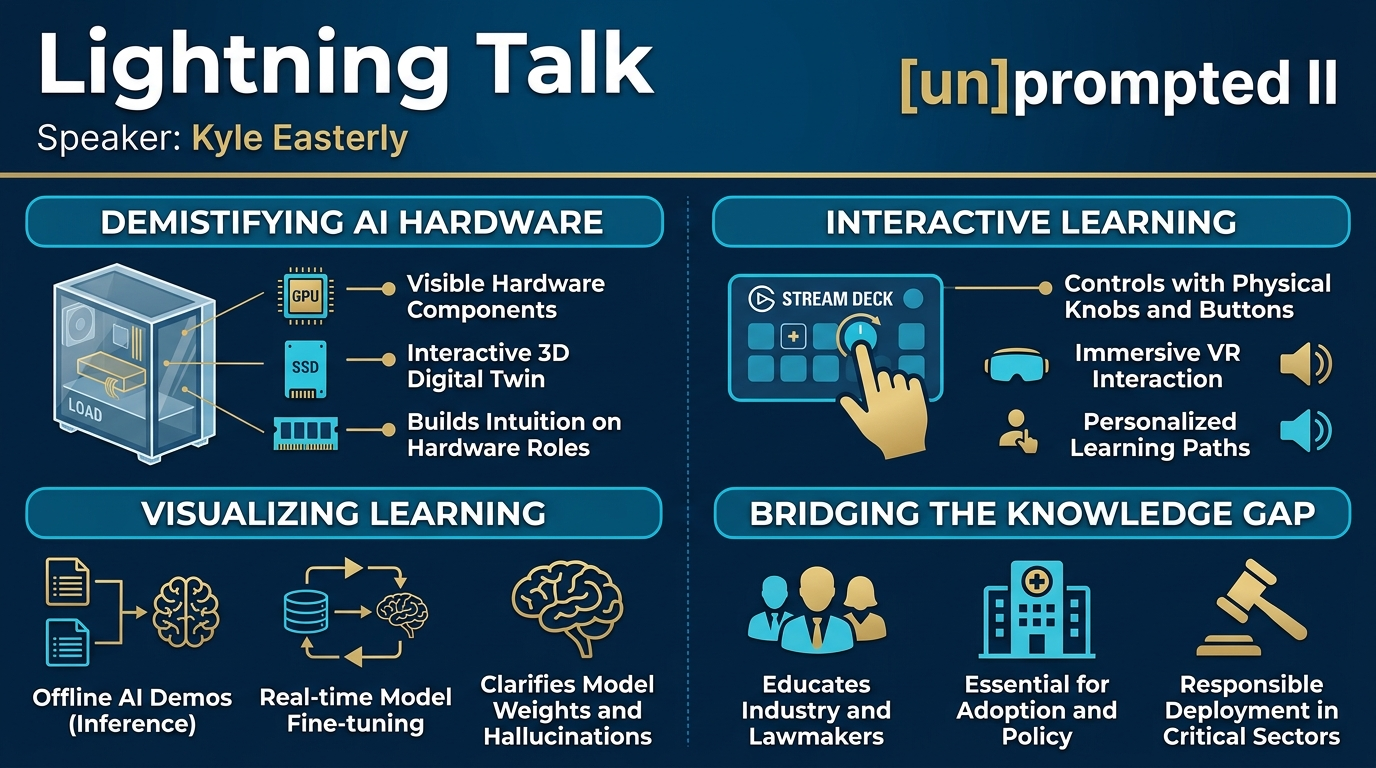
- Tangible Demystification of AI Hardware: The LOAD machine, housed in a rack-mount chassis with a transparent plexiglass lid, physically exposes the underlying hardware components crucial for AI operations. This direct visual access, combined with an interactive 3D digital twin of the machine, allows users to see and understand the roles of GPUs, SSDs, and memory, transforming abstract components into observable entities. This hands-on approach builds an intuition for how hardware directly influences AI performance.
- Effective Offline AI Demonstrations: LOAD operates entirely offline, utilizing locally running AI models. This capability is a significant finding as it demonstrates that complex AI concepts, often perceived as cloud-dependent, can be explained and interacted with in a self-contained environment. This offline functionality is critical for secure demonstrations and for environments with limited internet access, while also reinforcing the fundamental nature of the processes being taught.
- Interactive Learning Experience: The integration of a Stream Deck Pro with physical buttons and knobs allows for intuitive, interactive control over the demonstrations. Users can scroll through parts, ask the machine questions via a speaker, or even virtually manipulate components. This interactivity fosters engagement and allows for personalized learning paths, addressing specific queries about hardware differences (e.g., NVMe drive speeds).
- Illustrative AI Concept Demos: The talk highlighted several specific, highly effective demonstrations:
- Inference Visualization: Showing how AI processes information.
- Agent Fleets: Running 21 copies of Gemma 4 to simulate a "town" of generative agents, drawing inspiration from the 2023 Stanford generative agents paper. This visually conveys the concept of multi-agent systems and parallel AI processing.
- Fine-tuning Process Clarity: A particularly impactful demo involves fine-tuning a Llama model. Starting with the model attributing its creation to "Meta," the fine-tuning process (taking approximately one minute) visibly shifts its internal knowledge to credit "Delve Group and Kyle and Brian." Crucially, pausing the training after just 10 steps reveals "hallucinations" (e.g., Google, various universities), illustrating how the model's "pointer" directionally updates. This provides a clear, intuitive understanding of how models learn and how new information biases their responses.
- Immersive VR Interaction: The ability to don a VR headset and interact with the 3D digital twin, even to the point of virtually removing a GPU and witnessing its corresponding physical shutdown in the actual machine, represents a profound finding in experiential learning. This direct link between virtual action and physical consequence powerfully reinforces the relationship between hardware and AI performance.
These findings collectively demonstrate that a tangible, interactive, and visually driven approach to AI education, as embodied by the LOAD machine, is remarkably effective in making complex AI concepts accessible and intuitive for a broad audience.
Technical Deep Dive
▶ Watch: Demonstrating AI agent fleets and commercial use (3:40)
The LOAD (Local Offline AI Demo) machine is a meticulously engineered system designed to provide a transparent and interactive window into the mechanics of Artificial Intelligence. Its architecture integrates robust hardware, custom software, and innovative user interfaces to deliver a unique educational experience.
At its core, LOAD is built within a rack-mount machine chassis, which is strategically laid flat on a table and covered with a plexiglass lid. This design choice is fundamental to its educational mission, allowing full visual access to the internal components. The hardware configuration is optimized for demonstrating AI inference and training at a local scale. Key components mentioned include:
- Storage: The machine incorporates eight 2 terabyte SSDs, which Kyle Easterly noted were acquired years ago, highlighting their significant value. The discussion also mentioned NVMe drives in the context of demonstrating speed differences, implying a mix or comparison of storage technologies. High-speed storage is crucial for loading large models and datasets quickly, facilitating fluid demonstrations of training and inference.
- Memory: DDR4 memory was identified as a significant investment, underscoring its importance in AI workloads. Adequate and fast memory is essential for holding model parameters and intermediate computations during both training and inference.
- Graphics Processing Units (GPUs): The powerhouse of modern AI, the machine houses at least one NVIDIA A6000 48GB GPU. This professional-grade GPU, with its substantial 48GB of video RAM, is capable of running large language models and parallel processing tasks. Easterly mentioned frying one such GPU but having "spare tire" replacements, indicating a resilient setup for continuous operation. The system also features a water cooling system, which was recently refitted to be more streamlined, improving visibility of components and maintaining optimal thermal performance during intensive AI computations.
The software stack running on LOAD is equally critical. A custom-developed application creates a full 3D digital twin of every single part within the physical machine. This digital twin is not merely a static model; it is dynamically linked to the physical hardware, accurately reflecting the internal layout. This digital representation serves as the primary interface for many of the demonstrations.
Interaction with LOAD is facilitated through a Stream Deck Pro, a programmable control surface featuring buttons and knobs. This device allows users to intuitively navigate through the digital twin, select different parts for explanation, or trigger specific AI demonstrations. For example, users can ask the machine questions via an integrated speaker, such as "give me a tour of the machine" or "explain the difference in the speeds between the NVMe drives," and the machine, running local AI models, provides the answers offline.
The demonstrations themselves showcase a variety of AI concepts:
- Inference Workflows: The machine can visually illustrate the process of inference, where a trained AI model processes new data to make predictions or generate outputs. This is fundamental to understanding how AI delivers results in real-world applications.
- Generative Agent Fleets: One impressive demo involves running 21 copies of Gemma 4, a lightweight open-source model, concurrently. These agents are tasked with populating a virtual "town," drawing inspiration from the seminal Stanford Generative Agents paper from 2023. This vividly demonstrates parallel processing capabilities and the emergent behaviors of multi-agent systems, illustrating how multiple AI entities can interact and build complex environments.
- Model Fine-tuning: Perhaps the most impactful technical demonstration is the fine-tuning of a Llama model. Initially, the unmodified Llama model, when asked "who built you?", responds with "Meta built me." The demonstration then proceeds to fine-tune the model with custom data, a process that takes about one minute. After successful fine-tuning, the model correctly identifies "Delve Group and Kyle and Brian specifically" as its creators. A crucial insight is provided by pausing the training after just 10 steps. At this intermediate stage, the model "hallucinates," attributing its creation to entities like "Google" or "various universities in California or Alaska." Easterly explains this as the model's internal "pointer" directionally shifting its knowledge away from "Meta" and towards the new training data, eventually converging on the correct answer. This 3-minute demonstration provides a powerful, intuitive understanding of how model weights are updated during training and how new information biases an AI's responses.
- Commercial Applications: The machine also hosts demonstrations of Delve Group's commercial AI applications, such as paper log scanning and voicemail triage, showing practical AI deployment.
A truly immersive technical feature is the Virtual Reality (VR) headset integration. Users can put on a VR headset and interact directly with the 3D digital twin of the LOAD machine. In this virtual environment, they can perform actions like "taking out one of the GPUs." Critically, this virtual action is linked to the physical machine: the corresponding GPU inside the actual LOAD hardware is then programmatically shut off. This profound interaction provides a tangible, real-time understanding of how specific hardware components contribute to overall AI performance and how their removal impacts the system.
The LOAD machine, built in approximately one month with significant contributions from intern Brian from the University of Alaska Anchorage, represents a robust and versatile platform for AI education. Its offline, interactive, and visually transparent design provides an unparalleled technical deep dive for audiences seeking to understand the core mechanisms of AI.
Demo / Proof of Concept
▶ Watch: VR interaction to link hardware and performance (5:40)
The LOAD machine is, by its very nature, a comprehensive demonstration platform, serving as a powerful proof of concept for tangible AI education. Every aspect of its design and functionality is geared towards illustrating complex AI principles through direct, interactive engagement. The core idea is to move beyond abstract explanations and allow users to see, hear, and even virtually manipulate the components and processes of AI.
The primary proof of concept lies in the machine's physical presence itself. Enclosed in a transparent rack-mount chassis, LOAD allows for immediate visual inspection of its internal hardware—GPUs, SSDs, memory, and the water cooling system. This initial visual access is the first step in demystifying AI, showing that it's not an ethereal cloud service but a system powered by concrete, observable components.
Furthering this proof of concept are the specific interactive demonstrations:
- The 3D Digital Twin and Stream Deck Pro Interface: This combination proves that a virtual representation can be effectively linked to physical hardware for educational purposes. Users interact with the machine's digital twin via a Stream Deck Pro, selecting components, initiating tours, or asking questions. The machine's ability to respond to natural language queries about its hardware, all while operating offline, validates the concept of an intelligent, self-contained educational assistant. This demonstrates practical application of local AI models for interactive information retrieval.
- Generative Agent Fleet Simulation: The demonstration of running 21 copies of Gemma 4 to create a simulated town directly proves the capability of the hardware to support multi-agent systems and parallel AI processing. By referencing the 2023 Stanford Generative Agents paper, the demo grounds the concept in cutting-edge research, showing how agents can interact and build complex, dynamic environments. This provides a clear, visual proof of concept for generative AI and agent-based simulations.
- Real-time Model Fine-tuning: This is arguably the most impactful proof of concept. The ability to start with a Llama model that attributes its creation to "Meta," then visibly fine-tune it over approximately one minute to credit "Delve Group and Kyle and Brian," powerfully demonstrates the process of model adaptation and learning. The critical insight, proven by pausing the training after 10 steps and observing the model's "hallucinations" as its "pointer" shifts, offers undeniable proof of how model weights are updated and how new data directly influences an AI's knowledge base and outputs. This tangible, step-by-step visualization is a direct proof of concept for the effectiveness of transfer learning and model customization.
- VR-Hardware Interaction: The VR headset demonstration provides a profound proof of concept for immersive, experiential learning. The ability to virtually "take out one of the GPUs" in the 3D digital twin and then witness the corresponding physical GPU inside the LOAD machine shut off creates a direct, undeniable link between virtual interaction and real-world hardware impact. This not only proves the fidelity of the digital twin but also vividly demonstrates the functional consequence of hardware components on AI system performance. It's a powerful validation of using mixed reality for technical education.
In essence, the entire LOAD project serves as a robust proof of concept for an innovative paradigm in AI education. It demonstrates that by making AI tangible, observable, and interactive, complex concepts can be effectively conveyed to a broad, non-technical audience, fostering a deeper and more intuitive understanding of this critical technology.
Defensive Implications
▶ Watch: Conclusion: Bringing AI fundamentals to normal people (6:10)
While the LOAD machine is primarily an educational tool focused on demystifying AI fundamentals, its implications extend indirectly but significantly into the realm of cybersecurity and defensive strategies for AI systems. A more educated populace, particularly among industry leaders and policymakers, is inherently better equipped to understand, anticipate, and mitigate AI-related risks.
Firstly, the demystification of AI hardware and inference processes directly contributes to better security posture. When individuals understand that AI is not a magical black box but a system of interconnected hardware and software, they can better grasp where vulnerabilities might lie. For instance, understanding the role of GPUs and memory in processing AI models can inform physical security measures for AI infrastructure or the importance of secure hardware supply chains. Similarly, visualizing inference helps in comprehending how adversarial attacks might manipulate inputs to force erroneous or malicious outputs from a model.
Secondly, the fine-tuning demonstration has profound implications for defending against model poisoning and ensuring model integrity. By showing how a model's "knowledge" can be directionally shifted over a short period (e.g., 1 minute to change "Meta built me" to "Delve Group built me"), the talk implicitly highlights the ease with which a model could be maliciously retrained or poisoned with biased or harmful data. Defenders can leverage this understanding to implement robust data provenance checks, continuous model monitoring, and secure fine-tuning pipelines. The observation of "hallucinations" during partial training also underscores the importance of thoroughly validating fine-tuned models before deployment to prevent the propagation of misinformation or incorrect outputs, which can have significant security or safety consequences.
Thirdly, the educational outreach to sectors like oil and gas, healthcare, and telecom is critical. These industries are increasingly adopting AI, often in mission-critical applications where security failures can have catastrophic consequences. By providing a foundational understanding of AI to professionals in these fields, LOAD helps cultivate an AI-literate workforce capable of:
- Identifying potential attack surfaces: Understanding how AI models interact with data and hardware helps pinpoint areas susceptible to data injection, model extraction, or denial-of-service attacks.
- Evaluating AI solutions: Informed professionals are better positioned to ask critical security questions when procuring or deploying AI systems, demanding transparency, robustness, and explainability.
- Developing secure AI policies: With a clearer grasp of AI's inner workings, these sectors can develop internal policies and best practices that account for AI-specific security risks, rather than treating AI as a generic software component.
Finally, educating lawmakers on AI fundamentals is a crucial defensive measure for society as a whole. Well-informed legislators are more likely to create sensible, effective, and proportionate regulations that foster responsible AI development while addressing security and ethical concerns. Without this foundational understanding, regulations risk being either overly restrictive, stifling innovation, or dangerously permissive, leaving critical vulnerabilities unaddressed. The LOAD machine, by making AI comprehensible, empowers lawmakers to make evidence-based decisions that can protect national infrastructure, personal data, and public trust in AI technologies.
In summary, while not directly presenting defensive tools or techniques, the LOAD machine's mission to enhance AI literacy serves as a foundational defensive strategy. It equips a broader audience with the knowledge necessary to understand, scrutinize, and ultimately secure the AI systems that are rapidly becoming integral to our world.
Key Takeaways
- Tangible AI Education is Critical: Abstract explanations of AI are insufficient; physical, interactive demonstrations like the LOAD machine are essential for building intuitive understanding among non-technical audiences.
- Hardware's Role is Demystified: The LOAD machine visually and interactively demonstrates the direct impact of physical components (GPUs, SSDs, memory) on AI performance, moving beyond the "black box" perception.
- Fine-tuning and Inference are Made Observable: Concepts like model fine-tuning and inference can be clearly illustrated, with the Llama model fine-tuning demo effectively showing how models learn, adapt, and even "hallucinate" during the training process.
- Interactive and Immersive Learning Enhances Comprehension: Features like the Stream Deck Pro, the 3D digital twin, and VR integration significantly boost engagement and allow users to actively explore and understand complex AI mechanics.
- Offline AI Demos Offer Unique Advantages: Operating entirely offline, LOAD proves that fundamental AI concepts can be taught securely and effectively without cloud dependency, highlighting the power of local AI.
- Bridging the Knowledge Gap is Vital for Responsible AI: Educating industry professionals (oil/gas, healthcare, telecom) and lawmakers on AI fundamentals is crucial for informed decision-making, secure deployment, and effective policy-making in an AI-driven future.
About the Speaker(s)
Kyle Easterly is the Co-Founder and CEO of Delve Group, a software company he recently founded in January with his wife. Based in Anchorage, Alaska, Delve Group quickly evolved into an AI deployment software company, focusing on helping clients integrate and understand AI technologies. Easterly is passionate about bridging the knowledge gap surrounding AI, particularly for non-technical audiences in key Alaskan industries such as oil and gas, healthcare, and telecommunications. He was instrumental in the conception and construction of the LOAD (Local Offline AI Demo) machine, collaborating with an intern, Brian, from the University of Alaska Anchorage. His work emphasizes making complex AI concepts accessible and tangible, aiming to educate the public and lawmakers on the fundamental workings of this transformative technology.
Reviews
→ Top-rated talks at [un]prompted II 2026 — The AI Security Practitioner Conference
All talks from [un]prompted II 2026 — The AI Security Practitioner Conference