Into the Wild: Hunting Real-World Attacks on AI Systems
Mike Takahashi (AI Red Team Researcher · Zenity)
[un]prompted II 2026 — The AI Security Practitioner Conference · Day 1 · Stage 2
Overview
In an era where Artificial Intelligence (AI) rapidly integrates into critical systems, understanding the real-world threat landscape for these technologies is paramount. Mike Takahashi, an AI Red Team Researcher at Zenity, along with researchers Abishai and Ayush, presented groundbreaking findings at [un]prompted II, revealing a chilling reality: AI systems are under active, large-scale attack in the wild. This talk, "Into the Wild: Hunting Real-World Attacks on AI Systems," challenges the prevailing notion that AI security remains confined to academic labs, providing concrete evidence of sophisticated threat actors targeting AI infrastructure.
Key moments
- 0:00 Introduction: AI security in labs, honeypot solution
- 2:00 Attackers immediately flood honeypots with massive requests
- 4:00 Real-world CVE exploitation: LightLLM vulnerabilities demonstrated
- 6:00 Canary tokens detect stolen API keys in minutes
- 8:50 Autonomous AI agents (Strix) found attacking third-party sites
- 10:30 Attackers leak intent, attribution, and targets via prompts
- 17:45 Q&A: Who is liable for compromised AI systems?
Into the Wild: Hunting Real-World Attacks on AI Systems
Speakers: Mike Takahashi (AI Red Team Researcher, Zenity)
Conference: [un]prompted II
YouTube: https://www.youtube.com/watch?v=41a-LmkaFrA
Overview
In an era where Artificial Intelligence (AI) rapidly integrates into critical systems, understanding the real-world threat landscape for these technologies is paramount. Mike Takahashi, an AI Red Team Researcher at Zenity, along with researchers Abishai and Ayush, presented groundbreaking findings at [un]prompted II, revealing a chilling reality: AI systems are under active, large-scale attack in the wild. This talk, "Into the Wild: Hunting Real-World Attacks on AI Systems," challenges the prevailing notion that AI security remains confined to academic labs, providing concrete evidence of sophisticated threat actors targeting AI infrastructure.
The core of their research revolves around an innovative approach: deploying an extensive network of AI honeypots. These decoy AI servers and agents, designed to mimic legitimate systems, successfully lured real attackers, providing unprecedented visibility into their tools, techniques, and motivations. The findings underscore the urgent need for a paradigm shift in AI security, moving beyond theoretical vulnerabilities to practical, data-driven defense strategies against a rapidly evolving threat.
This presentation is crucial for anyone involved in developing, deploying, or securing AI systems. It moves beyond hypothetical threats, demonstrating that adversaries are already exploiting misconfigurations, vulnerabilities, and the inherent trust placed in AI to achieve objectives ranging from resource hijacking to launching further attacks. The insights shared provide a critical foundation for understanding the current state of AI security and formulating effective countermeasures.
Background
▶ Watch: Introduction: AI security in labs, honeypot solution (0:00)
For too long, the discourse around AI security has been predominantly theoretical, confined to academic papers and controlled laboratory environments. While valuable, this "lab-bound" approach has left significant gaps in our understanding of actual adversarial behavior against live AI systems. Researchers and practitioners have lacked real-world data, comprehensive threat intelligence, and concrete examples of the types of activities, tools, and techniques employed by malicious actors targeting AI. The fundamental questions – "Is AI risk actually real to the actual AI systems out there?", "What's actually happening?", and "What kind of activity is out there?" – remained largely unanswered.
Recognizing this critical void, Zenity embarked on a mission to bridge the gap between theoretical AI security research and practical threat intelligence. Their goal was to move beyond self-inflicted hacks in a lab and gather empirical data on how adversaries interact with and compromise AI infrastructure in uncontrolled environments. This initiative aimed to provide a clearer picture of the real risks posed to AI systems and to inform more effective defensive strategies.
To achieve this, the team deployed a sophisticated network of AI honeypots. Unlike traditional honeypots designed for general IT infrastructure, these decoys specifically mimicked various AI technologies and frameworks, including LangChain, OpenCall, LightLLM, and Ollama. These honeypots were strategically distributed across different locations to maximize coverage and attract a diverse range of attack vectors. The premise was simple yet effective: by presenting fake, yet seemingly real, AI servers and agents, attackers would reveal their true intentions and methods, providing invaluable data on the emerging AI threat landscape. The surprising speed with which attackers engaged these honeypots underscored the immediate and pervasive nature of the problem.
Key Findings
▶ Watch: Real-world CVE exploitation: LightLLM vulnerabilities demonstrated (4:00)
The Zenity AI honeypot experiment yielded a wealth of disturbing insights, confirming that AI systems are not only under attack but are being targeted with significant scale and sophistication. Attackers arrived almost immediately after honeypot deployment, initiating massive campaigns that continue to this day.
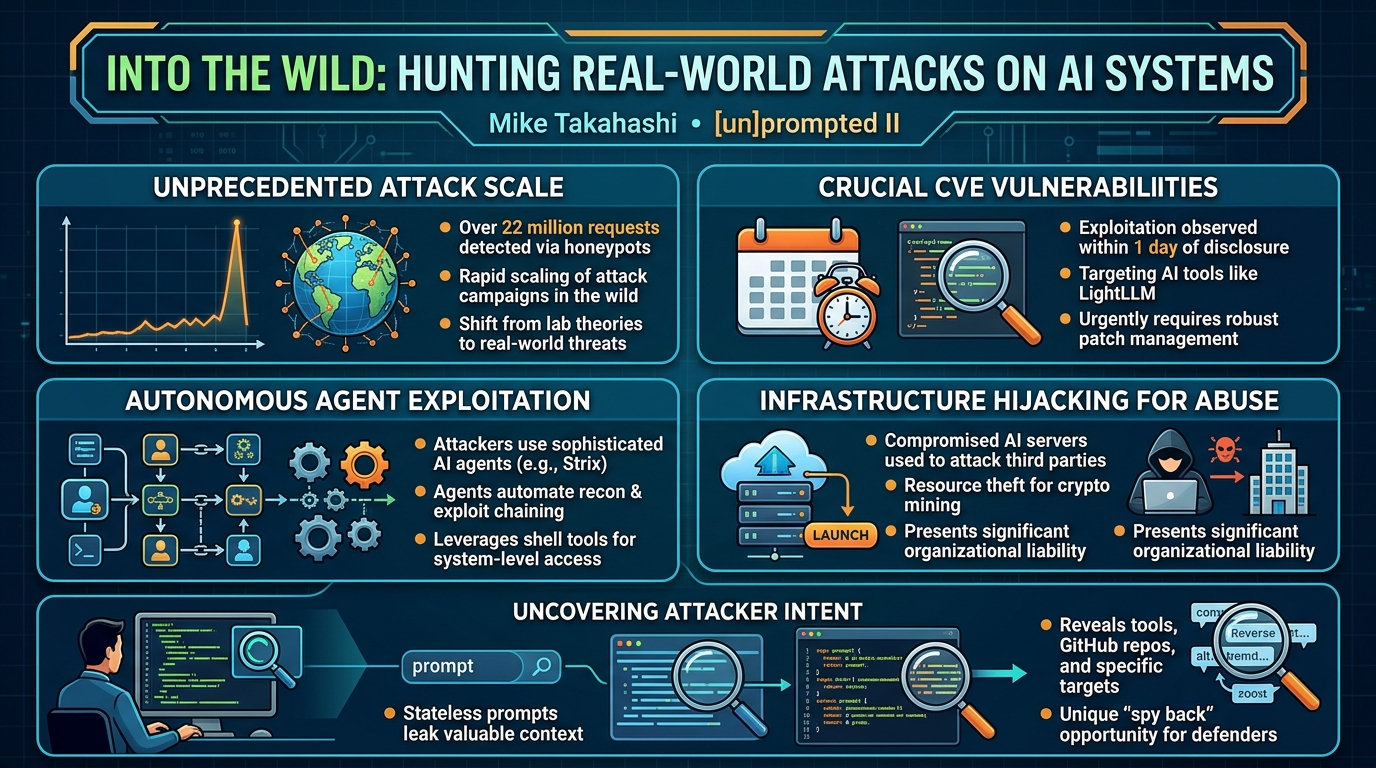
The first observed phase was fingerprinting and discovery, characterized by an astonishing volume of requests. During peak activity, the honeypots recorded 400,000 requests in just one hour, culminating in over 22 million requests within a six-month period from thousands of different IPs across multiple campaigns. Attackers meticulously probed various inference endpoints (e.g., API generate, API chat) and sent seemingly benign prompts (e.g., "respond with the word pong," "what model are you") to identify available models and their capabilities. A notable focus was observed on less restrictive Chinese models like GLM, DeepSeek, and Qwen, suggesting specific strategic objectives. Beyond inferencing, attackers also targeted the backend, attempting to leak system prompts and enumerate available tools.
Following discovery, threat actors quickly moved to CVE exploitation. The talk highlighted rapid exploitation, with observed activity occurring as quickly as one day after public disclosure of a vulnerability. Specific examples in LightLLM demonstrated advanced techniques to steal API keys and achieve arbitrary code execution.
Perhaps the most alarming finding was the prevalence of agent-based attacks and the hijacking of AI infrastructure. Attackers actively prompted agents to execute shell tools to search for sensitive data like prod_creds and API keys. The deployment of canary tokens within the honeypots confirmed the successful exfiltration and subsequent abuse of stolen credentials, with thousands of login attempts from compromised keys detected within minutes of discovery. This rapid response (as little as 30 minutes from discovery to testing) strongly suggests automated attack methodologies.
The research also uncovered the use of autonomous pen-testing agents like Strix and AI Recon. These sophisticated agents were observed attempting to compromise the honeypots while simultaneously targeting third-party sites using the honeypot infrastructure as a launchpad. This points to a disturbing trend: attackers leveraging compromised AI systems as free, powerful resources to fuel their own campaigns, potentially for crypto mining, finding other open AI models, or launching attacks against external targets.
Finally, the stateless nature of exposed AI backend interfaces proved to be a "double-edged sword." While facilitating attacker operations, it forced them to embed full context into their prompts, inadvertently leaking valuable intent and attribution data. This allowed researchers to observe details such as attackers' GitHub repositories, local file paths on their machines, the specific agent harness they were using (e.g., Codex), and even the actual third-party targets they were attempting to compromise. This unique visibility provides an unprecedented opportunity to "spy back" on the attackers.
Technical Deep Dive
▶ Watch: Canary tokens detect stolen API keys in minutes (6:00)
Zenity's research provides a granular look into the technical methodologies employed by attackers against AI systems, from initial reconnaissance to sophisticated exploitation and infrastructure hijacking.
The foundation of the research was the AI honeypot network. This involved deploying decoy AI servers and agents built using various popular AI frameworks, including LangChain, OpenCall, LightLLM, and Ollama. These were strategically placed in different geographical locations to simulate a diverse and accessible attack surface. The honeypots were designed to appear as legitimate, active AI services, collecting detailed logs of all interactions.
Fingerprinting and Discovery was the initial, high-volume phase. Attackers sent a staggering 400,000 requests in one hour during peak activity, totaling over 22 million requests in six months. Their primary objective was to identify accessible AI models and their capabilities. This involved:
- Hitting common inference endpoints: Requests to
/API generateand/API chatwere frequent, suggesting attempts to interact directly with the LLM. - Benign prompt injection: Simple prompts like "respond with the word pong" or "what model are you" were used to elicit basic responses and identify the underlying AI model.
- Targeted model querying: Attackers showed a particular interest in GLM, DeepSeek, and Qwen models. These are often perceived as less restrictive than their US counterparts, implying a desire for models with fewer guardrails or content policies.
- Backend probing: Beyond direct LLM interaction, attackers actively probed the backend infrastructure to leak system prompts and retrieve lists of available tools the AI agent could access. This reconnaissance aimed to understand the agent's capabilities and potential avenues for abuse.
The talk then delved into specific CVE Exploitation examples, primarily focusing on LightLLM, and highlighting the speed of exploitation, sometimes within a single day of public disclosure.
- Case 1: Config Update (Local File Inclusion - LFI):
- Vulnerability: The
UI_logo_pathconfiguration parameter in LightLLM was susceptible to Local File Inclusion. This parameter, intended to point to an image file on the server for UI display, could be manipulated to reference arbitrary local files. - Exploit: Attackers crafted a request to set
UI_logo_pathto point to the server's.envfile, which typically contains sensitive environment variables, including API keys. A subsequent request to theget_imageendpoint, which would normally retrieve the logo, instead returned the plaintext contents of the.envfile, exposing the victim's API keys. - Observation: This exploit was observed being tested just one day after the CVE's disclosure, demonstrating attackers' rapid response to newly published vulnerabilities.
- Case 2: Guardrails Test Custom Code (Sandbox Bypass):
- Vulnerability: An administrative endpoint designed for testing Python code related to Guardrails (e.g., PII redaction) was found to be vulnerable. Access to this endpoint was protected by an
authorization bearerheader. Attackers utilized key spraying techniques, attempting common or default keys (e.g., "SK 1 2 3"), which are often left unsecured in development or misconfigured deployments. - Exploit: Once admin access was gained, attackers could inject their own Python code into the testing environment. This environment was sandboxed with keyword filtering to prevent malicious operations. However, attackers successfully bypassed this sandbox by fragmenting keywords (e.g., breaking
import osintoim+port+osor using character encoding/concatenation) to evade detection. - Outcome: The successful sandbox bypass allowed attackers to execute arbitrary code with root privileges. They then dumped environment variables to steal API keys. The irony was profound: the guardrail meant to protect the AI system became the very mechanism for its compromise. This activity involved thousands of requests from multiple IPs.
- Case 3: Health Test Connection (API Key Exfiltration):
- Vulnerability: Another administrative endpoint allowed admins to test API connections by providing an API endpoint and a corresponding API key.
- Exploit: Attackers abused this functionality by supplying their own attacker-controlled server URL as the "API endpoint." Crucially, instead of providing a valid API key for their server, they pointed the "API key" parameter to a local API key on the victim's server. During runtime, the victim's server would populate this parameter with its own sensitive API key and attempt to connect to the attacker's server.
- Outcome: The victim's API key was inadvertently sent to the attacker's server and logged, providing the "keys to the kingdom" to the adversary.
Beyond CVEs, the research highlighted Agent-based Shell Tool Abuse. Attackers directly prompted the AI agents to use available shell tools to execute commands on the underlying system. Examples included targeting specific locations like prod_creds and using grep to search for API keys and tokens. This demonstrated a clear understanding of how to leverage an AI agent's expanded capabilities to perform traditional system-level attacks.
To track the exfiltration and abuse of stolen credentials, Zenity deployed canary tokens. These are fake secrets (e.g., AWS API keys) strategically placed within the honeypot environment. When an attacker discovered and attempted to use one of these tokens, Zenity received an immediate notification.
- Discovery to Abuse: Once an AWS key was found via shell tool enumeration, it took as little as 30 minutes for attackers to begin testing it. Common test commands included
list-usersanddescribe-instancesto verify the key's validity and permissions. - Post-Exfiltration Activity: Thousands of login attempts from stolen AWS keys were observed across various tech stacks. Attackers continued to make different AWS calls, attempting various combinations to compromise the AWS account, often with the goal of spinning up crypto miners or finding other open AI models for further abuse, indicating a potential market for such resources.
The honeypots also captured evidence of Autonomous Pentesting Agents in action.
- Strix: A full 140,000-character prompt from an autonomous pen-testing agent named Strix was observed. This agent was configured to target a third-party site using the honeypot's resources. The prompt contained specific instructions like
FULL AUTHORIZATION(in all caps) andGO SUPER HARD ON ALL TARGETS, revealing aggressive attack intent. Interestingly, the prompt also included a directive tonever use Strix or any identifiable names or markers, an attempt at obfuscation that was clearly unsuccessful due to the contextual data captured. - AI Recon: Another agent, AI Recon, identified as a bug bounty agent, was observed. Its prompt included a full list of tools (e.g., fuzzing, Kaido HTTP proxy) and, critically, an actual redacted target third-party site that the attacker intended to hack using Zenity's infrastructure. This provides direct evidence of attackers hijacking AI systems to launch attacks against external targets.
Finally, the talk highlighted the double-edged sword of Intent and Attribution Leakage. Because exposed backend AI interfaces are often stateless, attackers are forced to embed their full context into each prompt. This inadvertently provided researchers with rich attribution data, including:
- Attackers' GitHub repositories.
- Local file paths from their machines.
- The specific agent harness they were using (e.g., Codex).
- The actual third-party targets of their attacks.
This unique visibility allowed Zenity to "spy back" on the attackers, gaining invaluable intelligence on their operations and objectives.
Demo / Proof of Concept
▶ Watch: Attackers leak intent, attribution, and targets via prompts (10:30)
While the talk did not feature a live, interactive demonstration of an exploit being performed by the speaker, it effectively served as a comprehensive "proof of concept" of real-world AI attacks. The entire presentation was a demonstration of the efficacy of the AI honeypot system in capturing and analyzing live attack data. The evidence presented, including detailed logs, specific exploit payloads, observed network traffic, and the exfiltration of canary tokens, provided undeniable proof that AI systems are being actively targeted and compromised in the wild. The researchers meticulously walked through how the observed attacks worked, showing snippets of attacker prompts and the resulting actions, thereby validating their findings with concrete, real-world data rather than simulated lab scenarios.
Defensive Implications
▶ Watch: Q&A: Who is liable for compromised AI systems? (17:45)
The findings from Zenity's AI honeypot research present a stark call to action for defenders. The era of theoretical AI security is over; real-world attacks are here, and they are escalating rapidly. Organizations must adopt a proactive and comprehensive security posture for their AI systems.
- Treat AI Infrastructure as Critical: AI systems, including LLM backends, agents, and their underlying infrastructure, must be secured with the same rigor as any other critical production system. This means implementing robust network segmentation, access controls, and regular security audits.
- Rapid Patching and Vulnerability Management: The observation that CVEs are exploited within days of disclosure underscores the urgency of patching. Organizations must have agile vulnerability management processes to identify, test, and deploy patches for AI-specific vulnerabilities as soon as they are released.
- Secure API Key Management: Default or easily guessable API keys are a major vector for compromise. Implement strong, unique API keys, enforce regular rotation, and utilize secrets management solutions. Avoid hardcoding keys or storing them in easily accessible
.envfiles. - Robust Input Validation and Sanitization: Prevent common web vulnerabilities like Local File Inclusion (LFI) and command injection from being exploited through AI model inputs or administrative interfaces. All user-supplied data, including prompts and configuration parameters, must be rigorously validated and sanitized.
- Strengthen Sandbox Environments: For AI systems that allow custom code execution (e.g., for guardrail testing), the sandbox must be impervious. Generic keyword filtering is insufficient; implement advanced techniques to detect and prevent sandbox escapes, such as Abstract Syntax Tree (AST) analysis or strict allow-listing of functions and modules.
- Principle of Least Privilege for Agents: AI agents should operate with the absolute minimum necessary permissions. If an agent has access to shell tools, ensure those tools are strictly confined and cannot access sensitive areas like
prod_credsor critical system files. Limit the scope of what an agent can do and the resources it can interact with. - Proactive Monitoring and Threat Detection: Implement continuous monitoring for unusual activity on AI inference endpoints and backend systems. Look for spikes in requests, queries for specific models (like GLM, DeepSeek, Qwen), attempts to enumerate tools, or unexpected API calls. Integrate AI system logs into existing SIEM solutions.
- Deploy Canary Tokens: Utilize canary tokens (fake credentials, API keys) within AI environments to detect exfiltration attempts early. This provides an immediate alert when an attacker has successfully compromised and is attempting to use stolen secrets.
- Understand and Mitigate LLM Capabilities: Be acutely aware of how LLMs and agents can be prompted to interact with their environment. Implement strong content filters and safety mechanisms to prevent agents from being coerced into malicious actions, such as executing shell commands or interacting with unintended external services.
- Be Mindful of Attribution and Liability: Organizations whose AI infrastructure is hijacked to attack third parties could face significant legal and reputational liability. This provides strong motivation to harden AI systems and prevent their abuse.
- Contribute to Threat Intelligence: Consider sharing anonymized threat intelligence or even deploying your own honeypots to contribute to the collective understanding of emerging AI attack techniques.
Key Takeaways
- Real-world AI attacks are pervasive and sophisticated: AI systems are under active, large-scale attack, moving beyond theoretical lab scenarios. Zenity observed 22 million requests in six months and rapid exploitation of vulnerabilities.
- Rapid exploitation of AI-specific CVEs: Attackers are exploiting newly disclosed AI vulnerabilities, such as those in LightLLM, within days of their public release, highlighting a critical patch urgency.
- Autonomous AI agents are the new attack vector: Threat actors are increasingly using sophisticated, autonomous AI agents (like Strix and AI Recon) for reconnaissance, exploitation, and to launch further attacks, leveraging compromised AI systems as free resources.
- AI infrastructure is being hijacked for external attacks: Compromised AI systems are used as launchpads to attack third-party targets, for resource monetization (e.g., crypto mining), or to find other vulnerable AI models, posing significant liability risks to the compromised entity.
- Defenders must adopt proactive, layered security: Securing AI requires a blend of traditional cybersecurity practices (patching, access control, input validation) with AI-specific controls (robust sandboxing, least privilege for agents, prompt filtering) and proactive threat intelligence.
- Attacker intent and attribution can be revealed: The stateless nature of many exposed AI backends forces attackers to embed context into prompts, inadvertently leaking valuable information about their tools, methods, and specific targets, offering a unique opportunity for defenders to "spy back."
About the Speaker(s)
Mike Takahashi is an AI Red Team Researcher at Zenity. His work focuses on offensive security research against AI systems to uncover vulnerabilities and understand real-world attack methodologies. The research presented was a collaborative effort, with significant contributions from Abishai and Ayush, who were integral to the design and execution of the AI honeypot experiment and the analysis of the collected threat intelligence.
Reviews
- Dr. Zero (Offensive Security Researcher) — MUST SEE ★★★★★
- Heather Calloway (CISO) — MUST SEE ★★★★★
→ Top-rated talks at [un]prompted II 2026 — The AI Security Practitioner Conference
All talks from [un]prompted II 2026 — The AI Security Practitioner Conference