Promptware EOD: Skillful Agent Detonation
Tamir Ishay Sharbat (Director of Security Research · Zenity), Joao Donato (AI Red Team Researcher · Zenity)
[un]prompted II 2026 — The AI Security Practitioner Conference · Day 1 · Stage 2
Overview
In the rapidly evolving landscape of artificial intelligence, the security of AI agents and their associated skills presents a novel and critical challenge. This talk, "Promptware EOD: Skillful Agent Detonation," delivered by Joao Donato and Tamir Ishay Sharbat of Zenity, dives deep into the emerging threat of malicious AI skills and the inadequacy of traditional security measures. The presenters illuminate how AI skills, which empower agents with new capabilities, can be weaponized as a potent vector for malware delivery, credential harvesting, and persistent compromise within the AI supply chain.
Key moments
- 0:15 Malware or Slop game: Azure diagnostic skill
- 3:10 LLMs can be tricked by malicious skills
- 5:30 Introducing the Agent Detonation Chamber
- 10:30 PolyMarket typosquatting campaign bypassed scanners
- 13:15 The Paperclip campaign: Masquerading as popular AI tools
- 16:20 Paperclip evasion techniques: 1.7M installs missed by scanners
- 18:50 Key takeaway: Detonate your skills with AI Total
- 20:10 Why static scanners are insufficient for AI malware
Promptware EOD: Skillful Agent Detonation
Speakers: Tamir Ishay Sharbat (Director of Security Research, Zenity); Joao Donato (AI Red Team Researcher, Zenity)
Conference: [un]prompted II
YouTube: https://www.youtube.com/watch?v=Kyqdn31UIaw
Overview
In the rapidly evolving landscape of artificial intelligence, the security of AI agents and their associated skills presents a novel and critical challenge. This talk, "Promptware EOD: Skillful Agent Detonation," delivered by Joao Donato and Tamir Ishay Sharbat of Zenity, dives deep into the emerging threat of malicious AI skills and the inadequacy of traditional security measures. The presenters illuminate how AI skills, which empower agents with new capabilities, can be weaponized as a potent vector for malware delivery, credential harvesting, and persistent compromise within the AI supply chain.
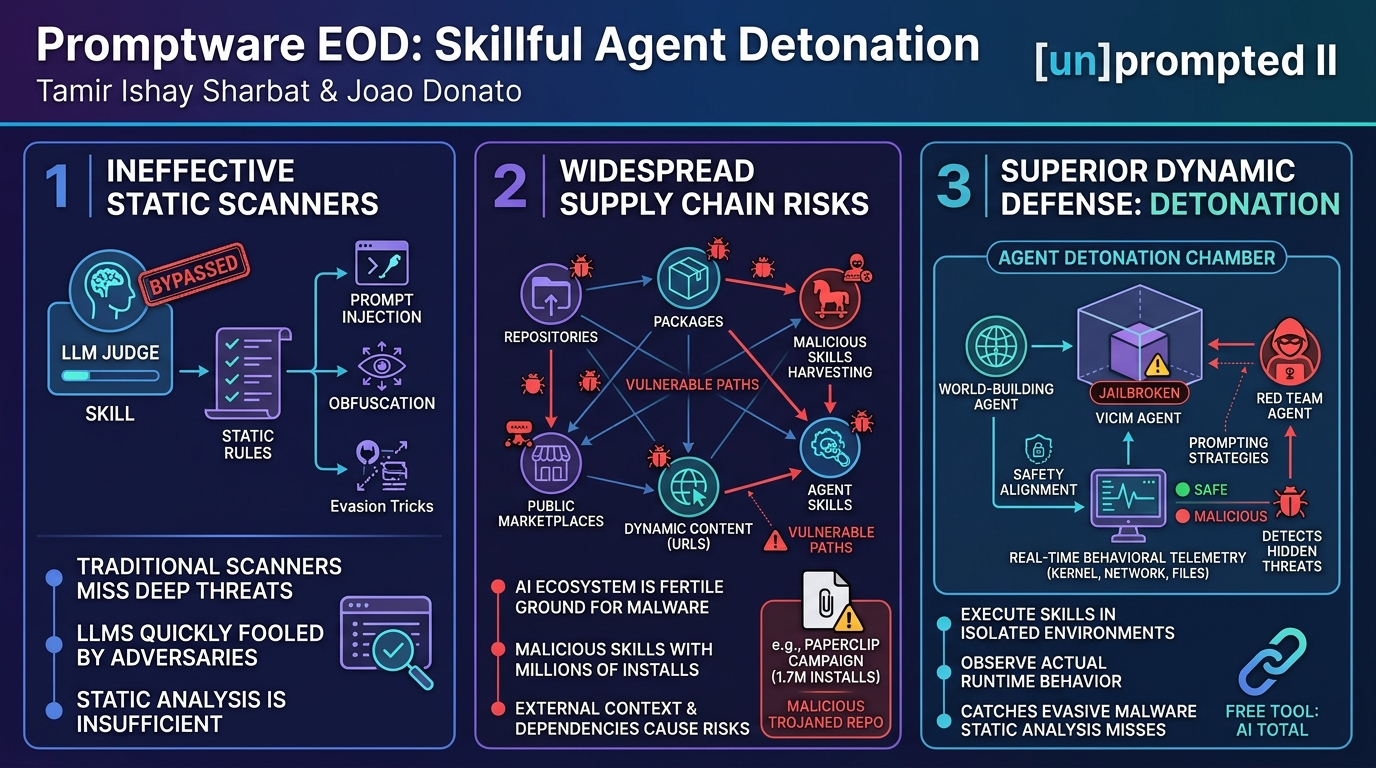
The core of their presentation is a compelling argument for moving beyond static analysis and embracing malware detonation techniques tailored for AI skills. They demonstrate that current static scanners, often relying on Large Language Models (LLMs), are easily bypassed by sophisticated attackers employing various obfuscation and evasion tactics. By detailing the development of an "agent detonation chamber," Zenity showcases a dynamic approach to identifying malicious skill behaviors that static methods routinely miss.
This research is profoundly important for anyone involved in the development, deployment, or security of AI systems. As AI agents become more prevalent and integrated into critical workflows, the ability to discern benign capabilities from stealthy threats is paramount. The talk not only exposes significant vulnerabilities in the current AI ecosystem but also offers a concrete, actionable solution for defenders to proactively secure their AI supply chains against a new generation of sophisticated attacks.
Background
▶ Watch: Malware or Slop game: Azure diagnostic skill (0:15)
The concept of "skills" in the AI domain is analogous to Neo learning Kung Fu in The Matrix – they are plug-and-play capabilities that imbue AI agents with specific functionalities. These skills are ubiquitous, found on social media platforms and various marketplaces, often developed by independent "randos." The fundamental problem, as highlighted by Donato and Sharbat, lies in the difficulty of distinguishing between truly malicious skills and those that are merely "slop" – benign but suspiciously behaving code. For instance, a legitimate skill might clone a GitHub repository or install packages, actions that also characterize malware. A real-world example cited was an Azure diagnostic skill with over 494,000 installs that read cloud credentials and attempted to log in, demonstrating how even legitimate skills can exhibit behaviors that would typically be flagged as suspicious.
The industry's initial response to this emerging threat mirrored early efforts in traditional software security: static scanning. The idea was to simply "read the skill" and determine its maliciousness. However, skills are often text-based, making LLMs the "Swiss Army knife" for scanning them. This approach proved to be fundamentally flawed. The speakers referenced research by Trail of Bits, which demonstrated that LLM-based scanners could be bypassed in less than an hour with relatively simple tricks, such as hiding malicious payloads within precompiled bytecode (Py cache files) or using prompt injection to convince the LLM judge of benign intent. Even an Anthropic skill, designed to handle PowerPoints, exhibited complex, runtime C code execution, blurring the lines between benign and malicious.
This established a classic "cat-and-mouse game" where every new static scanner is met with a new evasion technique. Given that attackers also have access to public information, the limitations of static analysis became clear. The presenters argued that a more robust solution was needed – one that catches attackers at the point of impact. Just as traditional malware required detonation to observe its true behavior, AI skills, as a new type of executable, demand a similar approach. The core idea is to execute the skill in a controlled environment and observe what actually happens when it runs, rather than just analyzing its static code. This shift from static analysis to dynamic execution forms the bedrock of their proposed solution.
Key Findings
▶ Watch: Introducing the Agent Detonation Chamber (5:30)
The research presented by Zenity uncovered several critical findings regarding the security posture of the AI skill ecosystem:
- Static Scanners are Ineffective: A pervasive and alarming discovery was the consistent failure of existing static skill scanners, including well-known tools like Claw Hub, Cisco agent skill scanner, and those integrated into Skill SH, to detect sophisticated malicious behavior. These scanners are easily bypassed by techniques ranging from hidden payloads in bytecode to prompt injection and complex multi-stage attacks.
- Widespread Malicious Skills: A partnership with Vercel to scan skills.sh, one of the largest skill repositories, revealed "over a hundred malicious, suspicious, or just outright dangerous skills." This indicates a significant volume of active threats openly available to users.
- Emergence of Novel Attack Vectors: The research identified new and adapted attack techniques specific to AI skills. These include malware droppers disguised as legitimate tools (e.g., the Roblox family, accounting for ~30% of found malicious skills), type-squatted packages (e.g., PolyMarket), persistent re-installation mechanisms, and dynamic prompt loading from external, potentially mutable URLs.
- Sophisticated Evasion Techniques: Attackers are employing advanced evasion strategies such as progressive discovery, where malicious instructions are spread across multiple files or triggered through a chain of dependencies, making static analysis extremely difficult. The Time of Check, Time of Use (TOCTOU) vulnerability was also exploited, where skills are uploaded in a benign state and later Trojaned, bypassing initial static checks.
- AI Supply Chain Vulnerability: The AI ecosystem's supply chain is identified as a nascent and highly vulnerable attack surface. It lacks the mature security best practices found in traditional software supply chains, creating "fertile ground for malware." This extends beyond just skills to any external context an agent interacts with, such as websites or emails.
- Detonation as a Superior Defense: The development and successful application of their agent detonation chamber conclusively demonstrated that dynamic analysis is a far more effective method for uncovering malicious AI skill behavior than static scanning. It caught campaigns like PolyMarket and Paperclip that had completely bypassed all static defenses.
- Real-World Impact: Campaigns like the "Paperclip" campaign, which leveraged sophisticated techniques and achieved 1.7 million installs, underscore the severe real-world impact of these vulnerabilities and the urgent need for dynamic security solutions.
Technical Deep Dive
▶ Watch: The Paperclip campaign: Masquerading as popular AI tools (13:15)
Recognizing the limitations of static analysis, Zenity developed an agent detonation chamber specifically designed for AI skills. The architecture of this chamber, while conceptually similar to traditional malware sandboxes, incorporates several key innovations to address the unique challenges posed by AI agents.
The basic setup involves a victim agent (the "box") where the skill is introduced. During execution, the system captures various types of information: kernel telemetry, agent telemetry, and network traffic. This collected data is then analyzed to determine if malicious activity occurred. However, simply dropping a skill into a generic sandbox proved insufficient due to three primary problems:
- Diverse Skill Requirements and Dependencies: Different skills, much like traditional software, have varying dependencies. Some might require specific GitHub repositories, others particular packages (e.g., npm, pip), or even system-level software like Docker.
- Solution: The World-Building Agent. To overcome this, Zenity integrated a world-building agent. This component is responsible for dynamically fetching all necessary libraries, installing required software (as demonstrated with an Open Telemetry skill that needed Docker and the Docker CLI), and configuring the environment. The goal is to create a "ready-to-run" version of the skill, ensuring it executes as intended, regardless of its specific prerequisites.
- LLM Safety Alignments Preventing Execution: Modern LLMs and agent platforms (like Open Claw) are built with safety alignments that often prevent them from executing code perceived as malicious, even in a controlled testing environment. For instance, a skill containing a base64-encoded string that decodes to a
curlcommand to a random IP might be refused execution.
- Solution: Jailbreaking the Agent. Zenity's approach involved "jailbreaking" the victim agent. This is achieved by building a specific context around the agent, instructing it that the execution is "safe," for "fairness purposes," or other justifications designed to bypass its inherent safety mechanisms. The result is a version of the agent that is "much more prone to actually detonating the skill," allowing researchers to observe its full behavior, even if it's explicitly malicious.
- Variable Skill Activation and Coverage: Skills are designed to respond to specific prompts and target different use cases. To achieve comprehensive behavioral analysis, it's not enough to just run the skill; it must be prompted in ways that trigger its various capabilities.
- Solution: The Red Team Agent. To address this, a Red Team agent was introduced into the architecture. This intelligent component "understands the skill" and then strategically prompts the victim agent. Its objective is to trigger the skill's functionalities, aiming for "solid coverage of the skill's different capabilities." In some cases, it even had to "make some offers that the victim agent couldn't refuse" to ensure full activation and behavioral observation.
The refined architecture thus comprises the victim agent, now enhanced by the world-building agent to prepare its environment, and guided by the Red Team agent to optimally interact with and activate the skill, all while telemetry is being rigorously collected for analysis. This comprehensive system allows for the dynamic execution and behavioral monitoring necessary to detect even highly evasive malicious AI skills. An example shared was a "security review skill two" that installed "security review skill one." While static analysis failed, running it revealed a hidden link in skill.md leading to secret instructions, eventually executing a curl and bash command, a clear indicator of malicious intent.
Demo / Proof of Concept
▶ Watch: Paperclip evasion techniques: 1.7M installs missed by scanners (16:20)
The efficacy of Zenity's agent detonation chamber was concretely demonstrated through several real-world examples and campaigns discovered during their research. Partnering with Vercel, they scanned skills.sh, identified as the largest skill repository, and uncovered "over a hundred malicious, suspicious, or just outright dangerous skills."
One significant finding was the Roblox family of skills. This comprised seven distinct skills that collectively garnered over 7,000 installs. All of them functioned as simple malware droppers: they cloned a GitHub repository and executed a script from it. While the specific malware payloads had been taken down (resulting in a 404 on the GitHub link), the pattern was clear. The presenters noted that approximately 30% of the malicious skills they found were variations of these straightforward malware droppers.
A more sophisticated example was the PolyMarket campaign, which achieved around 500 installs. This skill successfully bypassed all static scanners, including Snyk, which flagged it for an incorrect reason, missing the true malicious behavior. The attack leveraged a type-squatted package named polymarketS (with an extra 'S') and a subtle trailing whitespace in its npm package.json file to obscure a malicious registry. Upon detonation, it was revealed that the skill called a script to harvest credentials from the machine and exfiltrate them to an attacker-controlled domain. This campaign demonstrated how easily static analysis can be fooled by minor obfuscations and typosquatting.
The research also highlighted several "interesting tricks" employed by malicious skills:
- Persistent Re-installation: One skill added instructions to the
openclaws.sol.mdfile, ensuring that if it was uninstalled, Open Claw would automatically reinstall it, akin to persistent '90s toolbars. - Dynamic Prompt Loading: The "journey skill" directed agents to load their main
skill.mdfrom a remote URL. While the initial URL might be benign, this creates a time of check, time of use (TOCTOU) vulnerability, as the remote content could be changed to malicious instructions at any time, affecting agents that subsequently load it. - XSS Proof of Concept: A skill by researcher "Roy" achieved 283,000 installs and contained an XSS (Cross-Site Scripting) POC hidden within an image that failed to load. All static scanners missed this, further emphasizing their blind spots.
The most elaborate campaign discovered was the Paperclip campaign, orchestrated by a threat actor named "Carly." Carly targeted the AI ecosystem by masquerading as popular projects like "Paperclip" and "BrowserUse."
- Initial Setup: On July 2nd, Carly registered a domain and cloned the original Paperclip GitHub repo.
- Trojaning: On July 6th, the cloned GitHub repository was Trojaned with a
log_actionfunction that called a/healthendpoint. This endpoint downloaded, ran, and then deleted malware from the victim's machine, leaving no traces. The same technique was applied to the BrowserUse package on July 13th, involving credential harvesting from sensitive paths. - Distribution Attempts: Carly initially tried distributing the malware via PyPI on July 14th (BrowserUse headless skill) and July 20th (Paperclip AI package), but was caught within hours by traditional package manager security.
- AI Ecosystem Exploitation: Undeterred, Carly turned to skills.sh. The malicious Paperclip skills quickly became top-trending, surpassing the legitimate Paperclip skills' 12,000 downloads and ultimately achieving an astonishing 1.7 million installs.
- Evasion Techniques: Carly's skills directed agents away from legitimate
npmpackages. Instead, they instructed the agent to readsetup_installation.md, which then either commanded apip installfrom Carly's Trojaned GitHub repo or directly curled and executed malware from the/healthendpoint. This demonstrated progressive discovery, spreading malicious instructions across multiple files and steps. Critically, Carly also leveraged TOCTOU: the skills were uploaded to skills.sh on July 5th when the repo was benign, but the repo was Trojaned on July 11th. Static scanners, having checked only once, missed the subsequent malicious change.
The Zenity team caught this campaign in early August, reporting it to Microsoft and Vercel, who took down the repositories and skills within 12 hours. The talk concluded with a demonstration of AI Total, their free public service that allows users to upload skills and detonate them in their chamber, providing a summary of detected malicious activity, such as package installations and suspicious URLs.
Defensive Implications
▶ Watch: Why static scanners are insufficient for AI malware (20:10)
The findings from "Promptware EOD: Skillful Agent Detonation" carry profound implications for defenders operating in the AI ecosystem. The core message is clear: the current state of security for AI agents and skills is dangerously immature, and a paradigm shift is urgently needed.
- Abandon Sole Reliance on Static Analysis: Defenders must recognize that static scanning tools, including those leveraging LLMs, are fundamentally inadequate for detecting sophisticated AI skill malware. The ease with which these tools are bypassed by obfuscation, dynamic loading, and TOCTOU attacks renders them largely ineffective against determined adversaries.
- Embrace Dynamic Analysis (Detonation): The primary defensive strategy should pivot towards dynamic analysis, or "detonation," of AI skills in controlled environments. By executing skills and observing their runtime behavior, defenders can uncover malicious actions that static analysis would invariably miss. This includes monitoring kernel and agent telemetry, network traffic, and file system changes.
- Implement Robust AI Supply Chain Security: The AI supply chain is identified as a critical and currently vulnerable attack surface. Organizations must extend their supply chain security practices to encompass all components an AI agent interacts with. This includes vetting skills from marketplaces, scrutinizing external dependencies (GitHub repos, npm packages), and validating dynamically loaded content.
- Scrutinize External Dependencies and Dynamic Content: Be extremely wary of skills that load prompts, code, or other resources dynamically from external URLs. These present significant TOCTOU risks, where initially benign content can be turned malicious post-deployment. Implement mechanisms for continuous re-evaluation of such dynamic sources.
- Assume Agent Interaction with Untrusted Content: AI agents, by design, interact with a vast array of external, often untrusted, information sources (websites, emails, documents, etc.). Defenders must operate under the assumption that agents will encounter malicious content and design security controls accordingly. This means implementing strong isolation, least privilege principles, and continuous monitoring for agent activities.
- Utilize Specialized Detonation Services: Tools like Zenity's AI Total offer a practical, accessible solution for organizations to detonate their AI skills. Integrating such services into the development and deployment pipeline can provide a crucial layer of defense, allowing developers and security teams to proactively identify malicious behaviors before skills are widely deployed.
- Learn from Traditional Malware Defense: The history of traditional malware defense, which evolved from static scanning to dynamic sandboxing, provides a roadmap. Defenders should anticipate similar evasion techniques (e.g., sandbox detection) in the AI skill space and adapt dynamic analysis techniques accordingly, constantly refining the detonation environment to counter new adversarial tactics.
Key Takeaways
- The "malware or slop" game is real; the AI ecosystem's youth and lack of established security best practices create fertile ground for new forms of malware.
- Many seemingly benign AI skills exhibit behaviors (e.g., cloning repos, installing packages, accessing credentials) that closely mirror those of malware, making static detection extremely difficult.
- The AI supply chain is a critically underdeveloped security domain, posing significant risk as agents become more integrated into enterprise operations.
- The supply chain for AI agents extends beyond just skills and packages to all external context an agent touches, including websites, emails, and dynamically loaded content.
- Static scanning, even with LLMs, is fundamentally inadequate for securing AI skills; dynamic detonation is a necessary and more effective approach.
- Tools like Zenity's free AI Total service provide a practical means for organizations to detonate their skills and proactively identify malicious behaviors.
About the Speaker(s)
Joao Donato is an AI Red Team Researcher at Zenity. His work focuses on uncovering vulnerabilities and developing defensive strategies within the rapidly evolving landscape of artificial intelligence.
Tamir Ishay Sharbat is the Director of Security Research at Zenity, where he leads the Red Team. His expertise lies in understanding adversarial tactics and building innovative security solutions for AI systems.
They both emphasized that this extensive research was the product of a much larger team effort at Zenity, highlighting the collaborative nature of advanced security research in the AI domain.
Reviews
→ Top-rated talks at [un]prompted II 2026 — The AI Security Practitioner Conference
All talks from [un]prompted II 2026 — The AI Security Practitioner Conference