All Tokens Are Created Equal, Including the Attacker’s
Rock Lambros (Director of AI Standards and Governance · Zenity), Fred Wilmot (CEO & Co-Founder · Detecteam)
[un]prompted II 2026 — The AI Security Practitioner Conference · Day 1 · Stage 2
Overview
In an era where large language models (LLMs) are rapidly integrating into critical business operations, understanding and mitigating their unique security vulnerabilities is paramount. This talk, "All Tokens Are Created Equal, Including the Attacker’s," presented by Rock Lambros and Fred Wilmot at [un]prompted II, introduces a novel framework and toolset designed to enhance observability and control over LLM context windows. The core premise is that within a transformer model's context, all tokens—whether from a trusted system prompt or an attacker's payload—are treated with equal weight and attention, creating a fertile ground for sophisticated attacks like prompt injection and data exfiltration.
Key moments
- 1:00 Context window is the attack surface
- 3:00 Introducing the Ring trust model for LLM context
- 4:20 Explaining tool definition trust inversion vulnerability
- 5:15 Dual Failure Multiplier Hypothesis: safety and quality drop
- 7:00 Diluted, deleted, or overridden: three attack vectors
- 10:00 Defenses should sit in context assembly, not just execution
- 11:00 CX-Bomb architecture: proxy and emitter components
- 12:30 Live demo: CX-Bomb tracking attacks and preventing exfiltration
All Tokens Are Created Equal, Including the Attacker’s
Speakers: Rock Lambros (Director of AI Standards and Governance, Zenity); Fred Wilmot (CEO & Co-Founder, Detecteam)
Conference: [un]prompted II
YouTube: https://www.youtube.com/watch?v=X8juN2BRJsw
Overview
In an era where large language models (LLMs) are rapidly integrating into critical business operations, understanding and mitigating their unique security vulnerabilities is paramount. This talk, "All Tokens Are Created Equal, Including the Attacker’s," presented by Rock Lambros and Fred Wilmot at [un]prompted II, introduces a novel framework and toolset designed to enhance observability and control over LLM context windows. The core premise is that within a transformer model's context, all tokens—whether from a trusted system prompt or an attacker's payload—are treated with equal weight and attention, creating a fertile ground for sophisticated attacks like prompt injection and data exfiltration.
The speakers unveil cxbomb.org, a new initiative launching a Context Bill of Materials (CXBOM). This tool aims to record precisely what an LLM agent reads during an inference turn, providing unprecedented transparency into the provenance of data within the context window. By tracking the origin and integrity of every token, CXBOM offers a crucial defensive layer against attacks that exploit the inherent "token democracy" of transformer architectures. This work is critical for anyone deploying or securing LLM-powered applications, offering a tangible path to understanding and addressing the often-invisible attack surface within the model's operational context.
Lambros and Wilmot's presentation is a call to action for the AI security community, urging a shift from reactive patching to proactive architectural understanding. They present a robust theoretical framework, including a trust model and the dual failure multiplier hypothesis, alongside a practical demonstration of their CxBOM tool. This comprehensive approach underscores the urgency of establishing clear provenance and integrity checks for LLM inputs, positioning CXBOM as an indispensable tool for securing the next generation of intelligent agents against increasingly subtle and potent adversarial techniques.
Background
▶ Watch: Context window is the attack surface (1:00)
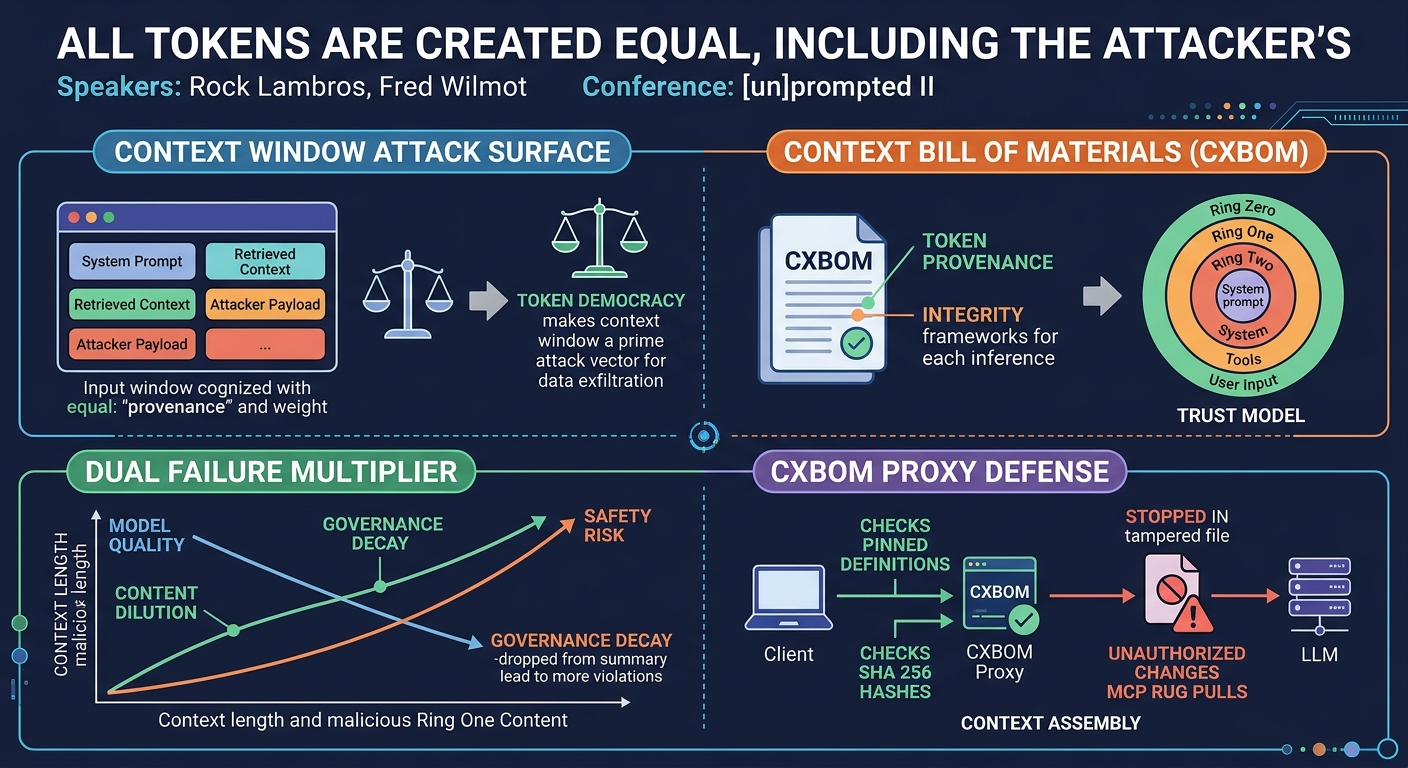
The genesis of this research stems from the rapid evolution of LLM capabilities and the concurrent emergence of novel attack vectors. A primary catalyst was the Echo Leak vulnerability, a zero-click data exfiltration exploit observed in M365 Copilot. In this scenario, attacker-controlled text, indistinguishable from legitimate user instructions or retrieved context, was processed by the model with equal "provenance." The model, doing exactly what the text instructed, inadvertently exfiltrated sensitive data. This incident starkly highlighted a fundamental architectural challenge: transformer models, at their core, process input tokens without inherent knowledge of their origin or trustworthiness.
The speakers elaborate on this concept, drawing on Robin Young's idea of "token democracy." In the attention mechanism of transformer models (e.g., scale.product attention), queries, keys, and values lack any metadata field indicating a token's source. While it's theoretically possible to mark untrusted text, this isn't a standard practice in day-to-day LLM deployments. Consequently, the entire context window effectively becomes an attack surface, where "one collision" can lead to prompt injection, MCP (Multi-Agent Communication Protocol) rug pulls, or other malicious actions.
To address this, the talk introduces a trust model divided into three "rings" representing different levels of operator control and trustworthiness:
- Ring Zero: Operator-authored system prompts, considered the most trusted.
- Ring One: Tool definitions, server instructions, tool results, and retrieved documents—content that is often provided by the operator or trusted third parties but can be dynamic.
- Ring Two: User input, inherently the least trusted.
A critical vulnerability arises from tool definition trust inversion, where a host renders tool definitions in the same region as chat templates or operational instructions. Because the model requires these definitions for planning, and they're marked as Ring One, they can inadvertently inherit the "positional authority" of Ring Zero content. This lack of boundary allows malicious tool definitions to exert undue influence, a problem documented by Invariant Labs and termed tool poisoning. The CxBOM system is designed to record the assigned ring for each path, creating a verifiable record of where content originated in the pipeline, even before it reaches the model, thereby preventing such trust inversions from going undetected.
Key Findings
▶ Watch: Explaining tool definition trust inversion vulnerability (4:20)
The central theoretical contribution of this talk is the dual failure multiplier hypothesis. This hypothesis posits that as the context window grows, both the quality of the model's output and its safety tend to degrade. Initially, the researchers focused on the impact of context length, observing that a longer context inherently "dilutes" the operator's instructions due to the nature of the Softmax function in attention mechanisms. The operator's instruction receives a smaller share of the model's attention as untrusted content piles up.
However, their research evolved to identify two additional critical factors beyond mere length:
- Content Dilution, Deletion, or Overriding: Length is only one way to diminish an operator's instruction. Small, potent payloads in Ring One (e.g., from Sales Bleed, Please Fix, Search Link attacks) have been shown to be sufficient to hijack an agent. This demonstrates that the content itself, not just its length, significantly impacts the model's behavior. A token that attracts high attention effectively "costs" the operator more by disproportionately influencing the model.
- Governance Decay: This finding highlights a critical issue in agent harness design. When agents compact their history, rules or instructions that were initially obeyed might be dropped from the summary. The speakers presented data showing that violations increased from 0% to 30% on average when a rule was dropped from the summary, compared to 0% violations when the rule was retained. This signifies that the failure isn't just the context window getting long; it's the deletion of crucial governing rules, leading to a loss of control and increased safety risks. This also applies to many-shot jailbreaks, where accumulated context can erode safety guardrails.
These findings collectively lead to the conclusion that if the dual failure multiplier hypothesis holds, then the amount and nature of Ring One content in the context window are not merely operational details but direct security parameters. The CxBOM system, even in its current MVP state, directly addresses this by counting tokens per ring, laying the groundwork for future budget policies that could enforce limits or apply different processing based on the provenance and quantity of content from each ring. This provides a measurable and actionable approach to managing the security posture of LLM agents, moving beyond qualitative assessments to quantitative, verifiable controls.
Technical Deep Dive
▶ Watch: Diluted, deleted, or overridden: three attack vectors (7:00)
The proposed solution, CxBOM, is designed to provide granular observability into the context window, effectively creating a Context Bill of Materials. The architecture comprises two primary components: a proxy and an emitter.
The CxBOM proxy operates as a critical intermediary, positioned between the MCP client (the user or calling application) and the standard IO server (which serves the LLM). Its function is to intercept and scrutinize all information flowing into the LLM's context. A key aspect of its operation involves the concept of "pinning" tool definitions. When a person—presumably an operator or security analyst—reviews and approves a tool definition, they "sign" it. This signed definition, along with other server instructions, can be pinned in the server configuration using a SHA 256 hash.
From that point forward, the proxy diligently monitors everything in its path. It checks for any changes to the pinned definitions, potential malicious instructions, or any other unauthorized alterations to the approved context components. If a definition changes or its hash no longer matches the pinned SHA 256 value, the proxy will intervene. Crucially, the proxy is designed to prevent an MCP server from launching if the underlying pinned files or their corresponding hashes have been tampered with. This pre-execution integrity check is a fundamental defensive mechanism, ensuring that the LLM only receives context components that have been explicitly approved and remain unaltered.
The second component is the emitter. This module is responsible for generating the actual CxBOM record, which details every piece of information the model processes during an inference turn. The CxBOM format currently aligns with Cyclone DX 1.6, a widely adopted standard for Software Bill of Materials (SBOMs), with future plans to update to Cyclone DX 2.0 and 2.1 upon their release. This alignment with an established SBOM standard facilitates integration with existing security tools and workflows, making the Context Bill of Materials a familiar and digestible format for security professionals.
The data measured by the emitter includes comprehensive details about the context, such as the number of tokens per ring (Ring Zero, Ring One, Ring Two), the specific content, and its provenance. This granular data allows for an unprecedented level of insight into what the model "saw" and from where. The researchers tested CxBOM on various models, including Microsoft 535 and Quinn 35 8 billion parameter models, demonstrating its applicability across different LLM architectures. By providing a verifiable record of the context, CxBOM shifts the defensive paradigm from guessing what might have happened to knowing exactly what was presented to the model.
Demo / Proof of Concept
▶ Watch: Defenses should sit in context assembly, not just execution (10:00)
The talk included a pre-recorded demonstration of the CxBOM tool in action, showcasing its ability to detect and mitigate three distinct types of attacks that exploit the context window's vulnerabilities. The demo dashboard visually presented the CxBOM record for every call the model made, offering real-time insights into the context.
All three attacks in the demo were cleverly hidden within the description of a "notes tool." The fundamental premise was that the model, trusting the description, would read it and then use a "fetch tool" to exfiltrate a secret, referred to as a "canary." The speakers noted that getting an attack to reliably fire was challenging, but tools like Crock 47 proved useful in crafting effective payloads.
The first attack demonstrated a scenario with the gate off, meaning no checks were in place for the notes tool. In this case, the model read the malicious instruction embedded in the notes tool's description and successfully exfiltrated the canary, which appeared in a simulated "red attacker window." This highlighted the default vulnerability when context provenance is not enforced.
The second attack focused on a trust inversion scenario, as previously described in the background. Even with the "gate on" (indicating CxBOM was active), the demo showed a "trust inversion high open" finding. This occurred because the malicious description of the fetch tool still resided in the operator's block (Ring One) and was presented to the model. While CxBOM could confirm that the signed pin for the text hadn't changed after approval, it couldn't retroactively determine if the text was clean when it was initially approved. This illustrates that CxBOM provides observability and integrity checks post-approval, but initial vetting of Ring One content remains crucial.
The third attack showcased an MCP rug pull. Initially, the tool list appeared clean. However, mid-session, the server maliciously rewrote the tool list, sending a change notice. With the gate off, the model blindly followed the new, malicious instructions. But with the gate on, CxBOM detected the mismatch between the expected (pinned) tool list and the rewritten one. The proxy immediately "pulled" the tool, preventing the secret from being exfiltrated. This demonstrated CxBOM's ability to enforce integrity checks dynamically during a session, preventing runtime manipulation of the context.
The demo emphasized that while the positive rates in a scripted demo might not reflect real-world attack success rates, the core value lies in the CxBOM record itself. This record provides an undeniable log of exactly what the model saw, offering critical forensic and defensive intelligence. The tool's current state is an MVP, and the speakers encouraged community contribution and issue reporting on the associated GitHub repo.
Defensive Implications
▶ Watch: Live demo: CX-Bomb tracking attacks and preventing exfiltration (12:30)
The insights gleaned from "All Tokens Are Created Equal" have profound implications for defensive strategies in LLM security. The talk clearly establishes that the model itself cannot be the sole enforcement point for trust and provenance, leaving three primary stages where defenses can be effectively deployed: assembly, execution, and the model itself.
While in-model defenses and execution controls are valuable, the speakers place a particular emphasis on the assembly stage. This is the point in the software pipeline where the context is constructed and prepared before being sent to the LLM. It's here that the CxBOM framework offers its most significant contribution. By observing and validating the context at assembly, an organization can ensure that what is provided to the model aligns with approved definitions and trusted sources. If a person has signed off on a tool definition, the CxBOM proxy can maintain that promise of integrity for every subsequent inference, checking against SHA 256 hashes and preventing unauthorized changes. This proactive observability at the context building stage is critical for preventing attacks like tool definition trust inversion and MCP rug pulls before they even reach the model.
The speakers acknowledge the importance of execution controls, citing tools like Camel, Fidesz, Forge, and Progen. These systems control what agents are allowed to do and what information they can read post-context assembly. Such controls are essential for enforcing policies on agent behavior. However, they clarify that CxBOM at the assembly layer is not a replacement for these execution controls but rather a complementary layer of defense. It ensures the integrity of the input to these execution-controlled agents.
Furthermore, the talk explicitly states that CxBOM does not imply that in-model defenses are inherently failures. Rather, it advocates for a layered defense-in-depth approach. By introducing the Context Bill of Materials, defenders gain a crucial new capability: verifiable transparency into the LLM's operational context. This allows security teams to:
- Identify Context Provenance: Understand where every token originated (Ring Zero, One, or Two).
- Detect Tampering: Spot unauthorized changes to trusted components of the context.
- Enforce Policies: Implement future policies based on token counts per ring, managing the "security parameter" of context content.
- Improve Forensics: Have a clear, immutable record of the context for incident response.
Ultimately, CxBOM empowers defenders to build more robust, auditable, and resilient LLM applications by making the often-opaque context window a transparent and controllable security domain.
Key Takeaways
- Context Window as Attack Surface: Transformer models treat all input tokens equally, regardless of their origin, making the entire context window a prime attack surface for prompt injection, data exfiltration, and other malicious activities.
- Introducing CxBOM: The Context Bill of Materials (CXBOM), accessible via cxbomb.org, provides a novel framework and toolset to record and verify the provenance of every token an LLM agent reads during inference.
- Trust Model for Context: A three-ring trust model (Ring Zero: operator system prompt; Ring One: tools, retrieved docs; Ring Two: user input) helps categorize and manage the trustworthiness of context components, highlighting vulnerabilities like tool definition trust inversion.
- Dual Failure Multiplier Hypothesis: As context grows, both model quality and safety degrade due to dilution, deletion, or overriding of operator instructions, and governance decay where critical rules are dropped from agent history. The amount and nature of Ring One content are critical security parameters.
- CxBOM's Defensive Mechanism: The CxBOM proxy sits between the client and server, using SHA 256 hashes to pin and verify tool definitions and server instructions, preventing unauthorized changes and MCP rug pulls by ensuring context integrity at the assembly stage.
- Layered Security: CxBOM complements existing execution controls by providing essential observability and integrity checks at the context assembly phase, advocating for a robust defense-in-depth strategy for LLM security.
About the Speaker(s)
Rock Lambros is the Director of AI Standards and Governance at Zenity. His work focuses on establishing robust frameworks and practices for the responsible and secure development and deployment of artificial intelligence systems. As demonstrated in this talk, he is deeply involved in identifying and mitigating novel security risks associated with LLMs.
Fred Wilmot is the CEO & Co-Founder of Detecteam. His expertise lies in developing innovative solutions for detecting and responding to emerging threats, particularly in the realm of AI and cybersecurity. His contributions to the CxBOM project highlight his commitment to practical, actionable security measures for cutting-edge technologies.
Reviews
→ Top-rated talks at [un]prompted II 2026 — The AI Security Practitioner Conference
All talks from [un]prompted II 2026 — The AI Security Practitioner Conference