0-Click Remote Exploits in an AI World
Anna Groza (Security Researcher · Calif.io), Bruce Dang (Calif.io)
[un]prompted II 2026 — The AI Security Practitioner Conference · Day 1 · Stage 1
Overview
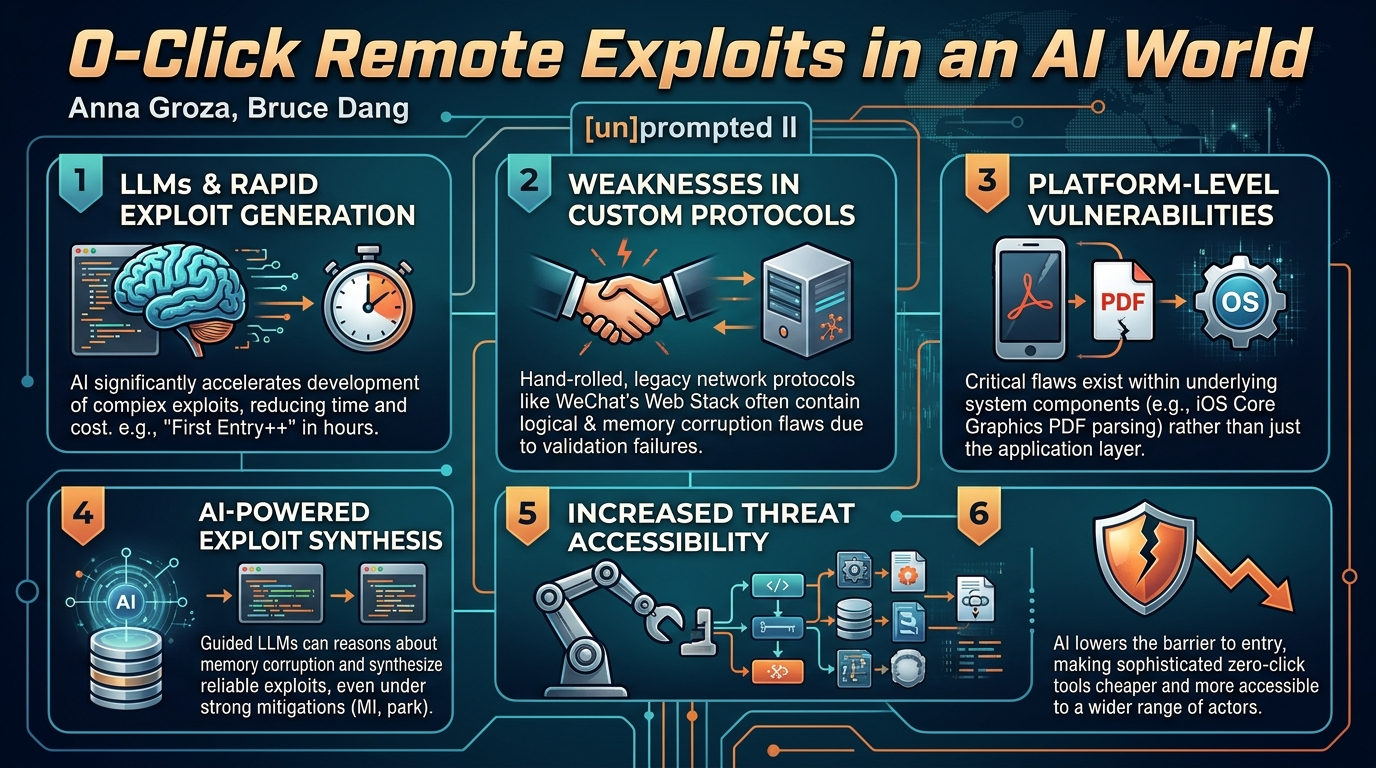
In an era increasingly shaped by artificial intelligence, the landscape of cybersecurity research is undergoing a profound transformation. This talk, delivered by Anna Groza of Calif.io, delves into the groundbreaking intersection of Large Language Models (LLMs) and zero-click remote exploit development. The core premise explored is the extent to which the traditionally arduous and time-consuming process of enumerating remote attack surfaces and crafting sophisticated exploits can be automated and accelerated by advanced AI models. Groza highlights that the capabilities of these models evolved significantly even during the few months of preparing the talk, underscoring the rapid pace of innovation in this field.
Key moments
- 0:00 Introduction: Automating Zero-Click Research with LLMs
- 2:00 Background: Messaging App State Machine Bugs
- 4:40 WeChat 'We Worm' Exploit & Propagation
- 9:40 NSO's FORCEDENTRY & Memory Corruption Theory
- 12:00 iOS Core Graphics 'FORCEDENTRY++' Exploit
- 14:00 LLM's Role in Developing 'FORCEDENTRY++' Exploit
- 17:40 End-to-End Sandbox Escape & SSH Demo
- 20:30 Q&A: Effectiveness of Apple's Lockdown Mode
0-Click Remote Exploits in an AI World
Speakers: Anna Groza (Security Researcher, Calif.io); Bruce Dang (Calif.io)
Conference: [un]prompted II
YouTube: https://www.youtube.com/watch?v=11EoBiBh5QY
Overview
In an era increasingly shaped by artificial intelligence, the landscape of cybersecurity research is undergoing a profound transformation. This talk, delivered by Anna Groza of Calif.io, delves into the groundbreaking intersection of Large Language Models (LLMs) and zero-click remote exploit development. The core premise explored is the extent to which the traditionally arduous and time-consuming process of enumerating remote attack surfaces and crafting sophisticated exploits can be automated and accelerated by advanced AI models. Groza highlights that the capabilities of these models evolved significantly even during the few months of preparing the talk, underscoring the rapid pace of innovation in this field.
The research presented focuses on practical, real-world vulnerabilities discovered in major messaging applications, emphasizing the critical role of reachability analysis in turning seemingly simple bugs into impactful, remotely exploitable threats. By combining static analysis with man-in-the-middle tooling, the Calif.io team empowered an LLM agent to modify messages between clients and observe their effects, systematically maximizing the attack surface. The findings reveal not only severe vulnerabilities in widely used platforms like WeChat and iOS Core Graphics but also challenge conventional notions about the cost, complexity, and defensive strategies against zero-click exploits in a world where AI is a potent force in both offense and defense.
This article dissects the technical intricacies of the presented exploits, the methodology employed, and the broader implications for security researchers, developers, and defenders. It serves as a stark reminder that as AI capabilities advance, so too must our understanding and preparedness for novel attack vectors and the accelerated development of highly potent cyber weapons. The talk makes a compelling case that the era of AI-driven exploit generation is not a distant future but a present reality, demanding a fundamental re-evaluation of security paradigms.
Background
▶ Watch: Introduction: Automating Zero-Click Research with LLMs (0:00)
The journey into understanding and exploiting messaging app vulnerabilities has a rich history, often characterized by the discovery of subtle state machine bugs and complex parsing logic flaws. Anna Groza's talk contextualizes her team's work by drawing parallels to significant prior research, illustrating a lineage of vulnerabilities that pave the way for current AI-driven exploration.
A foundational piece of prior work cited is Natalie Silvanovich's 2021 blog post on state machine bugs in messaging apps. Silvanovich's research, stemming from a 2019 Group FaceTime bug discovered by a 14-year-old, meticulously examined Web Stacks across various applications. Her findings revealed critical flaws, such as the ability to transmit microphone audio without consent in Signal, Facebook Messenger, and JioChat, and a race condition in Google Duo that could leak camera frames. The Group FaceTime bug itself was remarkably simple, allowing a user to hear audio from an invited party before they answered, directly from the app's UI, leading to Apple temporarily disabling Group FaceTime functionality. This incident underscored how seemingly minor logical flaws could have widespread implications.
Further context is provided by Brandon Titska's 2025 report from Google Project Zero, detailing an issue in WhatsApp's contact gating logic. This bug allowed an attacker to bypass normal message restrictions by creating a group chat, elevating a victim's contact to admin, and then sending media content that bypassed the usual contact validation. These examples highlight a recurring theme: the inherent complexity of messaging app architectures, particularly in handling communication states and contact permissions, frequently introduces subtle vulnerabilities that can be exploited for privacy breaches or remote code execution.
The theoretical underpinnings for understanding memory corruption and exploitation are also crucial. Groza references the 2021 NSO First Entry exploit, which targeted iOS, as a pivotal moment that reshaped her perspective on exploitation. This exploit, described as "beautiful" despite its malicious intent, demonstrated that sophisticated memory corruption could achieve arbitrary code execution even under stringent mitigations. This led to a deeper inquiry into whether such exploits were "unicorns" or indicative of a more fundamental misunderstanding of memory corruption. Halvar Flake's work, which formalizes reasoning about memory corruption by distinguishing between a system's intended finite state machine and its actual implementation, provides a conceptual framework. A bug, in this view, can put the implementation into an unintended state where normal operations yield unexpected effects, crucial for blind remote exploitation.
The challenge of ASLR (Address Space Layout Randomization), a primary hurdle in remote exploitation, is also discussed. Groza points out that overcoming ASLR often only requires a pointer to code and arithmetic, not necessarily a "full CPU" built within the exploit, challenging the perception of exploit complexity. Adding to this, the talk touches upon the Langsec (Language-theoretic Security) principles, which emerged from early 2008 research. Langsec advocates for simpler input formats, explicit validation, and avoiding scattered parsing logic to reduce the attack surface. However, Groza acknowledges the practical difficulties of implementing these principles, especially given the widespread reliance on complex file formats like PDFs, which users expect their devices to parse seamlessly. This inherent tension between functionality and security often leaves applications vulnerable to parser-related bugs, a recurring theme in the presented research.
Key Findings
▶ Watch: WeChat 'We Worm' Exploit & Propagation (4:40)
The Calif.io research team unearthed several critical vulnerabilities across widely adopted messaging platforms, demonstrating the power of LLM-assisted security research in uncovering complex, zero-click remote exploits. These findings underscore the fragility of trusted communication channels and the persistent challenges in securing intricate software ecosystems.
The first major finding is dubbed "We Worm," a highly impactful, wormable vulnerability discovered in WeChat's legacy Web Stack. WeChat, used by over a billion and a half people, employs two distinct, custom-rolled Web Stacks. The vulnerability resided in an older, now deprecated, Web Stack that utilized a custom STUN-like relay service for establishing peer-to-peer connections. The critical flaw was a logical bug within the VoIPsync API endpoint. This endpoint was designed to allow peers unable to connect directly to the STUN server to submit a relay update with an IP and port, essentially announcing their connection point. However, neither the Tencent backend nor the client performed any validation to ensure that the provided IP and port actually belonged to a legitimate Tencent server. This egregious oversight allowed an attacker to impersonate the STUN relay service, tricking the victim's client into connecting directly to the attacker.
Once connected, the actual exploit involved a memory corruption bug. While the client was in a "check-in" state, it would continuously send packets, including one containing an attacker-supplied C++ std::string representing the client IP. The handler for these relay packets copied this string, but crucially, it used strlen to determine its length. C++ std::string objects are not necessarily null-terminated. By crafting a protobuf with a non-null-terminated string of a specific length (e.g., 10 'A's), the strlen function would read beyond the intended buffer. On subsequent packets, this would lead to the client reading adjacent memory pointers and leaking their contents back to the attacker. This out-of-bounds read provided a highly reliable primitive that could be chained for remote code execution. The team demonstrated a stage two JavaScript payload that, upon compromise, would iterate through the victim's trusted WeChat contacts and call them using the same relay trick, effectively creating a self-propagating worm. This vulnerability was found using Opus Freight and a modest $200 code subscription, illustrating the accessibility of powerful tooling in the hands of researchers.
Beyond specific messaging app components, the research broadened to platform components, including a brief mention of an issue involving Samsung P (a platform component) combined with a Samsung exploit. While details were scarce due to ongoing collaboration with Meta's product security team on attack surface reduction and the fix not being fully perfect or released, it highlighted that significant attack surface often lies within these underlying system components rather than just the application layer.
The most ambitious and technically sophisticated finding was an exploit for an iOS Core Graphic anti-aliasing bug, nicknamed "First Entry++." This vulnerability, which had reportedly been exploited in the wild, targeted the Core Graphics framework responsible for rendering various visual elements, including PDFs. The root cause was identified as undefined behavior in C stemming from an inconsistent conversion between a double (floating-point number) and a signed fixed-point integer. Because the range of a double is significantly larger than that of a uint32_t, this conversion could be handled differently by two distinct code paths within iOS, leading to an exploitable state.
The primitive derived from this bug was a repeatable relative 60-bit add on the stack. Crucially, small buffers in the affected code path were allocated directly on the stack (which is canonically zero-tagged in the target environment) rather than on the heap (which would involve more complex Memory Tagging (MT) mitigations). By mixing this primitive with nested PDF streams, the researchers could deepen the call stack and reach useful saved interpreter state. The exploit culminated in the construction of a 32-bit full adder out of a PDF/TrueType read machine, enabling arbitrary arithmetic operations necessary for a robust exploit. What made this particularly remarkable was its reliability, even with MI in park (Memory Isolation in Pointer Authentication and Randomization) enabled on vulnerable iOS versions (pre-2671). The exploit is zero or one-click, depending on whether PDF thumbnailing automatically triggers the vulnerable parsing logic.
A groundbreaking aspect of "First Entry++" was the direct involvement of an LLM in its generation. After extensive manual observation and "steering" of the model (modifying agents to prevent shortcuts), Anna Groza provided the LLM with a specific /goal prompt: "demonstrate repeated." In approximately two hours, the LLM produced a working exploit. This demonstrated the model's ability to reason about complex memory corruption scenarios and generate highly sophisticated, reliable exploits, even under strong mitigations. The fact that the LLM-generated exploit was more sophisticated than some in-the-wild samples (which only worked with park/MT disabled) further highlights its capabilities. This exploit impacts any messaging app on iOS or macOS that parses PDFs using native APIs.
Finally, the talk briefly mentioned the existence of zero-click WhatsApp bugs that were fixed in iOS version 27.2. However, these were limited to trusted contacts, which, as Groza notes, makes them "kind of lame" in the context of untrusted, zero-click exploitation.
Technical Deep Dive
▶ Watch: iOS Core Graphics 'FORCEDENTRY++' Exploit (12:00)
The technical prowess demonstrated in the Calif.io research hinges on exploiting nuanced flaws in complex software architectures, augmented significantly by the capabilities of Large Language Models. Two primary exploits provide compelling case studies: the "We Worm" in WeChat and the "First Entry++" targeting iOS Core Graphics.
The WeChat "We Worm" exploit capitalized on a series of vulnerabilities within WeChat's custom, hand-rolled legacy Web Stack. This stack was designed to facilitate peer-to-peer communication using a STUN-like relay service. The initial entry point was a logical bug in the VoIPsync API endpoint. This endpoint's purpose was to allow clients that couldn't establish a direct connection to the STUN server to submit a relay update containing their IP address and port. Crucially, the system lacked proper validation: neither the Tencent backend nor the client ever verified if the provided relay IP and port genuinely belonged to a legitimate Tencent server. This fundamental trust issue enabled an attacker to impersonate the STUN relay. By sending a crafted VoIPsync message, an attacker could trick the victim's WeChat client into connecting directly to the attacker's controlled server, believing it was a legitimate relay.
Once the client was redirected to the attacker's server, a memory corruption vulnerability came into play. The client, while in an intermediate "check-in" state, would continuously communicate with the (now malicious) relay, sending packets. One such packet contained a C++ std::string representing the client's IP address, derived from a decoded protobuf. The handler for these relay packets would copy this client IP string. The critical flaw was the use of strlen to determine the length of this string. Unlike C-style strings, C++ std::string objects are not inherently null-terminated unless explicitly made so. An attacker could craft a protobuf containing a client IP string that was intentionally not null-terminated, but with a specific length (e.g., 10 'A' characters). When strlen was called on this non-null-terminated string, it would read past the allocated buffer until it encountered a null byte, effectively performing an out-of-bounds read. This read would then leak adjacent memory contents, including pointers, back to the attacker in subsequent packets. This primitive, a reliable information leak, could be leveraged to bypass ASLR and facilitate further exploitation, ultimately leading to remote code execution. The wormable nature was achieved via a JavaScript stage two payload that automatically propagated the exploit to trusted contacts by initiating calls using the same relay trick. The reliability stemmed from not crossing heap allocation boundaries, making the exploit highly deterministic.
The iOS Core Graphics "First Entry++" exploit is a testament to the sophistication achievable through AI-assisted vulnerability research, especially against hardened targets. The root cause was identified as undefined behavior (UB) in C, specifically an inconsistent conversion from a double (a 64-bit floating-point number) to a signed fixed-point integer (implicitly a 32-bit integer). The range of a double is vastly greater than that of a 32-bit integer, and when such a conversion occurs without proper bounds checking or handling, the C standard declares the behavior undefined. In iOS, two different code paths were found to handle this conversion inconsistently, leading to a corrupt state that could be manipulated.
A key aspect of the exploit's success was the memory layout. Small buffers, crucial for the exploit's primitive, were allocated directly on the stack, rather than the heap. This was significant because, in the targeted iOS environment, the stack was canonically zero-tagged. This meant that memory tagging (like Memory Isolation (MI) or Pointer Authentication and Randomization (park)), which are powerful mitigations on the heap, had less impact on these stack-allocated buffers. The exploit primitive derived from the UB was a repeatable relative 60-bit add on the stack. This allowed the attacker to perform controlled arithmetic operations at specific memory offsets relative to a known stack address. To deepen the call stack and reach specific, useful saved interpreter state within the Core Graphics processing pipeline, the exploit leveraged nested PDF streams. By chaining these, the attacker could manipulate the execution flow to achieve a more powerful primitive: constructing a 32-bit full adder out of a PDF/TrueType read machine. This "computational gadget" allowed the exploit to perform arbitrary arithmetic operations, essential for bypassing ASLR and achieving arbitrary code execution with high reliability, even with MI in park enabled on the latest vulnerable iOS versions (pre-2671). The ability of the exploit to function under these strong mitigations made it particularly potent, surpassing the capabilities of some in-the-wild exploits that required mitigations to be disabled.
The role of the LLM in generating the "First Entry++" exploit was transformative. While the LLM did not discover the initial bug, it was instrumental in exploiting it. Anna Groza described a meticulous process of observing the model's behavior, modifying its agents to prevent "shortcuts" she deemed undesirable, and then providing a high-level /goal prompt: "demonstrate repeated." The model, after this pre-conditioning, was able to generate the complex exploit logic, including the 32-bit full adder construction and the use of nested PDF streams, in approximately two hours. This efficiency highlights a critical shift: LLMs, when properly guided, can rapidly synthesize complex exploitation techniques against known primitives. Groza noted a counter-intuitive observation: LLMs performed better at exploitation when constrained by strong mitigations. She theorized that this is because mitigations effectively "cut off a large part of the search space" for a particular bug, directing the LLM towards more robust and sophisticated exploitation paths. This suggests that future exploit development, particularly for highly mitigated targets, may increasingly rely on AI to navigate and optimize complex attack chains.
Demo / Proof of Concept
▶ Watch: LLM's Role in Developing 'FORCEDENTRY++' Exploit (14:00)
The talk included compelling demonstrations that brought the theoretical discussions of zero-click exploits to life, showcasing the practical impact of the discovered vulnerabilities and the capabilities of LLM-assisted exploit generation.
For the WeChat "We Worm", while a live demonstration wasn't explicitly detailed in the transcript, Anna Groza vividly described its functionality. The proof of concept involved a stage two JavaScript payload that was automatically executed on a compromised client. This payload's primary function was to iterate through the victim's list of "trusted contacts" on WeChat. For each trusted contact, the payload would initiate a call using the same relay trick that facilitated the initial compromise. This propagation mechanism effectively turned the vulnerability into a self-spreading worm, capable of infecting an entire social graph within the messaging application. Groza highlighted its reliability, noting that it didn't even cross heap allocation boundaries, which often introduce instability in exploits. This demonstration underscored the ease with which a single compromise could cascade into a widespread network infection, leveraging the inherent trust relationships within a messaging app.
The demonstration for the iOS Core Graphics "First Entry++" exploit was visually presented, illustrating the full chain of compromise on an actual device. The video showed a sequence of events initiated by the zero or one-click exploit (depending on PDF thumbnailing). The initial stage involved leveraging the Core Graphics vulnerability to achieve arbitrary code execution, which then allowed the researchers to escape the sandbox that normally confines applications on iOS. Following sandbox escape, the demonstration proceeded to bootstrap packages on the device, a critical step in gaining persistent control and installing custom software. The ultimate outcome of this chain was the ability to SSH into the iPhone, providing full remote access to the device's file system and command line.
The demo culminated in the installation of tweaks from Cydia, a popular third-party app store for jailbroken iOS devices, further illustrating the complete control gained over the compromised iPhone. Groza mentioned that this particular exploit chain, one of several developed, was produced in approximately two weeks. The video was even filmed on Bruce's birthday, adding a lighthearted note to a serious technical achievement. The specific device used for the demonstration was an iPhone running the 271 day one OTA (Over-The-Air update), indicating it was a device running the latest publicly available, vulnerable iOS version at the time of its release. The visual quality of the POC videos was humorously attributed to "Ryan's anime girl inspiration," suggesting a playful approach to presenting highly technical and impactful research. This demonstration powerfully illustrated the real-world implications of the Core Graphics vulnerability, showcasing a complete, reliable, and sophisticated zero-click remote exploitation chain on a fully patched iOS device.
Defensive Implications
▶ Watch: Q&A: Effectiveness of Apple's Lockdown Mode (20:30)
The research presented by Anna Groza carries profound implications for defenders, highlighting critical vulnerabilities in widely used communication platforms and the escalating threat posed by AI-accelerated exploit development. Understanding these implications is crucial for evolving defensive strategies in the modern threat landscape.
First and foremost, the findings underscore the fragility of trusted/untrusted gating in messaging apps. The "We Worm" exploit in WeChat, for example, bypassed contact gating logic by impersonating a trusted relay, leading to a wormable compromise among trusted contacts. Similarly, while WhatsApp bugs were fixed, they were limited to trusted contacts, illustrating that even with patches, the inherent trust within a social graph remains a significant attack vector. Defenders must recognize that the traditional distinction between trusted and untrusted senders is increasingly porous. This suggests a need for broader sandboxing mechanisms rather than relying solely on logic-based contact gating. Applications should isolate components, especially those handling complex input formats or network protocols, to minimize the impact of a compromise, regardless of the sender's trust level.
The role of AI and LLMs in security research is a double-edged sword. While LLMs can aid defenders in finding and fixing bugs, this talk unequivocally demonstrates their potent capability in accelerating exploit development. The "First Entry++" exploit, generated by an LLM in just two hours, shows that the time and cost associated with crafting complex, reliable zero-click exploits are rapidly decreasing. Groza explicitly stated that the exploits shown were "less than five figures at the API price," making them far more accessible to a wider range of threat actors. This necessitates a shift in defensive posture: organizations can no longer assume that sophisticated zero-click exploits are the exclusive domain of state-sponsored actors with vast resources. The barrier to entry is lowering, demanding faster patch cycles, more robust exploit mitigations, and perhaps even the use of defensive AI to counter offensive AI.
A counter-intuitive but critical observation was that LLMs appear to perform better at exploitation when constrained by strong mitigations like MI in park. Groza theorized that this is because mitigations effectively "cut off a large part of the search space" for a particular bug, guiding the LLM towards more efficient and robust exploitation paths. This means that simply implementing strong mitigations is not a silver bullet; instead, they might inadvertently make it easier for AI to find the optimal exploit chain. Defenders must therefore focus on a defense-in-depth strategy that includes not just mitigations but also proactive threat hunting, comprehensive vulnerability management, and continuous security testing.
Specific technical recommendations for developers arise from the nature of the vulnerabilities:
- Avoid custom, hand-rolled protocols: The WeChat "We Worm" was enabled by a custom, legacy Web Stack with insufficient validation. Standardized, well-vetted protocols with robust security features are always preferable.
- Implement strict input validation: The lack of validation for the relay server IP/port in WeChat was a critical logical flaw. All external inputs, especially those affecting network connections or state machines, must be rigorously validated.
- Be hyper-vigilant about undefined behavior (UB) in C/C++: The iOS Core Graphics bug stemmed from inconsistent handling of
doubletosigned fixed-point integerconversion. Developers must meticulously review code for potential UB, especially in low-level languages, as compilers can optimize UB in unpredictable and exploitable ways. Fuzzing with UB sanitizers is essential. - Embrace Langsec principles: While challenging for widely used formats, the core idea of simpler input languages, explicit validation, and centralized parsing logic remains a strong defensive posture against parser-based vulnerabilities.
- Rapid patching and user updates: The WhatsApp bugs were fixed in iOS 27.2. Users must be encouraged to update their devices promptly. However, as Groza pointed out, targeting "grandma" (less security-aware users with older devices) remains a viable strategy for attackers to gain an initial foothold.
Finally, the talk highlighted the increasing potential for supply chain or social graph compromise. The NSO/Meta lawsuit reference and Citizen Lab's reporting on the misuse of the ad ecosystem for exploit delivery suggest that attackers may compromise "one hop further up the chain" (e.g., a less secure contact or an advertising network) to gain access to a broader attack surface and make the second stage of an attack easier. This implies that defensive strategies must extend beyond individual devices to encompass the entire digital ecosystem and social connections of high-value targets. Lockdown Mode on iOS, while useful, is not a panacea; it merely changes the "number of hops" and does not eliminate vulnerabilities like PDF rendering issues.
Key Takeaways
- LLMs are Revolutionizing Exploit Development: Large Language Models are no longer theoretical tools for security; they can actively and rapidly generate complex, reliable zero-click exploits, significantly reducing the time and cost traditionally associated with such research. The "First Entry++" exploit, generated in approximately two hours, is a stark example of this paradigm shift.
- Custom Protocols are Critical Weak Points: Hand-rolled, custom network protocols, especially legacy ones like WeChat's Web Stack, often contain fundamental logical and memory corruption flaws (e.g., the "We Worm") due to insufficient validation and complex parsing, making them prime targets for widespread compromise.
- Undefined Behavior in C/C++ is a Persistent Threat: Subtle instances of undefined behavior, such as inconsistent type conversions (
doubletofixed-point integerin iOS Core Graphics), can lead to powerful and reliable zero-click remote code execution primitives, even against highly mitigated systems. - Mitigations Can Paradoxically Aid AI Exploitation: Strong exploit mitigations like MI in park, while effective against traditional exploitation, can inadvertently simplify the search space for AI models, allowing them to more efficiently discover and construct robust exploit chains.
- "Trusted" vs. "Untrusted" Gating is Fragile: The distinction between trusted and untrusted contacts in messaging apps is increasingly unreliable. Attackers can bypass these gates (e.g., by impersonating trusted relays) or target less secure "trusted" contacts to compromise an entire social graph, necessitating a focus on broader sandboxing rather than narrow trust models.
- The Cost of Zero-Click Exploits is Decreasing: With LLM assistance, the financial and temporal investment required to develop potent zero-click exploits is rapidly diminishing, making these highly impactful tools accessible to a wider range of threat actors. This demands faster defensive responses and a proactive approach to security.
About the Speaker(s)
The talk "0-Click Remote Exploits in an AI World" was primarily delivered by Anna Groza, a Security Researcher at Calif.io. She is part of the dedicated Calyx research team, which was instrumental in pulling off the complex research and exploit development discussed in the presentation. While Bruce Dang is also listed as a speaker from Calif.io, Anna Groza presented the talk solo, humorously noting Bruce's absence at the beginning. The research highlights the cutting-edge work being done by the Calif.io team in exploring the intersection of AI and offensive security.
Reviews
- Dr. Zero (Offensive Security Researcher) — MUST SEE ★★★★★
- Heather Calloway (CISO) — MUST SEE ★★★★★
→ Top-rated talks at [un]prompted II 2026 — The AI Security Practitioner Conference
All talks from [un]prompted II 2026 — The AI Security Practitioner Conference