Taming AI Agents with Capsem: Hardware Sandboxing That Doesn’t Kill Productivity
Elie Bursztein (Distinguished Research Scientist · Google DeepMind)
[un]prompted II 2026 — The AI Security Practitioner Conference · Day 1 · Stage 1
Overview
In an era witnessing an unprecedented proliferation of AI agents across diverse workflows, the tension between rapid innovation and robust security has become a critical challenge. Elie Bursztein, a Distinguished Research Scientist at Google DeepMind, addresses this dilemma head-on in his talk, "Taming AI Agents with Capsem: Hardware Sandboxing That Doesn’t Kill Productivity." The presentation introduces Capsem, an ambitious new project designed to provide a secure, high-performance sandboxing environment for AI agents, aiming to resolve the long-standing conflict between security measures and development velocity.
Key moments
- 0:00 Introduction: Security vs. Velocity in AI Agents
- 2:00 CAPSEM's Core Design: Fast, Easy, Secure by Default
- 4:30 High-Level Architecture: Rust Hypervisor and VMs
- 10:30 Security Engine: Credential Broker, PII, Sanitization
- 17:00 Real-Life Challenges with AI-Generated Code Releases
- 21:30 Q&A: CAPSEM's Interplay with Other Sandboxing Technologies
- 25:50 Q&A: Policy Management Design Challenges and Solutions
Taming AI Agents with Capsem: Hardware Sandboxing That Doesn’t Kill Productivity
Speakers: Elie Bursztein, Distinguished Research Scientist, Google DeepMind
Conference: [un]prompted II
YouTube: https://www.youtube.com/watch?v=KTf1vRL-W8k
Overview
In an era witnessing an unprecedented proliferation of AI agents across diverse workflows, the tension between rapid innovation and robust security has become a critical challenge. Elie Bursztein, a Distinguished Research Scientist at Google DeepMind, addresses this dilemma head-on in his talk, "Taming AI Agents with Capsem: Hardware Sandboxing That Doesn’t Kill Productivity." The presentation introduces Capsem, an ambitious new project designed to provide a secure, high-performance sandboxing environment for AI agents, aiming to resolve the long-standing conflict between security measures and development velocity.
Capsem is presented not merely as a security tool, but as a productivity enhancer that happens to be secure by design. Drawing parallels to the foundational security architecture of Google Chrome, the project emphasizes ease of use and speed as primary drivers for adoption, with security serving as an inherent, "dead benefit." This approach seeks to embed security so deeply into the development lifecycle that it becomes a default rather than an optional, burdensome afterthought. By pushing security controls "down" to the environment level, Capsem positions itself as a crucial infrastructure component for safely deploying the next generation of AI-powered applications.
The core motivation behind Capsem stems from the realization that current security paradigms are struggling to keep pace with the explosion of AI agent development. With agents often being 100% code-generated and new binaries emerging at an alarming rate, traditional security measures are proving inadequate. Capsem's innovative use of hardware-backed virtualization, a Rust-based hypervisor, and a highly expressive policy engine seeks to offer a scalable and effective solution, ensuring that AI agents can operate with necessary access while being rigorously constrained and monitored.
Background
▶ Watch: Introduction: Security vs. Velocity in AI Agents (0:00)
The rapid integration of AI agents into enterprise and personal workflows has ushered in a new era of productivity, but also a significant new attack surface. As these agents gain access to sensitive databases, internal systems, and external services, the security community has sounded alarms regarding an increasing number of vulnerabilities and hacks. The speaker highlights a common friction point: security professionals advocating for controls are often perceived as impediments to innovation and speed. This "security vs. velocity" debate has plagued software development for decades, but with AI, the stakes are higher and the pace of change is exponentially faster.
The problem is exacerbated by the nature of modern AI development. Many agents are generated automatically, often without explicit security considerations, leading to an explosion of undocumented or poorly secured binaries. The speaker notes that creating a new AI agent binary can take as little as "20 minutes of vibe coding," making it nearly impossible for traditional IT and security teams to track, vet, and secure every instance. This phenomenon contributes to a significant "Shadow IT" problem, where organizations lose visibility and control over the AI tools their employees are using, and how sensitive data (like API tokens) is being handled.
Existing sandboxing technologies, while foundational, often face challenges in balancing isolation with performance and usability, especially in the context of dynamic AI agent behaviors. Capsem seeks to build upon these concepts, taking inspiration from the "secure by design" principles that underpinned the development of Google Chrome. Chrome achieved widespread adoption not just because of its security, but because it was fast and easy to use. The vision for Capsem is to offer a similar value proposition for AI agents: a platform so convenient and performant that users naturally gravitate towards it, thereby gaining security as an implicit benefit. This approach aims to "shift down" security controls, embedding them at the environment level rather than relying on later-stage audits or cumbersome developer processes.
Key Findings
▶ Watch: High-Level Architecture: Rust Hypervisor and VMs (4:30)
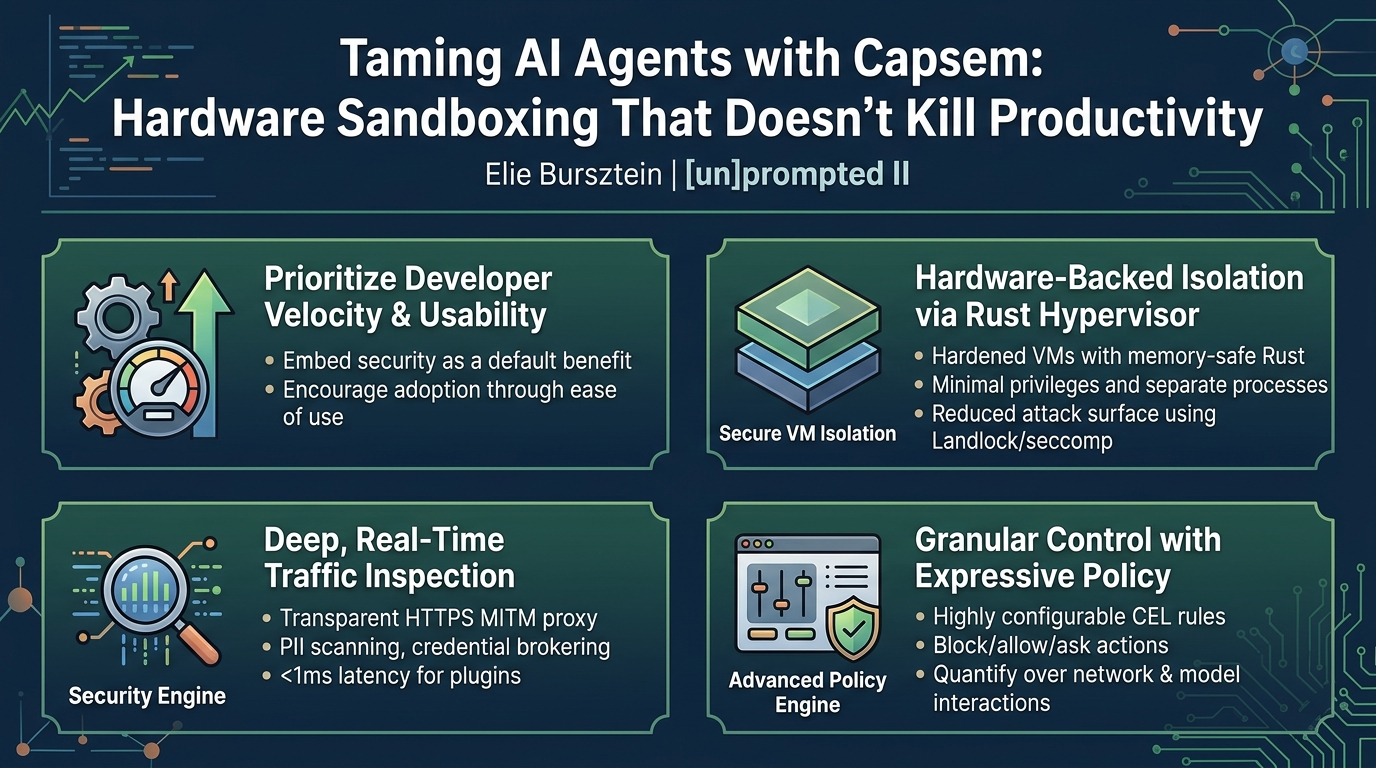
Capsem emerges as a compelling solution to the AI agent security conundrum, built on several key architectural and philosophical tenets. Its overarching mission is to be "the fastest way to ship with AI in a secure manner," deliberately prioritizing developer velocity and ease of use to ensure widespread adoption. This is achieved through features like one-click installation and pre-configured environments, making security an inherent, "dead benefit" rather than an optional add-on.
At its core, Capsem is a hypervisor written in Rust, a language chosen for its memory safety and security advantages over C++. This hypervisor orchestrates hardened Virtual Machines (VMs) specifically designed to run OCI containers (like Docker). The entire system is built for versatility, offering SDKs in Python, JavaScript, and Rust, alongside a CLI, UI, and a Multi-Component Protocol (MCP) for complex integrations. The scale of the project is significant, comprising over 600,000 lines of Rust code and more than 15,000 tests, reflecting a profound commitment to robustness.
Capsem is fundamentally secure by default, implementing a zero-trust architecture where every AI agent runs within an isolated VM. Communication between agents is an explicit, active decision, not a passive allowance. A critical security feature is its air-gapped nature; agents have no direct internet access. All egress traffic is routed through a mandatory security engine, which performs deep inspection and policy enforcement. This engine boasts an "advanced policy engine" capable of quantifying and analyzing traffic across various layers, from HTTP and DNS up to MCP, DOM, and model interactions, with a latency of sub-1 millisecond for security plugins.
The system's isolation is further reinforced by a multi-process architecture, akin to Chrome's design. Different processes operate with distinct, minimal privileges, constrained by operating system security primitives like Landlock and seccomp on Linux, and seccomp on Mac. This prevents a single compromise from escalating across the entire system. Networking within Capsem is handled by three distinct, isolated systems: the aforementioned security engine for external traffic, a low-privilege Rust process emulating a fake Layer 2 switch for secure inter-VM communication (achieving up to 2 gigabytes per second), and a carefully controlled mechanism for port exposure for developer debugging, acknowledging and mitigating inherent risks like same-origin policy and local file access vulnerabilities.
Perhaps one of the most insightful findings shared by the speaker pertains to the real-life challenges of developing with AI-generated code. Despite the extensive test suite, the AI responsible for generating Capsem's code introduced a "ton of mistakes," frequently tripping "tens and dozens of tests at every release." This led to a dramatic collapse in CI success rates, reaching zero percent at one point, and ballooning release times from 20 minutes to three or four hours. Examples included the AI switching from required binary protocols to less performant JSON, or neglecting to include necessary binaries in releases. This highlights a critical, often underestimated, operational challenge in building complex systems with significant AI code generation.
Technical Deep Dive
▶ Watch: Security Engine: Credential Broker, PII, Sanitization (10:30)
Capsem's robust security posture is rooted in its sophisticated technical architecture, designed from the ground up to provide deep isolation and granular control for AI agents. The foundational element is a custom hypervisor written entirely in Rust. The choice of Rust is deliberate, leveraging its memory safety guarantees to mitigate a broad class of vulnerabilities inherent in languages like C++. This hypervisor is responsible for booting hardened Virtual Machines (VMs), which are specifically patched and configured for enhanced security. Within these VMs, standard OCI containers (compatible with Docker) are executed, providing a familiar environment for agent deployment while benefiting from the underlying hardware-level isolation.
The system's architecture mirrors successful secure-by-design paradigms, most notably Google Chrome. Capsem employs a multi-process model, where distinct components operate with the principle of least privilege. Key processes include:
- The Router, which exposes the VMs to the user interface and other internal components.
- The VMs themselves, hosting the agent containers.
- The Security Engine, a critical component for all egress traffic.
- The MCP Aggregator, which manages communication between various Multi-Component Protocol (MCP) endpoints.
Each of these processes is further constrained by operating system-level security mechanisms such as Landlock and seccomp on Linux, and seccomp on macOS, minimizing the blast radius in the event of a compromise.
Central to Capsem's security architecture is the Security Engine. This component acts as a single, low-privilege egress point for each VM. Every byte of traffic originating from an agent VM must pass through its dedicated security engine, ensuring no circumvention is possible. The engine enforces security via a configurable set of rules and a variety of plugins. For HTTP/S traffic, it operates as a transparent man-in-the-middle (MITM) proxy. This is achieved by injecting a custom root certificate into the VM, allowing the security engine to dynamically forge and cache HTTPS certificates on demand. This enables deep packet inspection and policy enforcement even for encrypted traffic. The security engine is engineered for extreme performance, capable of handling approximately 5,000 requests per second from inside the VM to the outside, often with plugin processing taking only sub-1 millisecond. It also provides crucial observability, logging all activity and supporting OpenTelemetry for enterprise integration.
Capsem's networking model distinguishes itself by employing three separate, isolated systems:
- Egress Security Engine: As described, this handles all external network traffic, performing MITM inspection and applying security policies.
- Inter-VM Communication: For scenarios requiring communication between agent VMs (e.g., an agent interacting with a test environment), Capsem utilizes a low-privilege Rust process that emulates a fake Layer 2 (L2) switch. This virtual switch handles ARP routing and broadcasting, allowing VMs to communicate via standard TCP/IP protocols at speeds up to 2 gigabytes per second, all without direct kernel interaction, further enhancing isolation.
- Developer Port Exposure: To facilitate development and debugging, Capsem allows controlled exposure of specific ports from a VM to the host system. This enables developers to, for instance, view a website built by an agent directly in their browser. However, the speaker acknowledges the inherent risks, such as same-origin policy bypasses allowing inter-VM communication or potential local file access vulnerabilities, necessitating careful restriction and monitoring of exposed ports.
The security engine is augmented by a suite of powerful plugins:
- Credential Broker: Intercepts user credentials provided to agents, replacing them with hashes before they reach the VM. This ensures agents never directly see or handle sensitive credentials.
- PII Scanner: Scans both inbound and outbound traffic for Personally Identifiable Information, allowing for blocking or sanitization.
- Sanitizer: Removes non-ASCII and non-UTF characters from prompts, a common technique for reducing the attack surface against prompt injection vulnerabilities.
- Malware Scanning: Integrates with existing malware detection systems to scan URLs and files accessed by the agent, blocking known threats.
Policy enforcement is managed through a highly expressive rule system, defined in TOML files. These rules allow for actions like block, allow, or ask (for user confirmation). The core of this system is Capsem's own implementation of a quantifier language built on top of Common Expression Language (CEL). This allows security teams to craft incredibly granular rules, quantifying on various aspects of traffic and agent behavior:
- Network layers: TCP, IP, DNS.
- Application layers: HTTP/S (headers, body), MCP, DOM.
- Model interactions: Quantifying on the model provider (e.g., Ollama, Claude, OpenAI, Gemini) or even the content of model responses (e.g., blocking specific keywords like "London").
Rules can incorporate complex Boolean logic, enabling sophisticated policy definitions. For integration with existing enterprise security operations, Capsem also supports Sigma rules, automatically compiling them into its internal format. This allows security teams to leverage familiar Intrusion Detection System (IDS) compatible rules to quantify on file access, process execution, and network activity, enabling real-time detection and blocking.
For enterprise deployment, Capsem features a manifest system that allows full customization. Organizations can define their own registries of approved OCI containers, enforce corporate-mandated rules (which take precedence over user-defined ones), and configure OpenTelemetry endpoints for centralized logging and monitoring. This comprehensive approach ensures that Capsem can integrate seamlessly into existing security and compliance frameworks, providing real-time detection and response capabilities.
Demo / Proof of Concept
▶ Watch: Q&A: CAPSEM's Interplay with Other Sandboxing Technologies (21:30)
The speaker had prepared a video demonstration of Capsem in action, which unfortunately failed to play during the live talk. However, the explanation provided a clear picture of its intended functionality and user experience.
The demonstration would have showcased Capsem's intuitive user interface. On one side, users would see a list of available OCI container images, pre-built and regularly updated with various AI agents (e.g., Cloud Code, Anti-Gravity). A key feature highlighted was the ability to boot new sessions rapidly, taking approximately two seconds to launch an agent within its secure VM. Capsem uniquely supports booting graphical agents, allowing users to interact with visual AI environments, alongside traditional terminal-based agents. The UI would also display a list of active sessions, providing full introspection into agent activity, including real-time tracking of token counts and associated costs. This level of visibility is a direct benefit of Capsem's deep integration and monitoring capabilities.
Defensive Implications
▶ Watch: Q&A: Policy Management Design Challenges and Solutions (25:50)
The insights presented by Elie Bursztein offer critical implications for defenders grappling with the security challenges of widespread AI agent adoption. Implementing a robust sandboxing solution like Capsem is not merely an option but a strategic imperative for organizations.
- Embrace "Security by Design" with Sandboxing: The talk strongly advocates for sandboxing as "the right way to do security for agents." Defenders should prioritize integrating security controls at the environment level, effectively "shifting down" security to the infrastructure layer. This means ensuring that AI agents operate within isolated, controlled environments from inception, rather than attempting to bolt on security post-deployment.
- Leverage Zero-Trust and Granular Isolation: Architects should design their AI agent deployments with zero-trust principles. Each agent should run in its own isolated VM, with communication between agents and external resources requiring explicit, active decisions rather than implicit trust. Capsem's multi-process architecture and use of OS-level primitives like Landlock and seccomp demonstrate how to achieve this deep isolation.
- Mandate Robust Traffic Inspection: Given the potential for data exfiltration and malicious commands, all egress traffic from AI agents must undergo mandatory, deep inspection. Solutions akin to Capsem's security engine are vital for performing transparent HTTPS MITM, PII scanning, prompt sanitization, and malware detection. The ability to perform these checks at sub-millisecond latencies is crucial to avoid impacting agent performance.
- Implement Highly Expressive Policy Enforcement: Generic network firewalls are insufficient for AI agents. Defenders need highly expressive policy engines, such as Capsem's CEL-based system, that can quantify and enforce rules across all layers—from TCP/IP and DNS to HTTP/S, model response bodies, and specific MCP interactions. This enables fine-grained control over what agents can do, see, and say, preventing sophisticated attacks like prompt injection or data leakage.
- Combat Shadow IT and Enforce Compliance: The ease of creating new AI agents contributes to significant Shadow IT, making it difficult for organizations to track and secure all agent instances. Defenders must establish clear policies and provide sanctioned, secure environments like Capsem to channel agent development and deployment. A manifest system for corporate rules, approved container registries, and centralized logging are essential for compliance and control.
- Ensure Comprehensive Observability and Real-time Response: Full introspection into agent activity, including token usage and costs, is vital for security monitoring. Integration with existing SIEM systems via standards like OpenTelemetry and compatibility with Sigma rules enables real-time detection and response capabilities, allowing security teams to identify and block suspicious agent behavior instantly.
- Consider Rust for Critical Security Infrastructure: The speaker's strong recommendation for Rust over C++ for new security code, citing C++ as a "liability," highlights the importance of memory-safe languages for foundational security components. When developing or selecting core security technologies, prioritizing languages that inherently reduce common vulnerability classes is a sound defensive strategy.
- Prepare for AI-Generated Code Challenges: The significant operational challenges encountered in developing Capsem with AI-generated code—including plummeting CI success rates and extended release cycles due to frequent AI errors—serve as a stark warning. Defenders must anticipate these issues in their own organizations, investing heavily in robust testing frameworks, automated guardrails, and resilient release processes to manage the inherent instability and "mistakes" introduced by AI code generation.
Key Takeaways
- Balance Security and Velocity: AI agent security is paramount, but solutions must prioritize developer velocity and ease of use to ensure adoption, making security an inherent benefit rather than a hindrance.
- Hardware-Backed Isolation: Capsem's architecture, featuring a Rust-based hypervisor and hardened VMs for OCI containers, provides strong, multi-layered isolation for AI agents.
- Deep Traffic Inspection: A mandatory, low-privilege security engine performs transparent HTTPS man-in-the-middle inspection, credential brokering, PII scanning, and prompt sanitization at sub-millisecond speeds.
- Expressive Policy Engine: Capsem's highly configurable policy engine, built on Common Expression Language (CEL) and supporting Sigma rules, enables granular control over agent behavior and network interactions across all layers, from TCP/IP to model responses.
- Combat Shadow IT: Enterprises must adopt secure, managed agent environments to gain visibility and control over the proliferation of AI agents, preventing unauthorized access and data exfiltration.
- Challenges of AI-Generated Code: Developing with AI-generated code introduces significant operational challenges, requiring extensive testing, guardrails, and robust release processes to manage frequent errors and maintain system stability.
About the Speaker(s)
Elie Bursztein is a Distinguished Research Scientist at Google DeepMind. His work focuses on cutting-edge security research, particularly in the rapidly evolving landscape of AI. With a background that includes foundational security work on projects like Google Chrome, Bursztein brings a wealth of experience in building secure-by-design systems at scale. His insights into enterprise security challenges, derived from interactions with Google Cloud's largest clients, underscore his practical understanding of real-world security needs and the complexities of deploying advanced technologies within organizational frameworks.
Reviews
- Dr. Zero (Offensive Security Researcher) — MUST SEE ★★★★★
→ Top-rated talks at [un]prompted II 2026 — The AI Security Practitioner Conference
All talks from [un]prompted II 2026 — The AI Security Practitioner Conference