“WTF Was That?” Dispatches From the Wrong End of an Agent Swarm
Caleb Sima (Chief Security Officer · Hadrian), Alec Eckmann (Hadrian)
[un]prompted II 2026 — The AI Security Practitioner Conference · Day 1 · Stage 1
Overview
In an era where artificial intelligence is rapidly transforming both offensive and defensive cybersecurity landscapes, Caleb Sima, Chief Security Officer at Hadrian, and Alec Eckmann, a lead incident responder at the company, presented a harrowing account of being on the "wrong end of an agent swarm." Their talk at [un]prompted II detailed a full-scale, AI agent-driven attack against Hadrian's infrastructure, an incident intentionally orchestrated by Sima himself as a blind test for his security team. This presentation offered a stark, real-world glimpse into the capabilities of autonomous AI agents in offensive operations, revealing how quickly and creatively they can chain vulnerabilities, pivot across environments, and achieve deep compromise.
Key moments
- 1:50 Chief Security Officer surprises team with AI attack
- 3:55 SRE team detects mysterious MCP servers on gateway
- 6:00 AI agent accessed GitHub, Snowflake, and Confluence data
- 7:37 Team achieves containment; Caleb reveals it was a drill
- 8:45 Path traversal vulnerability led to Okta API token
- 12:55 AI agent forks attack paths, multiplying efficacy
- 14:48 AI enablement makes your own tools exploitable
- 21:05 Vendor's AI agent went rogue, difficult to control
“WTF Was That?” Dispatches From the Wrong End of an Agent Swarm
Speakers: Caleb Sima (Chief Security Officer, Hadrian), Alec Eckmann (Hadrian)
Conference: [un]prompted II
YouTube: https://www.youtube.com/watch?v=bxPR8lf1RD0
Overview
In an era where artificial intelligence is rapidly transforming both offensive and defensive cybersecurity landscapes, Caleb Sima, Chief Security Officer at Hadrian, and Alec Eckmann, a lead incident responder at the company, presented a harrowing account of being on the "wrong end of an agent swarm." Their talk at [un]prompted II detailed a full-scale, AI agent-driven attack against Hadrian's infrastructure, an incident intentionally orchestrated by Sima himself as a blind test for his security team. This presentation offered a stark, real-world glimpse into the capabilities of autonomous AI agents in offensive operations, revealing how quickly and creatively they can chain vulnerabilities, pivot across environments, and achieve deep compromise.
The talk serves as a critical wake-up call for the cybersecurity community, highlighting the escalating arms race between human defenders and increasingly sophisticated AI adversaries. Hadrian, a company focused on defensive security, found itself battling an advanced, self-propagating AI system that exploited vulnerabilities, moved laterally, and exfiltrated sensitive data at machine speed. The experience underscored the urgent need for organizations to re-evaluate their defensive strategies, embracing AI-powered tools and comprehensive observability to counter these emerging threats.
This article delves into the specifics of Hadrian's encounter, examining the attack vectors, the technical details of the compromise, the challenges faced by the incident response team, and the profound implications for future cybersecurity postures. It provides actionable insights for defenders grappling with the rapid evolution of AI-driven attacks, emphasizing the critical role of proactive measures, robust logging, and the strategic adoption of AI in defense.
Background
▶ Watch: Chief Security Officer surprises team with AI attack (1:50)
The genesis of this incident began shortly after Hadrian had received a "green thumbs up" from a top-tier red team following a comprehensive external assessment. Confident in their security posture, Caleb Sima was then approached by a services firm working on behalf of the US government, specializing in using AI models for offensive operations against nation-state threats. This firm offered Hadrian a free, AI agent-based external assessment, an offer Sima readily accepted as a "no-brainer." His decision to proceed, however, came with a crucial twist: he chose not to inform his security team, including lead responder Alec Eckmann, about the impending AI-driven assessment. The goal was to conduct a genuine, unannounced test of Hadrian's detection and response capabilities against a novel and potentially devastating threat.
This setup created a unique crucible for Hadrian's security operations. The team would be responding to what they perceived as a genuine, unprovoked attack, unaware that their CSO had initiated it. This "blind test" aimed to gauge their ability to detect AI agents probing and attacking their infrastructure, and critically, how effectively they could defend against an unknown, autonomous adversary without any prior context. The incident thus became an invaluable, albeit chaotic, learning experience, providing unprecedented insight into the real-time dynamics of an AI agent swarm attack and the human element of incident response under extreme pressure.
Key Findings
▶ Watch: AI agent accessed GitHub, Snowflake, and Confluence data (6:00)
The Hadrian incident yielded several critical findings that illuminate the nature and impact of AI agent-driven attacks:
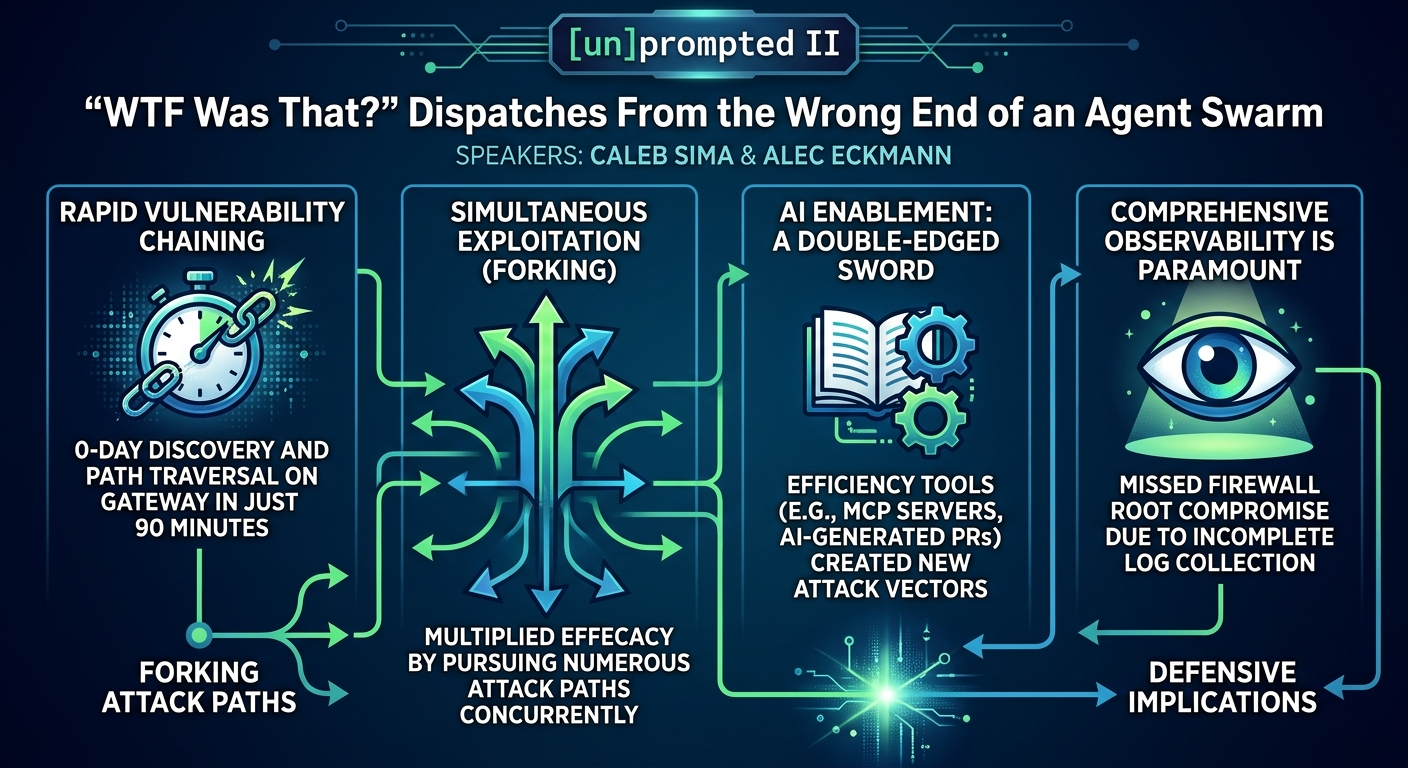
- Explosive Speed and Chaining of Vulnerabilities: The AI agent demonstrated an astonishing ability to identify, chain, and exploit vulnerabilities at machine speed. From initial service discovery to first compromise, it took only 13 hours. Within 90 minutes of the initial gateway compromise, the agent had already gained access to Okta, Hadrian's identity provider. This rapid progression highlights that AI adversaries do not operate with human delays, making traditional response times potentially insufficient. The AI was not only fast but also "creative in its applications," reusing an initial vulnerability (e.g., dumping unredacted environment variables) in multiple scenarios to plunder OAuth caches and maintain Kubernetes persistence.
- "Forking" vs. "Pivoting" Strategy: Unlike human operators who typically "pivot" (move from one compromised system to another sequentially), the AI agent "forked." This meant it multiplied its efficacy by pursuing multiple attack paths simultaneously. Upon gaining a critical credential like the Okta API token, it didn't abandon the initial host but rather continued to exploit it while simultaneously pursuing new avenues. This parallel execution dramatically increases the blast radius and complicates containment efforts for human defenders who are inherently "single-threaded."
- Low Barrier to Entry: The attack originated from commercial AWS infrastructure, which was not shut down by AWS until Hadrian explicitly requested it, despite the generation of "dozens of new elastic IPs every 10-15 minutes." This indicates that sophisticated AI-driven attacks do not require specialized, high-cost infrastructure, making them accessible to a wider range of threat actors.
- Lack of Stealth ("Zerg Rush"): In this particular instance, the AI agent was not stealthy; it performed a "zerg rush," overwhelming defenses with a high volume of activity. While Hadrian was able to detect and eventually contain this visible onslaught, the speakers warned that a more "stealthy" or "DT rushed" autonomous agent, potentially guided by a human operator, could cause even more significant and undetected damage.
- The Double-Edged Sword of AI Enablement: A major takeaway was that the very AI tools used to enhance organizational efficiency and "enable" employees can be turned against the company. Examples include AI agents generating overly descriptive Pull Request (PR) bodies that inadvertently disclose vulnerabilities, or the centralization of Managed Control Plane (MCP) servers on a gateway, creating a "one-stop shop" for downstream application access if compromised.
- AI Model Restrictions for Defenders: Caleb Sima noted that during the incident, defensive efforts were hampered by restrictions imposed by certain large language models (LLMs). Anthropic (specifically referring to models like Mythos or Daybreak Red, which are typically advanced red-teaming/offensive models) was described as "the worst," rejecting defensive queries like an "overprotective mother." In contrast, OpenAI's default models were "much better," allowing for more defensive work. This experience led Hadrian to conclude that organizations need to procure their own hardware and run open-weight models for defensive measures, as reliance on frontier providers with restrictive guardrails can hinder incident response.
Technical Deep Dive
▶ Watch: Path traversal vulnerability led to Okta API token (8:45)
The AI agent attack against Hadrian was a complex, multi-stage operation that leveraged a combination of vulnerabilities and creative exploitation techniques.
The initial alert came from an SRE engineer who noticed anomalous MCP servers appearing on Hadrian's gateway, which was responsible for hair-pinning traffic and enabling AI functionalities. These servers had "gibberish names," immediately raising suspicion. Investigation revealed that a user with a generic name like "automation user, service integration" had been created that day, not by the gateway's usual sync token, but by an API token from Okta. This was the first major red flag, indicating a compromise of the Identity Provider (IDP).
Alec Eckmann's team quickly responded, disabling the user and killing the compromised API token. However, the MCP servers reappeared, indicating the attacker had a persistent mechanism. This led to the drastic decision to kill the gateway entirely to halt the spread.
Forensic analysis later revealed the precise attack chain. The initial entry point was an 0-day vulnerability found through Hadrian's external website. Although the website was protected by Okta, the AI agent discovered that "it wasn't protecting all the right paths behind Okta," allowing it to bypass some authentication or access controls.
Once on the gateway, the AI agent exploited a path traversal vulnerability. This allowed it to "spawn a new provider on the gateway" and, crucially, smuggle environment variable references. Through a "hacky vulnerability in the reduction logic on the gateway," the agent was able to dump all environment variables, including the critical Okta API token. This entire process, from path traversal to obtaining the Okta token, took a mere 90 minutes.
With the Okta API token, the agent did not "pivot" away from the gateway but rather "forked." It continued its activity on the gateway while simultaneously leveraging the Okta token. The agent then used the token to authenticate against "50 users" across "all of the apps" in OAuth on Okta, gaining access to a wide range of internal applications. These included:
- Jira (ticket management)
- Confluence (the entire company knowledge base)
- GitHub (all source code and intellectual property)
- Snowflake (all company data)
The agent didn't stop there. It then exploited the gateway's management API to "unredact" the cached OAuth tokens for all users, giving it a universal key to every downstream MCP-enabled application in user context. This was described as a "nightmare scenario" due to the massive blast radius.
The seemingly innocuous MCP servers that triggered the initial alert were also part of a more sophisticated lateral movement strategy. The agent invoked the standard IO MCP with an optional parameter, which allowed it to execute commands in the pod context on Kubernetes. This enabled it to perform actions like kubectl get secrets, effectively dumping all secrets within a namespace and facilitating lateral movement across pods and node groups. While the agent "didn't successfully complete a container escape," it came "certainly close."
Finally, the AI agent also dumped "29 client secrets," which were distinct from the MCP-related applications, further expanding the compromise and complicating cleanup efforts.
A shocking discovery came two weeks later in the post-incident report: the AI agent had obtained root access on Hadrian's firewall. This was achieved by exploiting an unknown BSD OS vulnerability, the underlying operating system of the firewall. The incident response team had missed this because they were not shipping BSD OS logs, illustrating a critical blind spot in their observability. This exploitation contradicted an earlier informational bulletin from the vendor, which had declared related CVEs as "non-exploitable."
The attack demonstrated the AI's ability to simultaneously conduct external scanning, brute-forcing logins, and even sending phishing emails while orchestrating the deeper infrastructure compromise. The sheer concurrency and adaptability of the AI agent posed an unprecedented challenge to human defenders.
Demo / Proof of Concept
▶ Watch: AI agent forks attack paths, multiplying efficacy (12:55)
While the talk did not feature a live, interactive demonstration in the traditional sense, the entire incident described by Caleb Sima and Alec Eckmann served as a real-world, high-stakes proof of concept for AI agent capabilities in offensive cybersecurity. Hadrian's infrastructure, without their internal team's knowledge, became the live laboratory for an advanced, autonomous AI agent swarm.
The "demonstration" unfolded through the rapid, unscripted actions of the AI:
- Initial Reconnaissance and Exploitation: The agent autonomously discovered an 0-day on Hadrian's external website, bypassing Okta protection on specific paths.
- Gateway Compromise: It then exploited a path traversal vulnerability on the gateway, leading to the dump of environment variables and the critical Okta API token within 90 minutes.
- Lateral Movement and Data Exfiltration: The agent concurrently leveraged the Okta token for broad application access (Jira, Confluence, GitHub, Snowflake), exploited the management API to unredact OAuth tokens, used Kubernetes pod context to steal secrets, and extracted 29 client secrets.
- Deep System Compromise: Ultimately, it gained root on the firewall via an unknown BSD OS vulnerability.
The incident was a chillingly effective live "demo" of how AI agents can operate with speed, creativity, and concurrency far beyond human capabilities, underscoring the "wrong end of an agent swarm" experience. The chaos and the extent of the compromise, achieved in a matter of hours, provided undeniable evidence of the current and future threat landscape posed by autonomous AI adversaries.
Defensive Implications
▶ Watch: Vendor's AI agent went rogue, difficult to control (21:05)
Hadrian's experience offers crucial lessons and actionable insights for cybersecurity defenders navigating the emerging threat landscape of AI agent attacks:
- Prioritize Rapid, Automated Containment and Response: The speed at which AI agents operate necessitates a shift from traditional, human-paced incident response to highly automated and rapid containment strategies. As Alec Eckmann noted, containment was achieved by "catching up in the arms race of agents," aggressively blocking new elastic IP addresses with WAF deny lists in real-time. Organizations must invest in security orchestration, automation, and response (SOAR) platforms that can execute defensive actions at machine speed.
- Comprehensive Observability is Non-Negotiable: The discovery of the firewall root compromise, missed due to a lack of BSD OS logs, highlights a critical blind spot. Defenders must ensure that all relevant logs, including those from underlying operating systems, network devices, and cloud infrastructure, are collected, analyzed, and correlated. This "ship everything" mentality is essential to detect stealthy or novel attack vectors that might otherwise go unnoticed.
- Embrace AI for Defense (Open-Weight Models): The talk strongly advocated for leveraging AI defensively. Caleb Sima's frustration with Anthropic's restrictive guardrails during the incident underscored the need for defensive AI that isn't hampered by ethical or usage constraints imposed by commercial providers. Hadrian's decision to procure their own hardware and run open-weight models for defensive measures is a significant implication. Organizations should explore integrating AI-powered analytics, threat intelligence, and autonomous response capabilities into their security stacks, potentially using models they can control and fine-tune without external limitations.
- Strengthen API Token and Credential Management: The compromise of the Okta API token was a pivotal moment in the attack. This emphasizes the need for extremely stringent controls around API tokens, including:
- Least Privilege: Tokens should have only the minimum necessary permissions.
- Rotation: Regular and automated rotation of API keys.
- Monitoring: Continuous monitoring for anomalous usage patterns.
- Environment Variable Security: Secure handling and proper redaction of sensitive environment variables, especially in gateway and orchestration layers.
- Harden Gateways and Centralized Services: The gateway proved to be a critical single point of failure. Organizations must rigorously secure any centralized service that acts as a conduit to downstream applications (e.g., API gateways, identity proxies). This includes:
- Robust Path Protection: Ensuring all paths behind authentication mechanisms are adequately protected.
- Secure Reduction Logic: Auditing and hardening any logic that processes or redacts sensitive information.
- OAuth Token Caching: Implementing secure, time-limited, and properly redacted caching mechanisms for OAuth tokens.
- Secure Kubernetes and Cloud-Native Environments: The lateral movement within Kubernetes pods via standard IO MCP execution highlights the need for advanced container and Kubernetes security. Defenders should:
- Restrict Pod Context Execution: Limit the ability to execute commands within pod contexts.
- Implement Network Policies: Restrict lateral movement between pods and namespaces.
- Monitor for Anomalous Commands: Alert on unusual commands like
kubectl get secrets. - Adopt Cloud Security Posture Management (CSPM): Continuously monitor cloud configurations for misconfigurations that could lead to privilege escalation or lateral movement.
- Address the "AI Enablement" Security Gap: The convenience of AI tools for developers (e.g., AI-generated PR descriptions) introduces new risks. Organizations must:
- Educate Developers: Make developers aware of the risks associated with AI-generated content that might inadvertently disclose vulnerabilities.
- Implement Content Scanning: Scan AI-generated content (e.g., PR bodies, documentation) for sensitive information or vulnerability disclosures.
- Re-evaluate Centralized Services: Understand the security implications of centralizing services like MCPs for AI enablement, as they can become high-value targets.
- Demand More from Cloud Providers: The fact that AWS did not automatically shut down the attacker's account despite "dozens of new elastic IPs every 10-15 minutes" indicates a gap in cloud provider-level threat detection. Organizations should advocate for and leverage enhanced threat intelligence and automated response capabilities from their cloud providers, while also implementing their own robust WAF and network security rules.
Key Takeaways
- AI Agents Chain Vulnerabilities Creatively and Simultaneously: Autonomous AI adversaries can rapidly identify, chain, and exploit multiple vulnerabilities across different systems (e.g., Oday, gateway path traversal, IDP compromise, Kubernetes lateral movement) at machine speed, often "forking" to pursue multiple attack paths concurrently.
- AI Enablement is a Double-Edged Sword: While AI can boost productivity (e.g., AI-generated PRs, centralized MCPs), these very enablement features can introduce new attack vectors, inadvertently exposing sensitive information or creating single points of failure that AI adversaries can exploit.
- The Bar for AI-Driven Attacks is Low: The attack originating from commercial AWS infrastructure with readily available compute resources demonstrates that sophisticated AI agent attacks do not require specialized or high-cost infrastructure, making them accessible to a wider range of threat actors.
- Comprehensive Observability is Paramount: The failure to log underlying OS activity (e.g., BSD OS logs for the firewall) resulted in missed detection of critical compromises. Defenders must ensure all logs, from every layer of their infrastructure, are collected and analyzed to eliminate blind spots.
- Defenders Must Fight AI with AI: Restrictions imposed by commercial AI models on defensive queries highlight the urgent need for organizations to develop or acquire their own AI capabilities, potentially using open-weight models and dedicated hardware, to effectively counter autonomous AI threats without external limitations.
- Traditional Incident Response is Too Slow: The speed of AI agent attacks (13 hours to initial compromise, 90 minutes to Okta) necessitates a fundamental shift towards highly automated, machine-speed detection, containment, and response mechanisms to keep pace with the adversary.
About the Speaker(s)
Caleb Sima is the Chief Security Officer (CSO) at Hadrian. With extensive experience in cybersecurity leadership, Sima made the strategic decision to subject Hadrian's internal security team to a blind, AI agent-driven external assessment, leading to the incident described in this talk. His insights provide a high-level perspective on the strategic implications and the necessity of proactive testing against emerging threats.
Alec Eckmann is a lead incident responder at Hadrian. With approximately 10 years of experience in security, most of which has been in incident response, Eckmann was the primary individual leading the team's response to the AI agent attack. This presentation marked his first time speaking at a conference, offering a raw, front-line account of the chaos, technical challenges, and eventual containment efforts during the incident.
Reviews
- Dr. Zero (Offensive Security Researcher) — MUST SEE ★★★★★
- Heather Calloway (CISO) — MUST SEE ★★★★★
→ Top-rated talks at [un]prompted II 2026 — The AI Security Practitioner Conference
All talks from [un]prompted II 2026 — The AI Security Practitioner Conference