From DARPA AIxCC to Microsoft FORGE Lab: Lessons Building Hyperscale AI Code Scanning Tools
Taesoo Kim (VP, Security Research · Microsoft)
[un]prompted II 2026 — The AI Security Practitioner Conference · Day 1 · Stage 1
Overview
In this insightful talk at [un]prompted II, Taesoo Kim, VP of Security Research at Microsoft and a professor at Georgia Tech, shared profound lessons gleaned from leading the victorious Team Atlanta in the DARPA AI Cyber Challenge (AICC) and subsequently spearheading the development of hyperscale AI code scanning tools at Microsoft's Security Forge Lab. The presentation delves into the transformative impact of large language models (LLMs) on cybersecurity, highlighting how a once skeptical community has rapidly embraced AI for professional-level cyber tasks, dramatically altering the landscape of vulnerability discovery and remediation.
Key moments
- 0:00 Introduction: Winning DARPA AI Cyber Challenge
- 3:10 AI performs professional cyber tasks for $150
- 6:15 Microsoft's M-Dash: AI vulnerability scanning tool
- 7:00 M-Dash multi-agent workflow: recon, scan, validate, prove
- 12:45 M-Dash finds 200+ critical Windows vulnerabilities
- 14:00 Future challenges: scaling AI security, cost, exploitation
- 19:00 Q&A: AI accelerates patch analysis and exploit development
- 25:00 Q&A: Advantages of M-Dash's segmented AI pipeline
From DARPA AIxCC to Microsoft FORGE Lab: Lessons Building Hyperscale AI Code Scanning Tools
Speakers: Taesoo Kim, VP, Security Research, Microsoft
Conference: [un]prompted II
YouTube: https://www.youtube.com/watch?v=bf60B__4FDo
Overview
In this insightful talk at [un]prompted II, Taesoo Kim, VP of Security Research at Microsoft and a professor at Georgia Tech, shared profound lessons gleaned from leading the victorious Team Atlanta in the DARPA AI Cyber Challenge (AICC) and subsequently spearheading the development of hyperscale AI code scanning tools at Microsoft's Security Forge Lab. The presentation delves into the transformative impact of large language models (LLMs) on cybersecurity, highlighting how a once skeptical community has rapidly embraced AI for professional-level cyber tasks, dramatically altering the landscape of vulnerability discovery and remediation.
Kim's talk underscores a critical paradigm shift: the era of demonstrating AI's capability in cybersecurity is over; the new frontier lies in scaling these capabilities cost-effectively and prioritizing the identification of exploitable vulnerabilities. He meticulously details the architectural advancements of Microsoft's internal tool, M-Dash, a multi-agent orchestration engine that has been commercialized within Microsoft Defender products and has already unearthed hundreds of critical vulnerabilities, including remote code execution flaws in Windows and Hyper-V. The presentation serves as a compelling testament to the immediate and profound impact of AI in securing complex software ecosystems.
The core message resonates with both practitioners and researchers: AI-driven security is not a distant future but a present reality, offering unprecedented speed and scale in identifying and addressing software weaknesses. Kim emphasizes the need for a sophisticated, multi-stage approach to AI-powered code analysis, moving beyond simple prompt engineering to a structured, human-like workflow that integrates reconnaissance, discovery, validation, and proof-of-concept generation. This talk provides a roadmap for organizations looking to leverage the full potential of LLMs in their security pipelines.
Background
▶ Watch: Introduction: Winning DARPA AI Cyber Challenge (0:00)
The impetus for this revolution in AI-driven cybersecurity largely stemmed from the DARPA AI Cyber Challenge (AICC), a grand challenge announced by DARPA with the explicit goal of exploring "the frontier cyber capability of the large language model." This wasn't a trivial academic exercise but a high-stakes, multi-year competition with a $30 million prize pool, attracting over 100 teams from academia, industry, and the hacking community. The challenge brought together leading AI and infrastructure companies, forcing security experts, many of whom were initially AI skeptics, to engage deeply with LLMs.
Team Atlanta, led by Taesoo Kim, emerged as the dominant victor, securing a $4 million prize and demonstrating unparalleled prowess across all security categories, including bug finding and fixing. Their success was not merely a competition win but a validation of AI's potential. According to Kim, the AICC concluded with a definitive message: AI can indeed conduct professional-level cyber tasks, with a staggering statistic that each successful task cost a mere $150. This low cost and high success rate signaled a profound shift in the economics of security auditing.
Following the AICC, the lessons learned and technologies developed by participants rapidly transitioned into real-world applications. Organizations like Google, OpenAI, and Entropy began productizing AI-based code scanning tools. Kim notes the rapid adoption: unlike DARPA's self-driving car challenge, which took decades to commercialize, the AICC saw industry-wide impact within a mere year. This rapid assimilation was also driven by a "Mythos moment" in security, where the perceived "super intelligence" of AI began to empower non-security experts, serving as a critical wake-up call for the entire security community. Team Atlanta's core members subsequently joined Microsoft to form the Security Forge Lab, directly applying their winning strategies to Microsoft's vast codebase.
Key Findings
▶ Watch: Microsoft's M-Dash: AI vulnerability scanning tool (6:15)
The talk highlights several transformative findings that have reshaped the approach to software security:
Firstly, AI can perform professional-level cyber tasks with remarkable efficiency and cost-effectiveness. The DARPA AICC definitively proved that LLMs can identify and fix vulnerabilities at a level comparable to, or even exceeding, human experts, and at a fraction of the cost—estimated at $150 per successful task. This capability has moved beyond theoretical demonstration to practical deployment.
Secondly, the adoption cycle for AI in cybersecurity is unprecedentedly fast. Unlike previous DARPA Grand Challenges that took years or decades for commercialization, the impact of the AICC was felt across the industry within a single year. This rapid integration underscores the immediate value and maturity of AI for security applications.
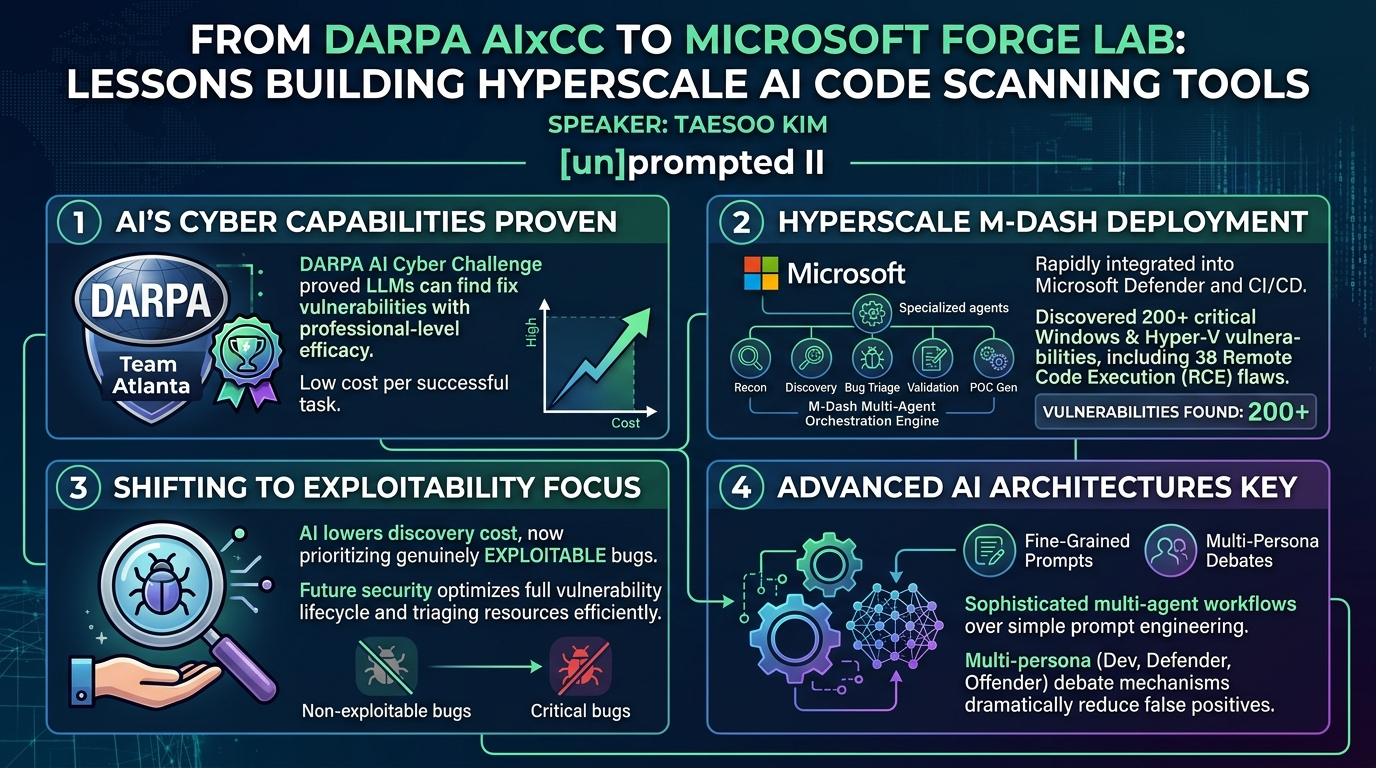
Thirdly, Microsoft's M-Dash tool represents a commercialized, hyperscale application of these AI principles. Developed and deployed within Microsoft in a mere five months post-AICC, M-Dash is now a core component of Microsoft's internal security pipeline and has been integrated into Defender products. Its effectiveness is stark: it has discovered over 200 high-criticality vulnerabilities, including 38 Remote Code Execution (RCE) flaws in Windows and Hyper-V, demonstrating its capability to secure critical infrastructure.
Fourthly, **the focus of AI-driven security is shifting from merely finding bugs to identifying exploitable bugs and reducing overall security costs.** Kim emphasizes that while finding vulnerabilities has become cheaper and easier, the subsequent phases of validation, triage, and remediation remain costly and time-consuming. Future efforts must integrate exploitation considerations early in the scanning process to ensure that identified bugs have genuine security implications and to optimize the entire vulnerability lifecycle.
Finally, the availability of "security tokens" (compute budget for AI reasoning) is becoming a critical metric for software security. Drawing a parallel to "Linus's Law" (given enough eyeballs, all bugs are shallow), Kim suggests that "given enough tokens, probably all security bugs are shallow." This highlights the importance of computational resources and efficient token utilization in achieving comprehensive security coverage.
Technical Deep Dive
▶ Watch: M-Dash finds 200+ critical Windows vulnerabilities (12:45)
Microsoft's M-Dash (Multi-Agent Orchestration Engine) embodies a sophisticated, multi-stage architecture designed to mimic the workflow of professional hackers and penetration testers. Unlike simpler AI-based bug-finding tools that merely chain skills, M-Dash orchestrates a detailed, human-centric process across five distinct phases: reconnaissance, discovery, bug triage, validation, and Proof of Concept (POC) generation.
The preparation phase involves a holistic analysis of the entire code repository. M-Dash builds a comprehensive knowledge base by scanning historical patch commits (e.g., in GitHub) to identify patterns of past vulnerabilities and their fixes. This enables the system to later find variant vulnerabilities—new instances of previously fixed bug classes.
During the scanning phase, M-Dash deploys up to 100 specialized agents concurrently. Each agent is designed to hunt for a very specific type of vulnerability. These agents operate with shared knowledge, minimizing redundant reasoning. A key design choice is to activate only the relevant agents for a given task, optimizing token usage.
The validation phase is critical for reducing false positives. M-Dash employs a multi-persona debate mechanism, utilizing multiple LLM backends. One model adopts the perspective of a software developer (often resistive to bug reports), another a defender, and yet another an offender. Only when these personas reach a consensus is a vulnerability flagged as a high-confidence true positive. This approach directly addresses the common developer friction associated with AI-generated bug reports.
For POC generation, a dedicated "proving agent" attempts to dynamically trigger the identified vulnerability. This involves creating specific inputs that can crash the system, hit assert statements, or violate observed invariants, providing concrete evidence of exploitability. This stage is crucial for pen testers who require tangible proof of system penetration.
Several core ideas underpin M-Dash's effectiveness:
- Converting Search to Decision Problems: Instead of broad queries like "find memory safety bugs in the repository," M-Dash advocates for fine-grained prompts. Asking an LLM to "find bugs in
function_Xwithinfile_Ylooking forvulnerability_type_Z" yields significantly better results by providing more context and narrowing the scope.
- Function as Orchestration Unit: To prevent LLMs from hallucinating due to insufficient context, M-Dash ensures that entire functions are fully consumed and analyzed. This allows all 100 agents to operate on a well-defined, shared context, facilitating more accurate reasoning and knowledge sharing.
- Delayed Exploitation Focus: M-Dash doesn't force agents to think about exploitation in the early stages. Initially, agents flag any suspicious code locations. The more resource-intensive task of proving exploitability is deferred to later stages, offering flexibility. Developers can use early-stage flags for proactive fixes on uncommitted changes, while pen testers can leverage later stages for full exploitation evidence.
- Code Enrichment Process: A crucial technique for reducing false positives involves enriching the source code. M-Dash uses LLMs to annotate functions with additional context, such as data flow or taint information, directly within inline comments or function prototypes. For example, indicating "there is a data flow from this argument here" drastically improves the agent's ability to identify true vulnerabilities by providing high-signal context, a technique that significantly reduced false positive rates. This process is automated, with an LLM performing the annotation, then connecting this information to the scanning agents.
M-Dash's architecture is also designed to be model-agnostic, allowing organizations to choose between powerful, expensive models (like GPT-Cyber) for high-stakes scans or smaller, cheaper models for broader, large-scale checks, optimizing token budget allocation across different stages of the pipeline.
Demo / Proof of Concept
▶ Watch: Future challenges: scaling AI security, cost, exploitation (14:00)
While the talk didn't feature a live, interactive demo, Taesoo Kim presented compelling evidence and results that serve as a robust proof of concept for M-Dash's capabilities. The most significant demonstration of its efficacy is its widespread adoption within Microsoft's Windows security team since April, integrating M-Dash into their CI/CD pipeline. This integration has led to the discovery of approximately 200 vulnerabilities, a number that continues to grow, many of which are high-criticality. Specifically, M-Dash has identified 38 Remote Code Execution (RCE) vulnerabilities in critical Microsoft products like Windows and Hyper-V. These are not "toy vulnerabilities" but serious security flaws with significant real-world impact.
Beyond its internal deployment, M-Dash's principles are also being applied to external targets, notably the Linux kernel. Kim detailed the use of an automatic exploit generation (AEG) agent that, given a patch, report, or crash, attempts to reproduce the vulnerability as a local privilege escalation or remote code execution. This agent converted about 5% of static Linux kernel vulnerability reports into reproducible crashes. Further analysis of these crashes, considering specific build configurations and dependencies, led to the identification and responsible disclosure of 11 local privilege escalation vulnerabilities in the Linux kernel. This collaborative disclosure process, coordinated with other stakeholders, highlights M-Dash's ability to not only find but also validate and escalate critical security issues in complex open-source projects. These results collectively demonstrate M-Dash's practical application and its success in uncovering high-impact vulnerabilities across diverse and critical codebases.
Defensive Implications
▶ Watch: Q&A: Advantages of M-Dash's segmented AI pipeline (25:00)
The rapid advancements and demonstrable successes of AI-driven vulnerability scanning, as showcased by M-Dash, carry profound implications for cybersecurity defenders:
- Mandatory Adoption of AI: The era of questioning AI's utility in security is over. Defenders must now actively embrace and integrate AI-based tools into their security pipelines. The cost-effectiveness ($150 per successful task) and professional-level capability demonstrated by AI make it an indispensable asset for any organization seeking to secure its software.
- Shifting Focus to Exploitability: With AI making vulnerability discovery cheaper and faster, defenders must prioritize identifying exploitable bugs from the outset. Integrating exploitation techniques into the scanning process (as M-Dash does) ensures that resources are focused on issues with genuine security implications, rather than theoretical flaws. This shifts the paradigm from "finding all bugs" to "finding all exploitable bugs."
- The "Security Token" Economy: The concept of "security tokens" (the computational budget allocated for AI reasoning) introduces a new metric for evaluating the robustness of a security posture. Organizations will need to strategically invest in sufficient token allocation for continuous, deep security reasoning across their repositories, akin to a "Linux Law" for AI-driven security.
- Accelerated Patching and Response: AI significantly reduces the time adversaries need to reverse-engineer patches and develop exploits (binary diffing). As Kim noted, this drastic reduction in "exploit window" time means organizations, even large ones like Microsoft, must be "extremely careful" to properly and promptly update end-user systems. Defenders need robust, automated patch deployment mechanisms to counter this accelerated threat.
- Integration into CI/CD is Critical: The adoption of M-Dash within the Windows security team's CI/CD pipeline underscores the necessity of embedding AI-powered scanning early and continuously in the software development lifecycle. This enables developers to catch and fix suspicious code before it even reaches a committed state, drastically reducing the cost and effort of remediation.
- Navigating Model Restrictions: While open-weight models are "extremely capable" for code scanning and binary analysis, commercial Frontier AI companies are increasingly resistant to allowing their models to be used for "offensive type of technique" like binary analysis and exploit generation. Defenders might need to rely more heavily on open-source LLMs or fine-tune models specifically for these sensitive tasks, developing in-house capabilities to maintain full control over their security tooling.
- Cost Optimization Beyond Discovery: Defenders must recognize that while AI lowers the cost of finding bugs, the downstream processes of validation, triage, and remediation remain expensive. This highlights the need for a holistic view of the security pipeline, leveraging AI not just for discovery but also for automating and streamlining subsequent stages to achieve true cost savings.
Key Takeaways
- AI has achieved professional-level cyber capabilities: The DARPA AI Cyber Challenge definitively proved that large language models (LLMs) can find and fix vulnerabilities with high efficacy and at a significantly low cost (e.g., $150 per successful task).
- Rapid industry adoption: Unlike previous grand challenges, AI-driven security tools have seen immediate and widespread commercialization and integration into enterprise security pipelines, demonstrating their critical value.
- Microsoft's M-Dash leads hyperscale security: M-Dash, a multi-agent orchestration engine, has been rapidly developed and deployed within Microsoft, identifying hundreds of critical vulnerabilities, including 38 RCEs in Windows and Hyper-V, and integrated into Defender products.
- Focus shifting to exploitable bugs and cost reduction: The new frontier in AI security is optimizing for finding genuinely exploitable vulnerabilities and reducing the overall cost of the entire security lifecycle, not just bug discovery.
- Advanced AI architecture is key: Techniques like multi-agent orchestration, fine-grained prompting, multi-persona validation debates, and LLM-driven code enrichment are crucial for building robust, high-precision AI code scanning tools.
- Defenders must embrace AI and anticipate adversary capabilities: Organizations need to integrate AI into their CI/CD pipelines for continuous scanning and be prepared for adversaries leveraging AI to accelerate exploit development against newly released patches.
About the Speaker(s)
Taesoo Kim is a distinguished figure in the field of cybersecurity, holding dual roles as a Vice President of Security Research at Microsoft and a Professor at Georgia Tech. His expertise spans both cutting-edge academic research and practical industry application. Kim led Team Atlanta to victory in the highly competitive DARPA AI Cyber Challenge (AICC), an achievement that significantly advanced the state of AI in cybersecurity. Following this success, he brought his team's expertise to Microsoft, where he has been instrumental in founding and leading the Security Forge Lab and developing advanced AI-driven vulnerability scanning tools like M-Dash. His work focuses on leveraging large language models and multi-agent systems to secure complex software ecosystems at hyperscale.
Reviews
- Dr. Zero (Offensive Security Researcher) — MUST SEE ★★★★★
- Heather Calloway (CISO) — MUST SEE ★★★★★
→ Top-rated talks at [un]prompted II 2026 — The AI Security Practitioner Conference
All talks from [un]prompted II 2026 — The AI Security Practitioner Conference