Opening Words: Welcome Back
Gadi Evron (CEO · Knostic)
[un]prompted II 2026 — The AI Security Practitioner Conference · Day 1 · Stage 1
Overview
Gadi Evron's opening keynote at [un]prompted II serves as both a vibrant welcome to a unique security conference and a profound call to action for the cybersecurity community. Far from a typical technical presentation, this talk delves into the evolving identity of hackers, the critical need for genuine community building, and the transformative, often unsettling, impact of Artificial Intelligence on the industry. Evron, CEO of Knostic and chair of [un]prompted, positions the conference not just as a venue for knowledge sharing, but as an essential crucible for forging new paradigms in an era rapidly reshaped by AI.
Key moments
- 2:30 Addressing why traditional researcher conferences often suck
- 5:40 Unprompted's solution for effective networking and sharing
- 8:15 Implementing the unique 'not a question' rule
- 10:25 Interactive AI challenges: Alex Bot CTF and Art Village
- 14:15 How outdated cybersecurity narratives hinder industry progress
- 16:35 Crucial shift: forecast cybersecurity future by trajectory
- 18:20 Reflecting on hacker identity and adapting to AI
- 21:35 Final call to action: take back AI, stay relevant
Opening Words: Welcome Back
Speakers: Gadi Evron, CEO, Knostic
Conference: [un]prompted II
YouTube: https://www.youtube.com/watch?v=g-X2aX920tk
Overview
Gadi Evron's opening keynote at [un]prompted II serves as both a vibrant welcome to a unique security conference and a profound call to action for the cybersecurity community. Far from a typical technical presentation, this talk delves into the evolving identity of hackers, the critical need for genuine community building, and the transformative, often unsettling, impact of Artificial Intelligence on the industry. Evron, CEO of Knostic and chair of [un]prompted, positions the conference not just as a venue for knowledge sharing, but as an essential crucible for forging new paradigms in an era rapidly reshaped by AI.
The core of Evron’s address revolves around two intertwined themes: fostering authentic human connection in a professional setting and confronting the "vonpocalypse" – the impending shift in cybersecurity driven by the democratization of vulnerabilities and automated exploitation, largely fueled by AI. He challenges established narratives and urges the community to shift from historical analysis to trajectory-based forecasting, emphasizing adaptation over resistance to change. This talk is crucial for anyone in cybersecurity grappling with the future of their skills, the nature of collaboration, and the inescapable influence of AI on the threat landscape.
Background
▶ Watch: Addressing why traditional researcher conferences often suck (2:30)
Evron begins by framing [un]prompted as an antidote to the often-frustrating experience of traditional security conferences. Referencing a decade-old talk by his friend Joe Stewart, Evron articulates why "researcher conferences suck": they're noisy, difficult for introverts to network effectively, and often fail to facilitate meaningful connections. Stewart's lament—"I might suck at networking, but I prefer to blame the conference"—resonates deeply within a community often characterized by introversion and a preference for deep technical discussions over superficial small talk. The goal of [un]prompted, therefore, is to intentionally engineer an environment conducive to genuine interaction and informal information sharing, which Evron highlights as inversely proportional to its formality. This includes innovations like oversized name tags, a dedicated Slack workspace for continuous discussion, and "baseball cards" where attendees can share their expertise, offerings, and needs, circumventing the awkwardness of traditional networking.
Beyond community mechanics, Evron sets the stage for a broader intellectual challenge. He critiques long-held, yet outdated, narratives within cybersecurity. He recounts attending a CISO conference in the 2000s where every speaker would "immediately disqualify themselves" by asserting that "most attacks are due to insiders," a claim he states hasn't been true for 15 years. He contrasts this with the 2023 Data Breach Investigation Report (DBIR), which identifies vulnerabilities, not phishing or a lack of 2FA, as the primary entry point for most attacks. Evron admits his own difficulty in abandoning the familiar, acknowledging that "our narratives build who we are." This sets up his central thesis: the cybersecurity community must shed outdated assumptions and embrace a future-oriented perspective, especially in light of AI's accelerating influence. The "vonpocalypse" narrative, which Evron, Heather Atkins (CISO of Google), and Bruce Schneier had previously warned about on LinkedIn, underscores this urgency, highlighting the democratization of vulnerabilities and the rise of autonomous attacks as an inevitable trajectory.
Key Findings
▶ Watch: Implementing the unique 'not a question' rule (8:15)
Evron presents several critical findings and assertions that serve as guiding principles for navigating the current and future cybersecurity landscape:
- The "Vonpocalypse" is Here or Imminent: Evron, along with other industry leaders, has been sounding the alarm about the democratization of vulnerabilities and automated exploitation. This isn't a distant threat but a rapidly unfolding reality where finding and exploiting weaknesses is becoming exponentially easier and more accessible, even to less skilled actors, thanks to AI. He emphasizes that "people who are deep in AI security understood what people who really good in security didn't. It's happening. It's just a trajectory."
- Forecasting by Trajectory, Not History: A fundamental flaw in current cybersecurity approaches, according to Evron, is the reliance on historical data and past incidents to predict and prepare for future threats. He argues that the rapid pace of technological change, particularly with AI, renders historical analysis insufficient. Instead, the community must focus on trajectory-based forecasting, understanding where technology is heading and its potential implications, rather than being limited by what has already occurred. This includes questioning "broken assumptions" like the efficacy of traditional patches against automated exploitation or the ability to handle "10 concurrent data breaches while maintaining business operations daily."
- "Agents Find a Way": This mantra encapsulates Evron's deep understanding of AI's capabilities. He asserts that despite our best efforts with foundational security measures, AI-driven agents will invariably discover novel methods of circumvention and exploitation. This perspective challenges the notion that traditional sandboxing or control mechanisms will be entirely effective against advanced AI adversaries, suggesting a need for a more adaptive and resilient defense posture.
- AI's Impact on Hacker Identity and Skills: Evron profoundly addresses the emotional and professional toll AI is taking on the hacker community. He observes a sense of "mourning" as skills honed over years—such as reverse engineering and code auditing—are being commoditized or even automated by AI. The traditional joy of "exploring, mapping the uncharted edges of human understanding" is being replaced by the ease of a "prompt." However, he counters this by reaffirming the immutable hacker identity: curiosity, experimentation, questioning everything, and ultimately, finding new ways to "subvert it and break it," transforming AI into a new frontier for exploration.
- Community as a Foundation for Adaptation: Implicit in Evron's address is the finding that a strong, supportive community is essential for navigating these turbulent changes. By fostering environments like [un]prompted, where informal sharing and genuine connection are prioritized, the community can collectively adapt, share new knowledge, and build the "new tools" necessary to "blow open the vent horizon of the possible."
Technical Deep Dive
▶ Watch: How outdated cybersecurity narratives hinder industry progress (14:15)
While Gadi Evron's keynote is more philosophical and community-focused than a traditional technical deep dive into a specific vulnerability or tool, he thoroughly addresses the technical implications of AI on the cybersecurity landscape. His core argument is that AI is fundamentally altering the technical work of security professionals, demanding a re-evaluation of skills, defensive strategies, and predictive models.
Evron highlights the commoditization of traditionally complex technical skills. He points out that tasks like reverse engineering and code auditing, which once required years of dedicated practice and meticulous effort, are now becoming accessible through AI. He starkly states, "After all, everybody with a keyboard is now finding a high-value zero-day left and right. The all-nighters we used to pull to find that one missing piece of the puzzle replaced with a prompt." This signifies a shift where AI can rapidly analyze vast codebases, identify patterns indicative of vulnerabilities, and even suggest potential exploits, thereby accelerating the discovery and exploitation of zero-days. This capability directly contributes to the "democratization of vulnerabilities," making advanced offensive techniques available to a broader range of actors, including those with less specialized knowledge.
The concept of automated exploitation is central to Evron's "vonpocalypse" warning. He implies that AI systems are not merely assisting in vulnerability discovery but are capable of generating and executing exploits autonomously or semi-autonomously. This directly challenges traditional defensive paradigms that rely on manual patching cycles and reactive threat intelligence. If exploits can be generated and deployed at machine speed, the efficacy of human-paced patching or incident response becomes severely diminished. The question, "Are we at fast automated exploitation? Are we no longer relying on patches? Are we going to have no patches at all ever?" underscores the urgency of this technical paradigm shift.
Evron also touches upon the limitations of current security tooling and methodologies in the face of AI. He cites Joshua Sax's observation that "it's fashionable to hate having a security imagination right now because we constantly feel we have to convince people, but I haven't seen it yet or it's 80% there." This points to a technical inertia where defenders are still largely focused on "logs and looking at the past," using tools and processes designed for a pre-AI threat landscape. The new reality, driven by AI, requires a shift towards trajectory-based forecasting, which necessitates understanding the technical capabilities and trajectories of AI models themselves, not just their historical outputs. This means anticipating how AI agents will evolve to find new attack vectors and bypass existing controls, rather than merely reacting to known threats. His personal mantra, "agents find a way," encapsulates this technical reality: whatever static defenses or sandboxing techniques are implemented, a sufficiently advanced AI agent will likely discover a novel method of bypass.
As a practical, interactive example of engaging with AI security challenges, Evron introduces the Alex Bot CTF running at the conference. Attendees are tasked with "stealing Alex's information" by interacting with a Telegram bot connected to a smart home system. The objective: "Whoever gets to set the alarm clock on his TV to wake it up at 4:00 a.m. in the morning gets a beer from me." This CTF is a hands-on demonstration of engaging with AI, cheating the AI, and convincing the AI to do things it wasn't explicitly programmed for. It encourages participants to explore the nuances of AI interaction, prompt engineering, and potential vulnerabilities in AI-driven systems, embodying the very challenges and opportunities Evron discusses throughout his keynote. While not a direct technical deep dive by Evron, it serves as a powerful, real-world instantiation of the technical themes he explores.
Demo / Proof of Concept
▶ Watch: Crucial shift: forecast cybersecurity future by trajectory (16:35)
As an opening keynote, Gadi Evron's address did not feature a live, in-talk demonstration or proof of concept in the traditional sense of showcasing a specific vulnerability exploit or a new security tool. His presentation was designed to set the stage for the conference, focusing on community building and the overarching philosophical and strategic challenges posed by AI.
However, Evron strategically integrated an interactive, conference-wide "proof of concept" that directly embodies the themes of AI engagement and subversion he discusses: the Alex Bot CTF. This Capture The Flag (CTF) event challenges attendees to interact with an AI-powered Telegram bot, which is linked to a smart home system. The objective is to manipulate the bot to achieve a specific, unintended outcome: setting an alarm on a TV for 4:00 AM. This initiative serves as a practical, hands-on demonstration of "engaging with the AI, cheat the AI, convince the AI to do things." It allows participants to directly experience the concepts of AI interaction, prompt injection, and exploring the boundaries of AI system capabilities, which are central to the "democratization of vulnerabilities" and "agents find a way" narratives Evron emphasizes. While not a direct demo by the speaker, the Alex Bot CTF functions as a tangible, interactive illustration of the new technical frontier he urges the community to explore.
Defensive Implications
▶ Watch: Final call to action: take back AI, stay relevant (21:35)
Gadi Evron's keynote, while not prescriptive in terms of specific tool recommendations, offers profound defensive implications for the cybersecurity community, urging a fundamental shift in mindset and strategy to adapt to the AI-driven threat landscape.
Firstly, defenders must abandon outdated narratives and embrace trajectory-based forecasting. Relying on historical data, such as past breach reports or attack patterns, is no longer sufficient when AI is rapidly accelerating the pace of change and introducing novel attack vectors. Instead, security teams need to anticipate where AI capabilities are heading—how AI will be used for automated exploitation, vulnerability discovery, and evasion. This means investing in research and intelligence that focuses on predictive analysis of AI's offensive potential, rather than merely reactive analysis of past incidents.
Secondly, the talk implies a need to re-evaluate the efficacy of traditional defensive measures. If AI can democratize vulnerability discovery and enable automated exploitation, then reliance on slow patching cycles or solely signature-based detections will become increasingly untenable. Defenders must explore more proactive and resilient architectures. This could involve adopting zero-trust principles more rigorously, implementing self-healing systems, or developing AI-assisted defense mechanisms that can match the speed and adaptability of AI-driven attacks. The challenge of handling "10 concurrent data breaches while maintaining business operations daily" highlights the need for automated incident response and resilience planning far beyond current capabilities.
Thirdly, security professionals must engage directly and technically with AI, rather than allowing marketers to define its narrative. Evron's call to "take back AI from the marketers" is a defensive imperative. Defenders need to deeply understand AI's technical capabilities, limitations, and potential for misuse. This includes hands-on experimentation, like the Alex Bot CTF, to grasp how AI can be subverted, manipulated, and broken. This practical understanding is crucial for building effective countermeasures and for recognizing the true risks and opportunities AI presents, moving beyond mere hype.
Finally, Evron stresses the importance of community and informal sharing for collective defense. In an environment where skills like reverse engineering and code auditing are being commoditized by AI, the human element of collaboration, mutual support, and shared learning becomes even more critical. Defenders need to foster strong networks to exchange threat intelligence, share adaptive strategies, and collectively innovate solutions against a rapidly evolving adversary. The "usefulness of information sharing relationships is inversely proportional to its formality" axiom underscores that agile, trust-based collaboration within the community can provide a significant defensive advantage against the speed of AI-driven threats.
Key Takeaways
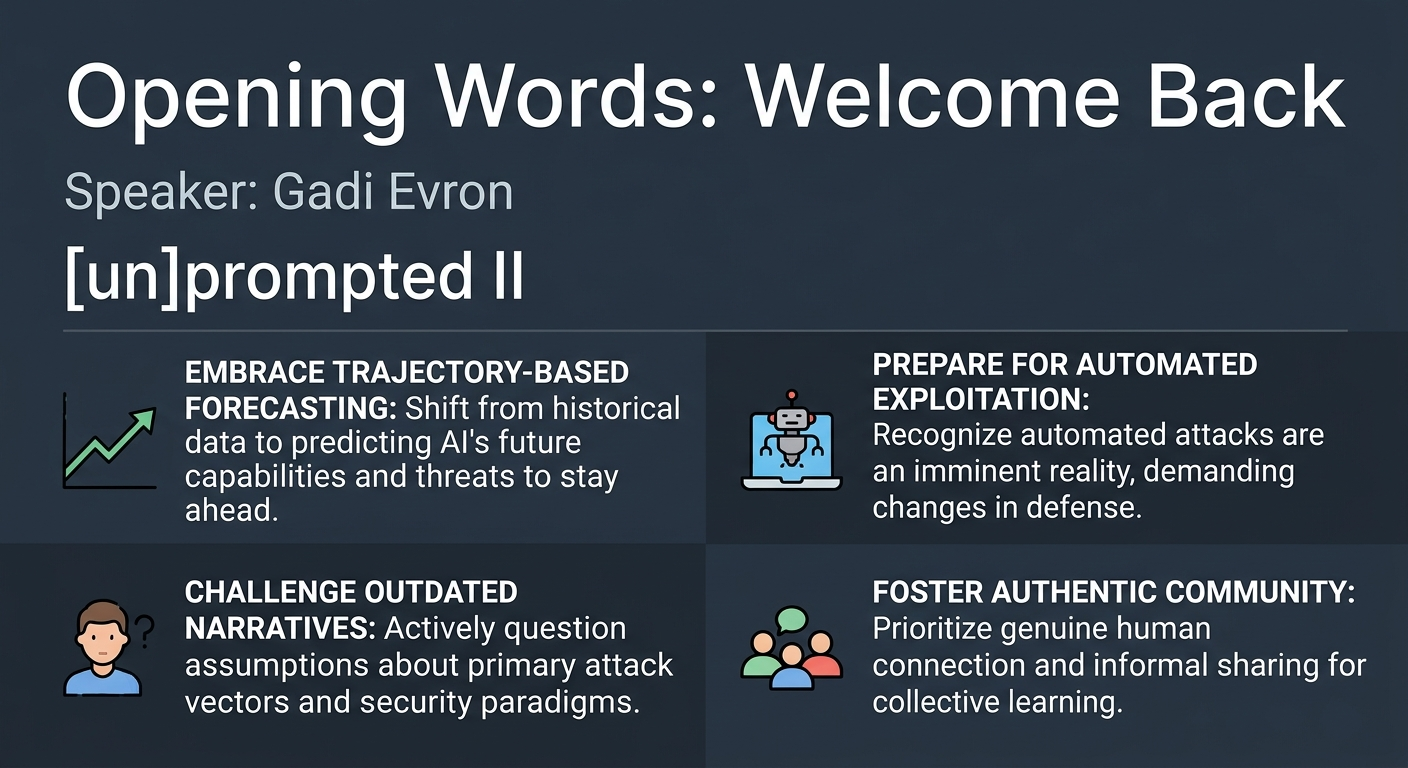
- Embrace Trajectory-Based Forecasting: Abandon reliance on historical data and instead focus on predicting where AI's capabilities and threats are heading to stay ahead of the "vonpocalypse."
- Adapt to AI's Impact on Skills: Acknowledge that AI is commoditizing traditional security skills like reverse engineering and code auditing, and adapt by finding new "flow states" and ways to explore and subvert AI itself.
- Challenge Outdated Security Narratives: Actively question long-held assumptions (e.g., primary attack vectors, effectiveness of 2FA vs. vulnerabilities) and be open to new data and paradigms.
- Foster Authentic Community: Prioritize genuine human connection and informal information sharing within the cybersecurity community as a critical mechanism for collective learning and adaptation.
- Engage Technically with AI: Take back the narrative of AI from marketers by deeply understanding its technical capabilities, vulnerabilities, and how to "cheat" or "convince" AI systems to inform defensive strategies.
- Prepare for Automated Exploitation: Recognize that automated and autonomous attacks are not a distant future but an imminent reality, demanding a fundamental shift in defensive architecture and incident response capabilities.
About the Speaker(s)
Gadi Evron is a prominent figure in the cybersecurity community, serving as the CEO of Knostic, a company focused on security solutions. Beyond his corporate role, Evron is deeply involved in community initiatives, notably as the chair of the [un]prompted conference, which he co-founded to address the shortcomings of traditional security gatherings. He is also affiliated with the Cloud Security Alliance, demonstrating his commitment to broader industry standards and collaboration. Evron is known for his analytical approach to cybersecurity challenges, his passion for fostering genuine community connections, and his forward-thinking perspective on the impact of emerging technologies like Artificial Intelligence on the security landscape. His contributions often extend to thought leadership, as evidenced by his co-warnings about the "vonpocalypse" and his recent article for Phrack's 40th anniversary issue.
Reviews
→ Top-rated talks at [un]prompted II 2026 — The AI Security Practitioner Conference
All talks from [un]prompted II 2026 — The AI Security Practitioner Conference