Opening Words - Being AI-Native Relevant - The Hobby Way
Gadi Evron (CEO · Knostic)
[un]prompted II 2026 — The AI Security Practitioner Conference · Day 3 · Stage 1
Overview
In his [un]prompted II talk, "Opening Words - Being AI-Native Relevant - The Hobby Way," Gadi Evron, CEO of Knostic, delivers a provocative and forward-looking thesis on the imperative for the security industry to embrace truly AI-native approaches. Evron contends that the "attacker singularity moment already happened," forcing defenders to radically rethink their strategies beyond incremental automation. His personal journey, framed as a "hobby" of discovering novel vulnerabilities with and in new AI models, serves as a practical blueprint for how security professionals can stay relevant and innovative in this rapidly evolving landscape.
Key moments
- 0:00 Introduction: Being AI-Native and the Attacker Singularity
- 2:30 On-the-Fly SQL Injection Fix Demonstration
- 5:00 The Four Layers of AI Usage for Security
- 7:00 AI-Native Vulnerability Research: Symmetry and Snouter
- 11:00 Solving AppSec: Focusing on Guard Coverage and Regressions
- 14:30 Adversary Brains: Operationalizing Threat Intelligence
- 17:00 Discovering Unknown Unknowns with Adversary Brains
- 18:00 Call to Action: Embrace Imagination in Security
Opening Words - Being AI-Native Relevant - The Hobby Way
Speakers: Gadi Evron, CEO, Knostic
Conference: [un]prompted II
YouTube: https://www.youtube.com/watch?v=JIYsdqGC4Hk
Overview
In his [un]prompted II talk, "Opening Words - Being AI-Native Relevant - The Hobby Way," Gadi Evron, CEO of Knostic, delivers a provocative and forward-looking thesis on the imperative for the security industry to embrace truly AI-native approaches. Evron contends that the "attacker singularity moment already happened," forcing defenders to radically rethink their strategies beyond incremental automation. His personal journey, framed as a "hobby" of discovering novel vulnerabilities with and in new AI models, serves as a practical blueprint for how security professionals can stay relevant and innovative in this rapidly evolving landscape.
Evron challenges the audience to abandon fear of imagination and "forget faster horses," instead advocating for speculative engineering fiction that can be made real today. He demonstrates this through three core areas: discovering entirely new classes of vulnerabilities using AI, reimagining application security (AppSec) as a system of operational resilience rather than endless patching, and transforming threat intelligence from static reports into dynamic, AI-powered "adversary brains." The talk emphasizes a shift from merely automating existing security tasks to fundamentally restructuring how we approach security problems, fostering a proactive and adaptable defense posture.
Background
▶ Watch: Introduction: Being AI-Native and the Attacker Singularity (0:00)
Evron sets the stage by asserting that the "attacker singularity moment already happened," signifying a point where adversaries' capabilities, particularly with AI, have outpaced traditional defenses. This necessitates a fundamental shift in mindset for security professionals. He likens this paradigm shift to the early days of the internet and search engines in the 1990s, where users had to adapt and learn new ways of searching to extract value. Similarly, today's security practitioners must learn to "speak" to AI models, understand their unique capabilities, and "fail forward" through experimentation.
He outlines a conceptual framework for AI usage in security, categorizing it into four distinct layers:
- Automate and Orchestrate Ourselves: Using AI to assist human tasks.
- Automate and Orchestrate the First (up to N layers): AI automating other AI-driven processes.
- Structure the Data for the Model: Preparing and presenting data in a way that is inherently native for AI processing, allowing models to interpret it differently.
- AI-Native: Fully leveraging AI's unique capabilities to solve problems in ways previously unimaginable, where the AI itself dictates the approach, not just assists a human-defined task.
Evron argues that the security industry largely remains stuck in layers one and two, occasionally touching layer three, but rarely, if ever, reaching layer four. His mission, driven by his hobby, is to break this inertia and explore the imaginative possibilities of truly AI-native security, moving beyond simply finding "faster horses" to conceptualizing entirely new modes of operation. This involves letting the models guide discovery, even if the initial prompts are vague, and being open to novel concepts like "symmetry" in code or operationalizing thousands of hypotheses.
Key Findings
▶ Watch: The Four Layers of AI Usage for Security (5:00)
Gadi Evron's talk unveils several groundbreaking applications of AI in security, demonstrating how a truly AI-native approach can yield novel insights and solutions across vulnerability research, application security, and threat intelligence.
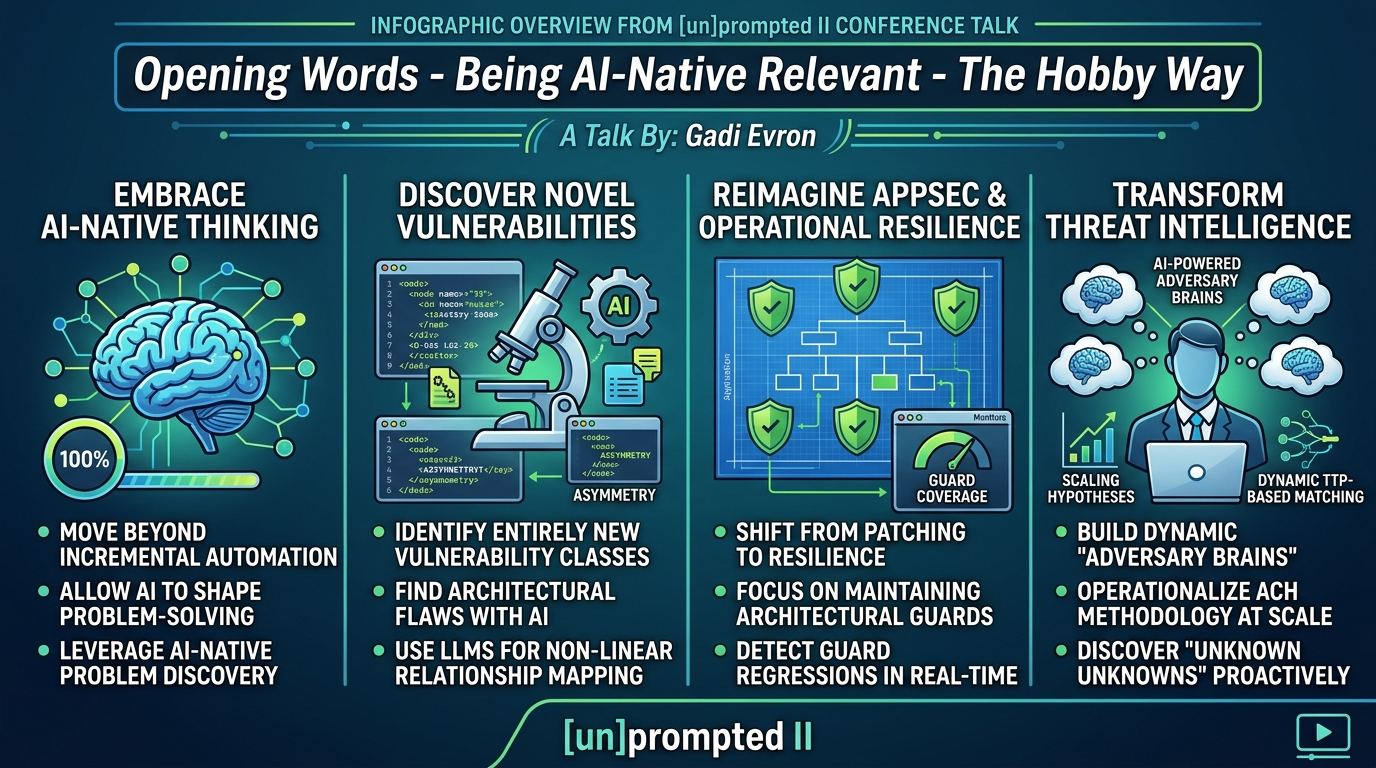
- Discovery of Novel Vulnerability Classes with AI: Evron showcases how large language models (LLMs) can be prompted to identify entirely new categories of logical vulnerabilities that traditional tools and methodologies often miss. This led to the development of tools like Snouter, which identifies security-relevant "asymmetries" in code, and Code Surf, which maps complex, non-linear relationships and trust boundaries within codebases using advanced graph analysis. These methods move beyond simple source-to-sink analysis, revealing architectural flaws previously obscured.
- Reimagining Application Security (AppSec) as Operational Resilience: Challenging the traditional, often overwhelming, cycle of vulnerability patching, Evron proposes a shift towards operational software resilience. By leveraging AI to analyze codebases and identify critical "guards" (security controls) and their interdependencies, defenders can focus on maintaining the integrity and coverage of these architectural strong points. This approach dramatically reduces the attack surface by making regressions in guard coverage an immediately actionable operational reality, rather than chasing an endless stream of individual vulnerabilities.
- Transforming Threat Intelligence with "Adversary Brains": Evron introduces the concept of Adversary Brains, an AI-driven system that operationalizes and scales the Analysis of Competing Hypotheses (ACH) methodology to thousands of hypotheses. Unlike static, IOC-focused threat intelligence, these brains dynamically process evidence, identify patterns in the arrangement of observations across time and systems, and can even infer "unknown unknowns" by detecting partial matches. This enables real-time, TTP-based detection and proactive discovery of evolving adversary tactics.
These findings collectively underscore Evron's core message: by embracing speculative engineering and allowing AI to guide discovery, the security industry can move beyond reactive measures to establish a more imaginative, resilient, and proactive defense.
Technical Deep Dive
▶ Watch: Solving AppSec: Focusing on Guard Coverage and Regressions (11:00)
Evron's exploration into AI-native security delves into specific technical methodologies across vulnerability research, AppSec, and threat intelligence.
AI-Driven Vulnerability Research
Evron initiated his vulnerability research by providing LLMs like Claude with open-ended prompts, specifically asking it to "find software flow logical vulnerabilities." Crucially, he instructed the model to ignore traditional vulnerability types that could be found by fuzzing, threat modeling, or existing static analysis tools, pushing it towards novel concepts. This iterative process led to the discovery of new ways to "talk" to the models.
One key outcome was Snouter, a concept centered around detecting "symmetry and asymmetry" in code. Evron illustrates this with simple analogies: a table with four legs versus two (a bug if not connected to a wall), or only three out of four sibling functions having security checks. More technically, Snouter can involve semantically comparing a function's doc string (its "contract") against its actual implementation. This is a prime example of layer three AI usage, where the model is asked to "read this, compare it to that semantically, no instructions," allowing the AI to identify discrepancies without explicit human-defined rules for what constitutes a "bug." This approach yielded over 600 findings when applied to Raptor, a well-hardened project, and even uncovered vulnerabilities in HD Moore's OpenBMC project, which he was preparing to present at Black Hat. Snouter focuses on code smells and leads, prioritizing recall over immediate precision.
Further expanding on this, Evron developed Code Surf using advanced models like Opus 5. While graph-based code analysis has existed for years (e.g., CodeQL), Code Surf leverages AI to map complex, non-linear relationships between functions that go beyond traditional source-to-sink analysis. For instance, it can identify a pattern where "Function A leads to Function B leads to Function C, but Function C also takes data from Function A." This allows the AI to map relationships based on values, call sites, routes, and crucially, trust zones. The resulting "subtraction graph" can reveal previously hard-to-detect architectural flaws, which Evron visually represents as "bypass diamonds," "guard splits," and "cross zone cycles." These are not merely vulnerabilities in the traditional sense, but rather structural oddities that indicate potential logical flaws or unexpected trust boundary interactions.
AI-Native Application Security (AppSec)
Evron challenges the efficacy of traditional vulnerability patching, arguing that "patches are disappearing on us" or are too slow and numerous to manage. He proposes a radical shift towards operational software resilience. This idea stemmed from a collaboration with John Cartwright, who suggested using the thousands of vulnerability findings (like those from Raptor) as a dataset.
The core concept involves creating a PuPu map (a cloud-generated graphic) that cross-references these findings with an application's existing "guards" (security controls). This map visualizes the shapes and flows between different parts of the application and its guards, identifying which guards carry the most weight, which flows pass through only one guard, and which findings rest on a single guard. The goal is to move away from fixing "thousands and thousands of vulnerabilities" and instead focus on maintaining a manageable number of critical architectural guards – for example, focusing on 4,000 guards instead of 100,000 findings.
The operational implication is profound: if a regression occurs where a specific "shape" (a flow or interaction) that previously passed through multiple guards suddenly relies on only one due to a code change, a bug, or a CI issue, this becomes an immediate operational alert for the Security Operations Center (SOC). This approach transforms AppSec from a reactive vulnerability chase into a proactive system for monitoring and maintaining architectural resilience, ensuring that critical defense-in-depth mechanisms remain intact.
Adversary Brains for Threat Intelligence
Evron critiques current threat intelligence (TI) for being overly reliant on static Indicators of Compromise (IOCs) and prose reports, which quickly become outdated and are difficult to operationalize at scale. He proposes Adversary Brains, an AI-native approach to TI that scales the high-level intelligence analysis technique known as Analysis of Competing Hypotheses (ACH). Historically, ACH is used for a small number of hypotheses (typically 2-4, rarely more than seven), but Evron envisions scaling this to "thousands of hypotheses" using LLMs.
These Adversary Brains collect evidence (IOCs, TTPs, telemetry, logs) and process them against a multitude of weighted hypotheses. Unlike traditional detection rules (Yara matching on a file, Sigma on a log line), an Adversary Brain matches on the arrangement of observations – how various entities (IPs, domains, TTPs) are observed across time and systems. This involves basic clustering or embedding space to understand the relationships and patterns. The system dynamically scores data, retires, splits, merges, and fades hypotheses, ensuring the threat intelligence remains agile and relevant.
A particularly innovative aspect is the ability to discover "unknown unknowns." If an Adversary Brain detects a partial match – meaning some elements of a known adversary's campaign are present, but others are missing – the system can infer the existence of a new, unknown element that completes the "shape" of the adversary's activity. This effectively turns a "known unknown" into a "known" by leveraging the contextual understanding of the adversary's typical patterns, allowing defenders to proactively identify shifts in campaigns or new adversary tools. This represents a significant leap from reactive IOC matching to proactive, AI-driven threat discovery.
Demo / Proof of Concept
▶ Watch: Adversary Brains: Operationalizing Threat Intelligence (14:30)
Gadi Evron presented two compelling, albeit "vibe coded," demonstrations designed to illustrate the immediate possibilities of AI-native approaches in security. While one demo experienced technical difficulties, the core concepts were clearly conveyed.
The first demonstration, dubbed the "Doom Demo," showcased the potential of mutable software and in-place replacements facilitated by AI. The scenario involved a basic Doom-like game where monsters would shoot at the player. Evron's goal was to modify this behavior live. Using a cloud-generated IDE, he sought out the specific function responsible for monster behavior. The idea was to then use Claude to "change it live," replacing the original code that enabled shooting with new code that made the monsters merely approach the player without firing. Although the live execution failed due to a combination of human error and a cloud issue, Evron had previously recorded a successful run demonstrating the concept. This proof of concept highlighted how AI could enable dynamic, real-time modification of software, potentially allowing for immediate patching or behavioral changes in response to threats.
The second demonstration focused on AI-driven, on-the-fly remediation for web application vulnerabilities. This involved a very simple web application that searched "barely databases." Evron performed a basic SQL injection attack. The first injection attempt successfully exploited the vulnerability. However, when the same SQL injection was attempted a second time, it failed. The explanation was groundbreaking: the system had detected the initial attack in its logs and, using AI, had "fixed it on the fly." Evron candidly admitted this was "purely vibe coded" and not production-ready, but it powerfully illustrated the potential for AI to create self-healing applications. This concept moves beyond traditional intrusion prevention systems by not just blocking known signatures, but by understanding the nature of an attack and dynamically adapting the application's defenses in real-time.
Both demonstrations, despite their simplified nature, served as powerful examples of "speculative engineering fiction" becoming real. They underscored Evron's call to embrace imagination and recognize that AI can enable immediate, dynamic responses and structural changes to software and systems, rather than just automating existing, static security processes.
Defensive Implications
▶ Watch: Call to Action: Embrace Imagination in Security (18:00)
Gadi Evron's talk provides a stark warning and a clear roadmap for defenders seeking to remain relevant in an AI-driven threat landscape. The core defensive implications revolve around a fundamental shift in mindset and operational strategy:
- Embrace AI-Native Thinking: Defenders must move beyond simply automating existing tasks (Layer 1-2 AI) to truly AI-native approaches (Layer 3-4). This means allowing AI to shape the problem-solving methodology, structuring data for its optimal consumption, and exploring imaginative, speculative engineering solutions rather than focusing on incremental improvements to "faster horses."
- Proactive Vulnerability Discovery: Leverage AI (e.g., Snouter, Code Surf) to proactively discover entirely new classes of logical and architectural vulnerabilities that traditional tools miss. This involves prompting AI to look for "asymmetries," complex functional relationships, and unexpected trust boundary interactions, enabling earlier detection and remediation of systemic flaws.
- Shift to Operational Software Resilience: Abandon the Sisyphean task of endless vulnerability patching. Instead, focus on operational software resilience by identifying and continuously monitoring critical architectural "guards" and their coverage. This involves using AI to map these controls (e.g., PuPu maps) and detect regressions in their efficacy or scope. Maintaining 4,000 critical guards is a far more manageable and impactful goal than chasing 100,000 individual findings.
- Dynamic, AI-Driven Threat Intelligence: Transform threat intelligence from static, IOC-based reports into dynamic, operationalized Adversary Brains. By scaling Analysis of Competing Hypotheses (ACH) with LLMs, defenders can achieve real-time, TTP-based detection that accounts for the arrangement of observations across time and systems. This approach also enables the proactive discovery of "unknown unknowns," turning them into actionable intelligence as adversary tactics evolve.
- Cultivate a Culture of Experimentation: Defenders should not be afraid to "fail forward" and experiment with new AI models and prompts. The initial focus should be on recall and exploring novel ideas, rather than getting bogged down by benchmarks. Regular iteration and re-evaluation with newer models will be key to unlocking transformative capabilities.
- Take AI Back from Marketers: Evron urges the security community to reclaim the narrative around AI from mere marketing hype. This technology represents a profound shift, "the hackening," that demands serious, technical engagement to truly harness its power for defense, not just for automating mundane tasks.
In essence, the defensive posture must evolve from reactive patching and signature matching to proactive architectural resilience, intelligent threat anticipation, and continuous adaptation, all powered by a deep, imaginative engagement with AI.
Key Takeaways
- Embrace AI-Native Thinking: Defenders must move beyond automating existing tasks to truly AI-native approaches, allowing AI to guide the discovery of new problems and solutions.
- Discover Novel Vulnerabilities: AI can identify entirely new classes of logical and architectural vulnerabilities (e.g., "asymmetries," complex code relationships) that traditional security tools often overlook.
- Reimagine AppSec with Operational Resilience: Shift focus from endless vulnerability patching to monitoring and maintaining critical architectural "guards," using AI to detect regressions and ensure defense-in-depth.
- Revolutionize Threat Intelligence: Leverage LLMs to scale Analysis of Competing Hypotheses (ACH) into dynamic "Adversary Brains" for real-time, TTP-based detection and the proactive discovery of "unknown unknowns."
- Cultivate Imagination and Experimentation: Don't fear speculative engineering; iterate, "fail forward," and continuously explore new ways to interact with and apply AI models to security challenges.
About the Speaker(s)
Gadi Evron is the CEO of Knostic, a company focused on security innovation. Throughout his talk, Evron positions himself as a "maker" and an "impostor" (in a self-deprecating yet confident manner), highlighting his personal journey of embracing AI to push the boundaries of security. His "hobby" is described as finding completely new ways to discover vulnerabilities in new models and understanding how these models "speak." Evron is a passionate advocate for imagination in security, challenging the industry to move beyond conventional thinking and embrace speculative engineering to tackle the evolving threat landscape.
Reviews
→ Top-rated talks at [un]prompted II 2026 — The AI Security Practitioner Conference
All talks from [un]prompted II 2026 — The AI Security Practitioner Conference