Half the Model Never Multiplies: Quantizing a Reasoner for the Endpoint
Ajaya Neupane (AI & Security · Ent AI), Brandon Dixon (CTO & Co-Founder · Ent AI)
[un]prompted II 2026 — The AI Security Practitioner Conference · Day 2 · Stage 2
Overview
This talk, "Half the Model Never Multiplies: Quantizing a Reasoner for the Endpoint," delivered by Brandon Dixon and Ajaya Neupane of Ent AI, delves into the critical challenge of bringing advanced AI reasoning capabilities directly to endpoint devices for enhanced security analysis. The core problem addressed is the current inadequacy of traditional security solutions, like Data Loss Prevention (DLP), in understanding the rich context of user and AI agent behavior within an enterprise. These systems often reduce complex actions to limited log lines, making it difficult for analysts to discern true risk. The speakers introduce a novel approach to run a small language model (SLM), specifically a quantized version of Google's Gemma model, directly on endpoints. This allows for local, context-aware analysis of data and behavior, circumventing the scalability, cost, and privacy issues associated with sending all enterprise data to the cloud for processing.
Key moments
- 0:00 Analyzing enterprise behavior with subtle context changes
- 4:00 Reducing Gemma's 8GB memory footprint to 2GB
- 4:45 Gemma's split architecture and quantization challenges
- 8:30 Breakthrough: Quantizing Gemma's Per-Layer Embeddings (PLE)
- 12:00 Layered harness for practical data loss prevention
- 15:00 Live demo: Endpoint data classification and policy enforcement
- 25:00 Q&A: Training small language models on custom data
Half the Model Never Multiplies: Quantizing a Reasoner for the Endpoint
Speakers: Ajaya Neupane (AI & Security, Ent AI), Brandon Dixon (CTO & Co-Founder, Ent AI)
Conference: [un]prompted II
YouTube: https://www.youtube.com/watch?v=0cbjp_vPYGc
Overview
This talk, "Half the Model Never Multiplies: Quantizing a Reasoner for the Endpoint," delivered by Brandon Dixon and Ajaya Neupane of Ent AI, delves into the critical challenge of bringing advanced AI reasoning capabilities directly to endpoint devices for enhanced security analysis. The core problem addressed is the current inadequacy of traditional security solutions, like Data Loss Prevention (DLP), in understanding the rich context of user and AI agent behavior within an enterprise. These systems often reduce complex actions to limited log lines, making it difficult for analysts to discern true risk. The speakers introduce a novel approach to run a small language model (SLM), specifically a quantized version of Google's Gemma model, directly on endpoints. This allows for local, context-aware analysis of data and behavior, circumventing the scalability, cost, and privacy issues associated with sending all enterprise data to the cloud for processing.
The talk highlights the practical application of this technology in data classification, a common pain point for many organizations struggling with accumulated, sensitive data alongside innocuous files. By enabling an AI model to read and reason over content directly on the user's machine, it can accurately identify sensitive information beyond simple regular expression matching. The significance of this work lies in demonstrating that powerful, open-weight AI models can be drastically optimized for resource-constrained environments without sacrificing critical performance, thus democratizing advanced AI for endpoint security.
Background
▶ Watch: Analyzing enterprise behavior with subtle context changes (0:00)
The genesis of this work stems from a fundamental disconnect in enterprise security. While modern applications and user interactions generate a wealth of contextual information, traditional security tools, particularly DLP, often fail to capture this richness. Data is typically funneled through various pipelines, stripped of its original context, and reduced to bare log lines. Security analysts are then left to reconstruct the narrative, a labor-intensive and error-prone process. This limitation is particularly evident in the realm of data classification, where identifying sensitive information often relies on simplistic pattern matching (e.g., regex for credit card numbers or Social Security numbers). Such methods are insufficient for understanding the nuanced sensitivity of documents that might contain a combination of seemingly innocuous elements that, when viewed in context, reveal highly confidential information.
The prevalent solution of sending all data to cloud-based AI services introduces its own set of problems: prohibitive transit costs, scalability challenges as data volumes grow, and significant privacy concerns given that sensitive enterprise data must leave the local environment. The speakers argue for a paradigm shift: bringing the reasoning capability to where the data resides – the endpoint. This approach leverages the fact that users prioritize and interact with certain data more frequently, allowing for more efficient, localized scanning and analysis.
The challenge, however, is the constrained computational footprint of endpoint devices. While many capable AI models exist, their memory and processing demands are typically too high for direct deployment. This led to the exploration of open models, which offer the flexibility to keep data local and avoid reliance on frontier model providers. The Gemma class of models from Google DeepMind was chosen for this research due to its architecture and potential for optimization. Out-of-the-box, the Gemma 2B (2 billion parameter) model requires approximately 8 gigabytes (GB) of memory to run at full precision, a non-starter for endpoint deployment. The ambitious target was to reduce this footprint to 2 GB, making it viable for modern endpoint compute environments.
Key Findings
▶ Watch: Gemma's split architecture and quantization challenges (4:45)
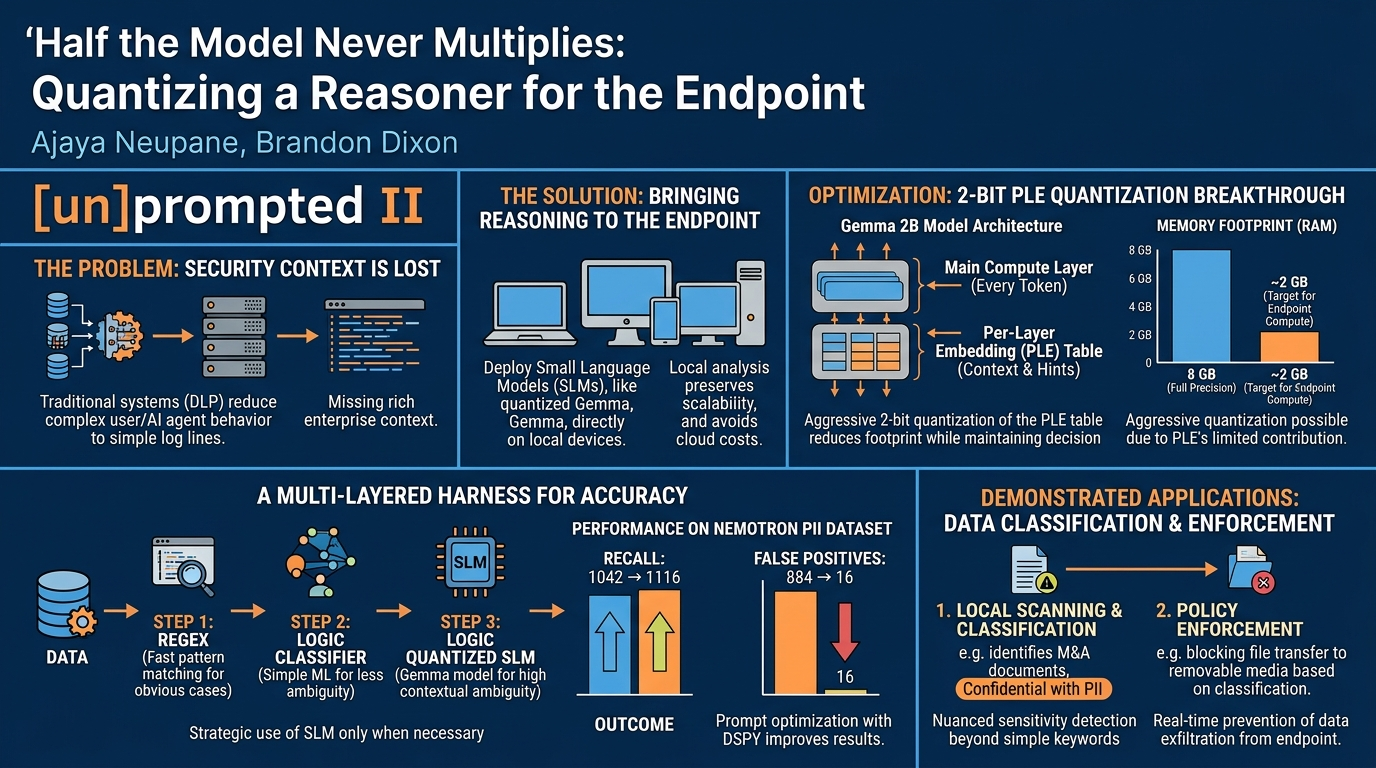
The central discovery of this research revolves around a novel quantization strategy that drastically reduces the memory footprint of the Gemma model while preserving its reasoning capabilities. The speakers identified that the Gemma architecture, specifically the 2B parameter version, is split into two distinct halves: a compute layer that processes every token, and a Per-Layer Embedding (PLE) table that provides additional context and hints to the compute layer.
Initial attempts at quantizing the compute layer to 4-bit and then 3-bit precision yielded mixed results, including an increase in false positives. The breakthrough came when the focus shifted to the PLE table. Surprisingly, quantizing the PLE table down to 2-bit precision resulted in performance remarkably close to the full precision model, particularly in decision-making tasks. This was unexpected because conventional quantization often focuses on the compute-heavy layers. The team hypothesized that the PLE's limited contribution, regulated by a "gated architecture" within the model, allowed for such aggressive quantization without significant degradation.
Specifically, their evaluation across various datasets demonstrated:
- Decision Accuracy: On a curated dataset of 40 samples (10 safe, 30 sensitive), the 2-bit PLE quantized model achieved similar detection rates and false positive rates as the full precision model.
- Reasoning Fidelity: Using KL divergence to measure probability distribution, the 2-bit PLE quantized model's reasoning (next-word prediction) remained close to the full precision version on datasets like Nemotron PII, Grade School Maths, and Cyber Sec Eval.
- General Capability: The model retained its ability to answer general questions, showing only minor gaps in broad knowledge that did not impact its primary task of DLP.
- Memory Footprint: The 2-bit PLE quantized Gemma model achieved the target of approximately 2 GB, a significant reduction from the original 8 GB.
Furthermore, to address any remaining gaps in the model's detection and improve overall reliability, the team developed a harness around the quantized SLM. This harness employs a layered approach:
- Pattern Matching (Regex): A fast, first-pass filter for obvious matches.
- Logic Classifier / Simple ML Classifier: For cases beyond regex but less ambiguous than those requiring full reasoning.
- Quantized SLM: The endpoint-optimized reasoning model, used only for ambiguous contextual data.
- Prompt Optimization: Utilizing a "genetic Pareto" algorithm from the DSPY library to dynamically optimize prompts, significantly improving both recall and precision. For instance, on the Nemotron dataset, recall improved from 1042 to 1116, and false positives dramatically dropped from 884 to 16.
This layered harness, combined with the novel PLE quantization, forms a robust and efficient system for endpoint-based data classification and security analysis.
Technical Deep Dive
▶ Watch: Breakthrough: Quantizing Gemma's Per-Layer Embeddings (PLE) (8:30)
The technical foundation of this work lies in understanding and optimizing the architecture of Google's Gemma 2B model. The speakers highlighted that Gemma's design includes a crucial distinction between its primary compute layers and an auxiliary Per-Layer Embedding (PLE) table. While the compute layers are responsible for the bulk of token processing, the PLE table acts as a lookup mechanism, providing additional information or "hints" that enhance the model's capabilities, similar to how larger models achieve their performance. This architectural insight proved critical for successful quantization.
The quantization process, which involves reducing the precision of the model's weights and activations, typically targets the most computationally intensive parts. Initially, the team followed this conventional approach, attempting to quantize the compute layer to 4-bit and then 3-bit precision. Their experimental results on 40 curated synthetic samples showed that while 4-bit compute slightly decreased sensitivity detection (from 28 to 27) with one false positive, 3-bit compute, despite catching all sensitive data, significantly increased false positives to six. Reverting the PLE table to higher precisions (16-bit, 8-bit, 6-bit) alongside 3-bit compute did not resolve the false positive issue, suggesting the compute layer was the primary culprit for the degradation.
A pivotal shift occurred when the team focused on quantizing the PLE table instead. Running the full precision model as a baseline (28 detections, 1 false positive), they found that quantizing the PLE table to 6-bit resulted in 27 detections. Remarkably, at 2-bit quantization for the PLE table, the model's performance was very close to full precision, showing only minor changes "within the noise." Further architectural analysis revealed that the PLE layers contribute to the model by adding values to the main layers, rather than directly multiplying through a gated architecture. This "limited contribution" mechanism, where a gating function likely modulates the PLE's influence, was identified as the reason why the PLE could be aggressively quantized to 2-bit without significant loss of model fidelity.
The evaluation methodology was comprehensive, assessing performance across three axes:
- Decisions: Probing the model's ability to make correct classifications using 40 curated samples and larger datasets like Nemotron and Crate data.
- Reasons: Measuring the similarity of the quantized model's generated explanations (next-word predictions) to the full precision model using KL divergence. This was tested on datasets such as Grade School Maths and Cyber Sec Eval (for prompt injections).
- General Ability: Ensuring the model didn't break its broader knowledge capabilities, using general data sets.
The results consistently showed that the 2-bit PLE quantized model maintained high fidelity. For instance, on Nemotron, disagreements with full precision were 135 at 6-bit PLE and 149 at 2-bit PLE – a slight increase but still within acceptable bounds, especially compared to the degradation seen at 3-bit. Similarly, for Grade School Maths and Cyber Sec Eval, the 2-bit PLE model remained highly comparable to the full precision baseline. The memory footprint for this optimized model was successfully brought down to approximately 2.06 GB, achieving the target.
To further refine detection and minimize false positives, a multi-layered harness was implemented. This harness prioritizes computationally lighter methods first:
- Regular Expressions: For unambiguous pattern matching.
- Logic Classifier: A simple machine learning classifier for less ambiguous contextual data.
- Quantized SLM: The Gemma model, invoked only when high ambiguity necessitates deep contextual reasoning.
Crucially, the prompt for the SLM was optimized using a dynamic optimizer called genetic Pareto, an algorithm available within the DSPY library. This optimization significantly improved the harness's overall performance, as demonstrated by the Nemotron dataset results: recall increased from 1042 to 1116, and false positives dropped from 884 to a mere 16. This layered approach ensures that the powerful but more resource-intensive SLM is used judiciously, maximizing efficiency and accuracy on the endpoint.
Demo / Proof of Concept
▶ Watch: Live demo: Endpoint data classification and policy enforcement (15:00)
Brandon Dixon provided a live demonstration of the quantized SLM running on a MacBook, showcasing its practical application within an endpoint security harness. The demo aimed to illustrate the real-world footprint and capability of the system beyond theoretical evaluation metrics.
First, the memory footprint was displayed using Activity Monitor. The system showed three key services:
- Core Daemon: Inclusive of an embedding model, consuming a larger but not specified amount of memory.
- Inference Host: This is the quantized Gemma model, actively consuming approximately 505 MB of memory. The speaker noted that while the model has a 2 GB footprint, the macOS operating system is efficient in paging models, leading to a lower active consumption.
- Content Inspection Host: This service orchestrates the regular expression matching and logic classifier components of the harness.
The demo then proceeded to show the system's ability to classify sensitive documents stored locally on the laptop. A "data estate" had been pre-built, where the background scanning process had already analyzed content in various folders. This scanner prioritizes regular expressions and escalates ambiguous cases to the quantized reasoning model.
A specific document named "Thursday follow-up" was chosen. Upon opening the file, the system displayed a classification label: "Confidential with PII." The classification was attributed to "layer three," indicating the quantized reasoning model was responsible. The document itself contained details about a fictitious merger and acquisition, including follow-ups and a transcript. The speaker emphasized that this type of content would be difficult for a simple regex-based approach to classify as sensitive, as it lacked immediately obvious patterns like Social Security numbers, but its overall context clearly indicated high sensitivity.
Finally, the demo illustrated policy enforcement based on this classification. A policy was configured to prevent sensitive documents of the "Confidential with PII" type from being moved to removable media. When an attempt was made to drag and drop the "Thursday follow-up" document to a connected USB drive, the system intercepted the action and blocked the transfer. This showcased the end-to-end capability: local AI reasoning to classify data, followed by real-time policy enforcement to prevent data exfiltration. The speaker also noted that this enforcement could extend to other channels like browsers or other applications.
This practical demonstration effectively conveyed the system's ability to run a powerful AI model locally with a minimal active memory footprint, accurately classify complex sensitive data, and integrate this intelligence into proactive security controls on the endpoint.
Defensive Implications
▶ Watch: Q&A: Training small language models on custom data (25:00)
The work presented by Brandon Dixon and Ajaya Neupane offers significant implications for cybersecurity defenders, particularly in the realm of Data Loss Prevention (DLP), insider threat detection, and overall endpoint security posture. By demonstrating the feasibility of running powerful, context-aware AI models directly on endpoint devices, several new defensive capabilities emerge:
- Enhanced Data Classification at the Source: Defenders can deploy highly intelligent data classification engines directly on user machines. This moves beyond simplistic pattern matching, allowing for nuanced understanding of document sensitivity based on content and context. This means documents describing M&A activities, strategic plans, or proprietary research can be accurately identified as sensitive even without containing explicit PII or financial data, improving the efficacy of DLP policies.
- Reduced Reliance on Cloud for Sensitive Data Analysis: Enterprises can significantly reduce or eliminate the need to send sensitive data to the cloud for AI processing. This addresses critical concerns around data privacy, compliance (e.g., GDPR, CCPA), and data sovereignty. Keeping data local mitigates transit costs, egress fees, and the risk of data exposure during movement.
- Improved Scalability and Performance: Processing data directly on the endpoint means that the security infrastructure scales with the number of endpoints, rather than being bottlenecked by centralized cloud services. The demonstrated active memory footprint of ~500 MB for a 2 GB model shows that advanced AI reasoning can run efficiently without significantly impacting endpoint performance.
- Proactive Policy Enforcement: The ability to classify data in real-time on the endpoint allows for immediate policy enforcement. As demonstrated, this can prevent sensitive files from being copied to removable media, uploaded to unauthorized cloud services, or shared via unapproved communication channels. This shifts DLP from a reactive, log-based alert system to a proactive, preventative control.
- Contextual Behavioral Analysis: Beyond data classification, the underlying reasoning capabilities of these endpoint SLMs can be extended to analyze user and AI agent behavior in context. This enables more sophisticated detection of insider threats, anomalous activities, and misuse of corporate resources by understanding the intent and context behind actions, rather than just the actions themselves.
- Customizable Threat Intelligence: The techniques for quantizing and fine-tuning SLMs on specific datasets mean that enterprises can develop highly specialized models tailored to their unique data types, industry regulations, and threat landscapes. This allows defenders to build bespoke AI agents that understand their specific definition of "sensitive" or "risky" behavior.
- Layered Security Architecture: The proposed harness—combining fast regex, logic classifiers, and the quantized SLM—advocates for a pragmatic, layered approach to security. This ensures that the most computationally intensive AI reasoning is only invoked when truly necessary, optimizing resource utilization and maintaining performance while maximizing detection accuracy. Defenders should adopt similar tiered strategies to efficiently manage security checks.
By adopting these principles, security teams can deploy more intelligent, privacy-preserving, and effective defenses directly where the action happens, significantly enhancing their ability to protect critical assets and respond to evolving threats.
Key Takeaways
- Endpoint AI is Feasible and Powerful: Open-weight language models can be significantly optimized to run directly on endpoint devices, enabling advanced AI reasoning capabilities without requiring cloud offload.
- Per-Layer Embedding (PLE) Quantization is Key: A novel technique of quantizing the Gemma model's Per-Layer Embedding (PLE) table to 2-bit precision proved highly effective in reducing memory footprint (from 8 GB to ~2 GB) while maintaining performance.
- Full Precision Isn't Always Necessary: The research demonstrates that for specific security use cases like data classification, full model precision is not always required, and aggressive quantization can yield positive results.
- Layered Security Harness is Crucial: Combining fast, lightweight methods (regex, logic classifiers) with a resource-optimized SLM in a "harness" dramatically improves both recall and precision, significantly reducing false positives (e.g., from 884 to 16 on Nemotron).
- Data Classification is Just One Application: The ability to run reasoning models on endpoints opens doors for numerous other security applications, including contextual behavioral analysis, insider threat detection, and advanced endpoint detection and response (EDR).
- Privacy and Scalability Benefits: Local AI processing keeps sensitive data on the endpoint, addressing privacy concerns, reducing data transit costs, and improving the scalability of security solutions across large enterprises.
About the Speaker(s)
Brandon Dixon is the CTO and Co-Founder of Ent AI. In his role, he focuses on developing innovative AI and security solutions. His experience and leadership are central to the company's efforts in bringing advanced artificial intelligence capabilities to the realm of enterprise security, particularly in solving complex challenges like endpoint-based reasoning and data classification.
Ajaya Neupane is part of the AI & Security team at Ent AI. His work is instrumental in the technical development and implementation of the AI models discussed in the talk. Ajaya's expertise lies in the intricate details of model architecture, quantization techniques, and rigorous evaluation methodologies to ensure that AI models are robust and performant in real-world security applications.
Reviews
→ Top-rated talks at [un]prompted II 2026 — The AI Security Practitioner Conference
All talks from [un]prompted II 2026 — The AI Security Practitioner Conference