Dream Bigger: Let's Patch Doom and Stop an Attack Now
Gadi Evron (CEO · Knostic)
[un]prompted II 2026 — The AI Security Practitioner Conference · Day 2 · Stage 1
Overview
In his compelling talk, "Dream Bigger: Let's Patch Doom and Stop an Attack Now," Gadi Evron, CEO of Knostic, challenges the cybersecurity community to abandon outdated paradigms and embrace a radical new future where software is not only self-healing but also capable of autonomously patching vulnerabilities in live production environments. Evron argues that the traditional models of software development, deployment, and security—characterized by slow cycles, high costs, and reactive measures—are fundamentally incompatible with the rapidly evolving capabilities of Large Language Models (LLMs) and AI agents. He posits that a profound shift, which he metaphorically refers to as "the crack" in reality, is already underway, demanding a complete redesign of how we build and secure systems.
Key moments
- 0:15 Core principles for agents: recovery, non-determinism, control, ephemeral code.
- 2:00 Envisioning a new, simple language built specifically for LLMs.
- 4:00 The inevitable future: live mutable software and self-healing systems.
- 9:30 Demo success: Agent automatically fixes SQL injection vulnerability live.
- 13:30 Triumphant Doom demo: Monster behavior patched live in production.
- 15:00 Longer term trust: Formal verification and 'good enough' mathematics.
- 18:20 Challenging convention: Code is ephemeral, just prompt your agent.
- 19:30 Attacker singularity happened; now it's time for ours.
Dream Bigger: Let's Patch Doom and Stop an Attack Now
Speakers: Gadi Evron, CEO, Knostic
Conference: [un]prompted II
YouTube: https://www.youtube.com/watch?v=Snd5ASnnw5E
Overview
In his compelling talk, "Dream Bigger: Let's Patch Doom and Stop an Attack Now," Gadi Evron, CEO of Knostic, challenges the cybersecurity community to abandon outdated paradigms and embrace a radical new future where software is not only self-healing but also capable of autonomously patching vulnerabilities in live production environments. Evron argues that the traditional models of software development, deployment, and security—characterized by slow cycles, high costs, and reactive measures—are fundamentally incompatible with the rapidly evolving capabilities of Large Language Models (LLMs) and AI agents. He posits that a profound shift, which he metaphorically refers to as "the crack" in reality, is already underway, demanding a complete redesign of how we build and secure systems.
Evron's presentation is a visionary call to action, urging practitioners to move beyond incremental automation of existing processes and instead "dream bigger" by redesigning systems from the ground up to leverage the inherent strengths of AI. He demonstrates, through evocative live coding examples, how LLMs can directly interact with and modify production code to remediate vulnerabilities and alter application logic in real-time. This talk is critically important for security professionals, developers, and architects, as it outlines a trajectory towards an "attacker singularity" where AI-driven threats necessitate an equally advanced, autonomous defensive posture, fundamentally redefining the role of humans in the security loop.
Background
▶ Watch: Core principles for agents: recovery, non-determinism, control, ephemeral code. (0:15)
The premise of Gadi Evron's talk is rooted in the observation that current software development and security practices are struggling to keep pace with the complexity and dynamism of modern systems. Evron identifies a pervasive, yet often unacknowledged, "crack" in our current reality—a nascent shift driven by AI that necessitates a fundamental re-evaluation of our approach. He highlights the limitations of the "old development process": human-centric coding, high verification costs, slow deployments, and the inevitable discovery of vulnerabilities post-deployment. This traditional model, Evron contends, is becoming increasingly unsustainable.
Evron introduces his personal operational model for interacting with AI agents, which underpins his vision for future software:
- Recovery First: Prioritizing system resilience and self-correction over absolute bug prevention. The agent's role is to "make it work," adapting arguments, rewriting code, and finding solutions dynamically.
- Embrace Non-Determinism: Acknowledging the inherent stochastic nature of AI systems. While determinism is often sought, Evron suggests that embracing flexibility, akin to how a human might creatively solve a problem, can be more effective.
- Control Theory: When the internal workings of a complex system are opaque, control can be exerted by managing inputs, outputs, and the orchestration of procedures, closing the loop to ensure expected results.
- Ephemeral Code: Viewing code as transient and disposable. With AI agents capable of generating and modifying code rapidly, the emphasis shifts from meticulously crafted, long-lived codebases to adaptable, on-demand solutions.
This philosophical shift sets the stage for Evron's core argument: instead of merely automating existing, outdated processes (building "faster horses"), we must redesign systems based on the new reality where LLMs are central. He points to the emergence of AI monitoring as a design pattern across various sectors, but stresses the critical need to evolve beyond monitoring to AI response and autonomous patching. While automated patching is an older concept that has struggled with trust, the advent of sophisticated AI agents, as explored by Ella Ramy in her openant talk, promises a future of truly self-healing software where agents can live inside production environments and autonomously remediate issues. Evron even speculates on the need for a "missing language" specifically designed for LLMs—one that is simple, correct, short, expressive, and perhaps even formally provable, moving beyond current programming languages like Python, TypeScript, or Rust for agent-driven coding.
Key Findings
▶ Watch: The inevitable future: live mutable software and self-healing systems. (4:00)
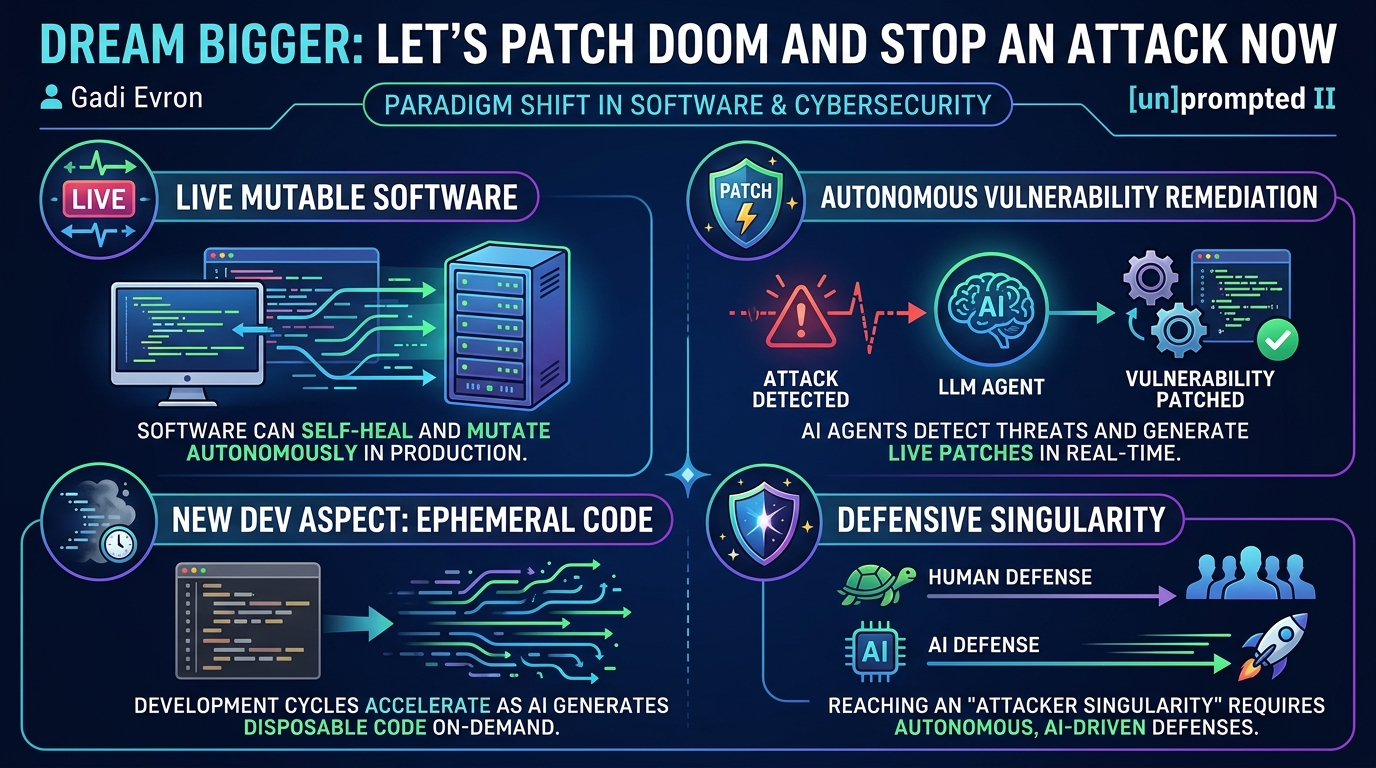
The central and most impactful finding of Gadi Evron's talk is the demonstrable potential for live mutable software driven by AI agents. Evron asserts that the future of software development and security lies not in merely automating existing layers, but in a fundamental redesign where LLMs act as active participants in the software lifecycle, including real-time vulnerability remediation. This represents a paradigm shift from static, human-authored code to dynamic, AI-managed systems.
Key findings include:
- LLMs as Live Code Modifiers: Evron conclusively demonstrates that LLMs can be used to understand existing code, identify problematic sections, and generate replacement code that is then applied directly to a live, running application. This capability extends beyond simple configuration changes to actual logic alteration.
- Autonomous Vulnerability Remediation: The talk showcases an LLM detecting a SQL injection attack from system logs, identifying the vulnerable code, and then generating and deploying a patch in real-time to mitigate the vulnerability. This moves security beyond detection and human-driven response to immediate, automated self-correction.
- Massively Accelerated Development Cycles: Evron projects that the "new dev aspect" powered by LLMs monitoring logs and generating code can accelerate software development by "100x, 2000x, 3000x," facilitating "live deployment in place" without traditional waiting periods. This speed profoundly impacts the feasibility of rapid patching.
- Ephemeral Code as a Reality: The talk reinforces the concept of code as transient. When LLMs can generate and regenerate code on demand, the emphasis shifts from maintaining static codebases to defining desired behaviors and allowing agents to manifest them. This challenges traditional notions of code ownership and version control.
- The Attacker Singularity Demands an AI Defense: Evron warns that the "attacker singularity moment already happened," implying that AI-powered offensive capabilities are already outstripping traditional human defenses. The talk posits that the only viable response is for defenders to achieve their own "singularity moment" through equally advanced, AI-driven defensive systems.
- The Need for "Good Enough" Formal Verification: While acknowledging the complexity of formal verification, Evron suggests that for AI-generated code, the goal should be "good enough" mathematical proof rather than perfect, exhaustive verification by human mathematicians, making it practical for production environments.
These findings collectively point to an imminent future where security is not an afterthought but an inherent, continuously self-optimizing function of the software itself, driven by intelligent agents.
Technical Deep Dive
▶ Watch: Triumphant Doom demo: Monster behavior patched live in production. (13:30)
Evron's vision for live mutable software fundamentally re-architects the traditional software stack, moving away from rigid, pre-compiled binaries to dynamic, adaptive systems. At its core, this involves integrating LLM agents directly into the production environment, allowing them to monitor, analyze, and modify code in real-time.
The "new dev aspect" described by Evron represents a radical departure from conventional software engineering. Instead of humans writing code, verifying it, and then deploying it through a slow, costly pipeline, LLMs are envisioned as constantly monitoring application logs and runtime behavior. When anomalies, errors, or vulnerabilities are detected, these agents can generate new code or modifications, verify them (or at least check against "trust signals"), and deploy them instantaneously. Evron suggests this could accelerate development by orders of magnitude (100x to 3000x), enabling live deployment in place. This concept is already seeing nascent forms in tools like Rookout, Sentry, Crushalytics, and Maxwell by double AI, which provide runtime visibility and dynamic instrumentation. However, Evron pushes this further by proposing that agents not just observe, but actively "live inside production" and self-heal.
A critical component of this future is the concept of ephemeral code. If LLMs can generate code rapidly based on prompts and contextual understanding, then the code itself becomes a temporary artifact of the desired behavior, rather than a fixed asset. This has profound implications for version control, code review, and even intellectual property, as the "code" might simply be the prompt that generated it.
To manage the inherent non-determinism and complexity of LLM-generated changes, Evron emphasizes control theory. When the internal state of an LLM-driven system is too complex to fully model or control, the focus shifts to controlling the inputs, outputs, and the orchestration of the change process. This involves defining clear expectations for what a code change should achieve and then verifying that the output aligns with those expectations.
Ensuring trust in autonomously generated and deployed code is paramount. Evron discusses several mechanisms:
- Guarantee-Based Verification / Contract Abstraction Layer: This involves having the LLM compare its generated code against a defined "contract" or "promise" of what the function or module is supposed to do. This could leverage docstrings, formal specifications, or other metadata to ensure the change adheres to intended functionality.
- Trust Signals: Instead of full formal verification, Evron suggests checking for "trust signals" like the presence of regression tests, adherence to coding standards, or other indicators of reliability before deployment. Ella Ramy's work on creating trust around autonomous patching is cited here.
- Formal Verification (Longer Term): While acknowledging its current difficulty, especially for concurrent or business logic, Evron sees formal verification as the ultimate goal for establishing trust. He highlights ongoing work in this space by projects like Lean, Rock, Daphne, Agda, PBS, and researchers at MIT, along with contributions from companies like CA Airbus. The key, however, is to achieve "good enough" mathematical rigor that is practical for production, rather than striving for unattainable perfection. This pragmatic approach recognizes that mathematicians cannot be "in the middle of production" for every code change.
Evron also speculates on the need for a "missing language" specifically designed for LLMs. This hypothetical language would be simple, correct, short, expressive, and potentially even formally provable. It would abstract away the complexities of current programming languages, allowing LLMs to operate at a higher, more semantic level, bridging the gap between intent and execution more effectively. This would remove the "barrier between code and production" by making the underlying implementation details less relevant to the LLM's operational logic.
This technical framework outlines a future where AI agents are not just tools, but active, intelligent components of the software itself, capable of continuous evolution and self-remediation, fundamentally altering the security landscape.
Demo / Proof of Concept
▶ Watch: Longer term trust: Formal verification and 'good enough' mathematics. (15:00)
Gadi Evron's talk included two compelling, albeit "vibe coded PC" (proof-of-concept) demonstrations, illustrating the core thesis of live, agent-driven code modification and autonomous patching. These demos, performed live, showcased the potential of LLMs to interact directly with running applications.
The first demonstration involved the classic video game Doom. Evron's goal was to modify the game's monster behavior in real-time. Initially, when the game started, monsters would fire at the player and maintain distance. Using a "semi-IDE" (Integrated Development Environment) that interfaced with an LLM (Claude, in this case), Evron issued a natural language prompt: "monsters should always walk toward player and never fire." After some initial debugging and a "human problem" (clicking the wrong function), the LLM successfully identified the relevant game logic, generated new code to alter the monster's firing and movement patterns, and applied this change live to the running Doom instance. The audience witnessed the monsters stop firing and instead relentlessly pursue the player. This demonstration powerfully illustrated the ability of an LLM to understand complex, unfamiliar codebases and implement behavioral changes dynamically.
The second, and arguably more impactful, demonstration focused on autonomous vulnerability remediation. Evron presented a simple "documentation app" with a known SQL injection vulnerability. He first demonstrated the vulnerability by executing a malicious SQL injection payload, which successfully returned sensitive data, confirming the flaw. The core of this demo was to show how an LLM could automatically detect and fix such an issue. Evron initiated the "fix" mechanism. The LLM was configured to monitor application logs. When the SQL injection attempt appeared in the logs, the LLM detected it, identified the vulnerable code segment, generated a corrected version of the code that prevented the injection, and then live-patched the running application. Evron then re-attempted the SQL injection, and this time, it failed, confirming the live fix. He further demonstrated the flexibility by "unbinding" the fix, allowing the vulnerability to reappear, and then re-applying the fix. This sequence underscored the agent's capability not just to detect, but to autonomously replace vulnerable code in a production-like environment, showcasing a proactive, self-healing security posture.
While Evron candidly acknowledged the "vibe coded PC" nature and the typical demo challenges, the successful execution of these proof-of-concepts provided concrete evidence for his assertion that LLMs can bridge the gap between code and production, enabling dynamic, self-modifying, and self-securing software. The Doom demo highlighted the ability to alter application logic, and the SQL injection demo directly addressed the critical security challenge of live vulnerability patching.
Defensive Implications
▶ Watch: Attacker singularity happened; now it's time for ours. (19:30)
Gadi Evron's vision carries profound implications for cybersecurity defenders, demanding a radical shift in strategy, tooling, and mindset. The era of live mutable software and autonomous patching necessitates a departure from traditional, reactive security models.
Firstly, defenders must prepare for a world where AI agents are integral to incident response and security engineering. Instead of solely relying on human analysts to interpret logs and manually apply patches, security teams will need to integrate and trust AI agents that can detect, analyze, and remediate vulnerabilities in real-time. This means developing robust frameworks for agent orchestration, monitoring agent behavior, and establishing "trust signals" for AI-generated code changes. The focus shifts from "human in the loop" for every decision to "human on the loop," overseeing and validating the autonomous actions of AI systems.
Secondly, the concept of ephemeral code challenges established security practices like static code analysis, traditional patch management, and vulnerability scanning. If code is constantly being generated and modified by LLMs, then security must become an inherent property of the code generation and modification process itself, rather than a post-development audit. This pushes security further left, into the realm of prompt engineering, contract verification, and runtime integrity checks for AI-modified binaries.
Thirdly, Evron's emphasis on control theory and "good enough" formal verification provides a pragmatic path forward for securing AI-driven systems. When the internal workings of an LLM are opaque, defenders can focus on controlling the inputs provided to the LLM (e.g., security policies, vulnerability context) and rigorously verifying the outputs (the generated code changes). This requires defining clear security contracts and leveraging techniques like guarantee-based verification to ensure that AI-generated patches do not introduce new vulnerabilities or break existing functionality. While full formal verification remains a long-term goal for complex systems, the pursuit of "good enough" mathematical assurance for specific, critical code changes becomes a viable defensive strategy.
Finally, Evron's warning about the "attacker singularity" underscores the urgency for defenders to embrace these new capabilities. If adversaries are already leveraging AI to generate sophisticated attacks, then reliance on slow, human-centric defenses will lead to an insurmountable disadvantage. Defenders must "stop fearing imagination" and actively experiment with AI-driven autonomous defense mechanisms, building their own "singularity moment" to level the playing field. This includes redesigning security architectures to be inherently self-healing, moving from merely detecting threats to actively patching them out of existence as they emerge in live environments. This paradigm shift requires security professionals to become proficient in AI orchestration, prompt engineering for security tasks, and the validation of AI-generated code.
Key Takeaways
- Live, self-healing software is the future: AI agents, particularly LLMs, are poised to move beyond monitoring to actively modify and patch code in live production environments, leading to truly self-healing applications.
- Autonomous vulnerability remediation is achievable: Demonstrations show LLMs detecting vulnerabilities (e.g., SQL injection) from logs and automatically generating and deploying code fixes in real-time, significantly reducing response times.
- A new software development paradigm is emerging: The "new dev aspect" leverages LLMs for vastly accelerated development (100x-3000x) and live deployment, challenging traditional, human-centric coding and slow release cycles.
- Trust in AI-generated code is critical: Building trust requires mechanisms like guarantee-based verification, checking for "trust signals" (e.g., regression tests), and pragmatic "good enough" formal verification.
- Defenders must embrace AI to counter the "attacker singularity": The increasing sophistication of AI-powered attacks necessitates an equally advanced, autonomous defensive posture, moving security from reactive human intervention to proactive, AI-driven self-correction.
- Rethink fundamental security assumptions: The concept of "ephemeral code" and live mutable software requires security professionals to abandon outdated paradigms and redesign systems with AI agents as core, trusted components, focusing on controlling inputs, outputs, and the orchestration of changes.
About the Speaker(s)
Gadi Evron is the CEO of Knostic, a company at the forefront of exploring the intersection of artificial intelligence and cybersecurity. His work, as evidenced by this talk, positions him as a visionary in the field, challenging conventional thinking and pushing the boundaries of what's possible with AI agents in software development and security. Evron advocates for a fundamental shift in how we approach building and defending digital systems, emphasizing autonomous, self-healing capabilities powered by Large Language Models.
Reviews
→ Top-rated talks at [un]prompted II 2026 — The AI Security Practitioner Conference
All talks from [un]prompted II 2026 — The AI Security Practitioner Conference