Weightless: Abliteration Without the Weights
Matt Suiche (Member of Technical Staff (MTS) · Tolmo)
[un]prompted II 2026 — The AI Security Practitioner Conference · Day 2 · Stage 1
Overview
In "Weightless: Abliteration Without the Weights," Matt Suiche, a cybersecurity veteran and Member of Technical Staff (MTS) at Tolmo, presents a novel approach to controlling the behavior of Large Language Models (LLMs) at runtime. The talk addresses a growing concern within the AI community: the increasing reliance on pre-trained models, the inherent biases and "guardrails" embedded within them, and the burgeoning supply chain risks associated with downloading modified, third-party models. Suiche argues that in an era where "everything around us is a prompt" and intelligence itself is a secured asset, the ability to audit and modify model behavior becomes paramount.
Key moments
- 0:00 Introduction: FSD anecdote and 'everything is a prompt'
- 3:30 AI as a race to control thought and research
- 5:30 Weightless: Runtime inference with small, auditable control vectors
- 10:45 Technical deep dive: Hooking the residual stream for control
- 12:30 Empowering local models and controlling behavior for research
- 15:50 Captain Vector: Creating custom GLP files to steer models
- 20:50 Conclusion: Take back control of your model activations
- 22:00 Q&A: Space savings and technical details on injection
Weightless: Abliteration Without the Weights
Speakers: Matt Suiche, Member of Technical Staff (MTS) at Tolmo
Conference: [un]prompted II
YouTube: https://www.youtube.com/watch?v=QcUmahBp9lE
Overview
In "Weightless: Abliteration Without the Weights," Matt Suiche, a cybersecurity veteran and Member of Technical Staff (MTS) at Tolmo, presents a novel approach to controlling the behavior of Large Language Models (LLMs) at runtime. The talk addresses a growing concern within the AI community: the increasing reliance on pre-trained models, the inherent biases and "guardrails" embedded within them, and the burgeoning supply chain risks associated with downloading modified, third-party models. Suiche argues that in an era where "everything around us is a prompt" and intelligence itself is a secured asset, the ability to audit and modify model behavior becomes paramount.
Suiche introduces Weightless, a framework designed to apply "control vectors" to LLMs during the inference process, effectively altering their output and internal "thinking" without requiring a full re-download or modification of the base model. This innovation tackles the significant challenges of storage costs, supply chain vulnerabilities, and the philosophical question of who dictates what users can "think about" or research with AI. By enabling localized, auditable, and efficient modification, Weightless empowers researchers and users to bypass restrictive guardrails, mitigate political biases, and ensure the integrity of their AI interactions, especially in the context of burgeoning local inference capabilities.
The core of Weightless lies in its ability to treat model inference as a debuggable process, akin to traditional software debugging. This paradigm shift allows for precise, runtime manipulation of model activations, offering unprecedented control over AI responses. The solution leverages a small, differential file format based on an extension of GGUF, drastically reducing the storage footprint compared to downloading entirely new, "obliterated" models. With minimal performance impact, Weightless presents a compelling argument for a future where users, not model developers, maintain ultimate control over their AI's cognitive landscape.
Background
▶ Watch: Introduction: FSD anecdote and 'everything is a prompt' (0:00)
The landscape of technology is rapidly evolving, with Large Language Models (LLMs) becoming integral to various aspects of work and research. Matt Suiche notes this shift by observing that many, including himself, are now "token maximalist[s]," heavily dependent on models for tasks like code generation. This dependency, however, comes with significant implications for security and intellectual freedom. Suiche highlights a critical concern: "AI is also a race to control what people think about." This control is often manifested through guardrails—pre-programmed limitations and biases within models that can dictate what topics are permissible for discussion or research, a phenomenon particularly frustrating for cybersecurity professionals accustomed to thinking "out of the box."
Historically, hackers and researchers have valued the freedom to explore and challenge boundaries, a spirit that clashes directly with restrictive AI guardrails. Suiche recounts personal frustrations with these limitations, leading him to explore "obliteration"—the process of removing or altering unwanted behaviors or biases in models. Initial explorations revealed a common practice: downloading "obliterated" models from third parties. This approach, however, introduces a severe supply chain issue akin to the long-standing problems with untrusted JavaScript packages. Users are forced to download potentially backdoored or compromised models, often massive in size (e.g., Kimi at 1.7 terabytes), simply to alter a specific behavior.
This existing methodology is inefficient and insecure. Each modification requires a full model re-download, consuming vast amounts of storage and bandwidth. Suiche emphasizes the high cost of storage, noting that even with multiple high-end GPUs, disk space quickly becomes a bottleneck. Furthermore, current methods like LoRA files (Low-Rank Adaptation) are primarily suited for additive modifications on dense model architectures and struggle with the increasing complexity of modern LLMs, such as Mixture-of-Experts (MoE) models or those with N-gram and transformer loop architectures. Suiche posits a fundamental shift in perspective: if model inference engines are viewed as "some sort of virtual machine or emulator," then their execution and internal states should be debuggable, much like traditional software. This analogy forms the philosophical bedrock for Weightless, offering a pathway to control model behavior without relinquishing trust or sacrificing efficiency.
Key Findings
▶ Watch: Weightless: Runtime inference with small, auditable control vectors (5:30)
The central innovation presented by Matt Suiche is Weightless, a groundbreaking framework that enables the runtime application of control vectors to modify the behavior of Large Language Models during inference. This approach fundamentally redefines how model "obliteration" and customization are performed, addressing critical issues of security, efficiency, and user control.
The key findings and contributions of Weightless include:
- Runtime Inference Modification: Unlike traditional methods that require downloading entirely new, modified models, Weightless applies changes on the fly during the inference process. This means the base model remains untouched, preserving its integrity and origin.
- Elimination of Supply Chain Risks: By working with stock models and applying small, auditable differential files, Weightless eradicates the need to trust and download potentially backdoored or compromised third-party models. Users can verify the control vectors themselves.
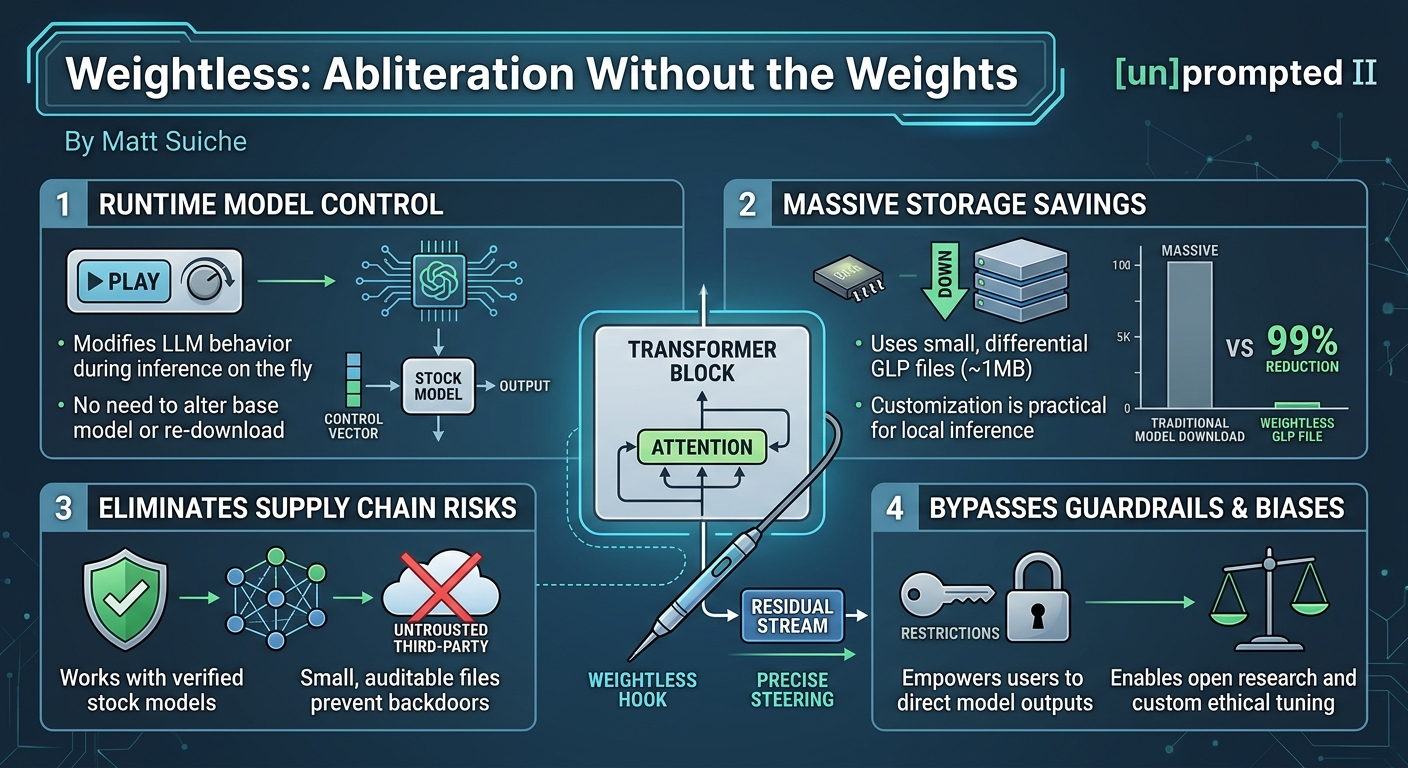
- Drastic Storage Savings: The "control vector" files, referred to as GLP files, are exceptionally small, typically around 1 megabyte even for massive base models like Kimi (which can be 1.7 terabytes). This represents an astonishing reduction in storage requirements, making model customization practical for local inference setups.
- Enhanced Flexibility for Complex Architectures: Weightless introduces a new file format that extends GGUF, allowing for more complex operations beyond simple additions (like those in LoRA files). This makes it effective for modern, intricate architectures such as Mixture-of-Experts (MoE) models, N-gram, and transformer loop designs, where LoRA falls short.
- Minimal Performance Impact: The application of control vectors via Weightless results in a negligible performance overhead, typically less than 1%. This is crucial for local inference scenarios where efficiency is paramount, ensuring that custom behaviors do not significantly degrade model speed.
- Empowerment of Users: Weightless provides users with the ability to directly influence model biases, bypass guardrails, and steer model output according to their specific needs. Suiche emphasizes that this returns control over "activations" to the user, combating the "race to control what people think."
- Debugging Paradigm for Models: The framework promotes a novel perspective where model inference is treated as a debuggable execution trace. This allows researchers to "follow their state" and apply "patches" or "hooks" to alter behavior, much like single-step debugging in traditional software.
These findings collectively represent a significant leap forward in LLM security and customization, offering a practical, secure, and efficient method for users to reclaim agency over their AI tools.
Technical Deep Dive
▶ Watch: Empowering local models and controlling behavior for research (12:30)
Weightless operates on the principle of dynamically altering the internal state of an LLM during its inference cycle, rather than static modification of the model weights. Suiche conceptualizes this process through the analogy of debugging traditional software: just as one might set breakpoints and modify registers in a virtual machine or emulator, Weightless allows for runtime manipulation of model "vectors."
The core mechanism involves injecting a hook function at a specific, critical juncture within the LLM's transformer architecture. For most dense and Mixture-of-Experts (MoE) models, this hook is strategically placed at the end of the transformer block, specifically within the residual stream function (e.g., in VLLM's implementation). The residual stream is where the outputs of the attention sublayer and the feed-forward network (FFN) writer converge before being passed to the next layer. By intercepting the data at this point, Weightless can reapply or modify tensors—the fundamental data structures within neural networks—effectively steering the model's subsequent computations and output.
Suiche illustrates this with a diagram of a modern transformer block in an MoE architecture. After the attention sublayer (which processes KV cache, a point of interest for projects like Taha's KV Phantom) and the FFN writer (which manipulates weights), the output feeds into the residual stream. It is before this output is pushed into the stream that the Weightless hook intervenes. This hook function is called every time data traverses a layer, allowing for layer-specific application of modifications defined in the GLP file. However, Suiche notes that for more complex or newer architectures, such as DeepSeek's Flash model with N-gram and four streams, the optimal hook position might shift, potentially requiring intervention within MHC-related functions rather than solely the residual stream.
The modifications themselves are encapsulated in small, differential files, referred to as GLP files. These files are an extension of the GGUF format, incorporating the necessary metadata for runtime application. Unlike LoRA files, which are primarily limited to additive operations suitable for dense models, Weightless's GLP files support more sophisticated operations, notably projection. Projection, in this context, allows for a multiplicative adjustment of the control vectors. This is particularly powerful for MoE models, where an alpha variable can be adjusted to "dial down" or increase the influence of specific behaviors without completely suppressing them. This fine-grained "dosage" control enables subtle steering of model output with precision.
To generate these GLP files, Suiche introduces a companion tool called Captain Vector. This tool works by capturing the "contrast" between a "good prompt" (one that elicits a desired, unbiased response) and a "bad prompt" (one that triggers unwanted behaviors or guardrails). By analyzing the differential output or internal states, Captain Vector derives and encodes the necessary control vectors into a GLP file, which can then be applied at runtime. This allows users to create custom "signatures" or overlays tailored to their specific needs, whether for bypassing guardrails, removing political biases, or experimenting with model behavior.
Weightless distinguishes itself from other obliteration and control projects:
- GCD (by Vince, mentioned by Suiche) operates at the very end of the inference pipeline, leveraging existing grammar features in engines like LLM to force specific output formats. This is a post-processing step, whereas Weightless modifies internal states.
- KV Phantom (by Taha) focuses on manipulating the attention layer's KV cache, a different point of intervention within the transformer block.
- Erratic is an open-source project that directly obliterates the model, resulting in a new, large model file. Weightless explicitly avoids this large file duplication.
- HF2Q (by Rob from IOActive) is focused on inference for Mac and has native GLP support, indicating growing adoption of Weightless's file format.
The ability to apply these modifications with less than 1% performance impact, coupled with the small file sizes, makes Weightless a highly practical solution for the burgeoning field of local inference, enabling researchers to experiment with and understand model behavior in a controlled, efficient, and secure environment.
Demo / Proof of Concept
▶ Watch: Captain Vector: Creating custom GLP files to steer models (15:50)
While the talk did not feature a live, on-stage coding demonstration, Matt Suiche provided compelling evidence of Weightless's practical efficacy through several key examples and acknowledgments of its capabilities.
A significant proof point came when Suiche described successfully reproducing a "PHP to shell exploit" using a local DeepSeek 4.1 model. This exploit, which involves generating malicious code, would typically be blocked by standard LLM guardrails. The ability to execute such a task on a local model, running at an impressive 100 tokens per second on a setup with four DGX GPUs, unequivocally demonstrates Weightless's capacity to bypass these restrictions and enable potentially sensitive or dangerous research. This real-world application validates the framework's ability to alter model behavior effectively and make local inference significantly more useful for security research.
Furthermore, Suiche explicitly mentions the availability of GLP files for a wide range of popular models, including Gemini 4, Kimi, and GLM. He directs attendees to his GitHub repository, which hosts "around like 10 or 15 GLP files for different models," all designed to obliterate various unwanted behaviors. These readily available, pre-made "patches" serve as concrete examples of Weightless in action, demonstrating that the technology is not merely theoretical but has been applied successfully across diverse LLM architectures. The fact that these files are typically "alpha megabyte" in size reinforces the core benefit of massive storage savings.
Suiche also alludes to a future of "vibe coding" and "speed run workshop" presentations, where researchers might show up with "no slides, purely vibe coding... just starting with an ID and just to see if it's possible." This vision, while aspirational, underscores the rapid prototyping and immediate feedback loop that Weightless enables, where ideas can be tested and model behaviors modified on the fly without lengthy setup or retraining. The existence of the Captain Vector tool, which allows users to create their own GLP files by contrasting "good" and "bad" prompts, further solidifies the framework's practical utility for custom obliteration.
Defensive Implications
▶ Watch: Q&A: Space savings and technical details on injection (22:00)
The Weightless framework introduces several profound implications for cybersecurity defenders and researchers, offering new tools and perspectives for navigating the complex landscape of AI security.
- Enhanced Model Auditing and Trust: By enabling modifications through small, differential GLP files rather than entire model downloads, Weightless drastically improves the auditability of AI systems. Defenders can inspect a 1-megabyte GLP file for malicious or unwanted changes much more easily than scrutinizing a 1.7-terabyte base model. This addresses a critical supply chain security vulnerability in AI, allowing organizations to maintain trust in their base models while customizing behavior with verifiable patches.
- Bypassing and Understanding Guardrails: The ability to effectively "obliterate" guardrails empowers security researchers to fully understand the capabilities and limitations of LLMs without artificial restrictions. This is crucial for red-teaming AI systems, identifying novel attack vectors, and developing more robust defenses. Defenders can use Weightless to explore the "multi-conditional thinking" of models, determining if an AI's refusal is a hard stop or merely a deflection, which has implications for identifying deeper biases or vulnerabilities.
- Custom Bias Mitigation and Control: Weightless provides a mechanism for users to identify and correct political, ethical, or other unwanted biases embedded within models. As Suiche notes, users can ask "political questions" and "make sure I know which bias it's starting with," then use Weightless to adjust this bias. This allows organizations to tailor models to their specific ethical guidelines and compliance requirements, ensuring that AI outputs align with corporate values.
- Agile Response to AI Threats: With the rapid evolution of AI, new vulnerabilities or malicious behaviors can emerge quickly. Weightless allows defenders to rapidly deploy "patches" (GLP files) to modify model behavior in response to new threats without the costly and time-consuming process of retraining or re-downloading entire models. This agility is vital in a fast-paced threat landscape.
- Secure Local Inference: As local LLM inference becomes increasingly powerful and common, Weightless ensures that these local models can be used securely and reliably. Researchers can run sensitive experiments or process proprietary data locally, confident that they control the model's behavior and are not inadvertently exposing information or generating harmful content due to unmanaged guardrails or biases. The ability to reproduce exploits like "PHP to shell" on a local, modified DeepSeek model highlights its utility for controlled security testing.
- Reclaiming User Agency: Fundamentally, Weightless is about restoring control to the end-user. In a world where "AI is a race to control how people think," this framework empowers individuals and organizations to "decide of your own activations," ensuring that AI serves as a tool for independent thought and research, free from external, opaque influences.
By offering a precise, efficient, and auditable method for influencing LLM behavior, Weightless significantly strengthens the defensive posture against AI-centric risks, from supply chain attacks to biased decision-making.
Key Takeaways
- Runtime Model Control: Weightless enables the modification of LLM behavior during inference, applying "control vectors" on the fly without altering the base model or requiring a full re-download.
- Efficiency and Storage Savings: The framework utilizes small, differential GLP files (e.g., 1MB for a 1.7TB model), drastically reducing storage needs and making model customization practical for local inference.
- Enhanced Security and Auditing: By working with stock models and auditable GLP files, Weightless mitigates supply chain risks associated with downloading untrusted, pre-obliterated models.
- Guardrail Bypass and Bias Mitigation: Weightless empowers users to bypass restrictive guardrails and adjust political or ethical biases within LLMs, allowing for more open research and customized AI outputs.
- Flexible Architecture Support: Unlike simpler methods like LoRA, Weightless's GGUF extension and "projection" operation can handle complex model architectures, including Mixture-of-Experts (MoE) models.
- Debugging Paradigm for AI: The approach treats model inference as a debuggable process, allowing researchers to hook into the residual stream and precisely steer model behavior with minimal performance impact (<1%).
About the Speaker(s)
Matt Suiche is a highly experienced cybersecurity professional with over two decades in the field. He has a distinguished background, having founded two previous startups: one focused on application virtualization and another specializing in incident response, with a particular emphasis on Windows internals and memory forensics. Suiche recently returned to San Francisco and joined Tolmo as a Member of Technical Staff (MTS). His work on Weightless reflects his deep understanding of low-level system internals, now applied to the complex architectures of modern AI models, viewing "model internals" as the new frontier akin to "Windows internals."
Reviews
→ Top-rated talks at [un]prompted II 2026 — The AI Security Practitioner Conference
All talks from [un]prompted II 2026 — The AI Security Practitioner Conference