Same Score, Different Brain: Comparing Models by How They Process What They Know
Tim Schulz (Co-Founder & CEO · Starseer)
[un]prompted II 2026 — The AI Security Practitioner Conference · Day 2 · Stage 1
Overview
In his talk, "Same Score, Different Brain: Comparing Models by How They Process What They Know," Tim Schulz, Co-Founder & CEO of Starseer, dives deep into the often-opaque internal mechanisms of large language models (LLMs). Challenging the prevailing reliance on external benchmarks, Schulz advocates for a more granular, layer-by-layer analysis of how models process information and form concepts. This approach moves beyond simply judging a model by its final output, urging the security community to embrace curiosity and apply a hacker's mindset to understand the "why" behind AI behavior.
Key moments
- 2:00 Challenge to hackers: Dive into AI interpretability
- 2:40 Benchmarks only grade final output; look deeper
- 4:55 Using contrastive prompts and probes to find signals
- 7:00 Capability curves reveal internal model differences
- 13:00 Refusal and safety are distinct model concepts
- 16:20 Obliteration: a general tool to remove any concept
- 22:00 Q&A: Isolating specific nodes for concepts like refusal
Same Score, Different Brain: Comparing Models by How They Process What They Know
Speakers: Tim Schulz (Co-Founder & CEO, Starseer)
Conference: [un]prompted II
YouTube: https://www.youtube.com/watch?v=JTiS2HsC9ZE
Overview
In his talk, "Same Score, Different Brain: Comparing Models by How They Process What They Know," Tim Schulz, Co-Founder & CEO of Starseer, dives deep into the often-opaque internal mechanisms of large language models (LLMs). Challenging the prevailing reliance on external benchmarks, Schulz advocates for a more granular, layer-by-layer analysis of how models process information and form concepts. This approach moves beyond simply judging a model by its final output, urging the security community to embrace curiosity and apply a hacker's mindset to understand the "why" behind AI behavior.
The core premise of the presentation is that models achieving similar scores on standard benchmarks can possess fundamentally different internal processing architectures and knowledge representations. By treating LLMs as "black boxes," current evaluation methods overlook critical details about their capabilities, safety mechanisms, and potential vulnerabilities. Schulz argues that a deeper understanding of these internal workings is not only crucial for improving model alignment and safety but also represents a fertile, "green field" for security researchers to explore and contribute to.
This talk is particularly relevant in the current AI landscape, where the rapid deployment of LLMs often outpaces our ability to thoroughly understand their inherent biases, refusal mechanisms, and the impact of various optimizations like quantization. Schulz provides practical methodologies, such as contrastive prompts and probes, to dissect model internals, enabling a more informed and robust evaluation of AI systems. His call to action encourages security professionals to bridge the gap between AI development and defensive strategies by peering inside the "brain" of these complex models.
Background
▶ Watch: Challenge to hackers: Dive into AI interpretability (2:00)
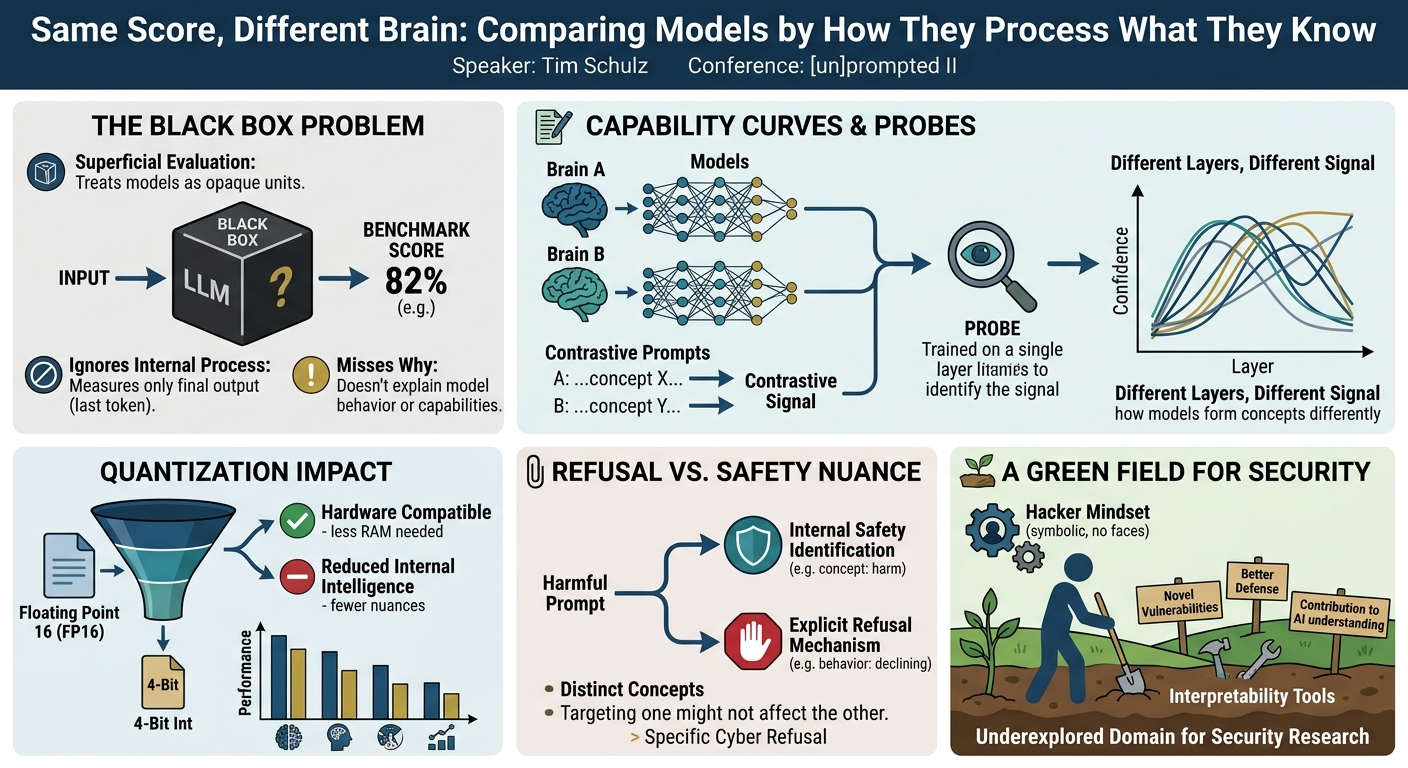
The current paradigm for evaluating large language models predominantly relies on benchmarks. These benchmarks, while useful for high-level comparisons, treat models as black boxes, assessing performance solely based on their final output—typically the last generated token. As Schulz points out, this method provides a score but offers little insight into why a model arrives at a particular answer or how it processes information internally. This superficial evaluation is problematic because it obscures the underlying mechanisms that dictate a model's behavior, including its safety features, refusal capabilities, and susceptibility to manipulation.
Fundamentally, an LLM consists of two main components: the computational graph (or architecture) and the weights. The computational graph defines the structure and organization of information flow within the model, typically remaining small, often under 10 megabytes, regardless of the model's overall size. In contrast, the weights comprise the vast collection of numerical parameters—often terabytes of data—that encode the model's learned knowledge and are adjusted during training. Models are structured into multiple layers, each progressively transforming the input data. However, standard benchmarks only measure the output of the last layer, effectively ignoring the rich data and processing happening in all preceding layers.
This lack of interpretability is a well-recognized challenge in AI, with even frontier research labs actively struggling to achieve full alignment and understanding of their most advanced models. The security implications are profound: without understanding how models internally represent concepts like "harmful content" or "refusal," it becomes exceedingly difficult to implement robust defensive measures or to confidently assess the impact of techniques like obliteration (concept removal). The problem exists because the focus has historically been on achieving high performance metrics, rather than on the transparency and explainability of the underlying cognitive processes within the model.
Key Findings
▶ Watch: Using contrastive prompts and probes to find signals (4:55)
Schulz's talk unveils several critical findings that challenge conventional model evaluation and open new avenues for security research:
Firstly, he demonstrates that benchmarks alone are insufficient to truly compare models. While two models might achieve similar final scores, their internal processing, as revealed by layer-by-layer analysis, can be dramatically different. This "same score, different brain" phenomenon highlights the limitations of black-box evaluation and the necessity of understanding internal dynamics.
A core contribution is the methodology for generating capability curves. By using contrastive prompts—pairs of questions with a single, subtle difference (e.g., "What's the capital of France?" vs. "What's the capital of Germany?")—researchers can observe where internal activations diverge within the model's layers. This divergence provides a signal that can then be used to train a probe. A probe is essentially a small, auxiliary model designed to identify specific concepts (like "capital city," "refusal," or "harmful content") from the activations of individual layers. By applying these probes across all layers, a detailed curve emerges, illustrating how strongly and at what stage a model processes a given concept. The Area Under the Curve (AUC) is used to quantify the confidence with which a probe can separate a specific signal.
Comparing these capability curves reveals nuanced differences: for instance, Gemma and Quen, despite having different architectures and often sparking online debates about which is "better," exhibit remarkably similar capability curves when processing certain concepts. Conversely, Neotron showed a much earlier and steeper drop-off in its ability to process the same concepts, indicating a fundamental difference in its internal knowledge representation, even if its final benchmark score might align with others. This allows for a deeper, more predictive evaluation of model capabilities before reaching the final output.
The talk also explores the impact of quantization, a technique used to make models smaller and faster by reducing the precision of their weights (e.g., from floating point 16 to int8 or 4-bit). Schulz emphasizes that while this can improve hardware compatibility, it can also significantly degrade a model's "intelligence." By applying the layer-wise analysis, researchers can precisely measure where and how much intelligence is lost at different quantization levels, offering a more informed trade-off assessment than just observing a final performance drop. Neotron, for example, exhibited a more pronounced degradation with quantization.
Crucially, Schulz highlights that refusal (the act of declining to answer a harmful or inappropriate query) and safety (the underlying identification of harmful content) are often distinct concepts within a model's internal architecture. This distinction is vital for effective safety training and obliteration techniques, as targeting "safety" might not directly address the "refusal" mechanism, and vice-versa. He notes that "cyber refusal" might also be distinct from other categories of refusal, underscoring the need for highly specific and nuanced intervention.
Finally, a fascinating finding is that probes can sometimes know more than the model itself. There are instances where a probe, trained on internal layer activations, can classify a concept (e.g., identifying a prompt injection) with higher confidence or accuracy than the model's final, explicit output. This suggests that valuable, actionable signals exist internally that are not always propagated to the surface, offering cheaper and more accurate classification capabilities.
Technical Deep Dive
▶ Watch: Capability curves reveal internal model differences (7:00)
The technical foundation of Schulz's analysis rests on dissecting the internal components and processing stages of large language models. As previously mentioned, an LLM is characterized by its computational graph and its weights. The computational graph defines the sequential layers through which information flows. Each layer performs specific transformations on the data, and the weights within these layers are the learned parameters that dictate the nature of these transformations. Traditional benchmarks, by solely evaluating the final output, effectively ignore the vast majority of these internal processing steps.
To overcome this limitation, Schulz proposes a method rooted in activation engineering and mechanistic interpretability. The first step involves generating contrastive prompts. This technique involves crafting two prompts that are nearly identical but differ in a single, specific detail (e.g., "What is the capital of France?" vs. "What is the capital of Germany?"). When these prompts are fed into the model, the internal activations across its many layers are recorded. By comparing the activations generated by the two prompts, researchers can pinpoint the exact layers and neurons where the model begins to differentiate between the two concepts. This divergence point provides a crucial signal for understanding where specific knowledge is being processed.
Once these internal signals are identified, a probe is trained. A probe is a small, typically linear, classifier model whose task is to detect the presence of a specific concept (e.g., "capital city," "refusal," "harmful intent") directly from the activations of a particular layer. For example, if the contrastive prompts were about capital cities, the probe would be trained to distinguish between "capital city" activations and "non-capital city" activations at various points in the model. The performance of this probe is often measured using metrics like the Area Under the Curve (AUC), which indicates the probe's confidence and ability to reliably separate the target concept's signal from noise. An AUC of 0.5 suggests a coin flip, while higher values indicate stronger signal separation.
The innovative aspect is the application of these probes to grade every layer of the model. Instead of just evaluating the final output, Schulz's method involves running the probe against the activations of each successive layer. This generates a capability curve, a graphical representation showing how strongly and consistently a specific concept is processed and represented throughout the model's architecture. For instance, a curve might show that a model starts processing the concept of "refusal" in earlier layers, with the signal strengthening towards the later layers, or it might show a premature drop-off if the concept is poorly represented.
Schulz also delves into the technical implications of quantization. This optimization technique reduces the memory footprint and computational cost of models by representing their weights with fewer bits. Common quantization levels include floating point 16 (fp16), int8, and 4-bit representations. While fp16 is standard for training, running models at int8 or 4-bit is common for deployment on resource-constrained hardware. The technical deep dive here involves measuring how these reductions in numerical precision impact the internal capability curves. For example, a model might maintain its concept processing capability well when moving from fp16 to int8, but show a significant degradation in the capability curve when dropping to 4-bit, indicating a substantial loss of internal "intelligence" for specific concepts. This granular analysis provides a more precise understanding of quantization trade-offs than mere benchmark score comparisons.
Furthermore, the talk touches upon obliteration, a technique for surgically removing specific concepts from a model. Schulz references NVIDIA's work where similar internal analysis was used to identify the layers and neurons responsible for processing user instruction direction. By "zeroing out" these specific parts of the model's internal context, NVIDIA researchers were able to prevent the model from interpreting certain tokens as instructions, thereby reducing the success rate of various attacks. This demonstrates that obliteration is a general-purpose concept removal technique, applicable not only to safety guardrails but also to fine-grained control over model behavior.
Finally, the discussion briefly acknowledges the academic debate around mono-semanticity versus poly-semanticity and superposition—whether concepts are localized to single neurons or distributed across many. Schulz emphasizes that regardless of this debate, the pragmatic value of probes remains: they provide a significantly better signal for decoding model behavior, even if the underlying representation is complex and distributed. The key is to carefully construct data sets or prompt sets that isolate specific concepts to minimize confounding factors, such as a long question about AI lighting up both "AI" and "long question" concepts.
Demo / Proof of Concept
▶ Watch: Obliteration: a general tool to remove any concept (16:20)
While Tim Schulz's presentation did not include a live, interactive demonstration of his methods, it effectively served as a proof of concept through the presentation of compelling analytical results and graphical representations. The core of the "demo" involved showing capability curves for various open-weights models like Gemma, Quen, and Neotron. These normalized graphs visually illustrated how different models process specific concepts across their layers.
For example, Schulz presented curves demonstrating that while Gemma and Quen often perform similarly on external benchmarks, their internal processing curves were also strikingly alike, suggesting a commonality in how they represent certain knowledge, despite potentially differing architectures. In contrast, Neotron displayed a significant drop-off in its capability curve much earlier in its layers, indicating a fundamental difference in its internal intelligence or concept representation compared to Gemma and Quen. These visual comparisons clearly articulate the "same score, different brain" phenomenon, providing concrete evidence that external benchmarks only tell part of the story.
Another critical visual proof of concept was the analysis of quantization's impact. Schulz showed how reducing the precision of model weights (e.g., to 4-bit) affected the capability curves of these models. While the specific curves for each model varied, the visual representation clearly showed measurable degradations in internal concept processing, with Neotron again exhibiting a more pronounced drop. This illustrated how layer-wise analysis can precisely quantify the trade-offs involved in model optimization.
Furthermore, Schulz referenced powerful real-world applications of these interpretability techniques. He highlighted significant work done by NVIDIA, where researchers utilized similar internal analysis to identify the specific layers and components within a model responsible for processing instruction direction. By applying an obliteration technique to these identified internal representations—effectively "zeroing out" the model's perception of certain tokens as instructions—NVIDIA was able to reduce the success rate of various attacks. This example serves as a strong testament to the practical, defensive implications of understanding and manipulating model internals, moving beyond theoretical discussions to tangible security gains.
These graphical analyses and real-world examples collectively function as a robust proof of concept, demonstrating the viability and value of Schulz's proposed methodology for deeper model understanding.
Defensive Implications
▶ Watch: Q&A: Isolating specific nodes for concepts like refusal (22:00)
The insights presented by Tim Schulz carry significant implications for the field of AI security and for defenders building and deploying LLMs. Moving beyond black-box evaluations is not just an academic exercise; it's a critical step toward building more resilient and trustworthy AI systems.
Firstly, enhanced model evaluation is paramount. Defenders can no longer rely solely on benchmark scores to assess a model's fitness for purpose. Implementing layer-wise analysis using contrastive prompts and probes allows security teams to gain a granular understanding of a model's true capabilities, its internal biases, and how robustly it handles sensitive concepts like refusal or harmful content. This deeper insight enables more informed decisions when selecting, fine-tuning, or deploying models, ensuring they meet specific security and safety requirements.
Secondly, understanding the impact of quantization becomes a defensive necessity. Many model providers or open-source releases offer various quantized versions (e.g., int8, 4-bit) for different hardware. Defenders must verify what they are actually running. Schulz's methods allow for a precise measurement of how much "intelligence" or conceptual understanding is lost at different quantization levels. This means security teams can assess the trade-off between performance/resource efficiency and the potential degradation of critical safety mechanisms or the model's ability to resist adversarial attacks. It empowers them to challenge providers on the true capabilities of their served models.
Thirdly, the distinction between refusal and safety is crucial for effective red teaming and safety training. Defenders need to understand which internal mechanisms are responsible for identifying harmful content versus those responsible for simply refusing a prompt. If a model's safety training targets the wrong internal concept, it might appear safe on the surface but remain vulnerable to subtle prompt injections that bypass the refusal mechanism. Moreover, recognizing that "cyber refusal" might be distinct from other harm categories means security professionals can tailor their defensive strategies and obliteration techniques with greater precision, ensuring that legitimate cybersecurity queries are not inadvertently blocked while malicious ones are.
Fourthly, the ability of probes to "know more" than the model's final output presents an opportunity for more efficient and accurate internal monitoring. Instead of relying on the LLM as a judge for tasks like prompt injection detection (which can be costly and slow), defenders could potentially deploy cheaper, faster internal probes to flag suspicious activities or concepts at an earlier stage of processing.
Finally, Schulz's talk serves as a call to action for the security community to embrace proactive security research in AI interpretability. The field is described as "green field," meaning there's immense opportunity for hackers and security researchers to apply their curiosity and problem-solving skills to uncover novel vulnerabilities, develop new defensive techniques, and contribute to the fundamental understanding of AI systems. This includes exploring how different harnesses (evaluation frameworks) affect internal model behavior and developing methods to analyze ablated models to determine precisely what concepts were removed and how, especially if the ablation technique used was a "hammer" rather than a "scalpel." This proactive engagement is essential to stay ahead of evolving AI threats.
Key Takeaways
- Beyond Benchmarks: Traditional benchmarks only evaluate a model's final output, treating it as a black box. A deeper understanding requires analyzing internal processing across all layers.
- Probes and Capability Curves: Contrastive prompts and probes enable the creation of capability curves, which visualize how models process specific concepts layer-by-layer, revealing hidden differences and similarities between models.
- Quantization Trade-offs: Reducing model precision (e.g., from fp16 to 4-bit) can significantly impact a model's internal intelligence. Layer-wise analysis allows for precise measurement of these trade-offs, critical for deployment decisions.
- Refusal vs. Safety Nuance: Refusal and safety are distinct internal concepts. Effective safety training and obliteration techniques must target the correct internal mechanisms, with "cyber refusal" potentially requiring specialized attention.
- Probes Offer Deeper Insights: Internal probes can sometimes "know more" about a concept than the model's final output, providing a cheaper and potentially more accurate method for classification and monitoring.
- A "Green Field" for Security: AI interpretability is an open and under-explored area, offering significant opportunities for security researchers to apply their expertise, uncover vulnerabilities, and contribute to the fundamental understanding and safety of AI.
About the Speaker(s)
Tim Schulz is the Co-Founder & CEO of Starseer. Throughout his talk, Schulz passionately advocates for a shift in how the security community approaches artificial intelligence. He frames the challenge of understanding AI internals as a natural extension of the hacker's mindset, emphasizing the importance of curiosity and diving into the "how" rather than just the "what." Schulz highlights that the field of AI interpretability is a nascent but critical domain, one that does not require a PhD or extensive AI expertise to contribute to. He actively encourages security professionals to engage with model analysis, stressing that their unique perspectives and problem-solving skills are invaluable for uncovering new insights and addressing the practical security problems faced today, rather than solely focusing on far-future "Terminator" scenarios.
Reviews
→ Top-rated talks at [un]prompted II 2026 — The AI Security Practitioner Conference
All talks from [un]prompted II 2026 — The AI Security Practitioner Conference