There Isn’t a Security Problem an Agent Can’t Help Solve
Amol Deshpande (Staff Security Engineer · Stripe), Namita Prakash (Software Engineer · Stripe)
[un]prompted II 2026 — The AI Security Practitioner Conference · Day 2 · Stage 1
Overview
In their [un]prompted II talk, "There Isn’t a Security Problem an Agent Can’t Help Solve," Amol Deshpande and Namita Prakash from Stripe unveil their journey in leveraging AI agents to tackle persistent security bottlenecks within the Software Development Life Cycle (SDLC). The presentation addresses a critical challenge faced by many organizations: despite the growing adoption of AI in software development, security testing and vulnerability remediation often remain slow, manual, and inefficient processes. Stripe's approach is not merely to "slap AI" onto existing workflows but to meticulously identify pain points and engineer tailored AI capabilities to streamline them, focusing specifically on the design and implementation phases.
Key moments
- 0:00 Introduction: AI for security bottlenecks in SDLC
- 2:30 Core principles for effective security agents
- 4:20 Agent-enhanced design docs for security context
- 8:00 Self-service, risk-based security review workflow
- 10:40 Significant results: 74% more efficient security reviews
- 17:40 Humans 'on the loop' for continuous agent supervision
- 28:30 Stripe's approach to developer security engagement
There Isn’t a Security Problem an Agent Can’t Help Solve
Speakers: Amol Deshpande, Staff Security Engineer, Stripe; Namita Prakash, Software Engineer, Stripe
Conference: [un]prompted II
YouTube: https://www.youtube.com/watch?v=Z2xlk7GMrs8
Overview
In their [un]prompted II talk, "There Isn’t a Security Problem an Agent Can’t Help Solve," Amol Deshpande and Namita Prakash from Stripe unveil their journey in leveraging AI agents to tackle persistent security bottlenecks within the Software Development Life Cycle (SDLC). The presentation addresses a critical challenge faced by many organizations: despite the growing adoption of AI in software development, security testing and vulnerability remediation often remain slow, manual, and inefficient processes. Stripe's approach is not merely to "slap AI" onto existing workflows but to meticulously identify pain points and engineer tailored AI capabilities to streamline them, focusing specifically on the design and implementation phases.
The core premise of the talk revolves around making security automatic, seamless, and readily available to developers, thereby shifting human security teams from being "in the loop" (a bottleneck) to "on the loop" (providing oversight and handling exceptions). By intelligently automating tasks such as injecting security context into design documents, conducting risk-based security reviews, managing policy exceptions, and verifying remediation efforts, Stripe has achieved significant efficiency gains. This talk provides a compelling case study for large software organizations looking to integrate AI strategically to enhance their security posture and accelerate development cycles without compromising safety.
Background
▶ Watch: Introduction: AI for security bottlenecks in SDLC (0:00)
The modern software development lifecycle, or SDLC, is a complex process with numerous stages from concept to launch. Within this framework, the Secure Software Development Life Cycle (SSDLC) integrates security considerations into each phase. However, as Deshpande and Prakash highlight, a Gartner survey revealed that while over half of organizations using AI in their SDLC reported reduced process times, an equally significant number still identified security testing and vulnerability remediation as major bottlenecks. This disparity underscores a fundamental problem: security, when treated as an afterthought or a manual gate, inevitably slows down development.
Stripe's journey began by recognizing that simply applying AI indiscriminately across all SDLC phases would not solve the underlying issues. Instead, they focused on understanding the specific security pain points experienced by their engineers. Their guiding principles for building AI-driven security solutions are:
- Automatic: Security should be built-in by default, activating without explicit user action.
- Seamless: Minimal manual back-and-forth, reducing friction for users.
- Readily Available: Meeting users in their existing workflows with actionable context.
Historically, challenges at Stripe, mirroring those in many organizations, included design documents lacking crucial security context, leading to extensive rework and delays during security reviews. The security review process itself was largely manual, human-dependent, and prone to exponential delays. Furthermore, handling routine policy exceptions and verifying vulnerability remediations consumed significant human security engineering resources. This talk builds upon foundational work presented in a previous [un]prompted conference, where Stripe discussed building guardrails and deploying agents in an assistive mode for security teams, particularly for threat modeling. This current presentation expands on that foundation, introducing self-service models and broader agentic capabilities.
Key Findings
▶ Watch: Agent-enhanced design docs for security context (4:20)
Stripe's strategic integration of AI agents across the design and implementation phases of their SDLC yielded several significant findings and improvements:
- Enhanced Design Documents: By leveraging a dedicated skill within their agentic environment, Stripe successfully automated the injection of a comprehensive security consideration section into design documents. While a "focused prompt" was also effective, the dedicated skill ensured the process was automatic and seamless, fulfilling a core principle. This significantly reduced delays caused by missing security context in later review stages.
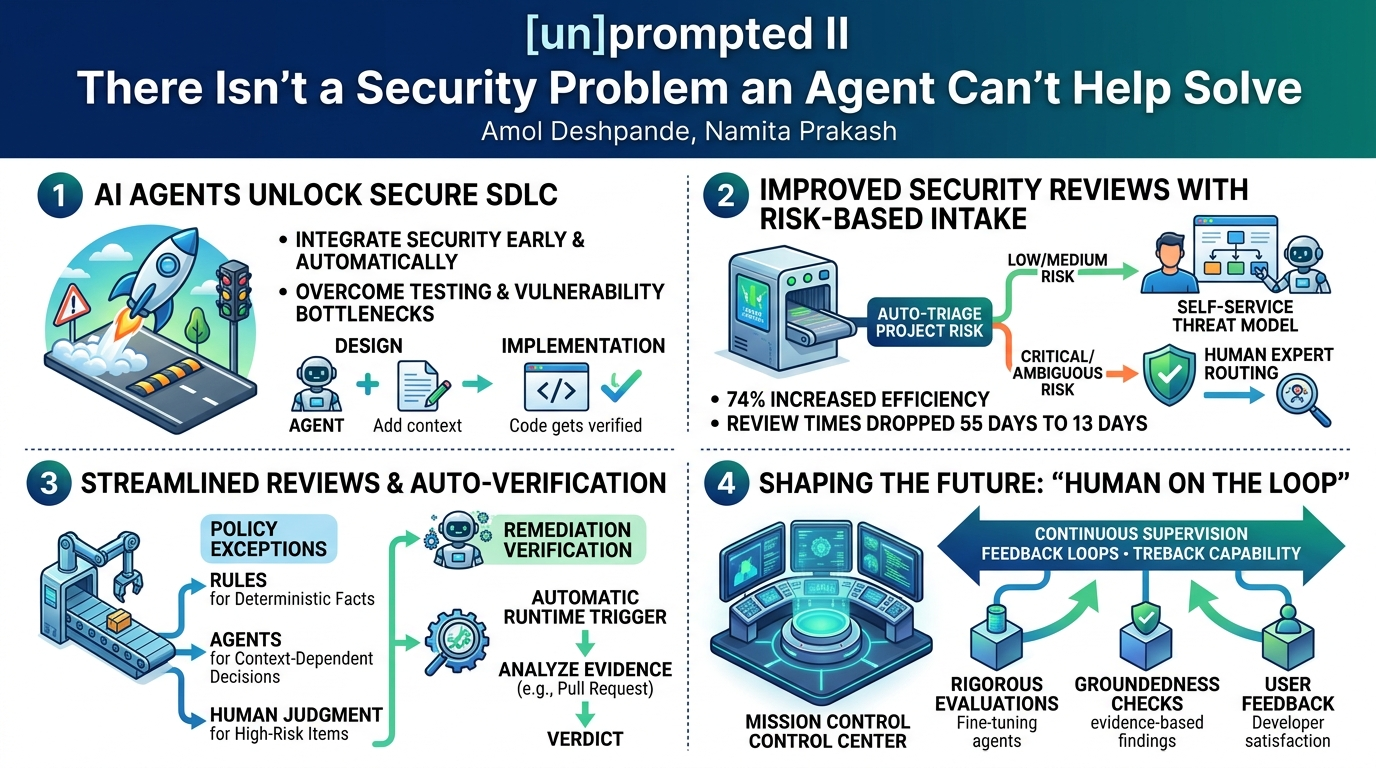
- Highly Efficient Security Reviews: Implementing a risk-based intake system for security reviews drastically improved efficiency. The system led to a 74% increase in efficiency and reduced the total time for security reviews to complete from an average of 55 days to just 13 days. This was achieved by intelligently triaging reviews: low-to-medium risk items received a self-service, agent-generated threat model, while critical or ambiguous cases were routed to human experts, optimizing human capacity.
- Streamlined Policy Exception Handling: For common policy exception requests, Stripe developed a three-pronged solution. This involved using rules for deterministic facts, agents for context-dependent decisions, and human judgment only for higher-risk items. This strategy effectively removed bottlenecks, allowing human attention to be focused on genuinely consequential requests.
- Automated Remediation Verification: An agent was developed to automatically verify the remediation of identified risks. Triggered at runtime, this agent analyzes evidence attached to a fix (e.g., a pull request) and provides a verdict (addressed, partially addressed, or not addressed) along with suggestions. This capability is crucial for scaling security operations, especially as code is increasingly generated by other agents.
- Shift to "Human on the Loop": A fundamental shift in operational philosophy was observed, moving humans from being "in the loop" (actively involved in every step, often causing bottlenecks) to "on the loop." In this model, humans provide continuous supervision, feedback, trend analysis, and handle ambiguous or high-risk cases, ensuring quality and allowing for rollbacks when necessary. This optimizes human expertise for critical decision-making and oversight.
- Quality Assurance Pillars: The success of these agents is underpinned by three quality pillars: rigorous evaluations (using curated historical and gold test cases), groundedness checks (ensuring findings are evidence-based and not hallucinations), and user feedback (prioritizing developer satisfaction and usability). These pillars maintain the accuracy and trustworthiness of the agent outputs.
Technical Deep Dive
▶ Watch: Self-service, risk-based security review workflow (8:00)
Stripe's approach to integrating AI agents is deeply rooted in understanding specific bottlenecks within the SDLC and architecting targeted solutions. The technical implementation focuses on separating concerns, leveraging internal knowledge bases, and maintaining stringent quality controls.
Agent-Enhanced Design Documents
The initial problem identified was the lack of security context in design documents, which often led to time-consuming back-and-forth during security reviews or, worse, insecure code being generated by downstream coding agents. Stripe's vision was to have an agent automatically inject a "security consideration" section into design documents.
To validate this, they employed a scientific method, running experiments with different prompting strategies against historical design documents that had previously caused security review bottlenecks.
- Control Condition (Plain Prompt): A simple request to the agent, "Can you write a security consideration section for this doc?"
- Focused Prompt: Provided more explicit instructions on the types of security concerns a reviewer might look for.
- Dedicated Skill: Similar to the focused prompt but integrated as an automatic skill the agent would invoke without user prompting.
Each output was evaluated against a scorecard including coverage (did it catch what a human reviewer caught?), specificity (was guidance specific to the design?), actionability (could a developer act on the information?), accuracy, and whether it would have prevented the original bottleneck. The dedicated skill emerged as the winner, though the focused prompt also performed well, preventing bottlenecks. However, the dedicated skill aligned best with Stripe's principle of making security automatic and seamless, removing the onus on the user to remember specific prompts. The agent's effectiveness is inherently tied to the quality of the initial design document, emphasizing the importance of clear inputs.
Risk-Based Security Review Intake
The traditional security review process was a significant bottleneck, characterized by manual intake, ticket creation, and security teams addressing requests sequentially, often with delays due to waiting for clarifications. Stripe replaced this with a risk-based intake system.
When a development team initiates a security review, an agent analyzes the intake form and project context. This agent has access to Stripe's internal systems knowledge and security invariants (internal security policies and best practices). Based on this analysis, it determines the project's risk level and assigns a treatment:
- Self-Service Treatment (Low/Medium Risk): The agent generates a comprehensive self-service threat model. This model is sent to the requesting team, who are then empowered to review the identified risks. They can mark risks as relevant, which automatically creates a remediation item with clear steps. If they deem a risk non-relevant, they must provide a reasoning, which feeds into an async audit queue for later review by the security team. Developers also have the option to escalate to a human if a risk is ambiguous. This model leverages the requesting team's deep project context for efficient initial triage.
- Manual Queue (Critical/Ambiguous Risk): High-risk or unclear projects are routed to the manual queue, ensuring human security experts focus their capacity on the most challenging cases.
This system significantly boosted efficiency (74% more efficient) and reduced review times (55 to 13 days) by automating the initial stages and empowering development teams. The quality of the agent-generated threat models is maintained through three pillars:
- Evals: A framework for fine-tuning agents against historical, human-generated threat models and "gold test cases" to ensure desired output quality.
- Groundedness Checks: Verifying that findings are evidence-based and not estimations or hallucinations.
- User Feedback: Continuous collection and integration of feedback from developers to ensure the agents provide valuable and usable outputs.
Structured Policy Reviews (Policy Exceptions)
Policy exception requests, such as deadline extensions for security action items, are common and can become a bottleneck for both developers and the security organization. Stripe devised a three-pronged solution to automate these:
- Rules-Based Automation: For deterministic facts, simple rules suffice. For example, if a requested deadline falls after the project release date, the request is automatically denied.
- Agent-Assisted Decisions: For requests requiring context (e.g., why an extension is needed, verification of blockers), an agent processes the request, gathers relevant information, and makes a decision.
- Human Judgment: Any request involving medium or higher-risk action items is automatically escalated for human review. This ensures that potentially consequential decisions are not made solely by an agent.
This strategy was rolled out in phases: offline evals against past cases to establish baseline accuracy and identify appropriate agent/human involvement; shadow mode, running the agent solutions in parallel with human reviewers to build confidence; and a risk-based rollout, starting with low-risk areas and gradually expanding scope while retaining human guardrails. This iterative approach ensures trustworthiness and allows for continuous refinement.
Automated Remediation Verification
Once risks are identified and remediation items created, verifying their closure was another manual, time-consuming process. Security engineers would manually review pull requests or other evidence, often dealing with dated context if the fix occurred long after the initial review. This is unsustainable given the speed of agent-generated code.
Stripe developed a runtime agent for this purpose. When a remediation item is marked as closed, this agent triggers automatically. It analyzes all context attached to the fix (e.g., code changes, commit messages, associated documentation). Based on this analysis, the agent provides a verdict: whether the risk is addressed, partially addressed, or not addressed. If not fully addressed, the agent also provides suggestions or feedback on how to complete the remediation. This system significantly enhances human efficiency by providing upfront, contextualized analysis, allowing human reviewers to focus on validating the agent's findings rather than gathering initial context.
Agent Architecture and Human Oversight
Across all these solutions, Stripe employs consistent principles for agent design and human integration:
- Separation of Concerns: Risk identification, evaluation, and verification are treated as distinct steps, each with curated datasets to ensure accuracy and prevent prompt deviations from affecting quality.
- Groundedness: Agents are fueled by Stripe's internal knowledge base, security invariants, and up-to-date product documentation, acting as a "source of truth." This minimizes hallucinations and ensures findings are relevant and evidence-based.
- Humans "On the Loop": Instead of being "in the loop" and causing bottlenecks, humans are positioned "on the loop." This involves continuous supervision through feedback, trend analysis, and async audits. This model also allows for rollbacks and manual handling of ambiguous cases, ensuring human judgment is applied where absolutely necessary. This balanced approach ensures agents perform reliably within their deployed context and generate valuable, usable output.
Demo / Proof of Concept
▶ Watch: Humans 'on the loop' for continuous agent supervision (17:40)
While the talk did not feature a live, interactive code demonstration, the speakers meticulously detailed the operational flows and capabilities of their agent-driven solutions, effectively serving as a conceptual demonstration of "how it worked." For instance, they walked through the entire self-service threat model workflow, explaining how an agent analyzes intake, generates a threat model, and how the requesting team interacts with it by marking risks as relevant or non-relevant, leading to automated remediation item creation or async audits. This process illustrates a fully functional, agent-orchestrated security review pipeline.
Similarly, the explanation of the three-pronged policy exception solution clearly outlined how rules, agents, and human judgment are sequentially applied based on the nature and risk level of a request. The description of the remediation verification agent triggering at runtime, analyzing code changes, and providing a verdict, effectively demonstrated its automated functionality. These detailed breakdowns, supported by metrics and process diagrams, served as a robust proof of concept for the efficacy and integration of Stripe's AI agents within their SDLC.
Defensive Implications
▶ Watch: Stripe's approach to developer security engagement (28:30)
The strategies and successes shared by Amol Deshpande and Namita Prakash offer profound defensive implications for any organization seeking to enhance its security posture and operational efficiency:
- Strategic AI Integration: Defenders should identify specific, high-friction bottlenecks within their SSDLC where AI agents can provide the most leverage. Simply "adding AI" everywhere is ineffective; a targeted, principled approach (automatic, seamless, readily available) is crucial.
- Shift to Risk-Based Automation: Implement risk-based intake and triage for security processes like design reviews and policy exceptions. This ensures that human security expertise is prioritized for critical, ambiguous, or high-risk scenarios, while routine or low-risk tasks are automated, significantly reducing overall lead times.
- Empower Developers with Self-Service: By providing developers with agent-generated security artifacts (like self-service threat models) and the ability to act on them, security teams can distribute responsibility and leverage developers' deep project context. This fosters a more proactive security culture.
- Adopt "Human on the Loop" Model: Move away from a model where human security engineers are direct bottlenecks. Instead, position them as overseers, providing continuous supervision, quality control, and handling exceptions. This maximizes the impact of scarce security talent.
- Invest in Agent Quality and Groundedness: Develop robust evaluation frameworks using historical data and "gold test cases" to fine-tune agents. Crucially, implement groundedness checks to ensure agent findings are evidence-based, accurate, and free from hallucinations, especially when drawing from internal knowledge bases.
- Maintain a Rich Internal Knowledge Base: The effectiveness of AI agents heavily relies on access to up-to-date, accurate internal documentation, security invariants, and past security findings. Organizations must invest in maintaining a comprehensive and accessible knowledge base to fuel their agents.
- Phased Rollouts and Continuous Feedback: For new agent solutions, adopt a phased rollout strategy (offline evals, shadow mode, risk-based expansion) to build trust and gather feedback. User feedback is paramount for refining agent behavior and ensuring user adoption.
- Automate Remediation Verification: The ability to automatically verify vulnerability fixes is critical for scaling security. Implementing agents that can analyze code changes and associated evidence significantly reduces the manual burden and speeds up the closure of security issues.
- Proactive Security Context Injection: Integrate agents early in the design phase to automatically inject security considerations into design documents. This shifts security left, preventing costly rework and insecure design choices later in the SDLC.
- Address Compliance and Audit Concerns: Be prepared to demonstrate human oversight and control points to auditors and compliance teams. The "human on the loop" model, with its emphasis on supervision and manual intervention for critical cases, provides a strong narrative for demonstrating due diligence.
Key Takeaways
- AI agents can dramatically reduce security bottlenecks in the SDLC, evidenced by Stripe's 74% efficiency gain and reduction of security review times from 55 to 13 days.
- A principled approach to AI integration is essential: Security solutions should be automatic, seamless, and readily available to developers to maximize adoption and effectiveness.
- Risk-based triage is critical for optimizing human capacity: Automate low-to-medium risk tasks (e.g., self-service threat models, policy exceptions) while reserving human expertise for critical or ambiguous cases.
- Humans transition from "in the loop" to "on the loop": Security professionals provide crucial oversight, feedback, and handle exceptions, ensuring quality and guiding agent evolution rather than being a manual bottleneck.
- Agent trustworthiness relies on robust quality pillars: Rigorous evaluations, groundedness checks (evidence-based findings), and continuous user feedback are non-negotiable for building reliable and adopted AI security tools.
- Start with specific, well-defined problems: Focus on identifiable pain points like missing security context in design, slow security reviews, or manual remediation verification to achieve tangible, measurable improvements.
About the Speaker(s)
Amol Deshpande is a Staff Security Engineer at Stripe. His work focuses on leveraging advanced technologies like AI to solve complex security problems and streamline security processes within large-scale software organizations.
Namita Prakash is a Software Engineer at Stripe. She contributes to building and implementing the AI-driven security capabilities discussed in the talk, with a particular emphasis on creating seamless and efficient security experiences for developers.
Reviews
→ Top-rated talks at [un]prompted II 2026 — The AI Security Practitioner Conference
All talks from [un]prompted II 2026 — The AI Security Practitioner Conference