Metrics for Agentic Systems: What “Good” Looks Like for a Security Agent
Shahanas Najeeb (Senior Agentic Security Engineer · Salesforce)
[un]prompted II 2026 — The AI Security Practitioner Conference · Day 2 · Stage 1
Overview
In the rapidly evolving landscape of cybersecurity, agentic systems and AI automation are increasingly touted as foundational solutions for enhancing defensive capabilities. However, a critical challenge remains: how do security teams truly measure the effectiveness and impact of these sophisticated agents beyond superficial metrics? Shahanas Najeeb, a Senior Agentic Security Engineer at Salesforce, tackles this crucial question in her talk at [un]prompted II. Najeeb highlights a common predicament faced by many organizations: presenting impressive dashboards filled with metrics like "thousands of runs" and "hundreds of thumbs-up ratings," only to be met with the fundamental question, "What actually improved from a security perspective?"
Key moments
- 0:50 The challenge: measuring real security impact
- 2:00 Four lenses: Adoption, Coverage, Accuracy, ROI
- 4:30 Measuring true adoption: grafted vs. ghosted output
- 8:00 Agent accuracy: understanding precision and recall
- 11:50 The "Grader Ladder" for evaluating agent accuracy
- 15:50 Crucial: testing agents to earn and maintain trust
- 17:40 Future challenge: a unified platform for agent metrics
Metrics for Agentic Systems: What “Good” Looks Like for a Security Agent
Speakers: Shahanas Najeeb, Senior Agentic Security Engineer, Salesforce
Conference: [un]prompted II
YouTube: https://www.youtube.com/watch?v=9esc7BqMRE8
Overview
In the rapidly evolving landscape of cybersecurity, agentic systems and AI automation are increasingly touted as foundational solutions for enhancing defensive capabilities. However, a critical challenge remains: how do security teams truly measure the effectiveness and impact of these sophisticated agents beyond superficial metrics? Shahanas Najeeb, a Senior Agentic Security Engineer at Salesforce, tackles this crucial question in her talk at [un]prompted II. Najeeb highlights a common predicament faced by many organizations: presenting impressive dashboards filled with metrics like "thousands of runs" and "hundreds of thumbs-up ratings," only to be met with the fundamental question, "What actually improved from a security perspective?"
This talk delves into the essential framework Salesforce developed to move beyond vanity metrics and quantify the genuine security impact of their production-grade agent fleet. Najeeb introduces four distinct "lenses" — Adoption, Coverage, Accuracy, and Return on Investment (ROI) — through which security agents can be rigorously evaluated. Her insights are particularly pertinent for security operations centers (SOCs) and engineering teams grappling with the deployment and optimization of AI-powered agents, offering a pragmatic approach to ensure these investments translate into tangible security enhancements.
The discussion is not merely theoretical; it is grounded in Najeeb's practical experience working directly with cybersecurity operations center analysts at Salesforce. Her role involves understanding their pain points to develop automation that makes their lives easier, smarter, and faster, ultimately bolstering the company's protection. The framework presented is a direct outcome of the need to justify and refine these agentic systems, ensuring they deliver real value in a complex security environment.
Background
▶ Watch: The challenge: measuring real security impact (0:50)
The proliferation of security agents and automated tools has brought both immense promise and significant measurement challenges. Traditional metrics, while easy to collect, often fail to reflect the true value or impact on an organization's security posture. As Najeeb illustrates, a dashboard showing "thousands of runs" or "hundreds of feedback thumbs-up ratings" might look impressive, but it doesn't answer the core question: "What is the impact of these agents on security?" An increase in API calls, for instance, might indicate activity, but not necessarily efficacy or security improvement.
This problem stems from the inherent complexity of security operations and the multifaceted nature of agentic systems. A security agent might perform a variety of tasks, from incident summarization and alert triage to automated remediation actions. Evaluating such diverse functions with a single, simplistic metric is insufficient. Organizations need a more holistic and nuanced approach to understand if their agents are genuinely assisting analysts, reducing risk, and optimizing resources. The absence of clear, impactful metrics can lead to misallocated resources, unaddressed vulnerabilities, and a lack of trust in automated systems. Salesforce's journey to define "what good looks like" for a security agent arose from this exact need, prompting a deep dive into creating a comprehensive evaluation framework that could withstand rigorous scrutiny and demonstrate actual security value.
Key Findings
▶ Watch: Measuring true adoption: grafted vs. ghosted output (4:30)
Shahanas Najeeb's talk introduces a foundational framework for evaluating security agents, built upon four critical lenses: Adoption, Coverage, Accuracy, and Return on Investment (ROI). These lenses move beyond superficial engagement metrics to provide a granular understanding of an agent's true impact.
- Adoption: This lens measures whether analysts are actually using the agent's output to inform or execute their work. It goes beyond mere impressions (e.g., reading a summary) or polite feedback (e.g., thumbs-up ratings) to verify active engagement and reliance on the agent's recommendations or insights.
- Coverage: This metric assesses the scope and relevance of cases an agent handles. It's not just about the sheer number of cases, but rather the proportion of eligible and impactful cases the agent addresses, ensuring it focuses on areas where it can provide the most value.
- Accuracy: This is arguably the most complex lens, moving beyond a simple "right or wrong" assessment. It dissects accuracy into precision and recall, accounts for multi-step investigations (the pass-to-the-K problem), and establishes a robust "grader ladder" to reliably determine if an agent's output and internal steps are correct.
- Return on Investment (ROI): The ultimate business metric, ROI quantifies the financial and operational benefits derived from the agent. This involves calculating the capacity value (time saved by analysts) and weighing it against the total operational cost of running the agent, providing a clear justification for its existence.
Together, these four lenses provide a comprehensive, actionable framework for security teams to objectively assess their agentic systems, identify areas for improvement, and build confidence in their automation strategies.
Technical Deep Dive
▶ Watch: Agent accuracy: understanding precision and recall (8:00)
Evaluating security agents requires a sophisticated understanding of their operational impact, moving beyond simple counts to nuanced assessments. Najeeb’s framework meticulously details how to achieve this across the four lenses.
Adoption
Adoption is not a raw number but a fraction – "18 out of what?" If only 18 out of 40 analysts use an agent for investigation, the focus shifts to understanding why the other 22 did not. Proving genuine adoption is challenging, requiring telemetry from deep within investigation and ticketing tools. Najeeb outlines several methods:
- Downstream Action Binding: If an agent recommends an action (e.g., "block an IP address" or "isolate a production domain"), this recommendation is tied to a unique ID. When an analyst approves and executes the action, the recommendation ID is bound to the action, proving the agent's direct influence.
- Grafted vs. Ghosted Adoption: For agents providing incident summaries, adoption can be measured by how much of the agent's output is incorporated into the ticketing system. Grafted adoption occurs when an analyst uses at least 80% of the summary but might edit the remaining 20% or add comments. This still signifies help from the agent. Ghosted adoption, conversely, is when the analyst ignores the agent's output entirely and types their own summary, indicating a lack of adoption.
- Execution of Recommended Artifacts: If an agent provides a specific artifact like a SQL query or a command, its adoption can be verified by checking if that exact query or command was executed in a relevant system (e.g., a SIEM) within a defined timeframe (e.g., 10 minutes).
Coverage
Coverage measures the scope and relevance of cases an agent addresses. Simply stating an agent works on "hundreds and thousands of cases" is insufficient. The key is to identify eligible cases and categorize them by impact: low, medium, or high impact. By understanding how many cases across these impact levels the agent handles daily, teams can ascertain its true reach and strategic value. Coverage is foundational, as it provides the basis for evaluating adoption, accuracy, and ROI.
Accuracy
Accuracy is the most intricate lens, demanding a rigorous approach beyond simple percentages. Najeeb illustrates this with a critical distinction:
- Precision vs. Recall: If an agent identifies 8 true positives out of 10 actual true positives, its recall is 80%. However, if to achieve this, it also raises 4 false alarms (identifying 4 non-true positives as true positives), then precious analyst time is wasted. The precision in this scenario drops to 67% (8 true positives / (8 true positives + 4 false positives)). Both metrics are crucial for a balanced view.
- Lucky Runs and the Pass-to-the-K Problem: Investigations are rarely single-step processes; they often involve 3 to 8 steps. The total accuracy of an investigation is the product of the accuracy of each step. If step 1 is 75% accurate, step 2 is 85%, and step 3 is 95%, the final accuracy is 0.75 0.85 0.95 = ~60.4%. As steps increase, overall accuracy decreases. A study of 240 agent runs found that while 175 provided the "right answer," 162 of those had missed a step, called a wrong tool, or hallucinated a number, yet still landed on the correct final verdict. This highlights the danger of only looking at the final output.
- Grading the Grader (The Grader Ladder): Determining an agent's accuracy requires a robust evaluation mechanism, especially when considering Large Language Models (LLMs) as judges. LLMs can be "people pleasers," readily agreeing with well-formatted prompts. To counter this, Najeeb proposes a Grader Ladder:
- State Check: For agents performing actions (e.g., updating a database or ticketing system), verify that the action actually occurred and the state change is correct.
- Code Checks: Double-check that the agent called the correct tools with the right arguments.
- Calibrated Model Judge: When using an LLM for summary-based agents, avoid generic prompts like "check whether the output is right." Instead, be highly specific, asking the model to judge if all the steps in the investigation were followed and if the information is factually correct based on given context.
- Expert Review: Since analysts are busy, a statistically significant sample of cases in production should undergo expert review. This ensures the agent has not drifted or hallucinated its verdict over time and that analysts agree with its actions.
Return on Investment (ROI)
The CFO's favorite question: "What did it actually save us?" ROI requires understanding both the value generated and the cost incurred.
- Capacity Value: Calculate the time saved per case. If an analyst takes 6 minutes to close a case with an agent vs. 10 minutes without, that's 4 minutes saved per case. For 100 cases, this translates to 400 minutes of saving.
- Total Cost: Sum the cost to run the agent (e.g., $100 per hour for 100 cases) and the analyst's hourly rate (e.g., $60 per hour).
- ROI Calculation: If an agent saves 400 minutes (6.67 hours) of analyst time at $60/hour (total value $400) and costs $100 to run, the ROI is ((Value - Cost) / Cost) 100% = (($400 - $100) / $100) 100% = 300%.
- Key Principle: Always review the cost per reviewed correct outcome, not just total cost by total runs, to ensure the investment is tied to successful, accurate results.
Najeeb emphasizes a critical safety consideration: even if an agent has high accuracy and saves thousands of hours, its score drops to zero if it performs an unsafe action, like isolating a production domain without human approval. This underscores the need for continuous testing and trust-building.
Demo / Proof of Concept
▶ Watch: Crucial: testing agents to earn and maintain trust (15:50)
While the talk did not feature a live technical demonstration or a specific proof of concept of a security agent in action, it effectively served as a conceptual framework and methodology for evaluating such systems. Shahanas Najeeb presented a detailed theoretical and practical guide on how to measure the effectiveness of security agents, drawing from Salesforce's real-world experience with their production agent fleet. The "demo" was, in essence, the comprehensive breakdown of the four lenses—Adoption, Coverage, Accuracy, and Return on Investment—and the specific metrics and challenges within each, providing a blueprint for how organizations can approach agent evaluation rather than showcasing a particular agent's functionality.
Defensive Implications
▶ Watch: Future challenge: a unified platform for agent metrics (17:40)
The framework presented by Shahanas Najeeb offers profound implications for cybersecurity defenders aiming to leverage agentic systems effectively and safely. By adopting these rigorous evaluation metrics, security teams can move beyond anecdotal evidence and superficial dashboards to build robust, trustworthy automation.
Firstly, building trust in agents is paramount. The "isolating a production domain without asking human" scenario highlights that even highly accurate and efficient agents can become liabilities if they lack appropriate guardrails. Defenders must continuously test agents for their authority—ensuring they operate within defined boundaries and permissions. Agents must also be resilient to prompt injection attacks, preventing malicious input from subverting their intended functions. Crucially, agents should be designed to hand off actions to human analysts when they are unsure, encounter errors, or cannot perform a requested action, preventing potentially catastrophic outcomes.
Secondly, the four lenses provide a strategic decision-making framework:
- Expand: If an agent's metrics across Adoption, Coverage, Accuracy, and ROI are consistently strong, it indicates readiness for broader deployment or increased autonomy. This data-driven approach justifies scaling successful automation.
- Fix: If metrics reveal weaknesses (e.g., low adoption, poor precision, high cost relative to value), it signals the need for agent refinement, debugging, or re-engineering. This allows for targeted improvements based on empirical data.
- Keep Supervision: If there isn't enough reliable telemetry to answer the questions posed by the four lenses, or if an agent's performance is inconsistent, maintaining human supervision is essential. This cautious approach prevents premature trust in unproven systems.
Furthermore, the emphasis on precision and recall in accuracy metrics encourages defenders to optimize agents not just for finding threats (recall) but also for minimizing false positives (precision). Reducing false positives directly translates to less analyst fatigue and more efficient use of human resources, a critical factor in overwhelmed SOCs. The Grader Ladder provides a practical guide for establishing internal validation processes, ensuring that even when LLMs are used for evaluation, their judgments are calibrated and reliable.
Finally, the ROI lens empowers security leaders to justify investments in agentic systems by demonstrating tangible cost savings and capacity gains. This allows for data-backed conversations with leadership, securing continued support for automation initiatives that genuinely enhance the organization's defensive posture. By implementing Najeeb's framework, defenders can transform agentic systems from potential black boxes into transparent, measurable, and strategically valuable assets.
Key Takeaways
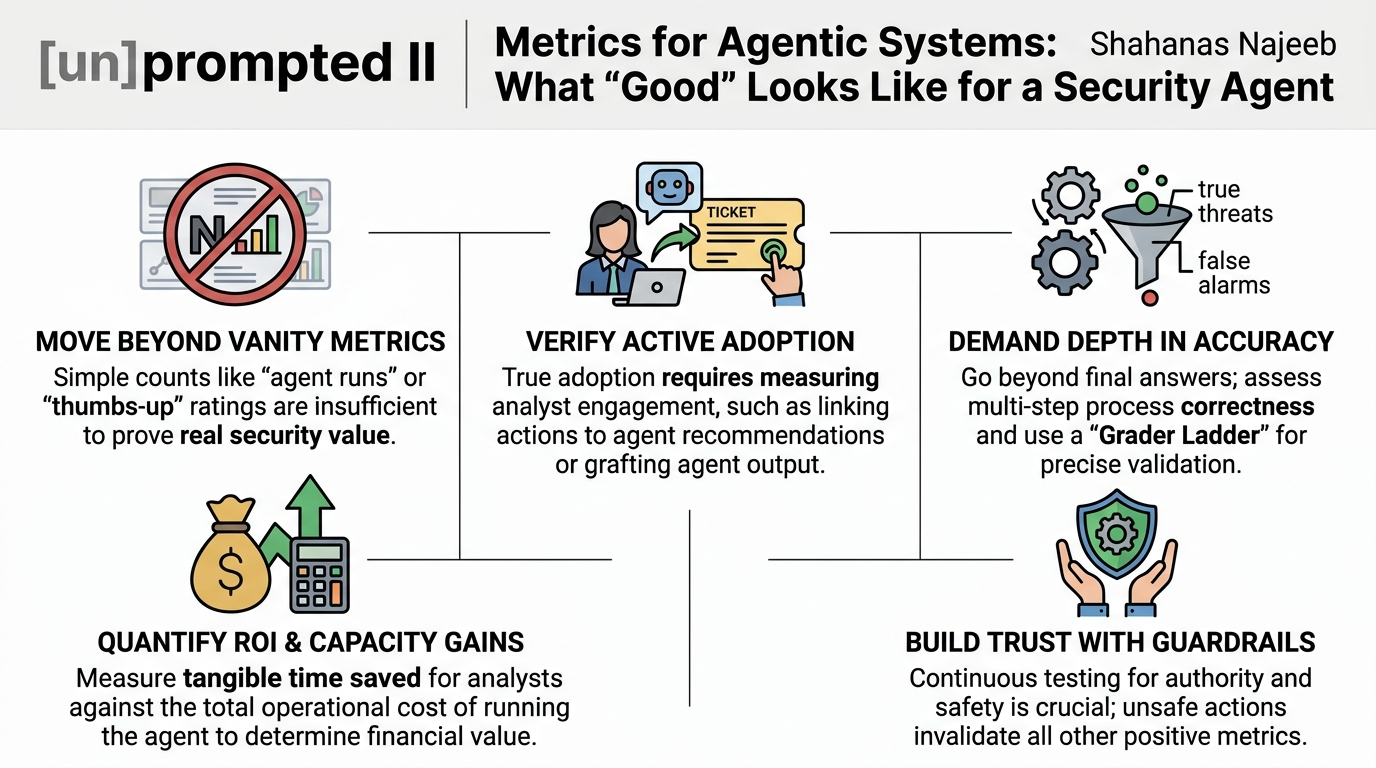
- Move Beyond Vanity Metrics: Simple counts of agent runs or "thumbs-up" ratings are insufficient. True impact requires measuring Adoption, Coverage, Accuracy, and Return on Investment (ROI).
- Adoption is Action, Not Impression: Verify actual analyst engagement through downstream action binding, grafted adoption (at least 80% usage of agent output), or execution of recommended artifacts (e.g., SQL queries).
- Accuracy Requires Depth: Distinguish between precision (minimizing false positives) and recall (identifying true positives). Account for multi-step processes with the pass-to-the-K problem, and use a robust Grader Ladder (state checks, code checks, calibrated LLM judges, expert review) to validate agent steps, not just final verdicts.
- Quantify Value with ROI: Calculate capacity value by measuring analyst time saved, then compare it against the total cost of running the agent to determine a clear Return on Investment. Focus on cost per reviewed correct outcome.
- Build Trust Through Testing and Guardrails: Agents must be continuously tested for authority, resilience to prompt injection, and the ability to hand off actions when unsure. Unsafe actions (e.g., isolating production without human approval) negate all positive metrics.
- Strategic Decision-Making: Use these metrics to decide whether to expand agent capabilities, fix identified issues, or keep supervision until sufficient telemetry is gathered and confidence is built.
About the Speaker(s)
Shahanas Najeeb is a Senior Agentic Security Engineer at Salesforce. In her role, she works closely with Salesforce's cybersecurity operations center (SOC) analysts to identify their pain points and develop innovative agents and automation solutions. Her primary objective is to enhance the efficiency and effectiveness of security operations, enabling analysts to protect the company "better, smarter, faster." Najeeb's work is directly informed by the practical challenges of deploying and evaluating AI-powered security agents in a large enterprise environment, making her insights grounded in real-world experience. Her expertise lies in translating operational needs into measurable, impactful agentic systems.
Reviews
→ Top-rated talks at [un]prompted II 2026 — The AI Security Practitioner Conference
All talks from [un]prompted II 2026 — The AI Security Practitioner Conference