CISOs Debrief: What We Learned, What We Need
Gadi Evron (CEO · Knostic), Allison Henry (Chief Information Security Officer · University of California, Berkeley), Maarten Van Horenbeeck (Fellow, Cybersecurity · Adobe), Sean Cassidy (Chief Information Security Officer · Plaid), Greg Notch (Chief Technology Officer · Expel)
[un]prompted II 2026 — The AI Security Practitioner Conference · Day 2 · Stage 1
Overview
The "[un]prompted II" conference featured a unique and candid "CISOs Debrief" panel, where leading Chief Information Security Officers shared their unfiltered takeaways from the event. Moderated by Gadi Evron, CEO of Knostic, the discussion brought together Allison Henry (CISO, UC Berkeley), Maarten Van Horenbeeck (Technical Fellow, Adobe, former CSO), Sean Cassidy (CISO, Plaid), and Greg Notch (CTO/CISO, Expel). The session aimed to bridge the gap between cutting-edge research and the practical realities of managing security programs, particularly in an era defined by rapidly evolving threats and the transformative impact of artificial intelligence.
Key moments
- 0:00 Introduction and speaker self-introductions
- 4:10 CISO perspective: More breaking than fixing
- 9:00 The critical importance of basic cyber hygiene
- 16:00 Invest in people: AI combat effective teams
- 18:20 Revolutionizing business applications with 'vibe-coding'
- 19:40 Dream talk: Ripping out old security processes
- 22:20 Maarten's future talk: Rapid attack surface reduction
CISOs Debrief: What We Learned, What We Need
Speakers: Gadi Evron (CEO, Knostic); Allison Henry (Chief Information Security Officer, University of California, Berkeley); Maarten Van Horenbeeck (Fellow, Cybersecurity, Adobe); Sean Cassidy (Chief Information Security Officer, Plaid); Greg Notch (Chief Technology Officer, Expel)
Conference: [un]prompted II
YouTube: https://www.youtube.com/watch?v=W6EujUe5Fqg
Overview
The "[un]prompted II" conference featured a unique and candid "CISOs Debrief" panel, where leading Chief Information Security Officers shared their unfiltered takeaways from the event. Moderated by Gadi Evron, CEO of Knostic, the discussion brought together Allison Henry (CISO, UC Berkeley), Maarten Van Horenbeeck (Technical Fellow, Adobe, former CSO), Sean Cassidy (CISO, Plaid), and Greg Notch (CTO/CISO, Expel). The session aimed to bridge the gap between cutting-edge research and the practical realities of managing security programs, particularly in an era defined by rapidly evolving threats and the transformative impact of artificial intelligence.
This article delves into the CISOs' perspectives on the current state of cybersecurity, their hopes and concerns regarding emerging technologies, and the critical adjustments required for security programs to remain effective. The conversation moved beyond typical corporate platitudes, challenging the panelists to articulate concrete priorities and innovative solutions amidst a landscape where foundational security practices are often neglected, and new threats, exemplified by AI-driven "agent swarms," loom large. The debrief underscored the urgent need for a paradigm shift in defensive strategies, emphasizing both a return to basics and a bold leap into AI-powered defense.
The core tension of the discussion centered on the perceived optimism surrounding new offensive AI capabilities versus the slower pace of defensive innovation. While some panelists expressed hope in the community's talent and specific talks, others highlighted the disproportionate focus on "breaking things" over "fixing things." This dynamic led to a critical examination of what CISOs truly need—from fundamental hygiene to advanced AI tools—to effectively protect their organizations in an increasingly complex and hostile digital environment.
Background
▶ Watch: Introduction and speaker self-introductions (0:00)
The cybersecurity landscape is in a constant state of flux, characterized by an accelerating pace of technological innovation and an equally rapid evolution of threat actor capabilities. This backdrop forms the essential context for the "[un]prompted II" conference and the subsequent CISO debrief. The conference itself, as described by Greg Notch, marked a shift from the previous "[un]prompted" event, which left him feeling "quite offensive" in its focus on vulnerabilities and attacks. This time, he observed "more hope," driven by talks that presented actionable insights for defense.
A central theme emerging from the discussion is the pervasive challenge of the "cybersecurity poverty line." Many organizations, including critical infrastructure providers and academic institutions like UC Berkeley, struggle to implement even basic security hygiene. Allison Henry starkly illustrated this, noting the absence of fundamental controls like EDR (Endpoint Detection and Response) and firewalls in environments where depreciated, unpatchable technology remains prevalent. This foundational deficit renders discussions of advanced AI defenses largely irrelevant for a significant portion of the industry. The panel implicitly acknowledges that while cutting-edge research is vital, it often exists in a different reality from the day-to-day struggles of many security teams.
Furthermore, the advent of sophisticated AI models introduces a new layer of complexity. Speakers referenced the concept of "rogue agent swarms" as an impending threat, capable of novel and rapid exploitation. This creates a significant asymmetry between offense and defense, where attackers can leverage AI for automated, scalable attacks, while defenders grapple with integrating AI into their existing, often antiquated, security stacks. The challenge extends to patching critical infrastructure where human intervention is risky or impossible, as highlighted by the discussion around the OpenAI talk on binary patching for devices like Asus routers. The financial and technical barriers to entry for these advanced solutions further exacerbate the problem, leaving many organizations ill-equipped to face the emerging threat landscape.
The traditional approach to security, built over decades with tools often grounded in "the problem that we had in the moment," is now under immense "pressure testing." Maarten Van Horenbeeck emphasized that this era will quickly reveal "what works and what doesn't work," forcing security teams to rebuild and reprioritize. The panel's objective was to distill these complex challenges into actionable strategies, moving beyond the abstract to address the immediate and future needs of CISOs navigating this transformative period.
Key Findings
▶ Watch: The critical importance of basic cyber hygiene (9:00)
The CISO debrief yielded several critical findings, reflecting a diverse range of perspectives on the current and future state of cybersecurity. A central tension emerged between optimism and realism. Greg Notch initially expressed more hope than at the previous conference, citing talks like Graphistry's work on detection and response, Stealth Bench's approach to stealthy offensive security for purple teaming, and OpenAI's binary patching talk as sources of actionable insight. Sean Cassidy echoed this sentiment, finding optimism in the caliber of individuals within the community. However, Allison Henry countered this with a dose of realism, observing a disproportionate focus on "breaking things" over "fixing things" at the conference, particularly concerning the practical application of AI patches to critical infrastructure like pacemakers or air traffic control systems due to technical, financial, and awareness barriers.
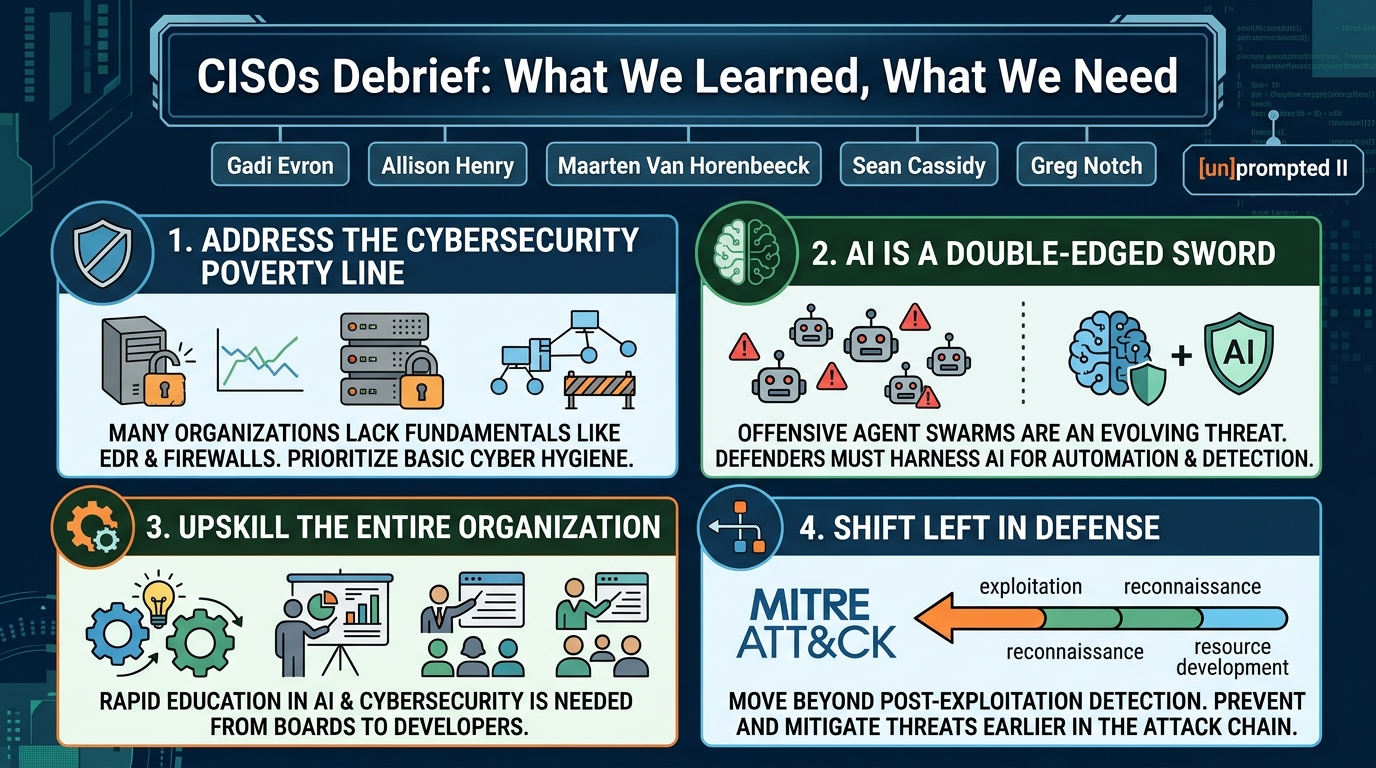
A stark and recurring theme was the "cybersecurity poverty line." Allison Henry highlighted that many organizations, including critical industries, lack fundamental security controls such as EDR and firewalls. She advocated for a return to basic cyber hygiene, emphasizing the need to block connections from unprotected machines and retire depreciated technology. This finding directly challenges the industry's often-singular focus on advanced threats, underscoring that for a significant portion of the ecosystem, the battle is still at the most basic level of defense. Maarten Van Horenbeeck subtly supported this by advocating for "attack surface reduction" and "instrumenting high-risk parts," which are fundamental security practices.
The discussion also underscored AI's dual role as both an existential threat and a potent defensive tool. The concept of "rogue agent swarms" was presented as a significant future challenge, capable of novel and rapid exploitation. However, the CISOs also saw AI as a necessary component of future defense. Allison Henry specifically expressed a desire for more AI tools for defenders and the need to educate the entire community, including developers and board members, on AI's potential. Greg Notch proposed automating risk registers with AI, while Maarten Van Horenbeeck envisioned "rapid attack surface reduction and instrumentation using a novel model for defense." This indicates a consensus that AI is not merely a threat to mitigate but a technology to harness for defensive advantage.
Finally, the panel stressed the imperative for reprioritization and a "shift left" in defense. Sean Cassidy articulated the need to move beyond current detection methods, which largely focus on the "point of exploitation" (e.g., EDR, ITDR), towards earlier stages in the MITRE ATT&CK framework. He argued that with "infinite possibilities for novel exploitation" enabled by AI, relying solely on post-exploitation detection is no longer viable. The CISOs recognized that traditional "risk acceptance" and long roadmaps for fixes are no longer tenable; the pace of change demands immediate action and a willingness to "burn down that whole side of security programs." The collective call was for CISOs to innovate beyond their current programs, investing in people, proactive pressure testing, and fundamental architectural changes like egress controls in cloud environments.
Technical Deep Dive
▶ Watch: Invest in people: AI combat effective teams (16:00)
The CISO debrief, while a high-level discussion, frequently touched upon specific technical concepts and challenges, reflecting the cutting-edge nature of the conference itself. The panelists referenced several talks that provided concrete technical examples. Greg Notch specifically praised the Graphistry talk for its work in detection and response engineering, highlighting its relevance to his own team's focus. He also commended the Stealth Bench talk, which explored techniques for making offensive security more stealthy and realistic for purple teaming exercises, a crucial practice for refining defensive capabilities.
Perhaps the most impactful technical discussion revolved around the OpenAI AI talk on binary patching. This talk demonstrated the potential for AI to identify and patch vulnerabilities in binaries where source code is unavailable. Notch found this "neat," particularly in the context of legacy infrastructure. However, Allison Henry immediately highlighted the formidable challenges: applying such patches to critical industrial control systems or medical devices (e.g., pacemakers) is fraught with risk. These environments often lack the technical expertise for deployment, present significant financial barriers, and crucially, involve systems where an erroneous patch could have life-threatening consequences. This underscores a critical gap between theoretical AI capabilities and their practical, safe deployment in sensitive operational technology (OT) environments.
The concept of AI-driven agent swarms was introduced as a potent offensive capability, capable of generating "novel exploitation." This presents a significant challenge for traditional security architectures. Sean Cassidy raised a critical asymmetry problem: while offensive agent swarms can "hack into everything," defensive agent swarms would require authorized access to critical systems, posing complex access control and authorization dilemmas that need to be solved. This implies a need for a new generation of zero-trust architectures specifically designed to accommodate and manage autonomous defensive agents.
In terms of defensive technical requirements, the CISOs called for a variety of improvements. Maarten Van Horenbeeck advocated for sandboxes and more focused attack surface reduction techniques, particularly by "instrumenting high-risk parts" of the infrastructure. Sean Cassidy made a direct technical plea for egress controls on AWS, specifically "outbound firewalls," to precisely control what each Kubernetes pod can communicate with externally. This highlights a desire to bring traditional network segmentation and perimeter defense concepts into modern cloud-native environments, moving beyond the often-porous security models prevalent in cloud deployments.
Allison Henry also touched upon the broader technical ecosystem, lamenting that developers are still "handwriting code in Cold Fusion" at her institution. This illustrates the struggle with technical debt and the slow adoption of modern development practices, which inherently create security vulnerabilities. Her vision for business analysts and HR personnel to "vibe code their own solutions" locally, bypassing "giant bloated business application suites," suggests a move towards decentralized, micro-application architectures that could potentially reduce the consolidated risk associated with monolithic enterprise software.
Finally, the discussion around future talks proposed by the CISOs pointed to emerging technical areas. Maarten Van Horenbeeck's dream talk involved a defensive AI model achieving "the same acceleration that we've seen offensive models achieve based on actual incidents, actual testing, actual pressure testing." This vision speaks to the development of adaptive, high-speed defensive AI capable of real-time threat neutralization. Greg Notch's proposal to "automate my risk register with AI" suggests leveraging AI for automated vulnerability management, threat intelligence correlation, and compliance reporting, moving beyond manual, spreadsheet-driven processes. These ideas collectively illustrate a perceived future where AI is deeply integrated into every layer of defensive operations, from foundational hygiene to advanced threat response.
Demo / Proof of Concept
▶ Watch: Dream talk: Ripping out old security processes (19:40)
While the "CISOs Debrief" itself was a panel discussion rather than a live demonstration, the speakers frequently referenced impressive technical demonstrations and proof-of-concepts presented in other talks at the "[un]prompted II" conference. These references provide insight into the types of innovations that captured the CISOs' attention and shaped their perspectives on the future of cybersecurity.
Greg Notch specifically highlighted the Graphistry talk, which likely showcased advanced detection and response engineering capabilities, possibly involving sophisticated data visualization or automated analysis of security events. He also mentioned the Stealth Bench talk, which demonstrated techniques for more "stealthy" and "realistic" offensive security operations, crucial for effective purple teaming. Perhaps most notably, the OpenAI AI talk on binary patching was singled out for its demonstration of AI's ability to patch vulnerabilities in compiled software without access to source code, exemplified by patching Asus routers. This was a clear technical proof-of-concept of AI's potential to address legacy system vulnerabilities. Allison Henry also mentioned attending a workshop on "training models to do cyber security work," indicating practical demonstrations of AI application in defense.
Looking forward, the CISOs articulated a strong desire for more defensive-oriented demonstrations. Allison Henry expressed a wish for a "real practical live demonstration of defender team under attack," showing "what they do to just something you learn by watching it happen live in front of you." This suggests a desire for live-fire exercises or simulated war games to observe real-time defensive strategies. Gadi Evron interpreted this as a call for an automated purple team, where adversarial AI agents test defenses, and blue teams refine controls over time.
Maarten Van Horenbeeck envisioned a dream talk demonstrating a defensive model that has achieved "essentially the same acceleration that we've seen offensive models achieve based on actual incidents, actual testing, actual pressure testing." This is a call for a robust, battle-tested defensive AI system, demonstrated through its efficacy against real-world or highly realistic simulated attacks. Sean Cassidy's desire for a talk on how "a lot of security processes, a lot of manual reviews, a lot of this approvals" were replaced with "something way better" implies a need for demonstrations of automated security operations and DevSecOps integration that show quantifiable improvements in efficiency and security posture. These collective aspirations underscore a significant gap in the current landscape: while offensive AI demonstrations are abundant, practical, effective, and widely shareable defensive AI proofs-of-concept are still largely in their nascent stages.
Defensive Implications
▶ Watch: Maarten's future talk: Rapid attack surface reduction (22:20)
The CISOs' debrief offers several critical defensive implications for organizations grappling with the rapidly evolving threat landscape. The core message is a dual imperative: reinforce foundational security while aggressively embracing AI for defense.
- Prioritize Basic Cyber Hygiene: Allison Henry's impassioned plea for "basic cyber hygiene" is paramount. Defenders must focus on implementing fundamental controls like EDR (Endpoint Detection and Response), ubiquitous firewalls, and robust internet egress blocking. Organizations must actively identify and secure or retire depreciated technology that cannot be patched. For many, this means addressing the "cybersecurity poverty line" before investing in advanced solutions. The panel stressed that neglecting these basics will lead to "drastically, drastically wrong" outcomes that can no longer be "risk accepted."
- Invest in AI for Defensive Capabilities: The future of defense hinges on leveraging AI. CISOs need to actively explore and adopt "AI tools for defenders." This includes training models for cybersecurity work, building sophisticated defensive AI models capable of rapid threat detection and response, and automating mundane tasks like risk register management. Maarten Van Horenbeeck's vision of AI-driven "rapid attack surface reduction and instrumentation" highlights the potential for AI to enhance core security functions.
- Upskill the Entire Organization: Cybersecurity is no longer solely the domain of the security team. Allison Henry emphasized the need to "get everybody upskilled, including our board." This means educating developers on secure coding practices (moving beyond "Cold Fusion"), empowering business analysts to "vibe code their own solutions" securely, and ensuring leadership understands the implications and potential of AI. Greg Notch's call to make "everybody on my team AI combat effective" underscores the urgency of this human capital investment.
- Shift Left in Detection and Response: Sean Cassidy's insight that current detection focuses on the "point of exploitation" is a call to action. Defenders must move "to the left in the MITRE framework," proactively identifying and mitigating threats much earlier in the attack chain. This involves advanced threat intelligence, proactive vulnerability management, and architectural changes that prevent exploitation rather than merely detecting it. This shift requires abandoning the traditional "risk accept, put it on the roadmap, I'll fix it in a year" mentality.
- Implement Granular Egress Controls: For cloud environments, Sean Cassidy's specific request for "egress controls on AWS" and the ability to "carefully specifically control what each Kubernetes pod does" is a critical architectural implication. This means implementing outbound firewalls and strict network segmentation in cloud-native deployments to prevent command-and-control communication, data exfiltration, and lateral movement, even if internal systems are compromised.
- Proactive Pressure Testing and War Gaming: Rather than waiting for the "first big AI swarm to attack us," organizations should engage in "faster pressure testing" of their systems and models. This includes automated purple teaming, live-fire exercises, and simulated adversarial engagements to validate defensive controls and identify weaknesses under realistic attack scenarios. This proactive approach will inform rapid iteration and improvement of security postures.
- Rethink Business Application Architectures: Allison Henry's suggestion to change how organizations approach "business applications" by encouraging local "vibe-coded solutions" and moving away from "giant bloated business application suites" has significant implications. This could lead to more decentralized, context-aware applications with reduced attack surfaces and easier maintenance, potentially mitigating the risks associated with large, complex enterprise software.
Key Takeaways
- The Cybersecurity Poverty Line is Real: Many organizations, including critical infrastructure, lack fundamental security controls like EDR and firewalls, making basic cyber hygiene an immediate and critical priority over advanced AI solutions.
- AI is a Double-Edged Sword: While AI-driven "agent swarms" represent a potent, rapidly evolving offensive threat, AI also offers powerful defensive capabilities that CISOs must actively harness for automation, threat detection, and response acceleration.
- Upskilling is Paramount: The entire organization, from technical teams to the board, needs rapid education and training in AI and cybersecurity to effectively leverage new tools and understand emerging risks.
- Shift Left from Exploitation: Traditional security, focused on detecting threats at the "point of exploitation," is insufficient against novel AI-driven attacks. Defenders must move "left in the MITRE framework" to proactively prevent and mitigate threats earlier.
- Proactive Defense is Non-Negotiable: "Risk acceptance" and slow remediation cycles are no longer viable. Organizations must embrace "faster pressure testing," automated war gaming, and immediate action to strengthen defenses against escalating threats.
- Demand for Defensive AI Tools: There is a clear and urgent need for the security community to develop and share more practical, effective, and battle-tested AI tools specifically designed for defensive operations.
About the Speaker(s)
The panel featured a distinguished group of cybersecurity leaders:
- Gadi Evron (CEO, Knostic): The moderator of the debrief, guiding the conversation among the CISOs.
- Allison Henry (Chief Information Security Officer, University of California, Berkeley): Leads cybersecurity efforts for one of the world's leading academic institutions, facing unique challenges balancing security with an open research environment.
- Maarten Van Horenbeeck (Fellow, Cybersecurity, Adobe, formerly Chief Security Officer): Recently transitioned from a CSO role to a technical fellow position at Adobe, indicating a deep technical background and focus on security engineering.
- Sean Cassidy (Chief Information Security Officer, Plaid): Oversees security for a prominent fintech company, navigating the complexities of financial data protection and rapid technological innovation.
- Greg Notch (Chief Technology Officer, Expel, also Chief Security Officer): Holds a dual CTO/CISO role at a security operations provider, giving him a broad perspective on both technological strategy and practical security implementation.
Reviews
→ Top-rated talks at [un]prompted II 2026 — The AI Security Practitioner Conference
All talks from [un]prompted II 2026 — The AI Security Practitioner Conference