Debate: Rethinking Cyber Defenses?
Sergej Epp (Creator of the Zero Day Clock), Jeremiah Grossman (CEO · Root Evidence)
[un]prompted II 2026 — The AI Security Practitioner Conference · Day 2 · Stage 1
Overview
In a stimulating debate at [un]prompted II, Sergej Epp and Jeremiah Grossman tackled the motion: "AI is the biggest shift in cyber risk since the internet." This discussion delved into the fundamental nature of cyber risk, the economics of offense and defense, and the practical implications for security strategies in an increasingly AI-driven world. Rather than presenting a unified front, the talk offered a sharp contrast between two distinct philosophies on how the cybersecurity community should perceive and respond to the advent of artificial intelligence.
Key moments
- 0:00 Debate Introduction: AI as biggest cyber risk shift
- 2:50 Sergej's opening: AI changes offense/defense economics
- 6:10 Jeremiah's opening: Vulnerabilities don't equal losses
- 9:00 Debating risk definition and proactive patching
- 11:55 AI's role in accelerating vulnerability discovery
- 19:20 Jeremiah's closing: Disrupting adversaries by increasing costs
- 24:30 Judge's analysis: AI fundamentally changes system defense
Debate: Rethinking Cyber Defenses?
Speakers: Sergej Epp, Creator of the Zero Day Clock; Jeremiah Grossman, CEO, Root Evidence
Conference: [un]prompted II
YouTube: https://www.youtube.com/watch?v=wPgbacDmNEk
Overview
In a stimulating debate at [un]prompted II, Sergej Epp and Jeremiah Grossman tackled the motion: "AI is the biggest shift in cyber risk since the internet." This discussion delved into the fundamental nature of cyber risk, the economics of offense and defense, and the practical implications for security strategies in an increasingly AI-driven world. Rather than presenting a unified front, the talk offered a sharp contrast between two distinct philosophies on how the cybersecurity community should perceive and respond to the advent of artificial intelligence.
Sergej Epp, advocating for the proposition, argued that AI fundamentally alters the threat landscape by making offensive capabilities cheaper and faster, thereby increasing inherent risk even before visible losses accrue. He urged a proactive re-evaluation of cyber security operating models. Jeremiah Grossman, in opposition, contended that while AI is a factor, it has not yet caused a paradigm shift comparable to the internet. He emphasized that adversaries already operate with extreme cost efficiency and that current data on exploitation and financial loss does not support the claim of a revolutionary change, advocating for a more targeted defense strategy focused on known exploited vulnerabilities.
The debate underscored a critical divergence in how security professionals interpret current data and predict future trends concerning AI's impact. It challenged the audience to reconsider their assumptions about risk assessment, resource allocation, and the efficacy of traditional defensive postures. By pitting these viewpoints against each other, the speakers aimed not to declare a definitive winner in terms of "facts," but to provoke a deeper, more nuanced understanding of AI's complex role in shaping the future of cyber defense.
Background
▶ Watch: Debate Introduction: AI as biggest cyber risk shift (0:00)
The landscape of cybersecurity has long been characterized by an ever-growing volume of vulnerabilities and a constant struggle for defenders to keep pace with attackers. This "vulnerability apocalypse," as termed by Jeremiah Grossman, sees hundreds of thousands of CVEs (Common Vulnerabilities and Exposures) disclosed annually, with the total number now exceeding 400,000. However, a critical point of contention in the debate was the interpretation of the impact of these vulnerabilities. Grossman highlighted that historically, only about 1% of all discovered vulnerabilities have ever been exploited, and a mere 2% have led to actual financial loss. This statistical reality forms the bedrock of his argument that the sheer volume of vulnerabilities does not directly equate to a proportional increase in realized risk or successful attacks.
The economics of cybercrime also serve as a crucial backdrop. Both debaters acknowledged that cyber security has always been about economics. Adversaries currently have access to incredibly cheap tools; a basic malware kit or phishing kit can be purchased on the dark web for a few hundred dollars, with infrastructure costing around a thousand. This low barrier to entry for attackers contrasts sharply with the hundreds of millions, or even billions, spent by organizations on defense. The core question posed by the debate, therefore, was whether AI significantly alters these established economic disparities and the existing patterns of exploitation, or if it merely amplifies an already lopsided equation without fundamentally shifting the "risk since the internet" benchmark. This context laid the groundwork for a discussion on whether AI-driven capabilities represent a true inflection point or just another incremental challenge in the ongoing cyber arms race.
Key Findings
▶ Watch: Jeremiah's opening: Vulnerabilities don't equal losses (6:10)
The debate did not yield traditional "findings" in the sense of research results, but rather presented two distinct and compelling arguments regarding AI's impact on cyber risk, each supported by different interpretations of available data and future projections.
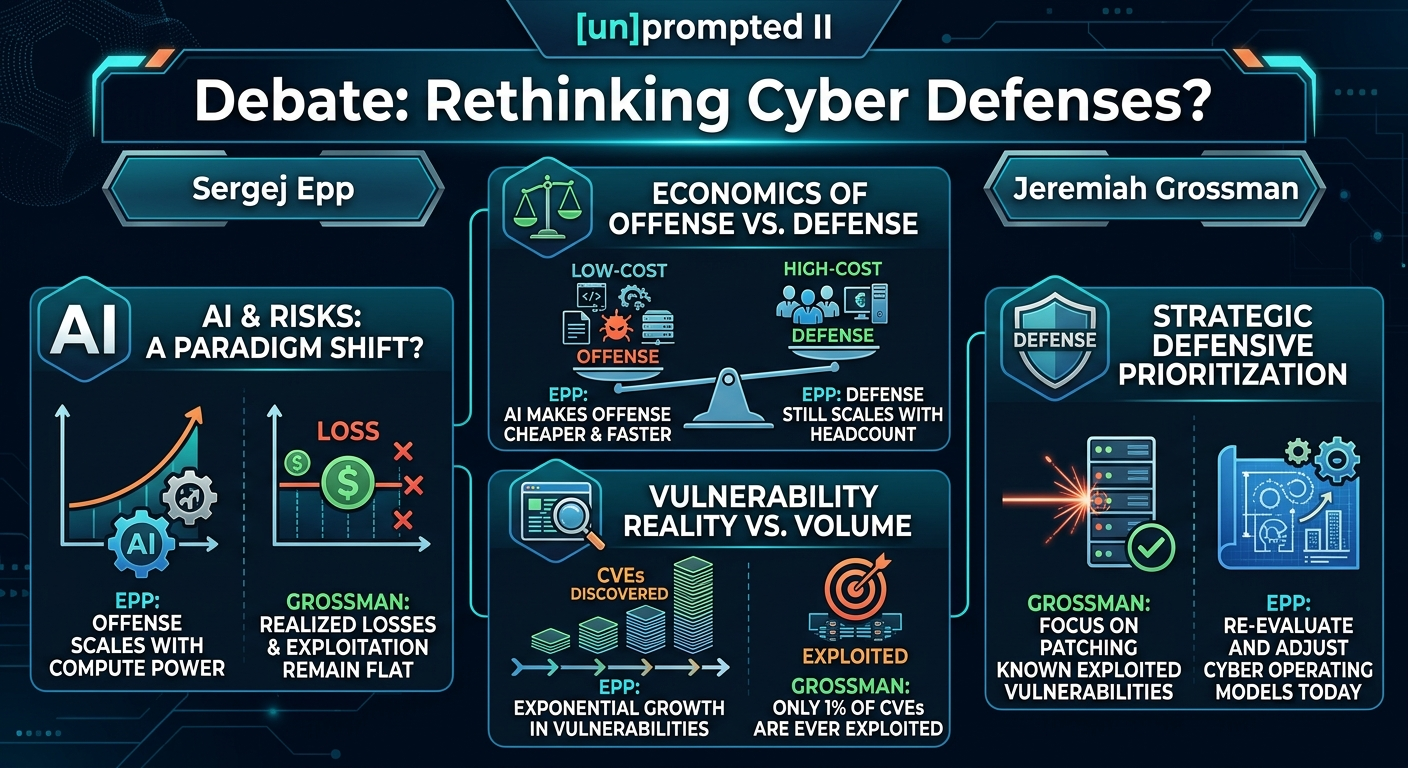
Sergej Epp, arguing for the proposition, asserted that AI represents a fundamental shift in cyber risk due to its transformative effect on the economics of offense. He highlighted an exponential growth in vulnerabilities, citing 15,000 vulnerabilities released in September of the current year compared to 2,500 the previous year. While acknowledging that the ratio of exploited to total vulnerabilities might remain stable, the sheer increase means defenders face five times more exploitation attempts to patch. Epp argued that losses are lagging indicators, while risk does not lag. He drew an analogy to signing a bad loan or the release of Eternal Blue before the widespread impact of WannaCry and NotPetya; risk is accepted at the point of exposure, not just when a breach occurs. He stressed that offense is now scaling with compute power, while defense remains tied to headcount, illustrating this with Bank of America hiring 1,000 contractors for remediation on top of 3,000 employees. For Epp, AI makes offense "pretty cheap," fundamentally changing the game.
Jeremiah Grossman, countering the proposition, maintained that AI has not introduced a shift in cyber risk comparable to the internet. His central argument was that the adversary is not innovating but merely scaling existing, already cheap methods. He reiterated that only 1% of all vulnerabilities are exploited, and 2% lead to financial loss, figures that have remained flat both before and after the rise of AI. Grossman emphasized that the breaches and losses are flat, despite the surge in CVEs. He questioned how much easier it needs to get for attackers, given the current low cost of entry for malware and phishing kits. For Grossman, the solution lies not in patching the entire planet, but in focusing defensive efforts on the 1% of vulnerabilities that are actually exploited, a strategy he believes has not been fully adopted. He contended that data from the CISA KEV list (Known Exploited Vulnerabilities) shows flat rates of exploitation, indicating no significant increase in exploitation speed or number due to AI.
The core divergence thus lay in the interpretation of "risk" and the immediacy of AI's impact. Epp viewed the increased potential for exploitation and the changing economics of offense as an immediate increase in risk, demanding a shift in defense. Grossman, conversely, focused on realized exploitation and financial loss, arguing that AI has yet to demonstrate a fundamental change in these metrics that would warrant classifying it as the biggest shift since the internet.
Technical Deep Dive
▶ Watch: Debating risk definition and proactive patching (9:00)
The technical heart of the debate revolved around how AI is impacting the discovery, exploitation, and remediation of vulnerabilities, and the underlying economics of these processes. Sergej Epp posited that AI significantly enhances offensive capabilities, particularly in vulnerability discovery. He conducted an informal poll, asking audience members if they had found a CVE using AI in the last 12 months, and then if they could have found the same vulnerability in the same amount of time without AI. The implication of the audience's response was that AI demonstrably accelerates and facilitates vulnerability discovery, suggesting a new era where attackers can identify flaws much faster and more efficiently. This capability, Epp argued, scales offense with compute power, a sharp contrast to defense, which still primarily scales with headcount. He termed the difficulty of proving software security versus exploiting it as the "cyber verifiers law," highlighting the inherent asymmetry favoring attackers. This economic imbalance, where offensive actions become cheaper and more scalable, is a key technical mechanism by which AI elevates risk in Epp's view. He used the analogy of the Red Sea conflict, where inexpensive drones ($2,000) are engaged by expensive rockets ($2 million), to illustrate how new, cheaper offensive capabilities can fundamentally alter the cost economics of warfare, a parallel he draws to AI in cybersecurity.
Jeremiah Grossman, however, challenged the notion that this theoretical increase in offensive capability translates into a practical, game-changing shift in the threat landscape. He argued that while CVE volume is indeed rising (e.g., 15,000 Microsoft CVEs in a year), the adversary isn't exploiting new vulnerabilities at a significantly faster rate. Grossman cited data indicating that the CISA KEV list, which tracks vulnerabilities actively exploited in the wild, remains relatively flat, typically listing 50 to 75 new exploited vulnerabilities per month. This, he contended, demonstrates that attackers are not being driven to innovate or exploit newly discovered, AI-generated vulnerabilities. Instead, they continue to rely on the vast trove of existing, often legacy, vulnerabilities because it is still highly profitable and easy to monetize. Grossman dismissed the idea of a rapidly increasing patch workload as a direct consequence of AI, suggesting that while CVEs increase, the number of actual patches might only rise incrementally, and organizations are already failing to patch even known exploited vulnerabilities (only 30% of CISA KEVs were patched by companies in a recent assessment). His technical argument is that AI might indeed lead to "even more legacy vibecoded crap hitting online," but without a corresponding shift in what gets exploited or how quickly, the fundamental risk profile remains unchanged. The judge's comment about the NeoCloud incident, where attackers used a non-disclosed vulnerability to harvest inference tokens, offered a counter-narrative, suggesting AI is already enabling sophisticated, novel attacks, even if the monetization strategy remains familiar.
In essence, Epp focused on AI's potential to accelerate the discovery and creation of vulnerabilities and the resulting economic asymmetry, while Grossman emphasized the actual exploitation patterns and the lack of observed change in adversary behavior or financial loss metrics. The debate highlighted the tension between theoretical capability and realized impact in the context of emerging technology.
Demo / Proof of Concept
▶ Watch: Jeremiah's closing: Disrupting adversaries by increasing costs (19:20)
The talk was structured as a formal debate and did not include a technical demonstration or a proof of concept in the traditional sense. However, Sergej Epp did conduct an informal poll with the audience, asking how many had found a CVE using AI in the last 12 months, and then how many believed they would have found the same vulnerability in the same amount of time without AI. This rhetorical device served as a real-time, albeit informal, "proof of concept" to illustrate his point about AI's ability to accelerate vulnerability discovery for offensive purposes, directly engaging the audience in validating his claim about AI's impact on technical capabilities.
Defensive Implications
▶ Watch: Judge's analysis: AI fundamentally changes system defense (24:30)
The debate offered sharply contrasting views on the defensive implications of AI, fundamentally challenging existing cybersecurity operating models. Sergej Epp's position calls for a radical rethinking of defensive strategies. He urged organizations to adjust their cyber security operating model and risk models today, without waiting for catastrophic losses. His analogy of accepting risk when signing a bad loan, rather than when default occurs, underscores the need for proactive measures. Epp advocated for moving beyond "guessing" in defense to an "actuarial era," where defenders actively follow and disrupt adversary actions based on observed trends and economic disincentives. He stressed the importance of investing more in security, rebuilding infrastructure, and achieving new protection and resilience. For Epp, the increasing volume of vulnerabilities and the cheapening of offense due to AI mean that current defense mechanisms are inadequate and will not be able to keep pace with attackers. He implicitly calls for investment in AI-driven defensive tools that can scale with compute, mirroring the offensive advantage, rather than relying on increasing headcount.
Jeremiah Grossman, conversely, proposed a more focused and economically pragmatic defensive strategy. His core recommendation is to prioritize patching only the vulnerabilities that are actively exploited in the wild. He argued that with only 1% of vulnerabilities ever being exploited, trying to "patch the planet" is an expensive and ultimately futile exercise. Instead, defenders should leverage resources more efficiently by focusing on known exploited vulnerabilities, particularly those listed on the CISA KEV list. This approach, he argued, is about making it more expensive for adversaries by disrupting their current and proven attack methods, rather than expending resources on patching vulnerabilities that are unlikely to be targeted. Grossman's strategy implies a shift from a broad, reactive patching regimen to a data-driven, targeted defense that directly addresses the most immediate threats. He contended that adversaries are scaling existing methods, not innovating with new AI-driven exploits, and therefore, defense should focus on disrupting those established, cost-effective campaigns. This means understanding and acting on the likelihood of exploitation rather than the sheer volume of discovered vulnerabilities.
Ultimately, the defensive implications hinge on whether one perceives AI as fundamentally altering the nature of cyber risk (Epp) or merely amplifying existing challenges (Grossman). Epp’s view demands a complete overhaul of defense to match the new offensive economics, while Grossman’s view advocates for a smarter, more targeted application of existing defensive principles to counter the adversary’s current modus operandi.
Key Takeaways
- AI's Fundamental Impact on Risk is Debated: Sergej Epp argues AI fundamentally shifts cyber risk by making offense cheaper and faster, increasing potential exposure even without immediate visible losses. Jeremiah Grossman contends AI hasn't caused a paradigm shift in actual exploitation rates or financial losses, asserting adversaries already operate cheaply.
- Economics of Offense vs. Defense: A central theme is the economic asymmetry. Epp highlights AI scaling offense with compute versus defense scaling with headcount, creating an unsustainable imbalance. Grossman notes that adversaries already have extremely cheap tools, questioning how much cheaper AI can make it.
- Vulnerability Volume vs. Exploitation Reality: Epp points to exponential growth in CVEs (e.g., 15,000 Microsoft CVEs in a recent month) as a clear indicator of increased risk. Grossman counters that only 1% of vulnerabilities are ever exploited, and 2% lead to financial loss, with these rates remaining flat despite AI's emergence.
- Strategic Defensive Prioritization: Grossman advocates for a targeted defense, urging organizations to prioritize patching only actively exploited vulnerabilities, particularly those on the CISA KEV list, rather than attempting to "patch the planet." Epp calls for a complete re-evaluation of cybersecurity operating models and investment in new protection and resilience.
- Risk Perception: Lagging Losses vs. Immediate Exposure: Epp differentiates between lagging losses (visible breaches) and immediate risk acceptance (unpatched vulnerabilities), suggesting that AI increases risk at the point of exposure. Grossman focuses on actual, realized losses and exploitation data as the primary metric for assessing risk shifts.
- The Adversary's Innovation vs. Scaling: Grossman argues that the adversary is not innovating with AI but scaling existing, profitable attack methods. Epp implies AI enables new forms of offensive innovation, such as faster vulnerability discovery, which will eventually manifest in increased exploitation.
About the Speaker(s)
Sergej Epp is recognized as the Creator of the Zero Day Clock, a project that likely tracks or highlights the urgency of addressing zero-day vulnerabilities. In the debate, he advocated for a proactive and transformative approach to cybersecurity in light of AI's emerging capabilities.
Jeremiah Grossman is the CEO of Root Evidence. He participated in the debate as an experienced voice arguing for a more pragmatic, data-driven approach to cyber defense, emphasizing the importance of focusing on known exploited vulnerabilities and the existing economics of cybercrime.
Reviews
→ Top-rated talks at [un]prompted II 2026 — The AI Security Practitioner Conference
All talks from [un]prompted II 2026 — The AI Security Practitioner Conference