Cryptography Under AI Pressure
Sunghyeon Jo (Co-founder & Cybersecurity Researcher · QED Audit)
[un]prompted II 2026 — The AI Security Practitioner Conference · Day 2 · Stage 2
Overview
In "Cryptography Under AI Pressure," Sunghyeon Jo, Co-founder and Cybersecurity Researcher at QED Audit, delves into the transformative impact of artificial intelligence on the field of cryptography. The talk addresses a critical contemporary debate highlighted by two contrasting predictions from leading cryptographers: Matthew Green's concern about the potential loss of public key cryptography versus Yehuda Lindell's assurance that decade-old hardness assumptions remain unbroken. Jo's extensive research, leveraging AI for cryptanalysis, reveals three distinct pressures AI exerts on cryptographic systems: the technological acceleration of attack discovery, the optimization of cryptographic efficiency, and the deepening understanding of mathematical foundations.
Key moments
- 0:00 Introduction: AI's three pressures on cryptography
- 3:45 Key recovery attack on Talos V4 post-quantum signature
- 7:00 Cryptanalysis of Poseidon hash function and its risks
- 9:30 AI efficiency pressure makes Poseidon hash unnecessary
- 10:45 Ethereum's Proximity Price for Reed-Solomon code safety
- 13:00 AI's current limits: Lattice cryptography remains unbroken
- 17:40 Q&A: AI's potential to autonomously solve crypto problems
Cryptography Under AI Pressure
Speakers: Sunghyeon Jo, Co-founder & Cybersecurity Researcher, QED Audit
Conference: [un]prompted II
YouTube: https://www.youtube.com/watch?v=R1MkIlzcijU
Overview
In "Cryptography Under AI Pressure," Sunghyeon Jo, Co-founder and Cybersecurity Researcher at QED Audit, delves into the transformative impact of artificial intelligence on the field of cryptography. The talk addresses a critical contemporary debate highlighted by two contrasting predictions from leading cryptographers: Matthew Green's concern about the potential loss of public key cryptography versus Yehuda Lindell's assurance that decade-old hardness assumptions remain unbroken. Jo's extensive research, leveraging AI for cryptanalysis, reveals three distinct pressures AI exerts on cryptographic systems: the technological acceleration of attack discovery, the optimization of cryptographic efficiency, and the deepening understanding of mathematical foundations.
This presentation is highly pertinent to the cybersecurity community, offering a pragmatic perspective on how AI is not just a theoretical threat but a practical tool reshaping cryptographic security. Jo substantiates his claims with concrete examples of vulnerabilities he uncovered in various cryptographic schemes using AI, demonstrating AI's capability to identify weaknesses in both nascent and widely adopted protocols. Beyond merely breaking systems, the talk explores AI's role in making previously impractical cryptographic schemes efficient and in refining the security parameters of complex mathematical constructs. Ultimately, Jo argues that AI will serve as a powerful "battle-testing" mechanism, leading to the evolution of more robust and resilient cryptographic solutions.
Background
▶ Watch: Introduction: AI's three pressures on cryptography (0:00)
Sunghyeon Jo's journey into AI-driven cryptanalysis began with his work at QED Audit, where he specialized in vulnerability research and bug bounties using Large Language Model (LLM) harnesses. This prior experience proved instrumental, as he successfully identified complex consensus bugs in blockchain systems, including a notable signature malleability bug in the BLS signature scheme. These successes, particularly in uncovering intricate logic flaws within cryptographic codebases, prompted a pivotal question: if LLMs could find such sophisticated vulnerabilities in blockchain implementations, could they also identify fundamental attacks within the theoretical designs outlined in cryptographic research papers?
This inquiry formed the bedrock of his subsequent research into "Cryptography Under AI Pressure." The increasing sophistication and accessibility of AI models presented an unprecedented opportunity to automate and scale cryptanalysis efforts. Traditional cryptanalysis often requires highly specialized human expertise, extensive computational resources, and significant time investment. Jo hypothesized that AI could dramatically reduce the cost and effort associated with finding cryptographic weaknesses, thereby exerting pressure on existing and emerging cryptographic designs. His work aimed to validate this hypothesis by applying AI tools to diverse cryptographic schemes, ranging from post-quantum candidates to zero-knowledge proof primitives, to understand the practical implications of AI's growing analytical prowess.
Key Findings
▶ Watch: Cryptanalysis of Poseidon hash function and its risks (7:00)
Sunghyeon Jo's research yielded several significant findings, demonstrating AI's capacity to identify vulnerabilities across different cryptographic domains and influencing the trajectory of cryptographic development:
- Key Recovery Attack on Talos V4: Jo successfully identified a key recovery attack against Talos V4, a threshold signature scheme based on NIST's ML-DSA (Module-Lattice-based Digital Signature Algorithm) post-quantum standard. Talos V4 was a candidate in NIST's call for threshold post-quantum signature schemes. The attack specifically targeted scenarios where T-1 parties were corrupted (meaning all but one of the required signers were compromised) and involved recovering the private key from two valid signatures generated using the same nonces. Jo reported this critical vulnerability to the authors on July 13, 2023, who subsequently confirmed and patched it by releasing Talos V5 a few weeks later, acknowledging the non-trivial nature of the fix which involved design trade-offs.
- Polynomial-Time Bit Recovery in ADP-Based Witness Encryption: Another significant discovery was a polynomial-time bit recovery attack against an ADP-based witness encryption scheme, originally proposed at ITCS 2020. Witness encryption is a powerful primitive where a message can only be decrypted by someone who knows a valid "witness" for a given statement. Jo's AI-driven analysis found a method to recover the message
Mwithout possessing the witnessW, fundamentally undermining the scheme's security guarantee that if no witness exists, the message should remain unrecoverable.
- Collision Finding in Poseidon Hash Function: While not a full break, Jo identified a collision in the Poseidon hash function, a cryptographic hash designed for Zero-Knowledge Proofs (ZKPs) and widely used in blockchain ecosystems. This finding emerged from the Ethereum Foundation's "Poseidon Cryptanalysis Initiative," a challenge to find collisions. Jo's approach, leveraging the challenge's allowance for choosing an arbitrary MDS matrix, led to the discovery of a "very special MDS matrix" that resulted in trivial collisions. Although not the "intended solution" for a general attack, this demonstrated a critical design sensitivity, earning him a $10,000 award from the Ethereum Foundation for highlighting a potential weakness. This finding, alongside four other cryptanalysis papers published in August, signaled a serious risk of the Poseidon hash function being broken.
- Efficiency-Driven Obsolescence of Poseidon: Beyond direct attacks, Jo highlighted how AI-driven efficiency improvements in ZKP systems rendered specialized hashes like Poseidon increasingly unnecessary. New proving systems, combined with public auto-research projects like snark.test, have dramatically accelerated the proving speed of traditional hash functions such as SHA-256 and Blake3. For instance, snark.test achieved a 3.5x speedup, enabling Blake3 hash function proofs at 1.85 million times per second on a single M3 Max chip. This substantial performance gain means that traditional, more thoroughly vetted hash functions can now be used efficiently within ZKPs, leading to the "sunset" of Poseidon hash function in Ethereum and broader blockchain contexts due to efficiency pressure.
- Advancements in Mathematical Foundations (Reed-Solomon Codes): Jo also participated in the Proximity Prize, a $1 million initiative by the Ethereum Foundation aimed at understanding the security of Reed-Solomon codes in ZKPs, specifically regarding the 128-bit security guarantee. While some parameters are known to be safe and others unsafe, a significant "gap" exists in understanding the security bounds for intermediate parameters. Through his work and public auto-research projects like
better.code, a clearer picture of safe and unsafe parameters for Reed-Solomon codes is emerging, although a substantial gap still remains, indicating a long way to go in fully comprehending these mathematical foundations.
Collectively, these findings underscore AI's dual role: as a potent tool for uncovering cryptographic vulnerabilities and as an accelerator for cryptographic innovation and efficiency, ultimately pushing the field towards more robust and mathematically sound designs.
Technical Deep Dive
▶ Watch: AI efficiency pressure makes Poseidon hash unnecessary (9:30)
Sunghyeon Jo's approach to cryptanalysis is deeply rooted in leveraging AI, particularly Large Language Models (LLMs), to automate and scale the process of identifying cryptographic weaknesses. His primary tool for this was an LLM harness named Lemma, developed at QED Audit.
The methodology behind Lemma is particularly insightful. Instead of brute-forcing or exhaustively searching for flaws, Lemma operates by taking a cryptographic paper (often in PDF text format) as input. It then generates hypotheses about potential weaknesses or attacks within the described scheme. This is a significant departure from traditional, human-intensive cryptanalysis, which requires deep expertise to manually formulate such hypotheses. Once Lemma generates these potential attack vectors, a triager or validator (presumably a human expert or a specialized automated component) checks if these hypotheses represent actual, viable attacks. This semi-automated process proved effective, leading to the discovery of critical vulnerabilities.
For the Talos V4 attack, Lemma's hypothesis generation capability was crucial. Talos V4 is a threshold signature scheme built upon ML-DSA, a lattice-based post-quantum signature algorithm. In a threshold signature scheme, n parties hold shares of a private key, and T out of n shares are required to produce a valid signature. Jo's attack specifically targeted a scenario where T-1 parties are corrupted. This means that nearly all necessary signers are compromised, leaving only one honest party to contribute. The vulnerability manifested when two valid signatures were produced using the same nonces. Nonces (numbers used once) are critical for the security of many signature schemes, and their reuse, especially under partial key compromise, often leads to information leakage. In Talos V4, this specific combination of T-1 corrupted parties and nonce reuse allowed for the recovery of the private key. The authors confirmed this finding, highlighting a subtle yet critical flaw in the scheme's design or implementation under specific operational conditions, leading to the release of Talos V5 with necessary design adjustments.
The ADP-based witness encryption attack further exemplifies AI's analytical power. Witness encryption is a highly advanced cryptographic primitive, allowing a message M to be encrypted such that it can only be decrypted by someone possessing a witness W that satisfies a public statement F (i.e., F(W) is true). The core security guarantee is that without W, the message remains secure, and if no such W exists, the message is inherently unrecoverable. Jo's AI-driven analysis uncovered a polynomial-time bit recovery method that could extract M without knowledge of W. This represents a fundamental break, as it violates the core indistinguishability property of witness encryption, making the scheme practically useless for its intended purpose. The technical details of how the polynomial-time recovery works were not elaborated in the talk, but the finding itself underscores AI's ability to probe complex mathematical assumptions and identify hidden algebraic or algorithmic pathways to compromise.
The Poseidon hash function collision demonstrates a different facet of AI's utility. Poseidon was specifically engineered for efficiency within Zero-Knowledge Proof (ZKP) systems, aiming to reduce the computational overhead of cryptographic hash operations in ZKP circuits. The Ethereum Foundation's challenge allowed participants to choose an arbitrary MDS (Maximum Distance Separable) matrix, a component critical to the hash function's diffusion properties. Jo's team, likely through AI-assisted exploration of the matrix space, identified a "very special MDS matrix" that led to trivial collisions. While not a general attack on Poseidon with standard parameters, this finding highlighted a design fragility: the security of the hash function was highly sensitive to the choice of its internal components, and a poor choice could lead to immediate compromise. This emphasized the need for rigorous analysis of all configurable parameters in new cryptographic designs.
Furthermore, Jo discussed the efficiency pressure on cryptography. The emergence of new proving systems for ZKPs, coupled with tools like snark.test, has drastically improved the performance of integrating traditional, widely-vetted hash functions (like SHA-256 and Blake3) into ZKP circuits. Specifically, snark.test achieved a 3.5x speedup for Blake3, enabling 1.85 million Blake3 hash computations per second on an M3 Max chip. This unprecedented speed effectively negated the primary advantage of specialized hashes like Poseidon, which were designed for ZKP-friendliness. The technical implication is that the overhead of general-purpose hash functions in ZKP environments has been reduced to a point where the security benefits of using battle-tested standards outweigh the marginal performance gains of specialized, newer, and potentially less secure alternatives. This paradigm shift, driven by engineering advancements and likely AI-assisted optimization, led to the "sunset" of Poseidon, illustrating how AI pressure can render cryptographic schemes obsolete not just through attacks, but through superior efficiency.
Finally, the discussion on mathematical foundations centered on Reed-Solomon codes, fundamental to many error correction and polynomial commitment schemes in ZKPs. The Proximity Prize aims to precisely define the parameters for achieving 128-bit security. While some parameter ranges are known to be safe or unsafe, a significant "gap" exists where the security guarantees are uncertain. AI, particularly through projects like better.code, is being used to explore this parameter space, generating stronger security bounds and narrowing this gap. This involves complex mathematical proofs and computational searches, areas where AI is increasingly demonstrating proficiency, pushing the boundaries of theoretical understanding in cryptography.
Demo / Proof of Concept
▶ Watch: AI's current limits: Lattice cryptography remains unbroken (13:00)
While Sunghyeon Jo's talk details successful attacks and findings, it does not describe a live demonstration or a public proof-of-concept for the audience. Instead, the "proof of concept" for his methodology lies in the confirmed vulnerabilities he discovered and reported. He explains how the LLM harness (Lemma) was used to generate hypotheses from cryptographic paper texts, and then how these hypotheses were validated to find actual attacks in schemes like Talos V4 and ADP-based witness encryption. The talk focuses on the results of applying AI for cryptanalysis rather than a real-time display of the AI tools themselves.
Defensive Implications
▶ Watch: Q&A: AI's potential to autonomously solve crypto problems (17:40)
The insights from "Cryptography Under AI Pressure" offer several critical defensive implications for cryptographers, security engineers, and organizations deploying cryptographic systems:
- Proactive AI-Driven Vulnerability Research: Organizations developing or deploying new cryptographic schemes should integrate AI-driven vulnerability research into their design and audit processes from the outset. Tools like Jo's Lemma LLM harness can significantly lower the cost and increase the speed of identifying weaknesses, even in theoretical designs. This "AI battle-testing" should become a standard part of the pre-deployment security lifecycle.
- Increased Scrutiny for New Cryptographic Schemes: New cryptographic proposals, especially those not yet widely adopted or extensively peer-reviewed over many years, are particularly vulnerable to AI-accelerated cryptanalysis. The attacks on Talos V4 (a NIST PQC candidate) and the ADP-based witness encryption scheme underscore this. Defenders should exercise extreme caution and demand rigorous, AI-assisted security audits before relying on unseasoned cryptographic primitives in production.
- Monitor Efficiency Shifts and Evolve Deployments: The "sunset" of the Poseidon hash function due to efficiency gains in traditional hashes for ZKPs highlights a crucial point: cryptographic choices are not static. Defenders must continuously monitor advancements in performance and underlying architectural shifts. If a more established, battle-tested primitive (like Blake3) becomes equivalently or more efficient than a specialized one, transitioning to the more robust option is a sound defensive strategy. This requires staying abreast of both cryptanalysis and performance engineering developments.
- Invest in Deeper Mathematical Foundations: The Proximity Prize and the ongoing work on Reed-Solomon codes illustrate the importance of fully understanding the mathematical underpinnings and precise security bounds of cryptographic primitives. Organizations should support or engage in fundamental research to close the "gap" between known safe and unsafe parameters, ensuring that the chosen security levels (e.g., 128-bit security) are genuinely achieved based on rigorous mathematical proof rather than heuristic assumptions.
- Prioritize Robustness and Battle-Tested Systems: Jo's personal experience of failing to break lattice cryptography (LWE problem) with "hundreds of billions of tokens" of AI computation offers a degree of confidence in well-established, extensively vetted systems. While AI lowers the bar for finding attacks, it also highlights the resilience of truly robust schemes. Defenders should prioritize cryptographic systems that have withstood significant scrutiny over time and against diverse attack methodologies, including AI-driven ones.
- AI as an Enabler for Stronger Designs: Beyond finding flaws, AI can also be leveraged to design stronger cryptographic tools. As Jo mentioned, AI can optimize functionality and make previously impractical but highly secure constructions (like Indistinguishability Obfuscation, IO) more practical. Defenders should explore how AI can assist in the design and optimization of next-generation, AI-resistant cryptographic protocols.
- Awareness of "Frontier Labs" Risk: Jo explicitly warns about the risk if "Frontier Labs" (leading AI research institutions) were to develop attacks for existing cryptographies. This suggests a need for ongoing threat intelligence and potentially collaborative efforts between AI researchers and the cybersecurity community to ensure responsible disclosure and mitigation of any such breakthroughs.
Key Takeaways
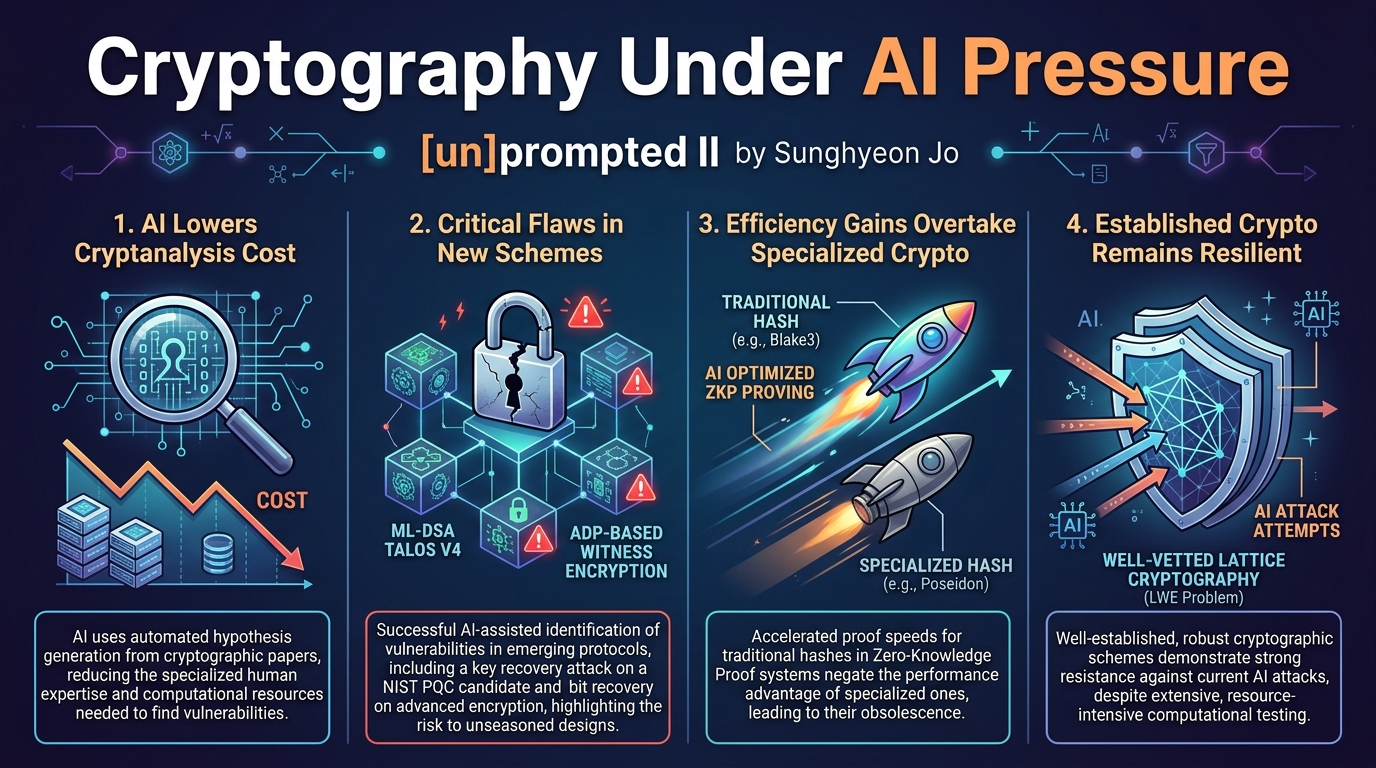
- AI significantly lowers the cost of cryptanalysis: AI, particularly LLM harnesses like Lemma, can quickly generate hypotheses for attacks, making the discovery of cryptographic vulnerabilities much cheaper and faster than traditional methods.
- New cryptographic schemes are vulnerable to AI-driven attacks: Schemes like Talos V4 (a NIST PQC candidate) and ADP-based witness encryption were found to have critical flaws through AI-assisted analysis, emphasizing the need for rigorous, AI-enhanced scrutiny of emerging designs.
- Efficiency gains from AI can render specialized crypto obsolete: Advances in ZKP proving systems, partly driven by AI, have made traditional hash functions (e.g., Blake3 at 1.85M proofs/sec) so efficient that specialized, ZKP-specific hashes like Poseidon are no longer necessary, leading to their "sunset."
- AI is deepening understanding of mathematical foundations, but gaps remain: AI is being used to refine security bounds for primitives like Reed-Solomon codes, though a substantial "gap" still exists in fully understanding safe parameter ranges for achieving specific security levels (e.g., 128-bit).
- Established, battle-tested crypto shows resilience against current AI: Despite extensive AI-driven attempts (e.g., "hundreds billions of tokens" on LWE problems for lattice cryptography), well-vetted, robust cryptographic systems have so far demonstrated resilience.
- AI can also assist in designing stronger cryptography: Beyond finding flaws, AI holds potential for optimizing and making practical highly secure, but complex, cryptographic functionalities like Indistinguishability Obfuscation.
About the Speaker(s)
Sunghyeon Jo is a Co-founder and Cybersecurity Researcher at QED Audit. He is recognized for his expertise in vulnerability research and bug bounties, particularly in the blockchain space, where he has leveraged LLM harnesses to uncover complex consensus bugs and signature malleability issues. His prior achievements include earning a gold medal in ICPC (International Collegiate Programming Contest), underscoring his strong background in competitive programming and problem-solving. Jo's research focuses on the intersection of artificial intelligence and cryptography, exploring how AI can both pressure existing cryptographic systems and contribute to the design of more robust and efficient future solutions.
Reviews
- Heather Calloway (CISO) — MUST SEE ★★★★★
→ Top-rated talks at [un]prompted II 2026 — The AI Security Practitioner Conference
All talks from [un]prompted II 2026 — The AI Security Practitioner Conference