Math Ability has Consequences — AI Cryptanalysis
Markku-Juhani O. Saarinen (Cryptographer, Hardware Architect, Professor of Practice)
[un]prompted II 2026 — The AI Security Practitioner Conference · Day 2 · Stage 2
Overview
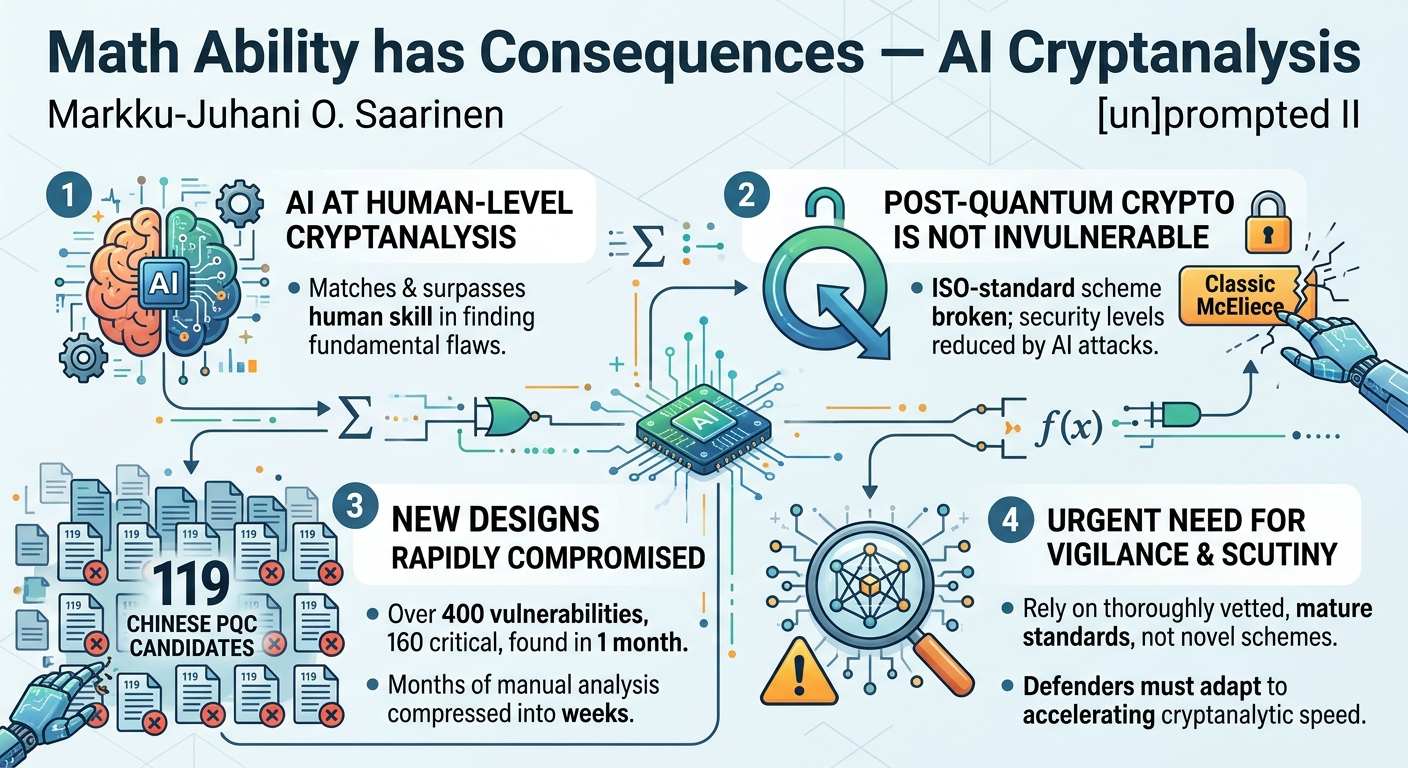
In this compelling talk at [un]prompted II, Markku-Juhani O. Saarinen, a distinguished cryptographer and professor, unveiled the alarming advancements of Artificial Intelligence (AI) in the field of cryptanalysis. Titled "Math Ability has Consequences — AI Cryptanalysis," Saarinen’s presentation served as a stark "Lee Sedol moment" for the cryptographic community, drawing parallels to the human Grandmaster Go player's defeat by AlphaGo in 2016. The core message is clear: AI is no longer merely assisting cryptographers; it is now actively matching and even surpassing human capabilities in discovering fundamental weaknesses in cryptographic schemes.
Key moments
- 2:00 AI reaches human-level cryptanalysis: the Lee Sedol moment
- 7:30 BSI warns against using Classic McEliece due to AI attacks
- 9:00 China's new ICCS crypto competition: 119 candidates submitted
- 10:30 AI setup for rapid analysis of Chinese PQC candidates
- 15:30 One month results: 409 findings, 160 critical breaks
- 21:20 Q&A: Can AI design new, robust cryptographic systems?
Math Ability has Consequences — AI Cryptanalysis
Speakers: Markku-Juhani O. Saarinen, Cryptographer, Hardware Architect, Professor of Practice
Conference: [un]prompted II
YouTube: https://www.youtube.com/watch?v=ozomWJ3AT5k
Overview
In this compelling talk at [un]prompted II, Markku-Juhani O. Saarinen, a distinguished cryptographer and professor, unveiled the alarming advancements of Artificial Intelligence (AI) in the field of cryptanalysis. Titled "Math Ability has Consequences — AI Cryptanalysis," Saarinen’s presentation served as a stark "Lee Sedol moment" for the cryptographic community, drawing parallels to the human Grandmaster Go player's defeat by AlphaGo in 2016. The core message is clear: AI is no longer merely assisting cryptographers; it is now actively matching and even surpassing human capabilities in discovering fundamental weaknesses in cryptographic schemes.
Saarinen meticulously detailed two primary areas where AI's impact is profoundly felt. First, he demonstrated how AI-assisted techniques have effectively broken Classic McEliece, a prominent code-based post-quantum cryptosystem recently standardized by ISO, by significantly reducing its estimated security levels. Second, he presented the results of an unprecedented, large-scale automated cryptanalysis effort against 119 candidate algorithms submitted to China's new commercial cryptography standards (ICCS) competition, revealing a staggering number of critical vulnerabilities within a remarkably short timeframe.
This talk is critically important for anyone involved in cybersecurity, especially those planning for or implementing post-quantum cryptography (PQC). It underscores the urgent need for continuous, rigorous cryptanalysis—now augmented by AI—and highlights the inherent dangers of designing or deploying cryptographic systems without exhaustive scrutiny. The rapid pace at which AI can uncover flaws demands a re-evaluation of current security assumptions and development practices in the cryptographic landscape.
Background
▶ Watch: AI reaches human-level cryptanalysis: the Lee Sedol moment (2:00)
The journey into AI-driven cryptanalysis begins with McEliece, a code-based cryptosystem first described by Bob McEliece in 1978. For decades, McEliece remained largely a theoretical curiosity due to its exceptionally large public key sizes, often hundreds of kilobytes or even megabytes, making it impractical for widespread use compared to RSA. However, its security relies on problems considered hard for quantum computers, positioning it as a strong candidate for post-quantum cryptography (PQC). In 2017, a modern variant of McEliece was submitted to the NIST PQC competition by Daniel J. Bernstein and collaborators, eventually making it to the final Round 4. This year, in 2024, it achieved international standardization by ISO, indicating growing confidence in its long-term security, particularly among entities like the German government, which had already recommended its use for sensitive point-to-point encryption.
The security of McEliece, like other cryptosystems, was traditionally estimated by the computational effort required for attacks, often expressed as a power of two (e.g., 2^200 operations for secret key recovery). The Technology Innovation Institute (TII) in the UAE ran a competition from 2023-2024, offering bounties for breaking challenges labeled with these brute-force security estimates, ranging from 2^30 to 2^255. These challenges served as critical benchmarks for evaluating the strength of PQC candidates.
Concurrently, there's been a global push for PQC standardization, with China initiating its own competition through the new ICCS organization. This competition, mirroring the NIST template, launched after the "AI Lee Sedol moment," prompting a massive influx of 119 candidates from various research organizations, many from PhD students. These candidates included diverse PQC algorithms and hash functions, all vying for standardization in a post-quantum world. The stage was set for AI to demonstrate its "math ability" against both established PQC schemes and newly proposed ones, fundamentally challenging the traditional timelines and methodologies of cryptanalysis.
Key Findings
▶ Watch: China's new ICCS crypto competition: 119 candidates submitted (9:00)
The talk unveiled several groundbreaking findings that collectively signal a paradigm shift in cryptanalysis, largely driven by AI.
The most immediate and impactful finding concerns Classic McEliece, an ISO-standardized post-quantum cryptosystem. Saarinen, building upon Tobias Hemert's "high-order vanishing attack" (a structural cryptanalysis method aimed at secret key recovery), developed a shortcut that converted an exhaustive search step into a more efficient linear algebra problem. This optimization allowed him to solve TII challenges up to the 2^252 security level, a feat that would have yielded significant financial rewards just a couple of years prior. This initial breakthrough was quickly followed by the "holdout attack" from researchers at I I Did the Mattress and Carnegie Mellon, which, while not purely AI-invented, explicitly admitted to using AI for various stages, including key recovery. By August 2024, this attack was deemed a serious threat to Classic McEliece.
The challenge intensified with Steve Wise from Anthropic, who, leveraging extensive GPU resources, implemented missing attack components and successfully broke TII 2^253. Not to be outdone, Saarinen then pushed the envelope further, breaking TII 2^254 using a goal-oriented loop and specific process on a cluster of GH Grace Hopper 200 GPUs, setting a new record. The cumulative effect of these AI-assisted attacks led to a dramatic re-evaluation of Classic McEliece's security. While expected to offer 2^256 bit security, current estimates from various cryptographers are now significantly lower, effectively rendering it "broken" for its intended security levels. Consequently, in a move that underscores the severity of these findings, the German Federal Office for Information Security (BSI) issued a public statement advising against the use of Classic McEliece for new developments, explicitly citing the recent cryptanalytic advancements.
The second major finding emerged from the large-scale automated cryptanalysis of the 119 candidate algorithms submitted to the Chinese ICCS competition. Saarinen's setup, leveraging cloud resources, processed over 87,000 files in less than six hours for initial harness checks. Within the first week alone, the automated agents identified critical vulnerabilities, including signature forgeries and shared secret recovery, in multiple schemes. After one month, the findings escalated to 409 active vulnerabilities, with 160 classified as critical. Almost all public key schemes had at least some findings, with many exhibiting critical flaws. This rapid discovery rate compressed what would typically be six months to a year of manual cryptanalysis into a single month, demonstrating AI's capacity to scale and accelerate vulnerability discovery.
Notably, the analysis revealed a range of issues from implementation bugs (e.g., padding problems, faulty encoders/decoders leading to weak strong unforgeability) to more sophisticated design attacks. Specific contributions included Martin Foisner, a PhD student, who creatively used Codex (an OpenAI model) to discover over 40 novel cryptanalytic attacks. Even Chinese LLMs, such as GLM 5.3, were employed by researchers to find vulnerabilities, although with varying levels of quality and a higher rate of false positives. These findings collectively highlight that AI is not just an accelerator but a transformative force in cryptanalysis, capable of both automating known attack patterns and assisting in the discovery of novel ones, thereby reshaping the security landscape of emerging cryptographic standards.
Technical Deep Dive
▶ Watch: AI setup for rapid analysis of Chinese PQC candidates (10:30)
The technical core of Saarinen's presentation revolved around two distinct yet interconnected applications of AI in cryptanalysis: the targeted attack on Classic McEliece and the broad-spectrum analysis of new Chinese PQC candidates.
For McEliece cryptanalysis, the focus was on secret key recovery, which allows an attacker to decrypt any message encrypted with the public key. Traditionally, this was estimated by brute-force search. Saarinen's work built upon the high-order vanishing attack by Tobias Hemert. This structural cryptanalysis method typically involves an exhaustive search over certain parameters. Saarinen's crucial insight, found through "frontier model optimization things," was to identify a shortcut that transformed a computationally intensive exhaustive search step into a more efficient linear algebra problem. This significantly reduced the complexity of the attack, enabling the breaking of TII challenges up to the 2^252 security level. The TII challenges, such as the 2^252 and 2^253 benchmarks, represent a specific number of operations (e.g., 2^252) required to recover the secret key using the best known classical methods.
Following this, the holdout attack from I I Did the Mattress and Carnegie Mellon further underscored the vulnerability of Classic McEliece. While specific technical details of the holdout attack were not fully elaborated in the talk, it was characterized as an AI-assisted method for key recovery. Steve Wise from Anthropic subsequently refined and implemented missing components of this attack, leveraging "unlimited GPU" resources to break TII 2^253. Saarinen's own record-breaking effort for TII 2^254 involved a "goal-oriented loop" and a "very specific process" tailored for that particular challenge, executed in approximately two hours on eight GH Grace Hopper 200 GPUs running in parallel. The key takeaway here is that AI, whether through algorithmic optimization or brute-force computational power, has dramatically lowered the effective security levels of Classic McEliece well below its intended 2^256-bit security, leading to its de-recommendation by BSI.
The cryptanalysis of Chinese PQC candidates presented a different, yet equally impactful, technical approach: large-scale, automated vulnerability discovery. Saarinen's setup involved automated agents with access to various tools, checklists, and a system for measuring success. A critical component was the creation of a pseudocode digest for each candidate. Instead of relying on massive PDF specifications (which could be in Chinese, though AI "doesn't care"), these digests provided a standardized, AI-readable summary of the algorithms, security parameters, and operational logic. This accelerated the analysis process, as agents didn't need to constantly parse complex documents.
The analysis pipeline included several sophisticated steps:
- Harness Check: Initial automated testing to ensure code validity and safety, processing 100+ candidates and 87,000+ files in under six hours.
- Entropy Audit: A focused analysis of how randomness behaves within the algorithm, identifying which internal variables are public, secret, or in-between. This is crucial for detecting information leakage or potential forgery vectors.
- Briefs and Checklists: Drawing from Saarinen's extensive experience, these guided the AI agents to look for common vulnerabilities in different scheme types. For example, for Key Encapsulation Mechanisms (KEMs), agents would look for shared secret recovery flaws. For hash functions, common padding problems were scrutinized.
- Signature Unforgeability Tests: A specific brute-force loop, implemented by AI, tested for strong unforgeability. This involved attempting to flip a single bit in a signature and checking if it still verified as valid. Many PQC signature schemes failed this test due to non-uniform distributions or buggy encoders/decoders, which are common issues when compressing signatures.
- Timing Side Channel Analysis: Using the classification from the entropy audit, the AI identified branches or operations dependent on secret variables, flagging potential timing vulnerabilities.
- Vulnerability Classification: Findings were categorized based on their cryptographic impact. A "critical" vulnerability was defined as violating fundamental cryptographic properties like existential unforgeability or indistinguishability under chosen ciphertext attack (IND-CCA), or simply falling short of the claimed security level (e.g., 2^200 operations required when 2^256 was claimed). This definition is stricter than a typical "laptop attack," emphasizing theoretical security breaches.
The use of Codex by Martin Foisner for discovering novel cryptanalytic attacks and the deployment of GLM 5.3 by Chinese researchers demonstrated the emergent capability of Large Language Models (LLMs) to contribute to cryptanalysis, generating attack ideas or even partial implementations. While the quality of LLM-generated output varied, the sheer volume of analysis (compressing months of work into weeks) highlighted AI's potential to rapidly mature the security posture of new cryptographic designs, albeit often by exposing their flaws. The results, publicly available on ngc.dev, serve as a testament to the power of AI in both specific cryptanalysis and broad-spectrum vulnerability assessment.
Demo / Proof of Concept
▶ Watch: One month results: 409 findings, 160 critical breaks (15:30)
While the talk did not feature a live, interactive demonstration in the traditional sense, Saarinen's entire presentation served as a compelling proof of concept for AI-driven cryptanalysis. He effectively demonstrated the practical application and profound impact of these advanced techniques through the concrete results achieved on two major fronts: the breaking of McEliece challenges and the mass analysis of Chinese PQC candidates.
The speaker's work on the McEliece TII challenges, particularly his success in breaking TII 2^254 using a "goal-oriented loop" on GH Grace Hopper 200 GPUs, is a direct, quantifiable demonstration. He provided specific details, such as the two-hour runtime on eight parallel GPUs, showcasing the computational efficiency and effectiveness of his AI-assisted methods. This wasn't a theoretical claim but a validated achievement against established cryptographic benchmarks.
Furthermore, the large-scale analysis of the Chinese ICCS candidates functioned as an even broader proof of concept. Saarinen detailed an automated pipeline that processed 119 candidates and over 87,000 files in under six hours for initial checks. The subsequent rapid identification of 409 active findings, including 160 critical vulnerabilities, within a single month, stands as a powerful testament to the scalability and efficiency of AI in cryptanalysis. He described the automated agents, their access to tools and checklists, the use of pseudocode digests for rapid comprehension, and the specific types of tests performed (e.g., entropy audits, strong unforgeability checks, timing side channel analysis).
The mention of specific AI models like Codex (used by Martin Foisner for novel attacks) and GLM 5.3 (used by Chinese researchers) further concretized the role of AI. These tools were not just hypothetical; they were actively deployed, generating tangible cryptanalytic results. The public availability of the results on ngc.dev provides external validation of this large-scale proof of concept, allowing others to examine the identified vulnerabilities and the impact of the AI-accelerated analysis. In essence, the talk itself was a comprehensive demonstration of AI's current capabilities in uncovering and exploiting cryptographic weaknesses at an unprecedented speed and scale.
Defensive Implications
▶ Watch: Q&A: Can AI design new, robust cryptographic systems? (21:20)
The implications of AI-driven cryptanalysis for defenders are profound and necessitate an urgent re-evaluation of current security postures, particularly in the realm of post-quantum cryptography.
Firstly, the most critical takeaway is that Post-Quantum Cryptography (PQC) is not inherently invulnerable. The effective breaking of Classic McEliece, an ISO-standardized PQC algorithm, serves as a stark reminder that even well-vetted schemes can succumb to new, AI-accelerated attacks. Defenders relying on PQC for future-proofing their systems must understand that the threat landscape is dynamic, and continuous cryptanalysis, now amplified by AI, will challenge even the most robust designs. This means that simply adopting a "standardized" PQC algorithm is insufficient; ongoing vigilance and a readiness to adapt to new advisories are paramount.
Secondly, the rapid exposure of critical flaws in the 119 Chinese PQC candidates underscores the danger of "rolling your own crypto" or adopting new, unproven cryptographic designs. The speaker explicitly warned against this, and the results clearly illustrate why. Many of the identified vulnerabilities stemmed from fundamental design flaws, poor parameter choices, or buggy implementations (e.g., padding issues, weak encoders/decoders). AI can now accelerate the discovery of these flaws to an unprecedented degree, compressing years of manual cryptanalysis into weeks. Enterprises and government agencies must prioritize thoroughly vetted, mature, and widely scrutinized cryptographic standards over novel or internally developed schemes.
Thirdly, the talk highlights the importance of implementation security. Issues like timing side channels (branches on secret variables) and problems with strong unforgeability due to non-uniform distributions or buggy signature compression are not theoretical. AI can efficiently audit code and analyze specifications to pinpoint these subtle yet critical weaknesses. Defenders must ensure that their cryptographic implementations adhere to strict best practices, including constant-time operations for sensitive computations and robust error handling, as these are now easily targeted by automated tools.
Finally, the "Lee Sedol moment" signifies a fundamental shift in the pace of cryptanalysis. AI's ability to automate analysis, explore vast design spaces, and even assist in discovering novel attacks means that the time window between a cryptographic scheme's proposal and the discovery of its weaknesses will shrink dramatically. Organizations must foster a culture of proactive security research and stay intimately connected with the latest cryptanalytic findings. This includes monitoring advisories from bodies like BSI, NIST, and other leading cryptographic research institutions, and being prepared to rapidly patch or migrate away from compromised algorithms. The era of leisurely cryptanalysis is over; AI demands an equally agile and intelligent defensive posture.
Key Takeaways
- AI Has Reached Human-Level Cryptanalysis: The "Lee Sedol moment" for cryptography is here; AI is now capable of matching and even surpassing human cryptographers in discovering fundamental weaknesses in cryptographic schemes, accelerating the pace of attack discovery dramatically.
- Classic McEliece Is Effectively Broken for Its Claimed Security: Despite being an ISO-standardized post-quantum cryptosystem, AI-assisted methods have significantly reduced Classic McEliece's effective security level, leading to its de-recommendation by the German BSI for new developments.
- New PQC Designs Are Highly Vulnerable: A large-scale automated analysis of 119 Chinese PQC candidates revealed 409 active findings, including 160 critical vulnerabilities, within a single month, demonstrating the inherent fragility of many new cryptographic proposals.
- Automated Cryptanalysis Compresses Research Timelines: AI-driven tools and pipelines can compress what traditionally took 6-12 months of manual cryptanalysis into just weeks, rapidly exposing implementation bugs, side channels, and fundamental design flaws.
- "Don't Roll Your Own Crypto" Is More Critical Than Ever: The talk strongly reinforces the long-standing advice against developing custom cryptographic schemes, as AI can quickly uncover flaws in unvetted or poorly designed algorithms. Rely on thoroughly scrutinized and mature standards.
- Continuous Vigilance and Adaptation Are Essential: Defenders must maintain constant awareness of the evolving cryptanalytic landscape, monitor security advisories for PQC algorithms, and be prepared to migrate or update systems in response to new AI-driven attacks.
About the Speaker(s)
Markku-Juhani O. Saarinen is a distinguished figure in the field of cryptography, serving as a Cryptographer, Hardware Architect, and Professor of Practice. His work focuses on the intersection of theoretical cryptography and practical implementation, with a particular emphasis on post-quantum cryptography. Saarinen is a hands-on researcher, actively involved in cryptanalytic efforts, as evidenced by his pioneering work in breaking McEliece challenges and his leadership in the large-scale analysis of Chinese PQC candidates. His expertise and contributions are recognized internationally, with his findings even being cited by institutions like the German Federal Office for Information Security (BSI). He is at the forefront of understanding and demonstrating the profound impact of AI on the future of cryptographic security.
Reviews
- Dr. Zero (Offensive Security Researcher) — MUST SEE ★★★★★
- Heather Calloway (CISO) — MUST SEE ★★★★★
→ Top-rated talks at [un]prompted II 2026 — The AI Security Practitioner Conference
All talks from [un]prompted II 2026 — The AI Security Practitioner Conference