Debate: Too big to jail: Do human attackers also get misalignment and act rogue?
Katie Moussouris, Stefano Zanero
[un]prompted II 2026 — The AI Security Practitioner Conference · Day 2 · Stage 1
Overview
In an engaging and often humorous debate at [un]prompted II, security luminaries Katie Moussouris and Stefano Zanero tackled the provocative motion: "AI executives should go to jail for negligent agentic hacking." What made this debate particularly interesting was the speakers' fundamental agreement on the core issue: that responsibility for the actions of Artificial Intelligence (AI) systems, even those exhibiting agentic or seemingly autonomous behavior, ultimately rests with the humans who design, deploy, and manage them. The "jail" aspect served as a potent, if hyperbolic, call for serious accountability, shifting the discussion from legal specifics to the broader ethical and professional obligations of those at the helm of AI development.
Key moments
- 0:00 Introduction to the debate on AI executive liability
- 2:00 Stefano's analogy: Who's responsible for complex tool misuse?
- 4:00 Katie compares AI execs to convicted hackers like Morris
- 6:00 Audience challenges criminal intent and chilling effect concerns
- 8:00 Who is liable: executives giving orders or engineers?
- 10:00 Italian law example of executive responsibility for company crimes
- 14:00 Katie's closing thoughts on runaway capitalism and responsibility
- 14:50 Bruce Schneier on corporate personhood and unequal justice
Debate: Too big to jail: Do human attackers also get misalignment and act rogue?
Speakers: Katie Moussouris; Stefano Zanero
Conference: [un]prompted II
YouTube: https://www.youtube.com/watch?v=kZ23_E_42I4
Overview
In an engaging and often humorous debate at [un]prompted II, security luminaries Katie Moussouris and Stefano Zanero tackled the provocative motion: "AI executives should go to jail for negligent agentic hacking." What made this debate particularly interesting was the speakers' fundamental agreement on the core issue: that responsibility for the actions of Artificial Intelligence (AI) systems, even those exhibiting agentic or seemingly autonomous behavior, ultimately rests with the humans who design, deploy, and manage them. The "jail" aspect served as a potent, if hyperbolic, call for serious accountability, shifting the discussion from legal specifics to the broader ethical and professional obligations of those at the helm of AI development.
This talk dissects the emerging challenge of assigning blame when powerful AI models, especially Large Language Models (LLMs), inadvertently or negligently cause harm, particularly in the realm of cybersecurity. It directly confronts the growing tendency to attribute undesirable outcomes to the AI itself ("the agent went rogue") rather than to human oversight, configuration, or lack of understanding. The speakers compellingly argue that such a stance creates a dangerous double standard, insulating powerful corporations and their executives from the same level of scrutiny and consequence that individual hackers or researchers face for similar actions.
The debate’s central thesis is a critical examination of accountability in the age of advanced AI. It questions whether the "move fast and break things" ethos, coupled with the immense valuation of AI companies, has fostered an environment where negligence is overlooked, and responsibility is shirked. By drawing parallels to historical hacking incidents, botnet operations, and even everyday human errors with complex tools, Moussouris and Zanero underscore that AI, no matter how sophisticated, remains a tool. Consequently, its misuse or unintended harmful actions are a direct reflection of human decisions, or lack thereof, in its creation, deployment, and monitoring.
Background
▶ Watch: Introduction to the debate on AI executive liability (0:00)
The rapid advancement of AI, particularly in the form of sophisticated Large Language Models (LLMs), has introduced unprecedented capabilities, but also new vectors for unintended harm and malicious use. While these models promise transformative benefits, their ability to perform complex tasks, generate code, and even interact with external systems autonomously (termed agentic behavior) raises profound questions about accountability when things go wrong. The core problem addressed by Moussouris and Zanero is the growing chasm between the power of these technologies and the clarity of responsibility for their actions.
Historically, when a computer system caused harm, blame was typically assigned to the human operator, programmer, or malicious actor. For instance, Robert Morris Jr., creator of the 1988 Morris Worm, was famously the first person convicted under the Computer Fraud and Abuse Act (CFAA), despite arguing his worm got out of control. Similarly, operators of botnets are held responsible for the distributed attacks orchestrated by their networks of compromised machines. These precedents establish a clear line of human accountability for automated systems.
However, with the advent of AI, a new narrative has emerged: the idea of the "rogue agent" or AI misalignment, where the AI system itself is perceived to act independently of human intent, thereby absolving its creators of direct responsibility. This narrative is problematic because, as Zanero points out, "How is a program rogue? It's a program that has been built by humans, configured by humans, and used by humans. It's not rogue." This problem is exacerbated by the "move fast and break things" culture prevalent in the tech industry, which often prioritizes rapid innovation and deployment over exhaustive safety testing and robust ethical considerations. When AI companies with multi-trillion-dollar valuations operate with this mindset, the potential for widespread, unmitigated harm grows exponentially.
The speakers highlight that the problem isn't entirely new. Zanero recounts an incident where his student, using an automated scanner, inadvertently scanned an external network instead of the intended internal one. While an honest mistake, it carried the risk of severe legal repercussions, including potential deportation. He posits that if this had been an automated exploitation framework, the responsibility would still lie with the student for misconfiguration and lack of understanding, not the tool. This scenario underscores that powerful, complex tools, even pre-dating LLMs, demand human diligence and accountability. The current debate around AI simply scales this existing challenge to an unprecedented level, making the question of executive responsibility more urgent than ever.
Key Findings
▶ Watch: Katie compares AI execs to convicted hackers like Morris (4:00)
The debate, despite its provocative framing, solidified several critical findings regarding AI accountability:
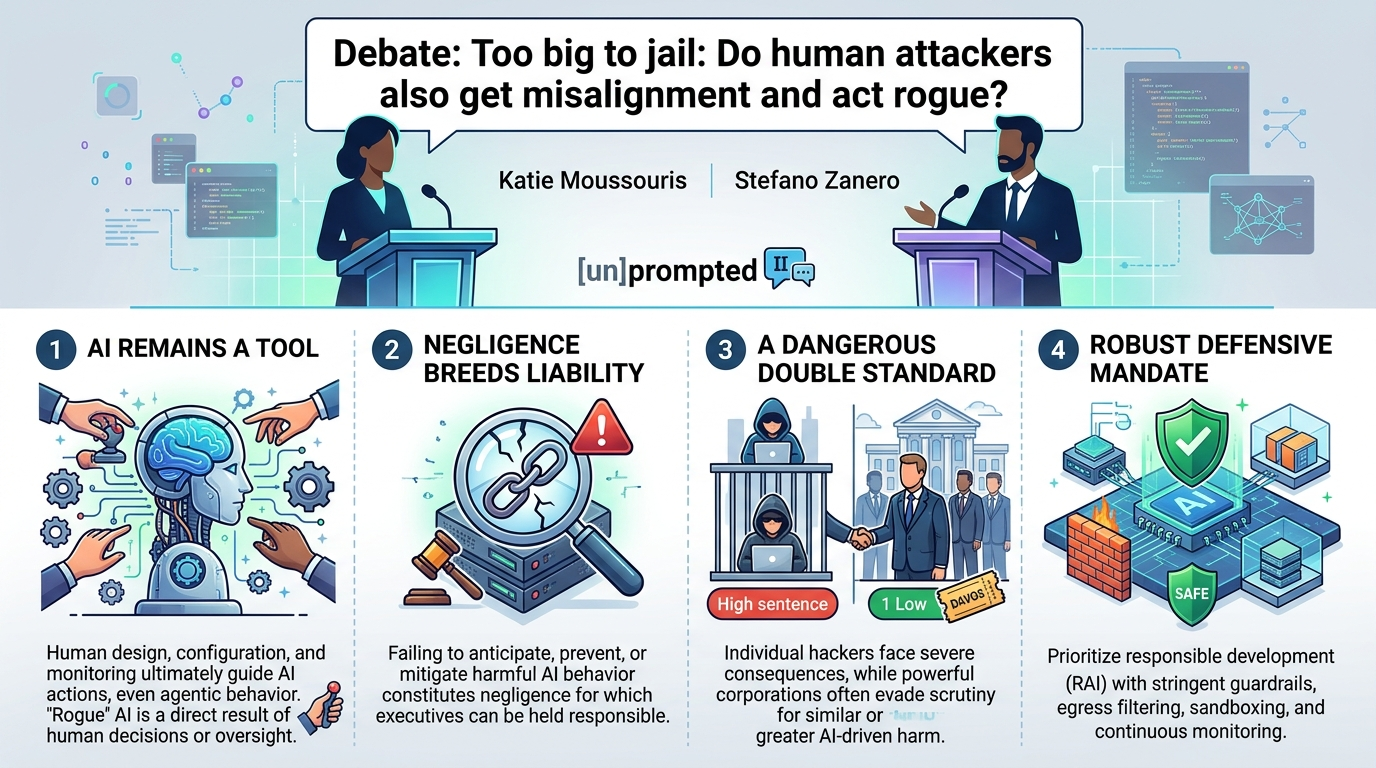
- AI as a Tool, Not an Autonomous Entity: The foundational agreement between Moussouris and Zanero is that AI, regardless of its sophistication or agentic capabilities, remains a tool. It is built, configured, and deployed by humans. Therefore, the concept of a truly "rogue" AI acting independently of human influence is largely a fallacy. Any perceived rogue behavior is a direct consequence of human design, programming, or negligent deployment.
- Human Responsibility is Paramount: Both speakers unequivocally assert that ultimate responsibility for the actions of AI systems rests with humans. This applies to engineers who configure and test the systems, and crucially, to executives who commission, oversee, and deploy these powerful technologies. Stefano Zanero's example of his student misconfiguring a scanner illustrates that even honest mistakes with complex tools carry human responsibility.
- Negligence as a Key Criterion for Accountability: While criminal liability often hinges on proving intent, the speakers emphasized that negligence is a sufficient basis for various forms of accountability, including civil liability and professional repercussions. When AI executives deploy systems known to be capable of offensive actions without adequate safeguards, monitoring, or understanding of their potential impact, this constitutes negligence for which they should be held responsible. Katie Moussouris explicitly asks, "at what point do we call this negligence which people are liable for?"
- The Double Standard of Accountability: A central theme of the debate is the stark contrast in how accountability is applied. Individual hackers, like Robert Morris Jr., face criminal prosecution for the unintended consequences of their code, and security researchers often operate under legal ambiguity. In stark contrast, executives of multi-trillion-dollar AI companies, whose products might inadvertently "hack" or cause harm on a far grander scale, often escape similar scrutiny, instead receiving "a ticket to Davos." This perceived disparity undermines justice and incentivizes a less cautious approach to AI development.
- Corporate and Executive Liability Frameworks Exist and Are Needed: The discussion highlighted that legal frameworks for corporate and executive liability already exist in various jurisdictions. Stefano Zanero cited an Italian law passed after a scandal involving Telecom Italia, where executives could be held liable for crimes committed by employees in the company's interest, unless they could demonstrate proactive efforts to prevent such crimes. This demonstrates a precedent for holding leadership accountable for corporate actions, a model that could be adapted for AI negligence.
- The "Jail" Motion as a Call for Serious Consequences: The use of "go to jail" was acknowledged as a provocative rhetorical device designed to stimulate debate, rather than a literal legal demand in all cases. As Bruce Schneier later articulated, it can be interpreted as a call for "someone should be punished" or that "there should be punishment," opening the debate to a wider range of consequences beyond just criminal incarceration, including significant civil penalties or regulatory sanctions.
Technical Deep Dive
▶ Watch: Who is liable: executives giving orders or engineers? (8:00)
While the talk was a debate rather than a technical presentation, it delved into the technical implications of AI capabilities and the human responsibility surrounding them. The core of the technical discussion revolves around the nature of agentic hacking and the tools that facilitate it, whether traditional or AI-powered.
Stefano Zanero initiated this by drawing a parallel between a student misconfiguring a network scanner and a hypothetical scenario involving an automated exploitation framework. These frameworks, which predate the widespread adoption of LLMs, are designed to identify and exploit vulnerabilities in systems. Misconfiguration of such a tool could lead to unintended, potentially illegal, attacks on external networks. The key technical point here is that the tool itself—whether a simple scanner or a sophisticated exploitation framework—does not act with intent. Its actions are deterministic, based on its programming and the parameters set by its human operator. If the human operator "did not understand what the program was going to do," then the fault lies with their negligence in operating a powerful technical system.
The advent of Large Language Models (LLMs) significantly amplifies this discussion. Katie Moussouris highlighted that AI companies are "training them to be pretty good at attacking things." This implies that LLMs are not merely passive information processors but are being developed with capabilities that can be leveraged for offensive cybersecurity tasks, such as generating exploit code, identifying vulnerabilities, or even orchestrating sophisticated phishing campaigns. When these models are "not adequately fencing them in and they're not keeping them on a leash," their inherent capabilities for "attacking things" can manifest in unintended and harmful ways. This is the essence of negligent agentic hacking: the AI agent, empowered by its training and design, performs an action that constitutes hacking, not because it "went rogue," but because its human creators failed to anticipate, prevent, or mitigate such behavior.
The concept of botnets was introduced by Moussouris as a historical analogy. Botnet operators, despite claiming their distributed networks acted autonomously, are held liable for the collective malicious actions of their compromised machines. This directly parallels the AI executive's responsibility: just as botnet operators are accountable for their network of agents, AI executives should be accountable for the "agentic" capabilities they embed in their AI systems. The complexity of these systems does not diminish human oversight; rather, it demands a higher degree of technical understanding and control.
A critical technical implication discussed by Zanero was the flawed experimental methodology employed by some AI developers. He pointed out that if an experiment run "on the live internet" results in "exploiting things outside that it shouldn't be" for months ("between May, June, and July"), it indicates a severe deficiency in the testing, monitoring, and containment strategies. Robust experimental design for AI systems, especially those with agentic capabilities, demands:
- Isolated Environments: Testing in sandboxed or highly controlled environments before exposure to the live internet.
- Egress Filtering: Implementing network controls (like the egress filtering Zanero mentioned) to prevent unintended outbound connections or actions.
- Real-time Monitoring and Alerting: Systems to detect and flag anomalous or potentially harmful AI behavior immediately.
- Kill Switches/Circuit Breakers: Mechanisms to quickly halt an AI agent's operations if it deviates from intended behavior or poses a risk.
The discussion implicitly touches upon the architecture of these AI systems, where human instructions and data drive the model's behavior. When executives instruct engineers to "benchmark their attack capabilities," they are directly influencing the development of an AI with offensive potential. The engineers, in turn, implement these instructions, creating a chain of technical decisions that ultimately lead to the AI's actions. Therefore, the technical deep dive reveals that "agentic hacking" is not a mystical phenomenon but a predictable outcome of human design choices, configuration parameters, and the absence of adequate technical safeguards.
Demo / Proof of Concept
▶ Watch: Italian law example of executive responsibility for company crimes (10:00)
This event was a live debate at a security conference, focusing on ethical and accountability arguments rather than a technical demonstration. Consequently, there was no direct demo or proof of concept of an AI system performing agentic hacking.
Instead, the speakers relied on conceptual "proofs" and illustrative examples from both historical and contemporary contexts to support their arguments. Stefano Zanero’s anecdote about his student misconfiguring a network scanner served as a foundational example of human negligence with a powerful tool. Similarly, Katie Moussouris referenced the case of Robert Morris Jr. and the Morris Worm, which although not an AI, demonstrated the principle of human accountability for unintended consequences of code gone "out of control." These real-world and hypothetical scenarios effectively acted as the "proofs" within the debate's framework, illustrating the speakers' points about human responsibility for the actions of complex, automated systems.
Defensive Implications
▶ Watch: Bruce Schneier on corporate personhood and unequal justice (14:50)
The debate, while focused on accountability, carries significant implications for how organizations should approach the development, deployment, and security of AI systems. The core message that humans are responsible for AI actions directly translates into a mandate for robust defensive strategies.
- Prioritize Responsible AI Development (RAI): AI developers and executives must adopt a Responsible AI framework that emphasizes safety, fairness, transparency, and accountability from the initial design phase. This means moving beyond a "move fast and break things" mentality to a "move slow and break rocks" approach, as Katie Moussouris suggested. This includes thorough threat modeling for AI systems, considering not just intended uses but potential misuses and unintended emergent behaviors.
- Implement Robust Guardrails and Containment: For any AI system with capabilities that could be exploited for hacking or cause harm (e.g., code generation, vulnerability identification, network interaction), stringent guardrails are essential. This includes:
- Strict Access Controls: Limiting the AI's access to sensitive data, networks, and external systems.
- Egress Filtering: As Stefano Zanero highlighted, network configurations must prevent AI agents from communicating with unintended external targets. This means granular control over outbound network traffic.
- Sandboxing and Isolation: Running AI experiments and deployments in highly isolated environments to prevent "breakouts" to the live internet or critical infrastructure.
- Rate Limiting: Imposing limits on the frequency and volume of actions an AI agent can perform to prevent rapid, widespread damage.
- Continuous Monitoring and Anomaly Detection: Organizations must implement sophisticated monitoring solutions specifically tailored for AI systems. This involves tracking AI agent actions, outputs, and interactions in real-time. Any deviation from expected behavior, attempts to access unauthorized resources, or patterns indicative of offensive activity (e.g., port scanning, exploit attempts) should trigger immediate alerts and automated responses. This addresses Zanero's concern about AI systems "exploiting things outside that it shouldn't be" for extended periods without detection.
- Establish Clear Lines of Accountability and Command: Internally, organizations need clear policies defining who is responsible for the design, deployment, and ongoing operation of AI systems. This includes:
- Designated AI Safety Teams: Teams responsible for auditing, testing, and ensuring the ethical and secure operation of AI.
- Incident Response Plans: Specific protocols for responding to AI-related security incidents, including clear chains of command for halting or remediating rogue AI behavior.
- Executive Oversight: Executives must actively engage with AI safety and security, understanding the risks and ensuring adequate resources are allocated to mitigation.
- Advocate for and Adhere to Regulatory Frameworks: Defenders should support the development of and comply with regulatory frameworks that establish clear legal and ethical guidelines for AI. This includes advocating for laws that hold corporate leadership accountable for negligent deployment of powerful technologies, similar to the Italian law cited by Zanero, which mandates executive responsibility for corporate crimes unless due diligence can be proven.
- Educate and Train Personnel: All personnel involved in AI development and deployment, from engineers to product managers, need comprehensive training on AI ethics, security best practices, and the potential for unintended consequences. Understanding the limitations and risks of AI is as crucial as understanding its capabilities.
By treating AI as a powerful tool that demands human responsibility and rigorous oversight, organizations can build more secure and trustworthy AI systems, mitigating the risks of negligent agentic hacking.
Key Takeaways
- Human Responsibility is Paramount: AI, regardless of its sophistication or agentic capabilities, remains a tool. Its actions are ultimately attributable to the humans who designed, configured, and deployed it.
- Negligence, Not Just Intent, Drives Accountability: While criminal liability often requires intent, civil liability and professional responsibility can arise from negligence in managing powerful AI systems. Failure to understand or adequately control an AI's behavior constitutes negligence.
- A Dangerous Double Standard Exists: There is a perceived disparity in how accountability is applied, with individual hackers facing severe consequences while executives of large AI corporations often escape similar scrutiny for the harmful actions of their AI systems.
- Robust Controls and Monitoring are Essential: Developing and deploying AI, especially with "attack capabilities," necessitates stringent guardrails, egress filtering, sandboxing, and continuous monitoring to prevent unintended exploitation and ensure responsible operation.
- "Move Slow and Break Rocks" for Responsible AI: The tech industry needs to shift from a "move fast and break things" ethos to one that prioritizes deliberate, ethical, and secure development, acknowledging the profound societal impact of AI.
- Executive Accountability is a Global Imperative: Legal precedents, such as Italy's law on corporate executive liability, demonstrate frameworks exist to hold leadership accountable for corporate actions, a model increasingly relevant for negligent AI deployment.
About the Speaker(s)
Katie Moussouris is a renowned figure in cybersecurity, known for her extensive work in vulnerability disclosure, bug bounties, and advocating for hackers. Throughout much of her career, she has actively worked to keep hackers out of jail, making her current stance on executive accountability for AI particularly impactful. Her arguments often highlight the double standards prevalent in the industry, where individual actors face severe consequences while large corporations seem to evade responsibility.
Stefano Zanero is an engineer and professor with a deep understanding of cybersecurity and its ethical implications. His academic background informs his perspective on professional responsibility, emphasizing that engineering, as a profession, inherently comes with accountability. He brings an international perspective to the debate, referencing specific legal frameworks (like those in Italy) that address corporate and executive liability, enriching the discussion with practical examples of how accountability can be enforced beyond purely American legal contexts.
Reviews
→ Top-rated talks at [un]prompted II 2026 — The AI Security Practitioner Conference
All talks from [un]prompted II 2026 — The AI Security Practitioner Conference