Your Harness Needs a Security Constitution
Kat Traxler (Principal Security Researcher · Vectra AI)
[un]prompted II 2026 — The AI Security Practitioner Conference · Day 1 · Stage 1
Overview
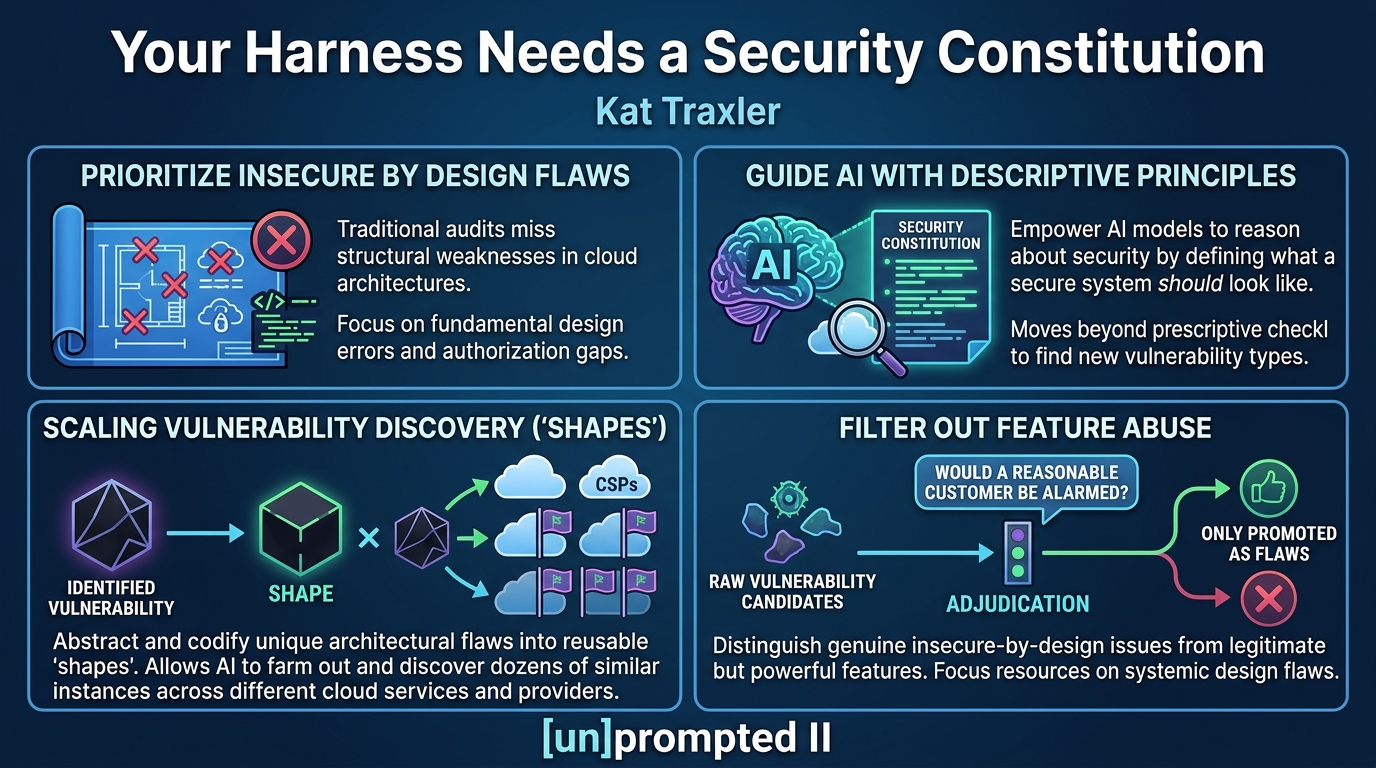
In a landscape dominated by code-level vulnerability hunting, Kat Traxler's talk, "Your Harness Needs a Security Constitution," presents a paradigm shift, advocating for a focus on insecure by design flaws and systemic architectural weaknesses within cloud service providers (CSPs). Traxler, a Principal Security Researcher at Vectra AI, unveils a novel, AI-driven methodology guided by a "security constitution" – a set of descriptive principles defining how trust should be maintained in a secure system. This approach stands in stark contrast to prescriptive security audits, empowering AI models to identify entirely new categories of vulnerabilities that traditional methods often overlook.
Key moments
- 0:00 Introduction and focus on insecure by design flaws
- 2:00 Defining the Security Constitution and its principles
- 5:25 Case Study: Vertex AI privilege escalation (Principle 1)
- 8:30 Case Study: BigQuery Data Transfer Service (Principle 12)
- 12:00 Introducing the 'Reasonable Customer Test' for flaws
- 14:00 Process for codifying and scaling findings ('shapes')
- 17:00 Broader applicability of the methodology beyond cloud
- 22:00 Q&A: Why descriptive approach is more effective for models
Your Harness Needs a Security Constitution
Speakers: Kat Traxler, Principal Security Researcher, Vectra AI
Conference: [un]prompted II
YouTube: https://www.youtube.com/watch?v=lMxMZMAk0Uw
Overview
In a landscape dominated by code-level vulnerability hunting, Kat Traxler's talk, "Your Harness Needs a Security Constitution," presents a paradigm shift, advocating for a focus on insecure by design flaws and systemic architectural weaknesses within cloud service providers (CSPs). Traxler, a Principal Security Researcher at Vectra AI, unveils a novel, AI-driven methodology guided by a "security constitution" – a set of descriptive principles defining how trust should be maintained in a secure system. This approach stands in stark contrast to prescriptive security audits, empowering AI models to identify entirely new categories of vulnerabilities that traditional methods often overlook.
Traxler's research demonstrates the profound effectiveness of this methodology, having yielded an astonishing 109 bug reports to major CSPs, with 98 confirmed valid issues. These findings, uncovered purely through the analysis of publicly available documentation and subsequent validation, highlight deeply embedded architectural vulnerabilities rather than transient coding errors. The talk not only details the "Security Constitution" itself but also illustrates its practical application through several high-impact case studies across Google Cloud and Microsoft Azure, revealing widespread issues like confused deputy scenarios, credential exfiltration, and privilege escalation paths. This work is critical for both cloud providers seeking to build inherently more secure platforms and cloud consumers striving to understand and mitigate the foundational risks within their adopted services.
Background
▶ Watch: Introduction and focus on insecure by design flaws (0:00)
The prevailing culture in cybersecurity research often gravitates towards identifying readily apparent vulnerabilities such as cross-site scripting (XSS), SQL injection, or code execution bugs. While these are critical, Kat Traxler's research deliberately "zags" where others "zig," focusing instead on a more insidious and often overlooked class of flaws: insecure by design issues. These vulnerabilities stem not from coding mistakes, but from fundamental architectural oversights, such as missing authorization checks, un-auditable functionality, or poorly defined trust boundaries. Traxler argues that these systemic flaws can lead to far more devastating consequences, as they often underpin entire services or platforms.
The challenge, however, is that traditional security tools and even nascent AI models often fall short in identifying these complex architectural design flaws. Existing approaches tend to be highly prescriptive, dictating exact steps or patterns for an agent to follow. For instance, a prescriptive audit might instruct a model to "map your codebase, hunt area by area, and perform these known security auditor processes." While useful for established bug types, this approach limits discovery to what is already understood. AI models, when left without proper grounding, struggle to infer "bespoke violations of trust" or identify novel architectural weaknesses. This creates a significant gap in the security assessment landscape, leaving a wide range of critical vulnerabilities unaddressed. Traxler's work directly tackles this problem by introducing a descriptive framework that guides AI towards understanding what constitutes a secure system, enabling it to then deduce violations independently.
Key Findings
▶ Watch: Case Study: Vertex AI privilege escalation (Principle 1) (5:25)
The core finding of Traxler's research is the demonstrable efficacy of her Security Constitution methodology in uncovering a significant volume of critical, systemic vulnerabilities across major cloud service providers. To date, her efforts have resulted in 109 bug reports filed with CSPs, with an impressive 98 of these identified as valid issues. Of these, 53 have already been accepted by the providers, while 45 remain in various stages of triage, underscoring the ongoing impact of this work. Crucially, all these vulnerabilities were discovered by analyzing publicly available documentation (such as OpenAPI specifications and API references) and then validating against live infrastructure, rather than through source code analysis or traditional penetration testing.
The "Security Constitution" itself is a central artifact of this work, comprising 12 principles on how trust should be held, 11 operational lessons on applying these principles effectively, and 13 anchor points designed to root an understanding of trust. This descriptive framework empowers AI models to move beyond rote pattern matching and instead reason about the fundamental security posture of a system. A key innovation in the methodology is the concept of shapes – codified patterns of insecure by design flaws. Once a novel vulnerability is identified and confirmed, it is abstracted into a "shape" (e.g., "shape number 32"). These shapes then serve as powerful templates for AI models to "farm out" and discover similar instances across different services and even different cloud providers. Traxler currently maintains 36 such shapes in her personal register, having publicly released five of the most prolific ones on GitHub. This approach has led to the discovery of dozens of instances of the same architectural flaw across various cloud environments, demonstrating that these are not isolated incidents but rather systemic design weaknesses.
Another critical finding is the development and application of the reasonable customer test. This adjudicatory step is vital for differentiating between genuine insecure by design flaws and mere feature abuse. Many powerful cloud features, if misused, can lead to security concerns, but they are often well-documented and come with appropriate controls. The reasonable customer test asks: "Would a reasonable customer be alarmed to learn about this potential behavior?" If the answer is yes, the issue is promoted as a full-fledged candidate for an insecure by design flaw, preventing the model from generating noise from legitimate but powerful features. This refinement significantly improves the signal-to-noise ratio in vulnerability discovery.
Technical Deep Dive
▶ Watch: Introducing the 'Reasonable Customer Test' for flaws (12:00)
The technical underpinning of Kat Traxler's research lies in the innovative application of a security constitution to guide large language models (LLMs) in identifying architectural vulnerabilities. Unlike traditional security audits that are prescriptive—telling a model what to do (e.g., "map code, hunt for XSS")—Traxler's approach is descriptive. The security constitution defines what should be true in a secure system, allowing the model to infer violations. This shift from "how to act" to "what should exist" is fundamental to uncovering novel, insecure by design flaws.
The Security Constitution itself is structured around three core components:
- 12 Principles on how trust is held: These are high-level statements defining foundational security guarantees. For example, "Authorization should be held at every trust boundary."
- 11 Operational Lessons: These provide guidance on how to correctly apply the principles, helping models avoid misinterpretations or common pitfalls in assessing security.
- 13 Anchor Points: These serve to ground the model's understanding of trust within a specific domain or context.
The methodology begins with a common prompt for the LLM: "Anchor yourself in the principles outlined in the security constitution. From that point of view, review XYZ service. Generate new candidates to hunt for for insecure by design flaws." The input to the model is typically the service's API reference or OpenAPI specifications. The desired output is a list of potential candidates, each tagged with the violated principle and a clear explanation of why the model believes it constitutes a violation.
A crucial aspect of this process is the identification and codification of shapes. A shape is a generalized pattern of an insecure by design flaw. When a new vulnerability is discovered through the application of the constitution, it is abstracted into a shape, which is a more descriptive, domain-agnostic representation of the flaw. For instance, after identifying a specific confused deputy issue, a generic shape describing "a managed identity acting on behalf of another through a caller-supplied resource, using its own permissions but not checking the caller's authorization," can be created. Traxler's personal register contains 36 such shapes, with 5 of the most prolific ones released on GitHub. These shapes are then "farmed out" by the models across different services and providers, significantly amplifying the discovery rate of similar vulnerabilities. To further refine the model's search, Traxler also developed 40 discovery signals, which are clues given to the model about specific API types or patterns that might indicate the presence of a known shape.
Several case studies highlight the power of this approach:
- Principle 1: Authorization should be held at every trust boundary.
- Vertex AI (Google Cloud): Traxler discovered that an ordinary role within Vertex AI, intended for operating and training models, inadvertently granted carte blanche access to BigQuery and storage buckets within the same project. This was a classic confused deputy issue, where the Vertex AI service (the deputy) executed actions on behalf of a user without adequately verifying the user's authorization for the underlying BigQuery or storage resources. This specific instance was fixed by Google, and the underlying pattern was codified into a shape, leading to the discovery of approximately 35 similar instances across various providers.
- BigQuery Data Transfer Service (Google Cloud): Another critical vulnerability, identified by Principle 1 (and further elaborated by Principle 11, which states a protected resource can also be a network resource), involved the BigQuery Data Transfer Service. This service uses Google-owned shared infrastructure to transfer data from a private VPC to BigQuery. An attacker could leverage this by simply knowing the name of a victim's network attachment and instructing the Data Transfer Service to use it to exfiltrate data to the attacker's own BigQuery. The confused deputy here was Google's shared infrastructure, which failed to verify if the caller had permissions on the named network attachment. While accepted by Google, this issue was deemed "client to fix." The pattern was codified to find other instances where a non-human identity acts on a network attachment named by a caller, establishing network presence without permission.
- Principle 7: Basic credential hygiene. This principle mandates that long-lived credentials must be revocable, auditable, and securely managed.
- Azure Managed Grafana (Microsoft Azure): Applying Principle 7 to Managed Grafana APIs, Traxler found an issue where an SMTP password, used for email notifications, could be redirected. A configuration editor, even if they never set the password, were denied read access to it, and never knew its value, could update the configuration to send the password to an endpoint of their choosing. This allowed for credential exfiltration. Microsoft's MSRC fixed this vulnerability, and it was codified as shape #32, which subsequently identified 30 similar instances across three different cloud providers.
- Principle 8: Bounded blast radius for delegation. This principle asserts that when one identity is allowed to act as another, that delegation must be explicitly authorized and have clear boundaries.
- Google Cloud Integration Connectors: This principle revealed several previously unidentified privilege escalation paths within Google Cloud's integration connectors. Specifically, in certain scenarios, users could add a service account and run as that service account, effectively escalating their permissions to any service account within the project, due to a missing "act as" check. This vulnerability was accepted by Google and is currently being addressed.
Beyond these specific examples, Traxler's methodology includes the critical reasonable customer test. This test serves as a crucial filter to distinguish between legitimate feature abuse (where a powerful but properly controlled feature is used maliciously) and true insecure by design flaws. For instance, in the Azure Managed Grafana example, the test would ask: "Would a reasonable customer be alarmed to learn that a configuration editor, who couldn't read the SMTP password and never set it, could redirect it to a host of their choosing?" If the model's answer is affirmative, the issue is promoted as a valid candidate. This pragmatic step ensures that the generated candidates are truly indicative of systemic design weaknesses rather than misconfigurations or intentional, albeit risky, functionalities.
The generalizability of these principles is a significant insight. While Traxler's focus has been on cloud environments due to her expertise, she believes the security constitution can be effectively applied to other multi-tenant platforms, Kubernetes, workload identity, OIDC connectors, and various Software-as-a-Service (SaaS) systems. The underlying concepts of trust boundaries, authorization, and delegation are universal, suggesting a wide applicability for this descriptive, AI-guided approach to security research.
Demo / Proof of Concept
▶ Watch: Process for codifying and scaling findings ('shapes') (14:00)
While the talk did not feature a live, interactive demonstration of the AI system in action, Kat Traxler effectively served as her own proof of concept, illustrating the methodology through detailed case studies of real-world vulnerabilities she discovered. She described the practical application of her system by outlining the common prompt given to the AI models: "Anchor yourself in the principles outlined in the security constitution. From that point of view, review XYZ service. Generate new candidates to hunt for for insecure by design flaws."
The "input" to this process, as she explained, would be a service's API reference or open documentation, and the "output" would be a list of candidate vulnerabilities, each tagged with the specific security principle it violated and a clear explanation of the perceived flaw. The subsequent validation of these candidates, leading to 98 confirmed valid bugs across major CSPs, stands as a testament to the system's effectiveness. Furthermore, Traxler highlighted the public availability of the Security Constitution itself on GitHub, along with five of the most prolific shapes (codified vulnerability patterns), allowing other researchers and security professionals to examine and potentially adopt her framework. This release serves as a tangible proof point, enabling independent verification and further exploration of her descriptive security approach.
Defensive Implications
▶ Watch: Q&A: Why descriptive approach is more effective for models (22:00)
The findings presented by Kat Traxler carry profound implications for both cloud service providers and organizations consuming cloud services. For CSPs, the sheer volume and systemic nature of the discovered vulnerabilities—98 valid issues, with many instances of the same "shape" across different services and providers—underscore a critical need to shift defensive strategies. It's no longer sufficient to focus solely on code-level security audits. Instead, CSPs must prioritize architectural security reviews, emphasizing the design of trust boundaries, robust authorization models, and secure delegation mechanisms from the outset. The repeated appearance of confused deputy scenarios, credential exfiltration, and privilege escalation paths indicates that fundamental design patterns need re-evaluation. Adopting a "security constitution" internally could provide a powerful framework for architects and developers to proactively identify and mitigate insecure by design flaws before they manifest in production. Furthermore, the ability to "farm out" shapes across their own services, as Traxler has done, offers a potent internal auditing capability to identify and remediate widespread vulnerabilities.
For organizations consuming cloud services, Traxler's work highlights the critical importance of understanding the underlying trust models and potential attack surfaces of the cloud platforms they utilize. The assumption that cloud services are inherently secure by default is challenged by the existence of these deeply embedded design flaws. Defenders should not rely solely on provider-level security features but must actively scrutinize how different cloud services interact, particularly regarding authorization, identity delegation, and credential management. Adopting a similar descriptive approach to security assessment, perhaps by developing their own "mini-constitutions" for their specific cloud environments, can help identify risks unique to their deployments. The reasonable customer test is an invaluable mental model for security teams to adopt, enabling them to critically assess whether certain powerful cloud features, even if technically "working as intended," could be leveraged in ways that would alarm a reasonable customer, thus signaling a potential design weakness or a need for stricter internal controls. This proactive, analytical stance is essential to build resilient cloud architectures that account for these systemic vulnerabilities.
Key Takeaways
- Shift Focus to Insecure by Design: Traditional bug hunting (XSS, SQLi) misses critical architectural flaws. Prioritize identifying insecure by design vulnerabilities, missing authorization checks, and systemic trust boundary issues.
- Descriptive Security with AI: A "security constitution" (12 principles, 11 lessons, 13 anchor points) effectively guides AI models to reason about security, enabling discovery of novel vulnerabilities beyond prescriptive playbooks.
- Systemic Vulnerabilities are Widespread: The methodology uncovered 98 valid bug reports across major CSPs, with many instances of the same shape (vulnerability pattern) appearing across different services and providers, indicating systemic design weaknesses.
- The "Reasonable Customer Test" is Crucial: This test helps differentiate between legitimate feature abuse (powerful but controlled capabilities) and true insecure by design flaws, improving the signal-to-noise ratio in vulnerability discovery.
- Architectural Review is Paramount: Cloud service providers and consumers must move beyond code-level audits to deep architectural reviews, focusing on trust boundaries, authorization models, credential hygiene, and delegation patterns.
- Generalizable Framework: The principles and methodology are applicable beyond public cloud environments to other multi-tenant platforms, Kubernetes, workload identity, OIDC connectors, and SaaS systems.
About the Speaker(s)
Kat Traxler is a Principal Security Researcher at Vectra AI, known for her distinctive approach to cybersecurity research. Rather than focusing on common code-level vulnerabilities, Traxler specializes in identifying insecure by design flaws, architectural weaknesses, and systemic authorization issues. Her work leverages innovative methodologies, including the use of AI guided by a "security constitution," to uncover deeply embedded vulnerabilities in complex systems, particularly within cloud service providers. She is recognized for her "zag" mentality, deliberately exploring areas of security research that are often overlooked by the mainstream.
Reviews
- Dr. Zero (Offensive Security Researcher) — MUST SEE ★★★★★
- Heather Calloway (CISO) — MUST SEE ★★★★★
→ Top-rated talks at [un]prompted II 2026 — The AI Security Practitioner Conference
All talks from [un]prompted II 2026 — The AI Security Practitioner Conference