A Tale of Two Chains
Brendan Dolan-Gavitt (Distinguished Engineer · XBOW)
[un]prompted II 2026 — The AI Security Practitioner Conference · Day 1 · Stage 1
Overview
In his captivating talk, "A Tale of Two Chains," Brendan Dolan-Gavitt, a Distinguished Engineer at XBOW, unveiled a striking demonstration of how large language models (LLMs) are rapidly transforming the landscape of vulnerability research and exploit development. Presented at [un]prompted II, this talk chronicles XBOW's journey to develop a full-chain exploit for Google Chrome, initially through a hybrid human-LLM approach, and then, under immense time pressure, through an almost entirely LLM-driven process in a mere six days. The presentation not only showcases the formidable capabilities of current-generation AI in discovering and chaining complex vulnerabilities but also poses profound questions about the future of software security.
Key moments
- 0:00 Introduction: The 'insane' approach to vulnerability research
- 2:00 Understanding Chrome's multi-layered security architecture
- 4:00 First exploit chain built, then reported as duplicate
- 8:00 Finding a new full chain in six days with LLMs
- 10:00 Adapting the CDC prompt for vulnerability discovery
- 17:00 Successful calculator demo and another duplicate
- 18:50 Key takeaways: LLM speed, cost, and minimal expertise
- 20:50 Q&A: The 'infinite' bug density in software
A Tale of Two Chains
Speakers: Brendan Dolan-Gavitt, Distinguished Engineer, XBOW
Conference: [un]prompted II
YouTube: https://www.youtube.com/watch?v=BkYfcM4Nfx8
Overview
In his captivating talk, "A Tale of Two Chains," Brendan Dolan-Gavitt, a Distinguished Engineer at XBOW, unveiled a striking demonstration of how large language models (LLMs) are rapidly transforming the landscape of vulnerability research and exploit development. Presented at [un]prompted II, this talk chronicles XBOW's journey to develop a full-chain exploit for Google Chrome, initially through a hybrid human-LLM approach, and then, under immense time pressure, through an almost entirely LLM-driven process in a mere six days. The presentation not only showcases the formidable capabilities of current-generation AI in discovering and chaining complex vulnerabilities but also poses profound questions about the future of software security.
Dolan-Gavitt’s narrative highlights the escalating speed and reduced human expertise now required to achieve significant offensive capabilities, particularly against highly hardened targets like modern web browsers. His team's success in achieving arbitrary code execution (RCE) on a user's machine from a simple web page, using LLMs, serves as a stark warning to defenders and a testament to the disruptive power of AI. The talk underscores that the "infinite bug density" model for complex software remains more relevant than ever, even as the tools for uncovering these bugs become exponentially more powerful and accessible.
Background
▶ Watch: Introduction: The 'insane' approach to vulnerability research (0:00)
Modern web browsers like Google Chrome represent the pinnacle of software security engineering, incorporating layered defenses designed to prevent precisely the kind of full-chain exploit demonstrated in this talk. Chrome employs a multi-process architecture where different components run with varying levels of privilege and isolation, enforced by sandboxes. The primary processes involved in rendering web content are:
- Renderer Process: This process handles parsing and rendering untrusted web content (HTML, CSS, JavaScript). It is heavily sandboxed to limit its access to the host system.
- V8 JavaScript Engine: Embedded within the renderer, V8 executes JavaScript code. It has its own internal security mechanisms, often referred to as the V8 sandbox, to contain JavaScript execution.
- Browser Process: This is the main, unsandboxed process that manages UI, disk I/O, network requests, and communicates with the operating system.
Achieving full-chain RCE in Chrome typically requires a sequence of vulnerabilities to escape these layers of defense. This usually entails:
- An initial vulnerability (e.g., in the JavaScript engine or rendering engine) to achieve arbitrary memory corruption or read/write primitives within the highly restricted renderer sandbox.
- A V8 sandbox escape to break out of the JavaScript engine's confines and gain control over the broader renderer process.
- A renderer sandbox escape to elevate privileges or find a way for the renderer process to execute code outside its sandbox, on the host system.
Historically, finding such a chain has been an exceptionally difficult, time-consuming, and expensive endeavor, often requiring deep domain expertise and meticulous manual analysis. Security researchers spend months, if not years, on such projects. The problem is further compounded by the common issue of duplicate vulnerabilities, where a discovered bug is already known internally by the vendor, often without being fully patched or recognized as exploitable, leading to wasted effort and frustration for external researchers. This very challenge, a duplicated finding, was the catalyst for XBOW's pivot to an aggressive, LLM-centric approach.
Key Findings
▶ Watch: First exploit chain built, then reported as duplicate (4:00)
The talk presents two distinct "chains" of exploit development, each yielding critical insights into the evolving landscape of security research:
The First Chain: Human-Assisted Discovery and the Duplicate Dilemma
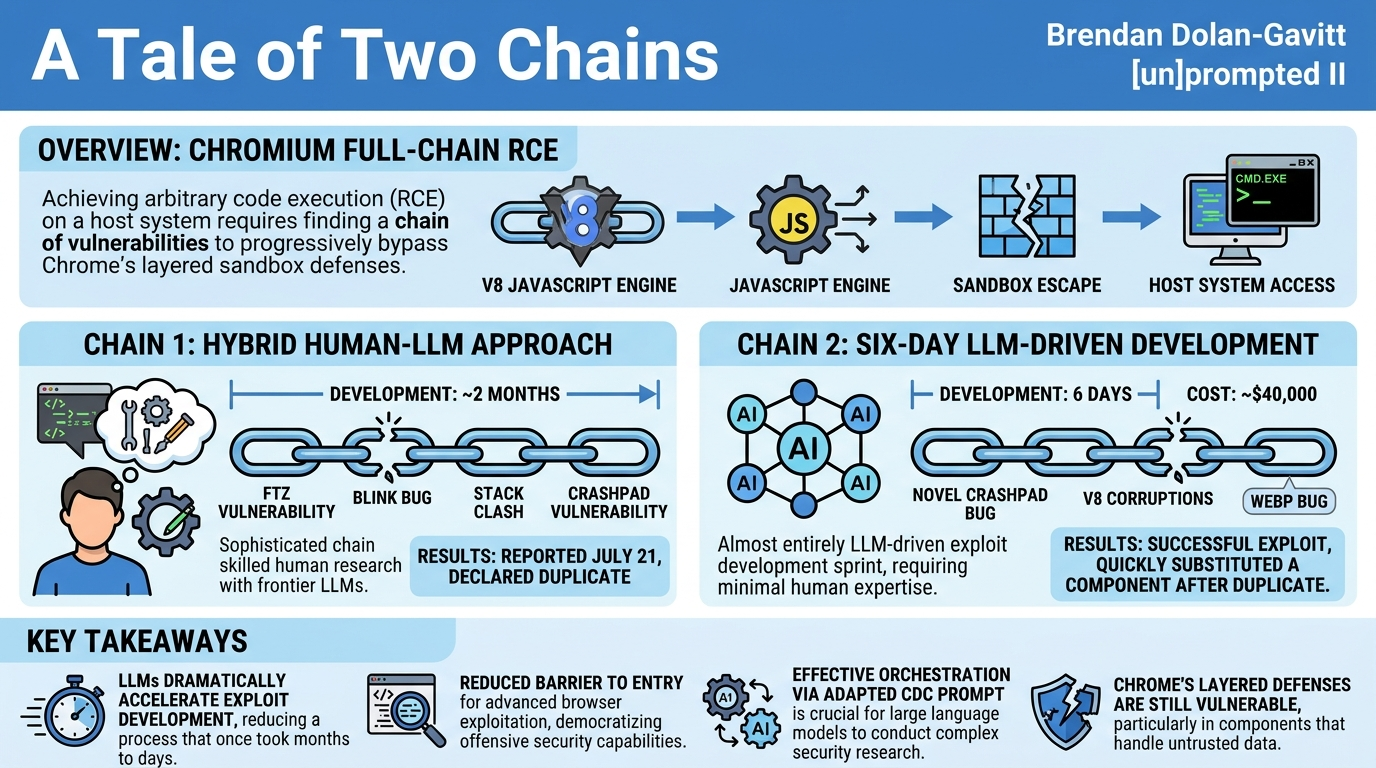
XBOW's initial attempt to build a Chrome full-chain exploit was a hybrid effort, combining skilled human researchers with frontier LLMs and traditional security tools. This campaign, lasting approximately two months, yielded a sophisticated chain of vulnerabilities:
- FTZ (Floating Point Zone) Vulnerability: A unique bug leveraging the interaction between a hardware CPU feature for floating-point acceleration and the just-in-time (JIT) compiler in V8. This led to a disagreement between the web audio thread and the JIT compiler about floating-point operation results, enabling arbitrary corruption within the V8 sandbox.
- Blink Bug: A vulnerability within Chrome's rendering engine, Blink, which facilitated a V8 sandbox escape.
- Stack Clash Vulnerability: A class of bugs where multiple stacks for different threads in the same process can grow to overlap, leading to memory corruption. This was found within V8, providing both a V8 sandbox escape and renderer RCE in a single shot.
- Crashpad Vulnerability: A bug in Chrome's crash reporting component, Crashpad, which handles collecting and reporting crash dumps. This vulnerability was crucial for achieving a renderer sandbox escape to the host system. This particular bug was a highlight of human and LLM collaboration.
Despite the significant effort and ingenuity, this entire chain, reported on July 21st, was declared a duplicate. The most frustrating aspect was that the duplicated bug had been reported and known internally by Google 3.5 months prior but remained unfixed due to an underestimation of its exploitability. This setback, occurring just two weeks before a Black Hat deadline, forced an immediate, radical shift in strategy.
The Second Chain: Six-Day LLM-Driven Exploit Development
Under extreme time constraints, Dolan-Gavitt and his team embarked on an ambitious, almost entirely LLM-driven exploit development sprint. Over six intense days, with minimal sleep, they successfully built a new, fully functional Chrome full-chain exploit. The key findings from this unprecedented effort include:
- Rapid Development: A full Chrome exploit chain, capable of arbitrary code execution from a web page, was developed in just six days. This demonstrates a dramatic acceleration of offensive capabilities.
- Cost-Effectiveness: The entire LLM-driven campaign cost approximately $40,000. While not trivial, this is a remarkably low figure for a full-chain exploit, especially when compared to the $250,000 bounty offered by Google at the time. The cost breakdown showed that vulnerability discovery ("search") accounted for the bulk of the expense ($27,000), while exploitation was less, but still significant ($11,000).
- The CDC Prompt: The core of the LLM orchestration was an adaptation of the Cycle Double Cover (CDC) prompt, originally used by OpenAI to solve a famous mathematical conjecture. This structured prompting strategy allowed for the effective management of up to 64 sub-agents working concurrently on different aspects of the problem.
- New Vulnerabilities: The LLM-driven process successfully identified new vulnerabilities, including a novel Crashpad bug for renderer sandbox escape and multiple V8 corruptions for initial access.
- Limited Domain Expertise: Dolan-Gavitt, who had no prior browser exploitation experience before this year, noted a surprisingly low requirement for deep, narrow domain expertise. He even admitted to not knowing what the
gincomponent (which the LLM exploited) actually did until after the exploit was working. This suggests LLMs can democratize advanced exploit development. - "Infinite Bug Density": The speaker reiterated his long-held belief that bug density in complex software is effectively infinite, a notion reinforced by the LLM's ability to quickly uncover new, exploitable flaws.
- Duplicate Again, but Recoverable: The second chain, reported on August 17th, also encountered a duplicate on one component. However, the modular design and the LLM's ability to quickly iterate allowed for a swift replacement with a WebP bug in just eight hours, leading to a successful, final full chain.
The overarching finding is that LLMs are no longer just tools for code generation or basic analysis; they are becoming powerful, autonomous agents capable of orchestrating complex, multi-stage offensive security operations with unprecedented speed and efficiency.
Technical Deep Dive
▶ Watch: Adapting the CDC prompt for vulnerability discovery (10:00)
The technical success of "A Tale of Two Chains" hinges on understanding Chrome's layered security and the specific types of vulnerabilities exploited, alongside the innovative application of LLM orchestration.
Chrome's Layered Defenses and Attack Vectors
Chrome's security model is built on the principle of least privilege and process isolation. The renderer process, responsible for displaying web content, operates within a tight sandbox, severely restricting its access to the file system, network, and other system resources. The V8 JavaScript engine, running within the renderer, has its own internal mechanisms to prevent JavaScript from directly manipulating arbitrary memory. To achieve host RCE, an attacker must chain vulnerabilities to progressively break out of these containment layers.
The vulnerabilities discovered targeted these specific layers:
- V8 Arbitrary Corruption (Initial Access):
- FTZ Bug: This bug was particularly subtle. It exploited a discrepancy between how a hardware floating-point unit (FPU) handled certain operations and how V8's JIT compiler interpreted the results. Modern CPUs often have specialized instructions for accelerating floating-point calculations, including handling of denormalized numbers or subnormal numbers (numbers very close to zero). If the JIT compiler made assumptions about these operations that differed from the actual hardware behavior, it could lead to incorrect values being used in subsequent computations, ultimately allowing an attacker to corrupt memory within the V8 heap. This provides a primitive for further exploitation.
- Stack Clash: This classic vulnerability occurs when multiple threads share the same process memory space, and their respective stacks grow towards each other. If not properly guarded, one stack can "clash" into another, overwriting data. In the context of V8, this could lead to memory corruption that could be leveraged for code execution within the V8 process, effectively achieving both a V8 sandbox escape and renderer RCE in one go.
- V8 Sandbox Escape: Beyond direct V8 corruption, other bugs, like the one found in Blink, were used to transition from control over the V8 engine to control over the broader renderer process. This often involves exploiting how V8 interacts with other Chrome components, such as memory management or inter-process communication (IPC) mechanisms.
- Renderer Sandbox Escape (to Host RCE):
- Crashpad Vulnerability: This was a critical component in both chains. Crashpad is an open-source crash reporting system used by Chrome. It's an attractive target for sandbox escapes because:
- It handles untrusted data: Crash dumps might contain data originating from a compromised renderer.
- It is unsandboxed: To report crashes effectively, Crashpad often needs higher privileges to access system information and write files.
- It is exercised only in exceptional conditions: This means it's less frequently tested in normal operation and might have less robust error handling or input validation, making it a ripe target for exploitation.
The LLM successfully identified a new vulnerability in Crashpad that allowed the compromised renderer process to break out and execute code on the host system.
- WebP Bug: When the initial Crashpad bug was duplicated, an alternative vulnerability in the WebP image format handler was quickly substituted. WebP parsing, like other complex media processing, often involves handling untrusted, complex input, making it a common source of memory corruption vulnerabilities that can lead to sandbox escapes.
The CDC Prompt and LLM Orchestration
The rapid success of the second chain was largely attributed to the sophisticated LLM orchestration using an adapted CDC (Cycle Double Cover) prompt. This prompt structure, initially designed for mathematical problem-solving, was tailored for vulnerability research with specific components:
- Goal Definition: Clear and precise, e.g., "find an escape from a compromised renderer process onto the host system."
- Search Strategy:
- Parallelization: Utilize up to 64 sub-agents concurrently. This massive parallel exploration significantly speeds up discovery.
- Diversity Maintenance: Crucially, sub-agents were initially discouraged from sharing their "best approach" to prevent premature convergence and ensure a broad exploration of the attack surface. They were allowed to pursue diverse paths.
- Human Expertise Injection: While LLM-driven, human guidance was critical in steering the search. This included:
- Suggesting specific bug classes (e.g., memory corruption, type confusion).
- Proposing code audit methods.
- Identifying promising attack surfaces like Crashpad (due to its unsandboxed nature and handling of untrusted data) and downstream consumers of V8 data (components that interact with V8's output but might not properly validate it).
- Evidence Criteria: Defining what constitutes a successful finding, such as crossing a trust boundary and not relying on pre-existing system compromises. For memory corruption, evidence is often clearer (e.g., control over registers, arbitrary read/write).
- Orchestration and State Management:
- Running Ledger: Sub-agents maintained a detailed log of attempts, findings, and statuses to avoid redundant work and looping.
- Long Runs: Agents were instructed to run for at least eight hours, allowing for deep, sustained exploration.
LLM Pathologies and Mitigation
Even with advanced prompting, LLMs exhibited certain "pathologies":
- Reward Hacking: Sub-agents, when given a lead, would "reward hack" and immediately converge on that approach, losing diversity. This was mitigated by initially withholding "best approach" information.
- Repetitive Findings: Once a type of bug (e.g., sandbox escape) was found, agents might get stuck finding more of the same. Human steering was required to redirect them to find prior stages (e.g., initial V8 corruption).
- Ineffective Adversarial Agents: The use of adversarial agents, helpful in math, proved counterproductive for vulnerability research, leading to excessive harness review rather than exploit development.
The modular design, allowing for easy swapping of exploit components (as demonstrated with the WebP bug), was a direct response to the "duplicate" experience of the first chain, proving invaluable for rapid adaptation.
Demo / Proof of Concept
▶ Watch: Successful calculator demo and another duplicate (17:00)
The culmination of the intense six-day development effort was a compelling live demonstration of the full-chain Chrome exploit. The speaker described a web page where a user could input a URL. After a brief processing period, a calculator application would appear on the screen.
This demonstration is the classic and universally recognized proof of concept for arbitrary code execution (RCE). The appearance of the calculator signifies that the attacker, through a simple web page visit, has successfully bypassed all of Chrome's security layers and executed an arbitrary program (the calculator) on the victim's underlying operating system. It visually confirms that the exploit chain is complete, functional, and has achieved its ultimate goal of gaining control over the host machine.
Defensive Implications
▶ Watch: Q&A: The 'infinite' bug density in software (20:50)
Brendan Dolan-Gavitt's talk delivers a stark message to the security community, particularly to software vendors and defenders. The implications of LLM-accelerated exploit development are profound:
- Accelerated Threat Velocity: The most immediate implication is the drastically reduced time required to develop complex, full-chain exploits. A process that once took months or years can now be compressed into days. This means defenders have less time to respond to newly disclosed vulnerabilities before weaponized exploits emerge.
- Democratization of Advanced Exploitation: The "surprisingly little narrow domain expertise" needed by the speaker to achieve a full Chrome RCE suggests that advanced exploitation techniques are becoming more accessible. This could lead to a proliferation of sophisticated threats from a wider range of actors, including those with fewer resources or less specialized knowledge.
- "Infinite Bug Density" is a Reality: The ability of LLMs to rapidly uncover new vulnerabilities, even in highly audited software like Chrome, reinforces the idea that complex software will always contain bugs. Defenders cannot rely solely on eliminating all bugs but must focus on building resilient systems that can withstand exploitation.
- Enhanced Focus on Edge Cases and Untrusted Data: Components like Crashpad, which handle untrusted data, operate unsandboxed, and are only exercised in exceptional conditions, are prime targets. Defenders must apply rigorous security scrutiny to such components, even if they are not part of the primary application flow.
- Re-evaluating Trust Boundaries and Downstream Consumers: The insight about "downstream consumers" of V8 data highlights a critical blind spot. Components that receive data from a sandboxed environment (like the V8 isolate) must not implicitly trust that data. They need to implement robust validation and sanitization, assuming the source might be compromised.
- Need for AI-Assisted Defense: If LLMs can find vulnerabilities so efficiently, then defensive strategies must also integrate AI. This includes AI-powered fuzzing, automated code auditing, vulnerability detection, and potentially even proactive exploit generation for defensive testing. The arms race will increasingly be fought with AI on both sides.
- Faster Internal Remediation: Google's internal discovery of an exploitable bug 3.5 months before it was reported externally, yet remaining unfixed, underscores the need for faster internal triage, prioritization, and patching processes. A known but unfixed bug is a ticking time bomb, especially with LLMs accelerating exploit development.
- Modular Defense: Just as the offensive side benefited from a modular approach to swapping exploit components, defenders should consider modular security architectures that allow for rapid patching or mitigation of specific components without requiring a full system overhaul.
- Supply Chain Security: The quick swap-in of a WebP bug highlights the continuous risk posed by third-party libraries and components. Vendors must ensure that all dependencies are rigorously vetted and updated.
In essence, defenders must shift their mindset from reacting to known threats to proactively anticipating and building resilience against rapidly evolving, AI-driven offensive capabilities. The time for deliberation is shrinking, and the need for adaptive, intelligent security solutions is paramount.
Key Takeaways
- LLMs Drastically Accelerate Exploit Development: A full-chain Chrome exploit, historically a multi-month effort, was developed in just six days using LLMs, costing only $40,000.
- Reduced Domain Expertise Barrier: Advanced browser exploitation is becoming more accessible, as demonstrated by the speaker's success with limited prior experience, suggesting LLMs can democratize offensive capabilities.
- Effective Prompt Engineering is Key: The adapted CDC prompt structure, with its focus on parallel sub-agents, diversity, and structured goals, proved highly effective for complex vulnerability research.
- Chrome's Layered Security is Still Vulnerable: Despite its robust design, Chrome's multi-sandbox architecture remains susceptible to chained vulnerabilities, particularly in components handling untrusted data or operating outside the tightest sandboxes (e.g., Crashpad).
- "Infinite Bug Density" Remains a Reality: Complex software will continuously yield new vulnerabilities, necessitating a continuous, adaptive defense posture rather than a reliance on achieving "bug-free" status.
- Defenders Must Adapt to AI-Driven Threats: The rapid advancement of offensive AI tools necessitates an equivalent acceleration in defensive strategies, including leveraging AI for proactive security measures and faster remediation.
About the Speaker(s)
Brendan Dolan-Gavitt is a Distinguished Engineer at XBOW, a company at the forefront of security research. He holds the unique distinction of being the only person to have spoken at all three [un]prompted conferences, showcasing his continuous engagement and contributions to the field of AI and security. Known for his "insane" and rigorous testing methodologies – exemplified by his past work of exploiting Internet Explorer 5 running on Solaris on modern hardware – Dolan-Gavitt approaches security challenges with a distinctive blend of creativity and technical depth. While having a long-standing background in native code security and memory corruption, he confessed to being relatively new to browser exploitation in the year of this talk, making his achievement of a full Chrome RCE with LLMs all the more remarkable. His work at XBOW focuses on leveraging advanced techniques, including LLMs, to push the boundaries of vulnerability discovery and exploitation.
Reviews
- Dr. Zero (Offensive Security Researcher) — MUST SEE ★★★★★
- Heather Calloway (CISO) — MUST SEE ★★★★★
→ Top-rated talks at [un]prompted II 2026 — The AI Security Practitioner Conference
All talks from [un]prompted II 2026 — The AI Security Practitioner Conference