Lightning Talk
G Mark Hardy (CEO · National Security Corporation)
[un]prompted II 2026 — The AI Security Practitioner Conference · Day 3 · Stage 2
Overview
In a landscape often dominated by highly technical disclosures and intricate vulnerability analyses, G Mark Hardy, CEO of National Security Corporation, delivered a refreshingly introspective lightning talk at [un]prompted II, focusing not on a specific cyber threat, but on the fundamental skill of public speaking itself. Titled "Lightning Talk," this presentation served as a meta-discussion, urging cybersecurity professionals to embrace the stage and the myriad benefits that stem from effective communication. Hardy's address diverges from typical conference fare, providing a critical perspective on professional development that is often overlooked in a field prioritizing deep technical expertise.
Key moments
- 0:00 Speaker's intro, Navy, and early career challenges
- 1:50 'Speak every chance you get' - Lena's wisdom
- 2:15 First presentation experience and meeting Admiral Grace Hopper
- 3:00 Practical tips: eliminating fillers, comfortable with silence
- 3:25 Self-training by reviewing presentation transcripts for fillers
- 4:00 How presenting enhances communication and promotability
- 4:40 Overcoming introversion and the profound impact of speaking
The Unspoken Value of Speaking: G Mark Hardy on Communicating in Cybersecurity
Speakers: G Mark Hardy, CEO, National Security Corporation
Conference: [un]prompted II
YouTube: https://www.youtube.com/watch?v=Y4l7mbV5Od4
Overview
In a landscape often dominated by highly technical disclosures and intricate vulnerability analyses, G Mark Hardy, CEO of National Security Corporation, delivered a refreshingly introspective lightning talk at [un]prompted II, focusing not on a specific cyber threat, but on the fundamental skill of public speaking itself. Titled "Lightning Talk," this presentation served as a meta-discussion, urging cybersecurity professionals to embrace the stage and the myriad benefits that stem from effective communication. Hardy's address diverges from typical conference fare, providing a critical perspective on professional development that is often overlooked in a field prioritizing deep technical expertise.
Hardy's talk, while brief, underscores the profound impact that well-articulated ideas can have within the cybersecurity community and beyond. He argues that the ability to convey complex technical concepts, strategic insights, or even the basic necessity of security measures is as crucial as the technical work itself. This presentation is a call to action for introverted professionals, encouraging them to step outside their comfort zones to share their knowledge, foster collaboration, and ultimately drive innovation and defense in an ever-evolving threat landscape. It's a reminder that even the most groundbreaking technical work remains inert without the power of persuasive communication.
Background
▶ Watch: Speaker's intro, Navy, and early career challenges (0:00)
G Mark Hardy's journey into advocating for public speaking is rooted in his own unconventional and challenging career path, which began with a foundational experience in the United States Navy. As an ROTC scholarship recipient, he committed to five years of naval service after graduating from Northwestern University. His passion for what we now call cybersecurity was evident early on, leading him to apply for orders to the National Security Agency (NSA). Despite successfully navigating the rigorous polygraph and application process, Hardy encountered a significant institutional barrier. He received a startling call from Washington, informing him that his orders were being canceled with the now-infamous quote: "The Navy has no need for computer security." This seminal rejection highlights the nascent and often misunderstood state of computer security as a discipline in the past, forcing Hardy to reconsider his active duty path.
Undaunted, Hardy resigned from active duty and transitioned to the reserves, subsequently joining Booz Allen Hamilton, a company he noted for its later association with figures like Edward Snowden, though not during his tenure. It was during his first week at Booz Allen that he received pivotal advice from a colleague named Lena, a seasoned professional he humorously described as "old" at 33 years old. Her simple yet profound counsel—"G Mark, speak every chance you get"—became a guiding principle. Taking this wisdom to heart, Hardy embarked on a quest to secure his first speaking engagement. This was a pre-internet era, requiring faxed forms and persistent follow-ups. After multiple rejections, he finally secured a slot at an ASUS conference in August 1986. This debut was further amplified by the serendipitous experience of sharing the stage with none other than Admiral Grace Hopper, a legendary figure in computer science. Meeting Hopper, a Navy Rear Admiral and pioneer in programming languages, provided a powerful validation and inspiration, cementing his belief in the transformative power of public speaking. He still cherishes a memento from her: 11.8 inches of bellwire, a physical representation of a nanosecond, illustrating her profound impact on his perspective. This rich personal history provides the bedrock for his impassioned argument for why every professional, particularly in cybersecurity, should cultivate their public speaking abilities.
Key Findings
▶ Watch: First presentation experience and meeting Admiral Grace Hopper (2:15)
G Mark Hardy’s lightning talk distilled the multifaceted benefits of public speaking into several compelling "findings" or advantages that extend far beyond the podium, influencing professional growth, career trajectory, and community contribution. These insights are particularly salient for the often-introverted cybersecurity community.
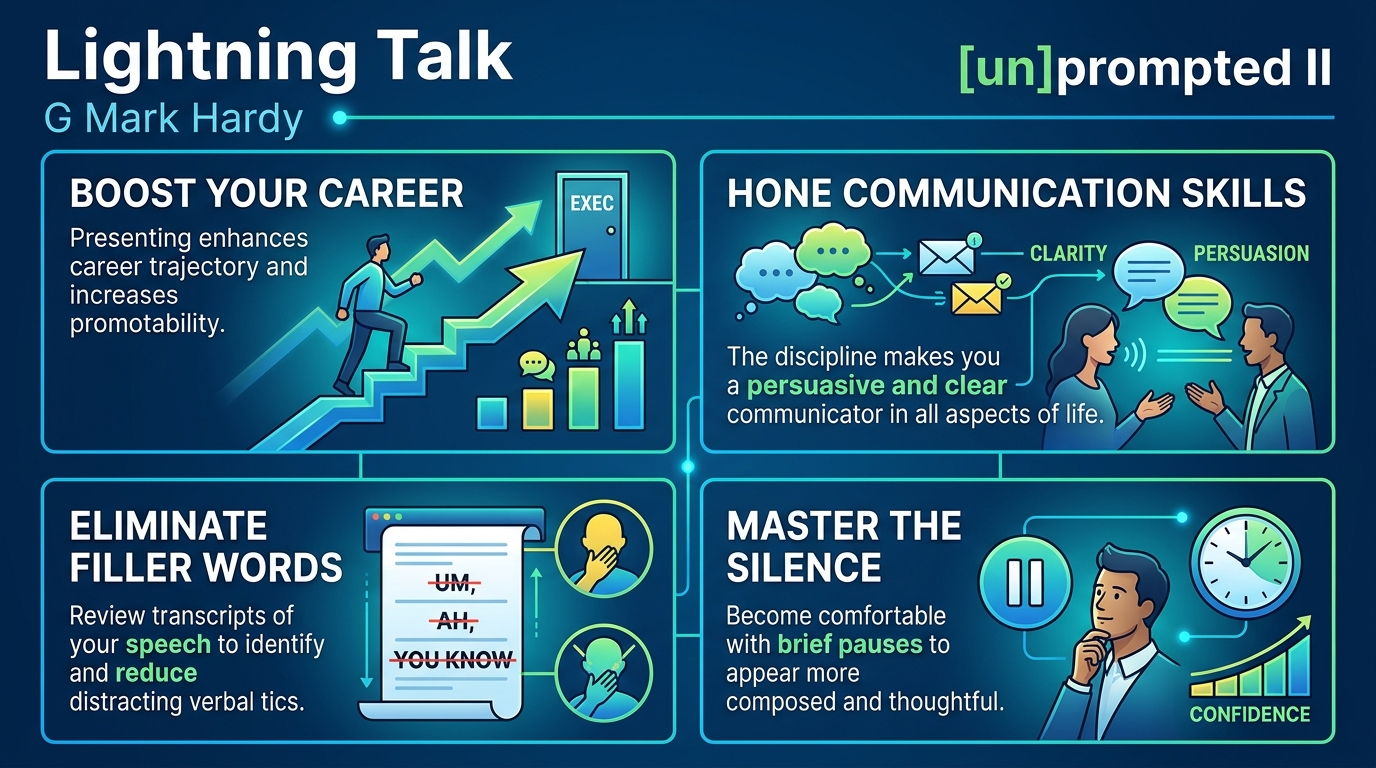
Firstly, Hardy emphasizes that public speaking makes one a better communicator in all aspects of life. The discipline required to articulate thoughts clearly and concisely for an audience translates directly into more effective conversations, clearer emails, and more impactful presentations in everyday professional settings. It hones the ability to convey complex ideas, ensuring that messages resonate and are understood, whether addressing a large conference hall or a small team meeting.
Secondly, developing speaking skills significantly enhances an individual's persuasiveness. When one can confidently and coherently present an argument, whether for a new security protocol, a budget allocation, or a strategic direction, the ability to influence and gain buy-in from others is greatly amplified. Hardy notes that this skill is crucial for cybersecurity professionals who often need to advocate for their initiatives against competing priorities or communicate the urgency of threats to non-technical stakeholders.
A critical, often overlooked finding is the self-discipline public speaking instills in eliminating filler words such as "ums," "ahs," and "you knows." Hardy shared a practical, self-improvement technique: reviewing transcripts of one's own speech. He highlighted how his podcast, "CISO Tradecraft," provides a literal transcript where every filler word is faithfully recorded. This tangible feedback loop enables speakers to identify and consciously reduce these verbal tics, leading to more polished, professional, and impactful delivery. The trick, he advises, is to become comfortable with silence—allowing brief pauses rather than feeling compelled to fill every gap with a sound, which makes the speaker appear more composed and thoughtful.
Furthermore, Hardy asserts that public speaking directly contributes to promotability and career advancement. Individuals who can effectively articulate ideas, represent their teams, and advocate for their people become invaluable assets. They are often chosen for leadership roles because of their ability to communicate vision and strategy, making them the "person who can get the ideas across." This visibility and demonstrated competence set them apart in competitive professional environments.
Finally, and perhaps most importantly for the cybersecurity community, public speaking provides a crucial opportunity to contribute. Hardy posits that everyone possesses "brilliant ideas" and is "doing cool stuff." However, if these insights cannot be shared effectively, their potential impact is severely limited. Whether through conference talks, blog posts, or whitepapers, the act of presenting allows professionals to disseminate knowledge, foster collective intelligence, and advance the state of the art in cybersecurity. For a field that relies heavily on shared intelligence and collaborative defense, this ability to contribute is paramount. He explicitly addresses the common introverted nature of many in the field, encouraging them to overcome the natural reluctance to "embarrass ourselves" for the greater good and profound career difference it makes.
Technical Deep Dive
▶ Watch: Practical tips: eliminating fillers, comfortable with silence (3:00)
This particular lightning talk, delivered by G Mark Hardy at [un]prompted II, did not feature a technical deep dive into specific cybersecurity vulnerabilities, exploit techniques, architectural designs, or protocol analyses. Instead, the focus was entirely on the meta-topic of professional development through public speaking. The content centered on soft skills, communication strategies, and career advice, rather than detailed technical content, code examples, or security architectures pertinent to traditional cybersecurity research.
Demo / Proof of Concept
▶ Watch: How presenting enhances communication and promotability (4:00)
Given the nature of G Mark Hardy's presentation as a motivational and advisory talk on the benefits of public speaking, no live demonstration or proof of concept was presented. The session did not involve any software, hardware, or exploit demonstrations, nor did it showcase any tools, techniques, or procedures related to cybersecurity operations or defense. The speaker's objective was to convey ideas and experiences rather than illustrate a technical capability.
Defensive Implications
▶ Watch: Overcoming introversion and the profound impact of speaking (4:40)
While G Mark Hardy's talk did not directly address specific defensive implications in terms of cybersecurity tools, strategies, or incident response protocols, its core message carries significant indirect value for defenders. The ability to communicate effectively, as championed by Hardy, is a foundational skill that underpins successful defensive operations.
Defenders frequently need to articulate complex threat landscapes, the criticality of vulnerabilities, or the necessity of security investments to non-technical stakeholders, including executives, board members, and end-users. A CISO, for example, must be able to persuasively argue for budget allocation for a new Security Information and Event Management (SIEM) system or to implement Multi-Factor Authentication (MFA) across an organization. Without strong communication skills, even the most technically sound defensive strategies can fail to gain traction or adequate resources.
Furthermore, effective public speaking facilitates the crucial process of threat intelligence sharing within the cybersecurity community. When researchers or practitioners discover new attack vectors, mitigation techniques, or Indicators of Compromise (IOCs), the ability to present these findings clearly and compellingly at conferences, workshops, or internal briefings accelerates collective defense. Hardy's emphasis on discipline in delivery and the elimination of filler words directly contributes to clearer, more impactful dissemination of vital security information, allowing other defenders to absorb and act upon it more efficiently.
In essence, while the talk offers no direct defensive "fix" or technical countermeasure, it highlights the often-underestimated power of communication as an enabling factor for all defensive postures. A defender who can educate, persuade, and clearly convey risk is ultimately more effective at protecting assets than one who cannot, regardless of their technical prowess. Therefore, the "defensive implication" lies in strengthening the human element of cybersecurity—the ability to articulate, advocate, and educate, which are all critical for building resilient security programs.
Key Takeaways
- Embrace Public Speaking for Career Growth: G Mark Hardy strongly advocates for cybersecurity professionals to actively seek opportunities to speak, highlighting that it significantly enhances career trajectory and increases promotability by positioning individuals as effective communicators and thought leaders.
- Hone Communication Skills Beyond the Stage: The discipline acquired through public speaking extends to everyday interactions, making one a more persuasive and clear communicator in conversations, meetings, and written correspondence, which is vital for conveying complex technical concepts.
- Utilize Transcripts for Self-Correction: A practical method for improving speaking habits is to review transcripts of one's own speech, as demonstrated with his "CISO Tradecraft" podcast. This allows for objective identification and elimination of filler words and other distracting verbal tics.
- Master the Power of Silence: Becoming comfortable with brief pauses during speech, rather than filling every gap with "ums" or "ahs," significantly enhances perceived confidence and thoughtfulness, leading to more impactful and professional delivery.
- Contribute to the Community by Sharing Knowledge: Regardless of introversion, sharing "brilliant ideas" and "cool stuff" through presentations is a crucial way to contribute to the collective advancement of the cybersecurity field, fostering collaboration and innovation.
- Overcome Introversion for Professional Impact: While many in cybersecurity may be naturally introverted, stepping outside of one's comfort zone to present can make a profound difference in one's life and career, transforming personal growth into professional influence.
About the Speaker(s)
G Mark Hardy is the CEO of National Security Corporation, bringing a wealth of experience and a unique perspective to the cybersecurity domain. His career began with an unconventional start, having been told by the Navy that there was "no need for computer security" despite his passion for the field. This pivotal moment led him to forge his own path, eventually joining Booz Allen Hamilton and later founding his own enterprise. Hardy is a staunch advocate for professional development and effective communication within the technical community. He is the host of the popular podcast "CISO Tradecraft," where he continues to share insights and foster dialogue on critical aspects of cybersecurity leadership and strategy. His journey from an aspiring Navy computer security specialist to a prominent CEO and thought leader underscores his enduring commitment to the field and his belief in the power of shared knowledge.
Reviews
→ Top-rated talks at [un]prompted II 2026 — The AI Security Practitioner Conference
All talks from [un]prompted II 2026 — The AI Security Practitioner Conference