Lightning Talk
Greg McCord (Cybersecurity Strategist and CISO Advisor · Confide Group)
[un]prompted II 2026 — The AI Security Practitioner Conference · Day 3 · Stage 2
Overview
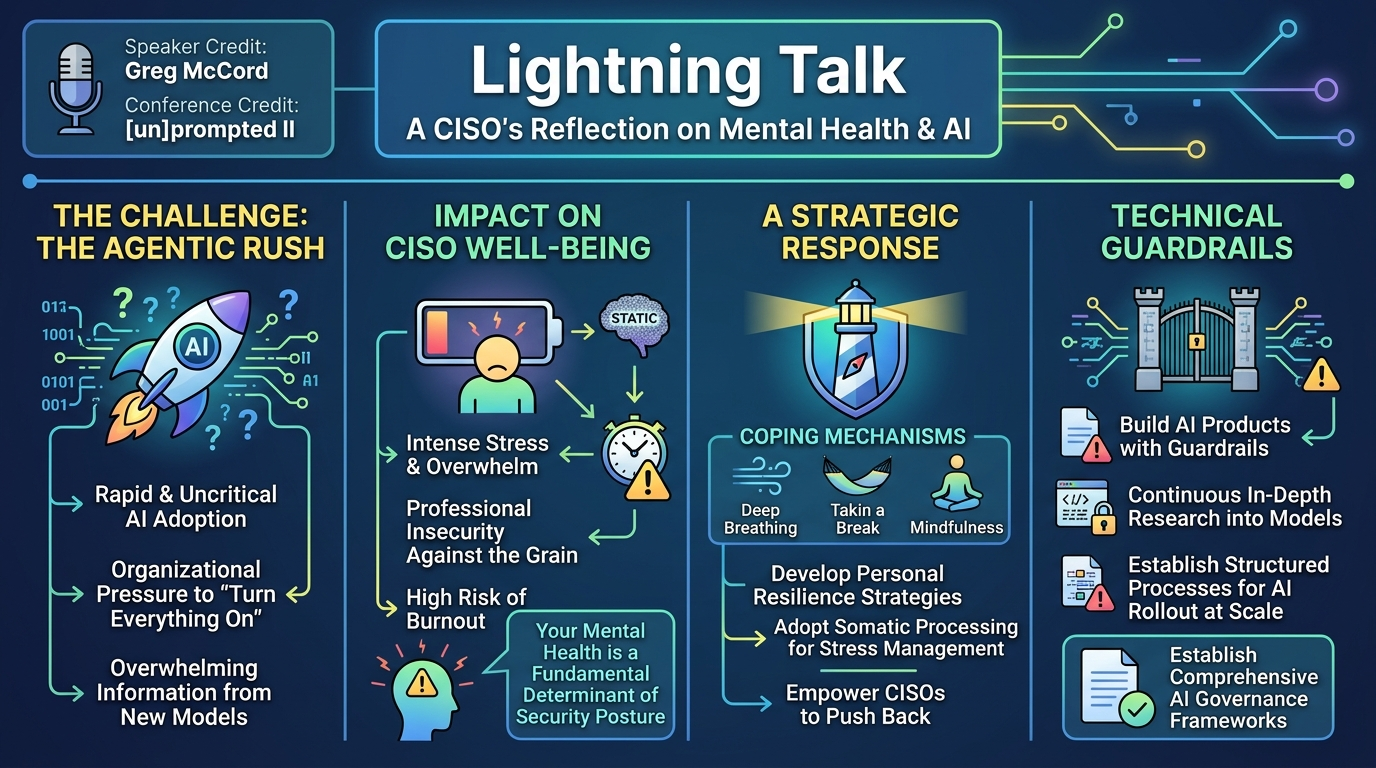
In a landscape increasingly dominated by discussions of AI's transformative potential and existential risks, Greg McCord's lightning talk at [un]prompted II offered a poignant and deeply personal reflection on a critical, yet often overlooked, aspect of cybersecurity: the mental health of its leaders. As Chief Security Officer for the Confide Group and CISO Protector of the CISO Society, McCord leveraged his own experiences to highlight the intense pressure faced by CISOs, particularly during periods of rapid technological change like the current "agentic rush" of AI. His talk served as a vital reminder that while we grapple with the complexities of securing advanced technologies, the well-being of the individuals at the forefront of this battle is paramount.
Key moments
- 0:00 Introduction: CISO's initial AI challenge
- 2:05 Personal coping strategy: changing state of mind
- 2:40 Recognizing research overload and needing breaks
- 3:55 Sharing AI rollout process for other CISOs
- 4:05 Guided deep breathing exercise for calm
- 4:35 Distinguishing effective vs. ineffective coping mechanisms
Lightning Talk
Speakers: Greg McCord, Cybersecurity Strategist and CISO Advisor, Confide Group
Conference: [un]prompted II
YouTube: https://www.youtube.com/watch?v=L_1uZy9sDOI
Overview
In a landscape increasingly dominated by discussions of AI's transformative potential and existential risks, Greg McCord's lightning talk at [un]prompted II offered a poignant and deeply personal reflection on a critical, yet often overlooked, aspect of cybersecurity: the mental health of its leaders. As Chief Security Officer for the Confide Group and CISO Protector of the CISO Society, McCord leveraged his own experiences to highlight the intense pressure faced by CISOs, particularly during periods of rapid technological change like the current "agentic rush" of AI. His talk served as a vital reminder that while we grapple with the complexities of securing advanced technologies, the well-being of the individuals at the forefront of this battle is paramount.
McCord's narrative began with a candid account of his previous role as a CISO for a technology company, where he found himself "against the grain" when advocating for caution and guardrails against the immediate, widespread adoption of AI. This resistance, coupled with an impending management change, plunged him into a period of significant personal and professional overwhelm. The talk pivots from this personal struggle to a broader call for proactive mental health strategies within the security community, emphasizing that effective security leadership is inextricably linked to personal resilience and well-being.
The core message of McCord's presentation resonates deeply within a profession known for its high stress, long hours, and constant threat landscape. By sharing his vulnerability and the coping mechanisms he developed, McCord not only destigmatizes mental health challenges but also offers tangible advice for CISOs navigating similar pressures. His current work at Confide Group, where he is actively building AI products and developing processes for AI rollout at scale, further solidifies his unique perspective, enabling him to bridge the gap between strategic security leadership and the practical implementation of emerging technologies, all while championing a healthier approach to the CISO role.
Background
▶ Watch: Introduction: CISO's initial AI challenge (0:00)
The cybersecurity industry operates under immense pressure, a reality acutely felt by Chief Information Security Officers (CISOs). These leaders are tasked with safeguarding organizational assets against an ever-evolving array of threats, often with limited resources and under the constant scrutiny of executive boards and regulatory bodies. The advent of Artificial Intelligence (AI) has introduced a new layer of complexity and urgency, precipitating what McCord terms the "agentic rush." This phenomenon describes the rapid, often uncritical, adoption of AI technologies across organizations, driven by a desire for innovation, efficiency, or competitive advantage. The inherent problem, as McCord experienced first-hand, is the organizational imperative to "turn everything on" without adequate consideration for security implications, data governance, or ethical safeguards.
Historically, the focus within cybersecurity has predominantly been on technical solutions, threat intelligence, and compliance frameworks. Less attention has been paid to the human element – specifically, the psychological toll on security professionals. This oversight creates a fertile ground for burnout, stress, and mental health crises, particularly for CISOs who bear ultimate responsibility. McCord's experience highlights several systemic issues:
- Organizational Pressure: The drive for rapid innovation can override prudent security practices, putting CISOs in the difficult position of being seen as an impediment rather than an enabler.
- CISO Vulnerability: Being "against the grain" or navigating management changes can lead to professional insecurity and personal distress, as CISOs often find themselves on the "chopping block."
- Lack of Standardized AI Governance: At the time of the "agentic rush," comprehensive frameworks for securely integrating AI were nascent or non-existent, forcing CISOs to develop strategies on the fly.
- Information Overload: The sheer volume of new AI models and technologies requires an overwhelming amount of research and analysis, contributing to stress and extended work hours.
The problem, therefore, is multifaceted: it's not just about securing AI, but about securing the people responsible for securing AI. Prior work in this domain has largely been reactive, addressing burnout after it occurs, rather than proactively building resilience. McCord's talk aims to shift this paradigm, advocating for a proactive approach that integrates mental well-being with robust security strategy, acknowledging that the human factor is as critical as any technological defense. The absence of readily available, battle-tested processes for AI rollout at scale, combined with the intense pressure to innovate, created a void that individual CISOs, like McCord, were forced to fill, often at significant personal cost.
Key Findings
▶ Watch: Recognizing research overload and needing breaks (2:40)
The central discovery illuminated by Greg McCord's talk is the critical intersection of CISO mental health and the strategic adoption of emerging technologies, specifically AI. His personal ordeal underscores a vital, often unacknowledged truth: the psychological well-being of security leaders is not merely a personal matter but a fundamental determinant of an organization's security posture. When CISOs are overwhelmed, under pressure, or facing professional insecurity, their ability to make sound, strategic decisions, push back against risky directives, and effectively lead their teams is severely compromised.
McCord's journey revealed several key findings:
- The Peril of Unchecked AI Adoption: The "agentic rush" to deploy AI without proper guardrails poses significant risks to customer data and overall organizational security. McCord's initial instinct to say "no" or "wait" was proven correct, highlighting the essential role of the CISO as a critical, discerning voice in technology adoption. The pressure to conform, however, often silences this voice, leading to potentially catastrophic outcomes.
- Mental Resilience as a Strategic Asset: McCord's personal spiral into overwhelm demonstrated that mental health challenges can incapacitate even the most experienced security leaders. Conversely, developing effective coping mechanisms, such as somatic processing (as advised by his therapist wife), taking deliberate breaks, and changing one's state of mind, acts as a "recharge of a battery." This resilience allows CISOs to approach complex problems with renewed energy and a fresh perspective, leading to better decision-making and more effective leadership.
- The Necessity of Structured Processes for AI Rollout: Through his current role at Confide Group, McCord has identified and is now implementing a process for how to roll out AI at scale. This finding is critical because it moves beyond mere conceptual "guardrails" to practical, actionable steps. It implies that security leaders can and must develop repeatable, defensible methodologies for evaluating, integrating, and securing AI technologies, rather than reacting ad hoc to organizational demands. This structured approach not only enhances security but also reduces the cognitive load and stress on security teams.
- The Power of Proactive Research and Education: Faced with the overwhelming task of understanding nascent AI technologies, McCord directed his team to "immediately start researching everything they possibly can about every single model." This directive underscores that in an era of rapid technological change, continuous, deep-dive research into new models, their capabilities, and their inherent risks is non-negotiable for effective security. It transforms the CISO's role from a gatekeeper into a knowledgeable strategist, capable of guiding safe innovation.
In essence, McCord's talk reveals that the fight for robust cybersecurity in the age of AI is as much an internal battle for mental fortitude and strategic clarity as it is an external battle against threats. The ability to pause, reflect, and implement structured, human-centric approaches is the ultimate contribution to navigating this complex landscape successfully.
Technical Deep Dive
▶ Watch: Sharing AI rollout process for other CISOs (3:55)
While Greg McCord's talk primarily focuses on the human and leadership aspects of cybersecurity, the underlying technical challenges of the "agentic rush" of AI are implicitly central to his narrative. The speaker's resistance to "turn everything on" without guardrails stemmed from a profound understanding of the technical intricacies and potential vulnerabilities inherent in rapidly deploying nascent AI models. This section will delve into the technical considerations that necessitate such caution, even if the talk itself did not present code or architectural diagrams.
The core technical problem McCord identified was the risk to customer data. When organizations rush to integrate AI, they often overlook crucial data handling protocols. AI models, particularly large language models (LLMs) or machine learning (ML) systems, require vast amounts of data for training and inference. Without proper data governance, organizations risk:
- Data Leakage: Sensitive customer data, intellectual property, or proprietary information can inadvertently be fed into public or third-party AI models, leading to exposure.
- Prompt Injection and Data Poisoning: Malicious actors can manipulate inputs (prompts) to extract sensitive information from AI models or inject corrupted data during training to compromise model integrity and output reliability.
- Insecure API Integrations: AI services are often consumed via APIs. Insecure API design, weak authentication, or lack of rate limiting can create critical attack vectors, allowing unauthorized access or abuse of AI functionalities.
- Model Inversion Attacks: Adversaries can attempt to reconstruct training data from a deployed model, potentially exposing sensitive information that was used to train it.
McCord's directive to his team to "immediately start researching everything they possibly can about every single model" highlights the technical due diligence required. This research would encompass:
- Model Architecture and Training Data: Understanding how a model was built, what data it was trained on, and its inherent biases or limitations. This includes assessing the provenance and cleanliness of training datasets.
- Security of AI Frameworks and Libraries: Evaluating the underlying software stacks (e.g., TensorFlow, PyTorch, Hugging Face) for known vulnerabilities, patch management, and secure configuration best practices.
- API Security and Access Controls: Implementing robust authentication (e.g., OAuth 2.0, API keys with granular permissions), authorization, and auditing for all AI-related APIs. This includes securing both internal and external integrations.
- Threat Modeling for AI Systems: Proactively identifying potential attack vectors specific to AI, such as adversarial examples (inputs crafted to deceive the model), data exfiltration through model outputs, or denial-of-service attacks targeting AI inference engines.
- Compliance and Regulatory Requirements: Ensuring that AI deployments adhere to data privacy regulations (e.g., GDPR, CCPA) and industry-specific compliance standards, especially regarding the handling of sensitive data.
The concept of "guardrails" translates into a series of technical controls and architectural decisions. These could include:
- Secure Sandboxing and Environment Isolation: Deploying AI models and their associated data pipelines in isolated, secure environments to limit the blast radius of a compromise.
- Input/Output Validation and Sanitization: Implementing strict validation and sanitization processes for all data entering and exiting AI models to prevent prompt injection, data exfiltration, or other forms of manipulation.
- Access Control and Least Privilege: Ensuring that only authorized personnel and systems have access to AI models, training data, and inference endpoints, following the principle of least privilege.
- Monitoring and Logging: Implementing comprehensive monitoring and logging for AI model performance, data access, and suspicious activities to detect anomalies and potential attacks. This includes monitoring for model drift or unusual outputs that could indicate compromise.
- Red Teaming and Adversarial AI Testing: Proactively testing AI systems for vulnerabilities using techniques like adversarial example generation to identify weaknesses before they are exploited.
McCord's current work at Confide Group, where he is "building AI products" and developing a "process of how to roll out AI at scale," implies the establishment of a robust AI security framework. This framework would likely incorporate elements of Secure Software Development Life Cycle (SSDLC) adapted for AI, focusing on security from design to deployment. It would involve defining clear roles and responsibilities, integrating security testing into the AI development pipeline, and establishing continuous monitoring and incident response capabilities specifically tailored for AI systems. The technical implication is a shift from generic cybersecurity practices to specialized, AI-centric security engineering.
Demo / Proof of Concept
▶ Watch: Guided deep breathing exercise for calm (4:05)
While Greg McCord's talk did not feature a traditional technical demonstration or a proof of concept in the sense of showcasing code, exploit techniques, or a new security tool, it did include a powerful, albeit non-technical, demonstration of a coping mechanism. This was not a "demo" of a security vulnerability or a defense, but rather a practical illustration of how individuals can manage stress and overwhelm in high-pressure environments.
McCord invited the audience to participate in a simple, yet effective, exercise:
- Stop: Pause from immediate activity.
- Close your eyes: Disengage from visual stimuli.
- Big deep breath in: Inhale slowly and deeply.
- Hold it: Retain the breath for a moment.
- Let it go: Exhale slowly.
He then asked, "Who here felt a slight change in their demeanor?" Acknowledging his own nervousness, McCord highlighted that even this brief exercise could induce a sense of calmness. This "demo" serves as a practical example of somatic processing, a technique his therapist wife advises, which involves observing and addressing physical sensations in the body to manage emotional responses.
The significance of this demonstration lies in its direct connection to the talk's core theme: the mental well-being of cybersecurity professionals. It illustrated that even amidst the high-stakes, fast-paced world of tech and security, simple, accessible techniques can be employed to regain composure and mental clarity. While not a technical PoC, it was a "proof of concept" for mental self-care, demonstrating that proactive engagement with one's internal state can be a powerful tool for resilience, allowing CISOs to "recharge their battery" and approach problems with a clearer mind. This is crucial for making sound technical and strategic decisions in the face of complex challenges like AI adoption.
Defensive Implications
▶ Watch: Distinguishing effective vs. ineffective coping mechanisms (4:35)
Greg McCord's talk, while personal, carries profound defensive implications for organizations and cybersecurity professionals, particularly CISOs. His experience underscores that effective defense against emerging threats like those posed by AI requires not only technical prowess but also robust leadership, strategic foresight, and a commitment to mental well-being.
Here are the key defensive implications:
- Implement Robust AI Guardrails Proactively: Organizations must move beyond ad-hoc AI adoption and establish comprehensive AI governance frameworks. This includes defining clear policies for AI model procurement, development, deployment, and data usage. Technical guardrails should encompass:
- Data Minimization and Anonymization: Only using the necessary data for AI models and anonymizing sensitive information where possible.
- Access Controls: Strict access policies for AI models, training data, and inference APIs.
- Input/Output Filtering and Sanitization: Protecting against prompt injection and data exfiltration.
- Regular Security Audits: Conducting independent security assessments of AI models and their integrations.
- Responsible AI Principles: Embedding ethical considerations, fairness, transparency, and accountability into AI system design.
- Prioritize Deep Research into AI Models: Security teams must dedicate resources to continuous, in-depth research of all AI models, both proprietary and third-party, that an organization intends to use. This involves understanding:
- Model Vulnerabilities: Known weaknesses, biases, and potential for adversarial attacks.
- Data Provenance and Usage: How training data was sourced and whether it contains sensitive information or intellectual property.
- Compliance and Legal Implications: Ensuring AI usage aligns with data privacy regulations (e.g., GDPR, CCPA) and industry standards.
- Supply Chain Security for AI: Assessing the security posture of AI vendors and open-source components.
- Develop Structured Processes for Technology Rollout: Emulate McCord's initiative at Confide Group by creating formal, repeatable processes for integrating any new technology, especially AI. This structured approach ensures that security is baked in from the outset, rather than bolted on as an afterthought. Key elements include:
- Security by Design: Integrating security assessments and controls into the entire development lifecycle of AI applications.
- Cross-Functional Collaboration: Engaging legal, privacy, engineering, and business units in the AI adoption process.
- Risk Assessment Frameworks: Utilizing standardized methodologies to evaluate the security, privacy, and ethical risks of AI systems.
- Pilot Programs and Staged Rollouts: Testing AI solutions in controlled environments before widespread deployment.
- Foster a Culture that Supports CISO Pushback: Organizations must empower CISOs to voice concerns and push back against rapid, insecure technology adoption without fear of professional reprisal. This requires:
- Executive Buy-in: Acknowledging the CISO's strategic role in risk management, not just as a cost center.
- Clear Escalation Paths: Establishing mechanisms for CISOs to raise critical security concerns to the board or executive leadership.
- Psychological Safety: Creating an environment where security professionals feel safe to challenge assumptions and advocate for best practices, even if it delays business initiatives.
- Champion CISO and Team Mental Health: Recognizing that an overwhelmed CISO cannot effectively defend the organization, leadership must prioritize mental wellness initiatives. This includes:
- Promoting Work-Life Balance: Encouraging breaks, managing workloads, and discouraging excessive hours.
- Providing Resources: Offering access to mental health support, stress management training, and resilience programs.
- Destigmatizing Mental Health: Creating an open environment where discussing stress and seeking help is normalized.
- Building CISO Networks: Facilitating peer support groups where CISOs can share experiences and coping strategies, as McCord does through the CISO Society.
By addressing these defensive implications, organizations can build a more resilient security posture, not only against external threats but also against the internal pressures that can undermine even the most robust technical defenses. The human element, specifically the well-being and strategic clarity of the CISO, emerges as a critical, often underestimated, defensive asset.
Key Takeaways
- CISO Mental Health is Paramount: The intense pressure of the cybersecurity role, especially during rapid technological shifts like the "agentic rush" of AI, can severely impact a CISO's mental well-being, directly affecting their ability to lead effectively and make sound security decisions.
- Guardrails are Non-Negotiable for AI Adoption: Rushing to deploy AI without proper security, privacy, and ethical guardrails poses significant risks to customer data and organizational integrity; CISOs must be empowered to advocate for caution and structured implementation.
- Proactive Research is Essential: Security teams must commit to continuous, in-depth research into new AI models and technologies to understand their vulnerabilities, implications, and secure integration requirements.
- Structured Processes Enhance Security and Reduce Stress: Implementing clear, repeatable processes for evaluating and rolling out new technologies, like AI, not only strengthens an organization's security posture but also reduces the overwhelming cognitive load on security professionals.
- Coping Mechanisms are Vital Resilience Tools: Personal strategies such as taking breaks, practicing mindfulness (e.g., deep breathing), and engaging in somatic processing are crucial for managing stress, recharging mental batteries, and maintaining perspective in high-pressure environments.
- Empower CISOs to Push Back: Organizations must foster a culture where CISOs feel supported and empowered to challenge risky business directives without fear of professional repercussions, recognizing their role as critical risk managers.
About the Speaker(s)
Greg McCord is a distinguished cybersecurity strategist and CISO advisor with extensive experience in safeguarding organizational assets amidst evolving threat landscapes. He currently serves as the Chief Security Officer for the Confide Group, where he is actively involved in building AI products and developing robust processes for the secure rollout of AI at scale. In addition to his role at Confide, McCord is also the CISO Protector of the CISO Society, a testament to his commitment to supporting and advocating for his peers in the security community. Prior to his current position, McCord held a CISO role for a technology company, where he experienced firsthand the challenges of navigating rapid technological change and organizational pressure regarding AI adoption, an experience that deeply informs his current insights and advocacy for mental health in the cybersecurity profession.
Reviews
→ Top-rated talks at [un]prompted II 2026 — The AI Security Practitioner Conference
All talks from [un]prompted II 2026 — The AI Security Practitioner Conference