Lightning Talk - Seeing Like a Surveillance State
Lance E. Spencer (Founder, Researcher, Advisor)
[un]prompted II 2026 — The AI Security Practitioner Conference · Day 3 · Stage 2
Overview
In an era defined by rapid technological advancement, the capabilities of surveillance states are undergoing a profound transformation. Lance E. Spencer, a seasoned expert with a distinguished background in US Army active service and a decade at NSA Cyber Command, presented a compelling lightning talk at [un]prompted II titled "Seeing Like a Surveillance State." Spencer, whose past work involved "surveilling surveillance states," now dedicates his research to the risks of artificial intelligence (AI) and its responsible application in national security and public safety. This talk dissects the historical challenges faced by totalitarian regimes in monitoring their populations and illuminates how modern technology, particularly AI, is systematically dismantling the traditional bottlenecks that once limited their power.
Key moments
- 0:00 Introduction and speaker's NSA/Cyber Command background
- 2:00 How totalitarian states collect immense citizen data
- 4:20 Information overload: The 'haystack of needles' problem
- 6:00 Big Tech makes hiding from surveillance impossible
- 8:00 AI eliminates the human bottleneck in analysis
- 10:10 US laws struggle to keep pace with capabilities
Lightning Talk - Seeing Like a Surveillance State
Speakers: Lance E. Spencer, Founder, Researcher, Advisor
Conference: [un]prompted II
YouTube: https://www.youtube.com/watch?v=-gSHjEpwyqg
Overview
In an era defined by rapid technological advancement, the capabilities of surveillance states are undergoing a profound transformation. Lance E. Spencer, a seasoned expert with a distinguished background in US Army active service and a decade at NSA Cyber Command, presented a compelling lightning talk at [un]prompted II titled "Seeing Like a Surveillance State." Spencer, whose past work involved "surveilling surveillance states," now dedicates his research to the risks of artificial intelligence (AI) and its responsible application in national security and public safety. This talk dissects the historical challenges faced by totalitarian regimes in monitoring their populations and illuminates how modern technology, particularly AI, is systematically dismantling the traditional bottlenecks that once limited their power.
Spencer's presentation underscores a critical shift: the transition from human-centric intelligence gathering to an AI-driven, omnipresent surveillance apparatus. He argues that while surveillance states have always been inherently paranoid and data-hungry, the sheer volume of information they could effectively process was historically constrained by human analytical capacity. AI, however, is now dissolving these limitations, enabling unprecedented scale and efficiency in data collection, analysis, and dissemination. The implications are stark: it is becoming exponentially harder for dissidents to evade detection, and the very concept of privacy is being redefined.
The talk serves as a stark warning, particularly for liberal, open societies. Spencer highlights that while the full extent of this AI-powered surveillance state may not yet be "evenly distributed," it is already a lived reality in places like China. The central challenge for Western nations is to reconcile these emerging capabilities with their foundational principles of freedom, civil liberties, and the separation of powers between law enforcement and national security agencies. Understanding the mechanisms and implications of this new surveillance paradigm is not merely an academic exercise but a vital imperative for safeguarding democratic values in the digital age.
Background
▶ Watch: Introduction and speaker's NSA/Cyber Command background (0:00)
Surveillance states operate from a fundamental position of paranoia, driven by a constant, insatiable demand for intelligence. Historically, fulfilling these intelligence requirements involved arduous, human-intensive processes: agents collected information, analysts sifted through it, reports were disseminated, and actions were taken. This complex chain was fraught with inefficiencies, turf wars between various intelligence, law enforcement, and military agencies, and the inherent limitations of human perception and processing. While every security state has its unique characteristics, they all "rhyme" in their core functions, often dividing efforts between foreign intelligence collection, domestic collection, or a blend of both.
A critical distinction Spencer draws is between Western democracies and totalitarian states. In the West, a general trust in the local population typically directs the bulk of security efforts outward, with a clear—though sometimes blurred, as with the FBI's dual mission—separation between law enforcement and national security. Totalitarian states, conversely, allocate half or more of their national security resources inward, precisely because they cannot trust their own citizens. This internal focus manifests in pervasive control mechanisms: mandating citizen registration, approving activities, and leveraging full control over domestic infrastructure. Such states can deploy physical assets like stakeouts and tails, tap telecommunications and cell phone networks at will, install cameras anywhere, and compel access to any commercial data.
One of the most significant historical challenges, even for regimes with total internal control, has been information overload. While collecting immense amounts of data was feasible, transforming that raw data into actionable intelligence was a monumental task. Spencer vividly describes his experience at the NSA, where the problem was rarely finding "a needle in the haystack," but rather dealing with a "haystack of needles"—a deluge of information from which the truly valuable "platinum needles" had to be painstakingly identified amidst "stainless steel" and "silver." This analytical bottleneck, coupled with the ever-present fear of "unknown unknowns"—critical information missed until it was too late—defined the operational reality of intelligence agencies for decades. Even seemingly robust security measures like encryption, while technically sound, often failed to protect individuals in a surveillance state. As Spencer notes, when a state controls all infrastructure and can exert physical coercion, they can simply "use the wrench." Encryption, in such contexts, can ironically make an individual stand out, flagging them for further scrutiny rather than providing true anonymity.
Key Findings
▶ Watch: Information overload: The 'haystack of needles' problem (4:20)
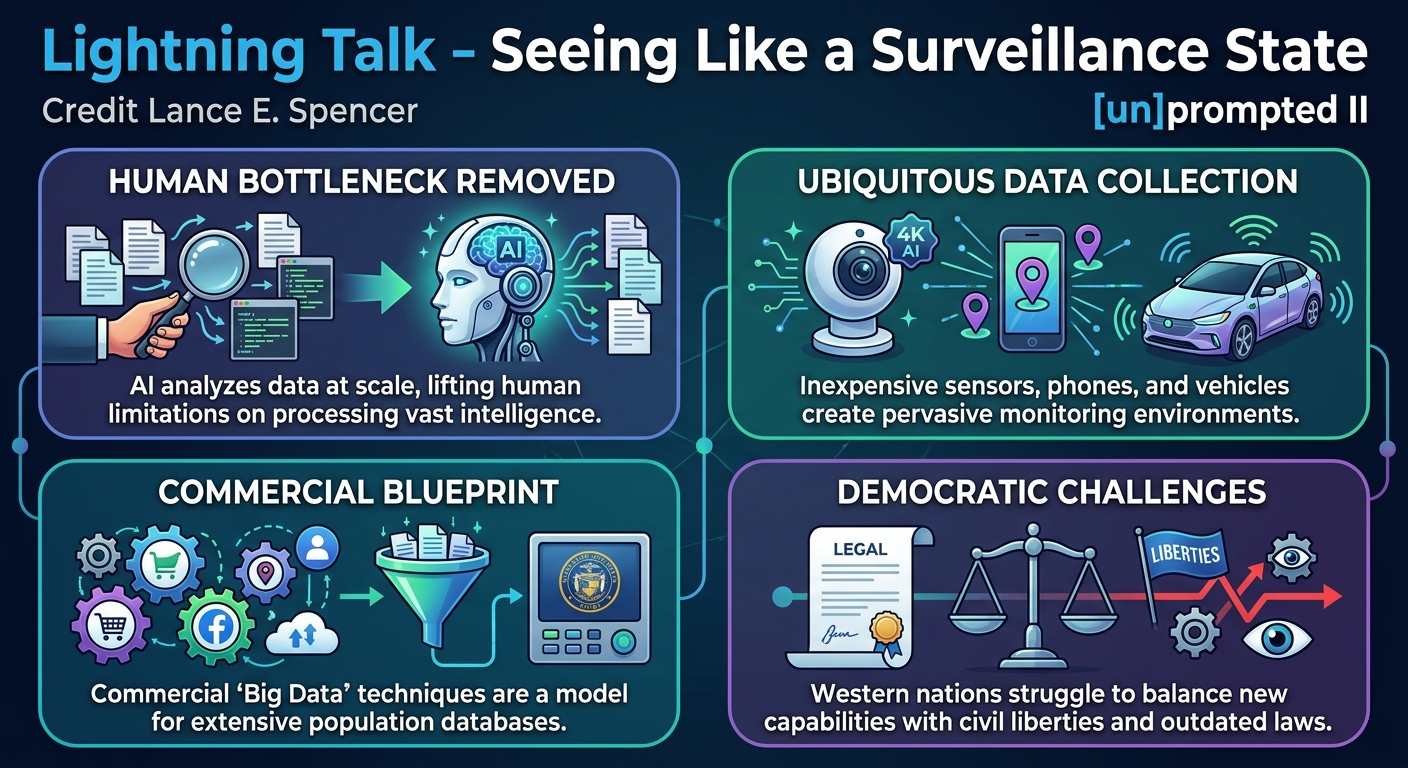
The talk meticulously outlines how several converging technological trends are fundamentally altering the landscape of state surveillance. The first key finding is the dramatic democratization and miniaturization of advanced collection technology. Spencer highlights the astonishing fact that a "4K AI-powered locally baby camera" can be purchased for roughly $80, the price of its SD card. This exemplifies the ubiquity and affordability of sophisticated audio and visual recording devices, many embedded with local AI processing capabilities. Beyond fixed cameras, cell phones are acknowledged as ubiquitous mobile tracking devices, and increasingly, all cars are being empowered with computers, transforming them into mobile collection platforms, with autonomous vehicles like Waymo cited as prime examples. This creates an environment of ubiquitous technical surveillance, a term the CIA reportedly uses to describe a world where virtually everything is recorded by default, posing significant challenges even for covert operations.
Second, the speaker emphasizes that Big Data is a "solved problem." Drawing parallels with the commercial sector, Spencer notes that ad tech companies have become "scary good" at building massive data platforms and "correlating the hell out of it." This commercial prowess provides a ready blueprint for surveillance states, which can then mandate universal data collection, thereby constructing comprehensive, real-time databases of their populations. This, however, exacerbates the historical challenge of information overload, shifting the burden from raw collection to intelligent processing.
Third, new and emerging digital tracking methods are making concealment increasingly difficult. While traditional digital tracking across devices is well-known, Spencer points to more advanced techniques like gait analysis, which can identify individuals from a distance even if their faces are masked. He also mentions breathing and Wi-Fi sensing as emerging biometric and tracking modalities. The alarming concept of "mind reading" is also touched upon, albeit with the caveat that while polygraphs are not genuine mind-readers, the technology is "coming."
The most profound key finding, however, is that AI has effectively erased the human bottleneck that once limited the power of surveillance states. Spencer recounts his own experience as a rate-limiting factor at the NSA, where his "eyeballs looking at it, my fingers typing out the translation" were the primary constraint on processing vast datasets and delivering timely intelligence. With AI, particularly advanced language models like "Astra" (a tool Spencer hypothesizes would have made him "100x employee"), translation, analysis, and data surfacing can be performed "at scale for very cheap." While humans still guide, check, correct, and act, the AI handles the massive ingestion and initial processing, allowing "all of the data" to be processed and analyzed efficiently. This exponential increase in processing capacity means that the "bottleneck that used to restrain the power over a surveillance state is now basically been erased," making it "much, much, much harder for a would-be dissident to hide." This future, Spencer warns, is not merely theoretical; it is already a reality in China and will increasingly challenge liberal societies worldwide.
Technical Deep Dive
▶ Watch: Big Tech makes hiding from surveillance impossible (6:00)
The technical underpinnings of the modern surveillance state, as described by Spencer, represent a formidable convergence of ubiquitous sensors, advanced data aggregation, and sophisticated AI-driven analytics. At the heart of this transformation is the sheer accessibility and power of collection technologies. The speaker highlighted the proliferation of 4K AI-powered cameras, exemplified by consumer-grade "baby cameras" costing as little as $80. These devices are not merely recording; they often incorporate local edge AI processing, enabling real-time object detection, facial recognition, and behavioral analysis without needing to stream all raw data to a central server. This distributed intelligence dramatically expands surveillance capabilities while reducing bandwidth and storage demands.
Beyond fixed cameras, the concept of mobile collection devices is critical. Cell phones, practically universal, serve as personal tracking beacons, transmitting location, communication metadata, and even biometric data. Increasingly, modern automobiles are equipped with powerful computers and sensors, transforming them into sophisticated data collection platforms. Spencer specifically mentions autonomous vehicles like Waymo, which, with their array of cameras, lidar, and radar, continuously map and record their surroundings, contributing to a granular understanding of public spaces. This leads to what the CIA reportedly terms ubiquitous technical surveillance, a state where continuous, pervasive recording is the default, making traditional covert operations exceedingly difficult.
The challenge of information overload, historically a major impediment, is now being tackled by advancements in Big Data platforms and artificial intelligence. Spencer notes that commercial entities, particularly in ad tech, have mastered the art of building vast data lakes and applying complex algorithms for data correlation. This capability allows disparate pieces of information—from purchase history and web browsing to social media interactions and physical movements—to be linked, creating comprehensive profiles of individuals. In a surveillance state, where data collection can be mandated and consolidated, this commercial expertise provides a powerful blueprint for state-sponsored surveillance, enabling the construction of a "comprehensive database of basically everything all the time."
The true game-changer, however, is the application of AI for analysis and processing. Spencer's personal anecdote from the NSA vividly illustrates the former human bottleneck: analysts like him were the "rate limiting factor" in translating, interpreting, and reporting intelligence from massive datasets. AI, especially advanced large language models (LLMs) and machine translation tools, can now perform these tasks at unprecedented speed and scale. He imagines a tool like "Astra" (likely a placeholder for advanced AI capabilities) dramatically accelerating his work, noting its native proficiency in translation. This means that vast quantities of intercepted communications, visual feeds, and transactional data can be almost instantaneously processed, translated, categorized, and flagged for human review. The AI serves as an intelligent filter, sifting through the "haystack of needles" to surface the "platinum needles" that human analysts previously struggled to find.
Furthermore, the talk touches on emerging biometric and sensing technologies that bypass traditional methods of concealment. While masks can obscure faces, gait analysis—the unique way an individual walks—allows for identification from video footage, even at a distance. More esoteric methods like Wi-Fi sensing, which can detect movement and even breathing patterns by analyzing disturbances in Wi-Fi signals, indicate a future where physical presence alone might be sufficient for detection. The implication is clear: the technological capacity for surveillance is rapidly outstripping conventional counter-surveillance techniques. Even encryption, while technically robust, is rendered ineffective against a state that can apply physical coercion ("the wrench") or simply note the unusual use of encrypted communications as a flag for suspicion. The aggregate effect of these technologies is a system where hiding, particularly at scale, becomes virtually impossible without extreme, often illegal, measures.
Demo / Proof of Concept
▶ Watch: AI eliminates the human bottleneck in analysis (8:00)
While the talk provided a highly detailed and analytical overview of surveillance state capabilities, it did not include a live demonstration or a proof of concept. The speaker explicitly mentioned at the outset, "We're not going to watch this video sadly," referring to a clip from The Simpsons movie, indicating that the presentation was focused on theoretical and practical implications rather than a live technical showcase.
Defensive Implications
▶ Watch: US laws struggle to keep pace with capabilities (10:10)
The implications of Lance Spencer's analysis are profound, both for individuals living under surveillance states and for liberal democracies grappling with these advancing capabilities. For individuals within totalitarian regimes, the message is stark: hiding is becoming exponentially difficult, if not impossible. Traditional methods of evasion, such as using encryption, are not only insufficient but can be counterproductive, marking an individual for heightened scrutiny. The omnipresence of AI-powered cameras, mobile tracking, and pervasive data correlation means that any attempt to operate outside state visibility requires extreme, often unsustainable, measures that would quickly draw unwanted attention. The speaker notes that while some individuals in open societies might go to great lengths (e.g., custom Linux, avoiding all major platforms), such efforts are futile and dangerous at scale in a surveillance state.
For liberal societies, the defensive implications are more complex, centering on the urgent need to reconcile advanced technological capabilities with fundamental civil liberties and existing legal frameworks. Spencer highlights a critical lag in the United States, where laws are struggling to keep pace with the rapid evolution of surveillance technologies. While federal agencies like the FBI and the Intelligence Community operate under more defined rules, the regulatory landscape at the state and local levels is often "made up" or determined through piecemeal court cases.
Specific examples underscore this legal void:
- Stingrays: These cell-site simulators, which mimic cell towers to intercept mobile phone data, have seen widespread use by law enforcement, often with unclear legal mandates or judicial oversight.
- Ad tech data: The vast troves of commercially collected data, including precise geolocation information, behavioral profiles, and communication patterns, are increasingly accessible to law enforcement. However, clear federal laws dictating how this data can be used, if at all, for surveillance purposes are largely absent. This creates a dangerous grey area where private data can be repurposed for state surveillance without the robust protections typically afforded by warrants or probable cause.
- Geolocational data: The precise tracking of individuals via cell phones and other devices presents significant privacy challenges, yet the legal standards for accessing and utilizing this data by various agencies remain ambiguous and inconsistent across jurisdictions.
The core defensive challenge for open societies is to prevent the unchecked adoption of these powerful surveillance tools from eroding democratic principles. This requires a proactive legislative response from bodies like Congress, which Spencer admits is "very uncommon these days." Without clear legal boundaries, robust oversight, and public discourse, there is a significant risk that the "seeing like a surveillance state" model could gradually creep into liberal societies, undermining the very freedoms they aim to protect. Defenders must therefore not only understand the technical capabilities of modern surveillance but also actively engage in shaping the ethical and legal frameworks that govern their use.
Key Takeaways
- AI has dissolved the human bottleneck in surveillance: Artificial intelligence, particularly in translation and data analysis, enables surveillance states to process vast quantities of data at scale, eliminating the human limitations that previously constrained their power.
- Ubiquitous, cheap, and powerful collection technologies are pervasive: Inexpensive 4K AI-powered cameras, smart devices, and connected vehicles (e.g., Waymo) create an environment of "ubiquitous technical surveillance," making covert operations and individual anonymity exceedingly difficult.
- Encryption alone is insufficient against a determined surveillance state: While technically robust, encryption does not protect against physical coercion ("the wrench") and can even make an individual stand out, drawing unwanted attention from authorities who control all infrastructure.
- Commercial "Big Data" and ad tech provide a powerful blueprint for state surveillance: The advanced capabilities of commercial platforms in correlating disparate data points offer a proven model for surveillance states to build comprehensive, real-time databases of their populations.
- Liberal democracies face a critical challenge in balancing capabilities with liberties: Western nations must urgently address how to integrate advanced surveillance technologies while preserving civil liberties, maintaining the separation of powers, and developing robust legal frameworks.
- Current US laws are lagging behind technological advancements: Legal standards, particularly at state and local levels, are struggling to keep pace with technologies like Stingrays, ad tech data utilization, and pervasive geolocational tracking, creating dangerous grey areas for privacy and oversight.
About the Speaker(s)
Lance E. Spencer is a distinguished Founder, Researcher, and Advisor with a profound background in national security. He served for five years in active duty with the US Army before dedicating a decade of his career to the National Security Agency (NSA) and Cyber Command. During his time at these critical agencies, Spencer specialized in "surveilling surveillance states," gaining invaluable insights into their operational methodologies and technological capabilities. Currently, his research focuses on understanding the risks associated with artificial intelligence and advocating for its responsible and effective deployment within national security and public safety contexts. His unique blend of military, intelligence, and research experience provides him with a comprehensive perspective on the evolving landscape of global surveillance and its societal implications.
Reviews
→ Top-rated talks at [un]prompted II 2026 — The AI Security Practitioner Conference
All talks from [un]prompted II 2026 — The AI Security Practitioner Conference