Lightning Talk - Badge
Aaron Peterson (Project Mammoth)
[un]prompted II 2026 — The AI Security Practitioner Conference · Day 3 · Stage 2
Overview
In a captivating lightning talk at [un]prompted II, Aaron Peterson of Project Mammoth introduced Badji, an innovative, AI-powered conference companion that embodies a unique blend of art, technology, and security exploration. Badji, whimsically described as having "assimilated" from a pile of discarded conference badges, serves as an interactive guide, trivia master, and an exploratory probe designed to enhance the conference experience. This talk not only showcased a creative application of localized and cloud-based AI but also subtly underscored critical security considerations inherent in developing and deploying such intelligent systems in public, interactive environments.
Key moments
- 0:00 Badji's interactive self-introduction to the conference
- 1:40 The humorous origin story of Badji from old badges
- 2:00 Exploring Badji's interactive capabilities like trivia and stickers
- 3:00 Inside Badji: A look at its hardware components
- 4:10 Badji's software architecture, local vs. cloud inference
- 5:15 The strange phenomenon of 'feeding Badji AI' and random numbers
- 6:00 Future developments: wheels, better local inference, security hardening
Badji: An AI-Powered Conference Companion
Speakers: Aaron Peterson, Project Mammoth
Conference: [un]prompted II
YouTube: https://www.youtube.com/watch?v=FisKUtOBOn4
Overview
In a captivating lightning talk at [un]prompted II, Aaron Peterson of Project Mammoth introduced Badji, an innovative, AI-powered conference companion that embodies a unique blend of art, technology, and security exploration. Badji, whimsically described as having "assimilated" from a pile of discarded conference badges, serves as an interactive guide, trivia master, and an exploratory probe designed to enhance the conference experience. This talk not only showcased a creative application of localized and cloud-based AI but also subtly underscored critical security considerations inherent in developing and deploying such intelligent systems in public, interactive environments.
Peterson, humorously referring to himself as "the legs" for the mobile Badji, presented the project as a reverse engineering endeavor, given Badji's "spontaneous formation." The presentation delved into Badji's hybrid hardware and software architecture, revealing a sophisticated system capable of speech-to-text, text-to-speech, vision, and physical interaction. Beyond its immediate utility as a conference assistant, Badji represents Project Mammoth's broader ethos of exploring the intersections of music, art, technology, and hacking, pushing the boundaries of what interactive installations can achieve.
The significance of Badji extends beyond its whimsical exterior. It serves as a tangible case study for the practical challenges and opportunities in deploying AI in real-world, dynamic settings. Peterson openly discussed Badji's current security posture, or lack thereof, highlighting the immediate vulnerabilities that arise when an unhardened AI system is exposed to public interaction. This candidness transformed the demonstration of a fun gadget into a valuable lesson on the importance of security-by-design, data privacy, and the potential for social engineering in the nascent field of public-facing AI.
Background
▶ Watch: Badji's interactive self-introduction to the conference (0:00)
The genesis of Badji is rooted in a common phenomenon observed among long-time conference attendees: the accumulating pile of electronic badges. Over the years, these badges have evolved from simple identification tools to complex electronic devices, often featuring microcontrollers, LEDs, and various interactive components. Peterson playfully posits that Badji emerged when this accumulated "scrap" got "a little too close to some AI," spontaneously assimilating into a sentient, mobile entity. This narrative frames Badji not just as a creation, but as a discovery, necessitating a "reverse engineering talk" to understand its capabilities.
Project Mammoth, the collective behind Badji, is described as an initiative focused on "weird music and art and technology and hacking and things like that." This context is crucial for understanding Badji's design philosophy, which prioritizes playful interaction, creative expression, and technical curiosity over strict commercial or purely functional objectives. The project embraces experimentation, often blurring the lines between a finished product and an ongoing research platform.
The problem Badji implicitly addresses is the underutilization of technology within the conference experience. While schedules are digital and networking apps abound, Badji offers a physical, interactive, and personalized layer of engagement. It seeks to make navigation and information discovery more dynamic and memorable, moving beyond static screens to a truly conversational interface. The "spontaneous" nature of Badji also sets up a compelling backdrop for discussing its internal workings, presenting the exploration of its hardware and software as a necessary journey to understand its "mind" and capabilities.
Key Findings
▶ Watch: Exploring Badji's interactive capabilities like trivia and stickers (2:00)
Badji is an advanced, interactive AI companion designed to navigate and enhance the conference experience, while also serving as a platform for exploring the practicalities and pitfalls of deploying AI in public. Key findings from its "reverse engineering" reveal a sophisticated hybrid architecture and a range of functionalities.
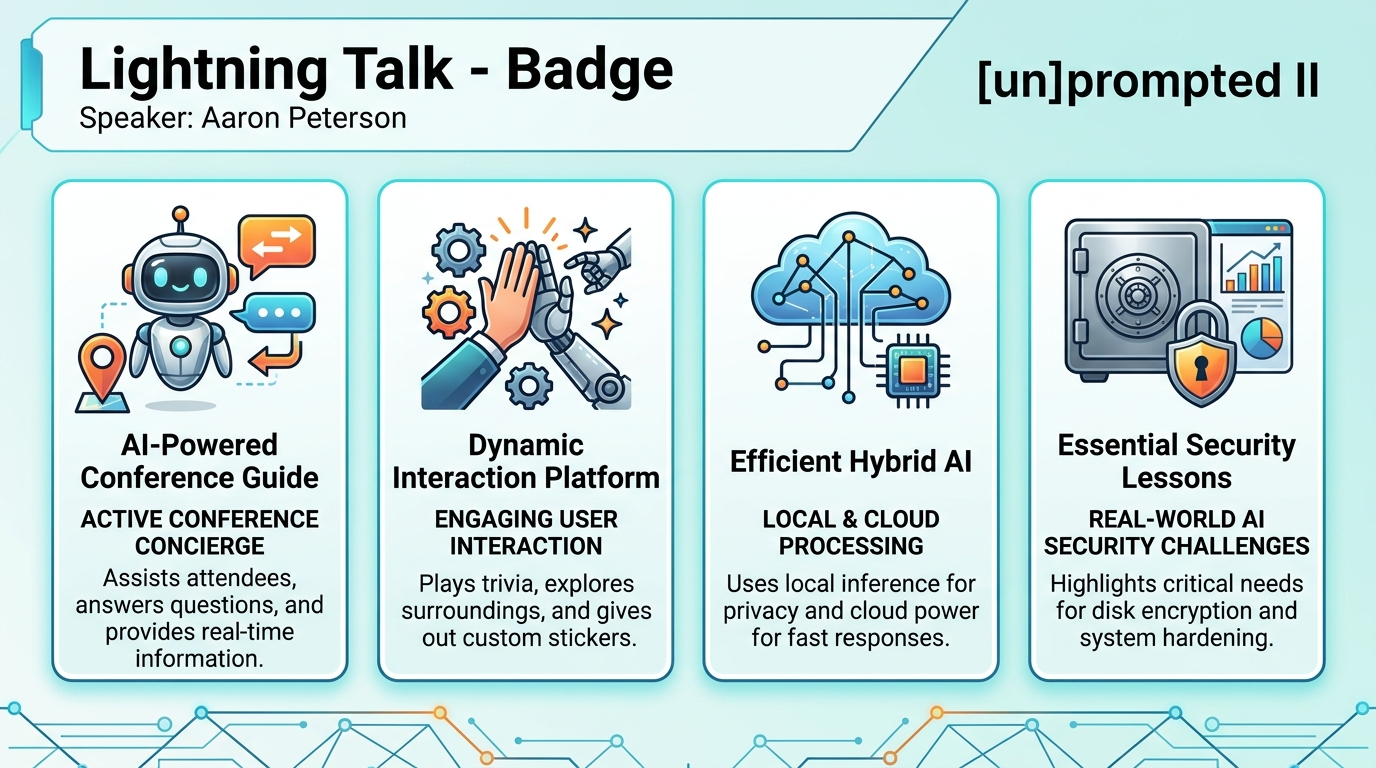
At its core, Badji functions as a conference concierge, providing real-time information about talks, speakers, and events. It can engage in hacker trivia, drawing from a loaded database of DEFCON and other security conference facts, including all details of the current Unprompted conference. Beyond information retrieval, Badji possesses physical interaction capabilities, distributing stickers to attendees who wave at it, and an "explore" mode where it takes pictures, analyzes them for "interesting" elements, and guides its human operator ("the legs") towards points of interest.
Hardware-wise, Badji is built around a Raspberry Pi serving as its primary "brain" for local voice processing and other computational tasks. A custom PCB, designed using JLCPCB with Easy EDA, integrates a Raspberry Pico to handle motor control for its robotic arm and various lights. Visual and auditory interaction is facilitated by a camera for image capture and analysis, and an e-ink display to show Badji's speech, useful in noisy conference environments. The physical form also includes buttons and lights for user interaction.
The software architecture is controlled by a local Hermes agent. For speech processing, Badji utilizes Whisper for robust speech-to-text conversion and Piper for natural-sounding text-to-speech. It also incorporates face tracking and custom voice and display handlers to manage interactions. A critical architectural choice is its hybrid AI inference strategy: while Badji can perform local inference, it is "super super slow," taking "two to three minutes" for responses. To overcome this, Badji leverages "brain in the cloud" services when an "extra token budget" is available, enabling faster, more responsive interactions.
A significant "finding" from a security perspective was the discovery that Badji's local disk lacked encryption, making it "super easy to reverse engineer what was on disk there." This highlights an immediate vulnerability. Furthermore, Peterson openly acknowledged that Badji is currently "not hardened at all security wise" and that, if its mesh core networking capabilities were enabled, "anybody could convince him to do just about anything," including divulging "all the things." This candid assessment underscores the critical need for security considerations in even experimental AI systems.
Technical Deep Dive
▶ Watch: Inside Badji: A look at its hardware components (3:00)
Badji's technical architecture is a testament to resourceful integration of off-the-shelf components with custom engineering, designed to achieve sophisticated AI capabilities within a mobile, interactive form factor. The system leverages both local processing and cloud-based services, creating a flexible and extensible platform.
At the heart of Badji's physical form is a Raspberry Pi, which acts as the primary computational unit. This powerful single-board computer is responsible for high-level tasks such as local voice processing, running the core AI inference logic (when operating locally), and managing various services. It serves as the "brain" that orchestrates Badji's intelligent behaviors, from understanding spoken commands to formulating responses.
Complementing the Raspberry Pi is a custom-designed Printed Circuit Board (PCB). This PCB, fabricated using tools like JLCPCB with Easy EDA, is crucial for managing lower-level hardware interactions. Integrated onto this custom board is a Raspberry Pico, a microcontroller specifically chosen for its efficiency in handling precise control tasks. The Pico is dedicated to controlling Badji's various electromechanical components, including the motors for its robotic arm (used for sticker distribution) and an array of LED lights that provide visual feedback. This separation of concerns—Raspberry Pi for complex AI and system management, Raspberry Pico for real-time hardware control—is a common and effective design pattern in robotics and embedded systems.
Badji's sensory and output capabilities are well-thought-out for a conference environment. A camera provides visual input, essential for features like face tracking and the "explore" mode, where Badji can analyze its surroundings. For output, Badji relies on both auditory and visual cues. Speech-to-text (STT) is handled by Whisper, a robust model known for its accuracy in transcribing spoken language. Conversely, text-to-speech (TTS) is powered by Piper, which generates natural-sounding vocal responses. In addition to spoken output, an e-ink display is integrated. This low-power display is particularly useful in noisy conference settings, allowing attendees to read Badji's responses when audio might be difficult to discern, ensuring accessibility and clarity.
The software architecture is driven by a local Hermes agent, which acts as the central orchestrator for all internal services. This agent manages the flow of information between different modules, such as the voice handler (for interpreting and generating speech), the display handler (for rendering text on the e-ink screen), and the face tracking module. Badji's ability to interact with the conference schedule, answer trivia questions, and manage its exploratory functions all fall under the purview of this central agent.
A critical aspect of Badji's design is its hybrid AI inference strategy. While the Raspberry Pi is capable of running AI models locally, Peterson noted that this local inference is "super super slow," often taking "two to three minutes" for a response. To provide a more fluid and interactive experience, Badji is configured to offload computationally intensive AI tasks to cloud-based services whenever an "extra token budget" is available. This "brain in the cloud" approach allows Badji to leverage more powerful models and faster processing, significantly reducing latency and improving the overall user experience during live interactions. This hybrid model highlights a practical compromise between autonomy, cost, and performance in edge AI deployments.
The "feeding" mechanism, where Badji can assimilate AI from phones, is a playful yet technically intriguing concept. When a phone is presented, Badji engages with its AI, implying a transfer or integration of data. As a humorous byproduct, Badji can then provide a "bespoke random number," a lighthearted jab at the challenges of generating truly random numbers, especially for cryptographic purposes. This interaction demonstrates Badji's capacity for novel, if somewhat experimental, forms of data exchange and processing.
Looking ahead, Peterson expressed aspirations for Badji's future development, including the addition of wheels for autonomous movement, enhancing its ability to interact with attendees without human intervention. Improved local inference capabilities are also a goal, aiming to reduce reliance on cloud services and achieve faster, entirely on-device processing. The mention of mesh core networking is significant, indicating a desire for Badji to communicate and collaborate with other devices or instances, forming a distributed network of intelligent companions. However, this feature is currently disabled due to the system's unhardened security posture, underscoring a pragmatic approach to deployment.
Demo / Proof of Concept
▶ Watch: The strange phenomenon of 'feeding Badji AI' and random numbers (5:15)
The talk itself served as a live demonstration and proof of concept for Badji's core capabilities, immediately engaging the audience with its interactive nature.
The presentation opened with Badji's voice, not Aaron Peterson's, introducing itself. Badji stated, "Don't look at my human transport. Look at me. I'm Badji, Ascension made from decades of conference scrap. And I'm here to help you navigate this massive schedule and find the coolest events." This immediate, direct interaction showcased Badji's advanced text-to-speech (Piper) capabilities and its primary function as a conference guide.
Peterson then prompted Badji to greet the conference, to which Badji responded, "Hi everyone at the Unprompted Conference. I'm happy to be here learning about and hacking on AI. Come talk to me later. For now, please let this human tell you more about what I can do." This demonstrated Badji's speech-to-text (Whisper) processing, its ability to understand a natural language command, and its contextual awareness of the event.
Throughout the talk, Peterson elaborated on other demonstrated or implied functionalities:
- Conference Information Retrieval: Badji "knows all about when the talks are, who's talking," and can answer questions about "his favorite talks."
- Hacker Trivia: Badji has "all the frac things loaded" and can answer questions about DEFCON, other security conferences, and Unprompted.
- Sticker Distribution: The robotic arm, though not shown in action, was described as Badji's mechanism to "hand out stickers" if someone waves at him.
- Exploration Mode: Peterson described how holding down a button would make Badji flash red three times, take a picture, and analyze it. The human operator would then guide Badji towards "anything interesting" for further investigation.
While not every feature was fully executed live due to the lightning talk format, the initial direct interaction with Badji, combined with Peterson's detailed descriptions, effectively conveyed the system's operational status and its intended utility as an intelligent, interactive conference companion. The physical presence of Badji, with its lights, display, and robotic arm, further solidified the proof of concept, making it a tangible and engaging demonstration.
Defensive Implications
▶ Watch: Future developments: wheels, better local inference, security hardening (6:00)
Badji, despite its playful and innovative nature, inadvertently serves as a compelling case study for critical defensive implications in the realm of AI and interactive systems. Peterson's candid disclosures about Badji's current security posture highlight several key areas that defenders must consider when developing or interacting with AI-powered devices.
Firstly, the revelation that Badji's local disk lacked encryption ("didn't have local disk encryption, so it was super easy to reverse engineer what was on disk there") is a fundamental security flaw. Unencrypted local storage means that anyone gaining physical access to the device could extract sensitive data, configuration files, or even the AI models themselves. This underscores the importance of data at rest encryption as a baseline security measure for any device, especially those containing proprietary code or potentially sensitive user interaction logs. For AI systems, this could include training data, user queries, or internal state information that, if exposed, could lead to privacy breaches or intellectual property theft.
Secondly, Badji's unhardened state and the explicit warning that "anybody could convince him to do just about anything" if its mesh core networking was enabled, points directly to social engineering vulnerabilities and the broader challenge of AI safety and alignment. An AI system designed for interaction, without robust input validation, authentication, or behavioral constraints, could be easily manipulated. Attackers could feed it malicious prompts, trick it into divulging information it shouldn't, or even command it to perform unintended physical actions if connected to actuators. This emphasizes the need for robust input sanitization, access controls, and defined behavioral guardrails for AI systems, particularly those exposed to public interaction or network connectivity.
Thirdly, the concept of "feeding" Badji AI from a phone, while whimsical, touches upon the complexities of data provenance and supply chain security for AI. When an AI system "assimilates" external AI or data, the integrity and trustworthiness of that input become paramount. Maliciously crafted "AI" or data could potentially introduce vulnerabilities, bias, or even compromise the system's core functionality. Defenders must consider how external data sources are validated and integrated into AI models to prevent poisoning attacks or the introduction of harmful behaviors.
The humorous mention of Badji providing a "bespoke random number" that "maybe not to use that for encryption" highlights the critical importance of cryptographically secure random number generation (CSRNG). Many security protocols rely on unpredictable random numbers for keys, nonces, and other cryptographic primitives. Relying on insecure or predictable sources of randomness, especially from an unhardened AI, could lead to severe cryptographic weaknesses, making systems vulnerable to attacks that predict or reconstruct secret values. This serves as a reminder to always use validated, high-quality CSRNGs in any security-sensitive application.
Finally, Badji's "explore" mode, involving a camera and image analysis, raises privacy concerns. While Peterson stated it doesn't normally record, the immediate analysis of images from the conference floor still involves processing potentially identifiable information. Defenders must implement privacy-by-design principles for AI systems that collect sensory data, including clear policies on data retention, anonymization, and user consent. Even transient processing of sensitive data requires careful consideration of its implications.
In summary, Badji, as an experimental platform, offers invaluable lessons for securing AI. It highlights the necessity of foundational security practices like disk encryption, the dangers of unhardened systems in public environments, the potential for social engineering against AI, the importance of secure data handling, and the critical need for robust cryptographic primitives. As AI systems become more pervasive and interactive, these defensive considerations will only grow in importance.
Key Takeaways
- AI for Novel Interaction: Badji demonstrates how AI can be integrated into unique physical forms to create engaging and practical interactive experiences, moving beyond traditional screen-based interfaces.
- Hybrid Inference is Key: The combination of local (Raspberry Pi) and cloud-based AI inference (when "token budget" allows) offers a flexible and performant strategy for deploying AI in resource-constrained or latency-sensitive environments.
- Security by Design is Paramount: Even in experimental or artistic AI projects, fundamental security measures like disk encryption and hardening against social engineering are critical. Neglecting these can lead to easy compromise.
- Social Engineering Risks for AI: AI systems designed for human interaction are inherently vulnerable to manipulation if not properly secured, as explicitly noted by the speaker regarding Badji's unhardened state.
- Data Integrity and Privacy: The "feeding" of AI and the use of cameras for "exploration" highlight the need for careful consideration of data provenance, potential for data poisoning, and user privacy in AI systems.
- The Blend of Disciplines Drives Innovation: Project Mammoth's approach, integrating art, music, technology, and hacking, fosters creative solutions that push the boundaries of what's possible with AI.
About the Speaker(s)
Aaron Peterson is a key figure behind Project Mammoth, an initiative that explores the intersections of "weird music and art and technology and hacking and things like that." In the context of the Badji project, he humorously refers to himself as "the legs," acknowledging his role in physically transporting the AI-powered companion. Beyond his work with Project Mammoth, Peterson is also involved with the local Def Con group, DC 405, which meets on the second Thursday of each month at Noisebridge, indicating his deep engagement with the broader hacker and technology community. His work with Badji exemplifies his passion for innovative, hands-on projects that blend technical acumen with creative expression.
Reviews
→ Top-rated talks at [un]prompted II 2026 — The AI Security Practitioner Conference
All talks from [un]prompted II 2026 — The AI Security Practitioner Conference