Lightning Talk - From Prompt to Protection, Scaling Security Guardrail Across Every AI Surface
Rhea Tejwani (Principal Security Architect · Indeed)
[un]prompted II 2026 — The AI Security Practitioner Conference · Day 3 · Stage 2
Overview
As artificial intelligence rapidly integrates into every facet of enterprise operations, transforming traditional product surfaces into interactive, natural language interfaces, the attack surface for novel security risks expands dramatically. This talk, "From Prompt to Protection, Scaling Security Guardrail Across Every AI Surface," delivered by Rhea Tejwani, Principal Security Architect at Indeed, addresses the critical challenge of securing these burgeoning AI ecosystems at scale. Tejwani highlights that beyond the widely recognized threat of prompt injection, organizations must contend with a broader spectrum of AI-specific risks, including data exfiltration and input obfuscation. The central thesis of her presentation is the imperative for a centralized, platform-level security control to uniformly mitigate these risks across hundreds of diverse AI-powered applications.
Key moments
- 0:00 Introduction: Scaling security for prompt injection and AI risks
- 2:00 Need for a single platform-level security guardrail
- 4:00 Guardrail architecture: Rules, LLM as judge, pre-inference validation
- 5:00 Challenges: Scaling millions of requests, latency, and cost
- 6:00 Two-layer prototype approach and impact of new frontier models
- 8:00 Q&A: Handling user messages blocked by the guardrail
Lightning Talk - From Prompt to Protection, Scaling Security Guardrail Across Every AI Surface
Speakers: Rhea Tejwani, Principal Security Architect, Indeed
Conference: [un]prompted II
YouTube: https://www.youtube.com/watch?v=y4ypIa1bpYE
Overview
As artificial intelligence rapidly integrates into every facet of enterprise operations, transforming traditional product surfaces into interactive, natural language interfaces, the attack surface for novel security risks expands dramatically. This talk, "From Prompt to Protection, Scaling Security Guardrail Across Every AI Surface," delivered by Rhea Tejwani, Principal Security Architect at Indeed, addresses the critical challenge of securing these burgeoning AI ecosystems at scale. Tejwani highlights that beyond the widely recognized threat of prompt injection, organizations must contend with a broader spectrum of AI-specific risks, including data exfiltration and input obfuscation. The central thesis of her presentation is the imperative for a centralized, platform-level security control to uniformly mitigate these risks across hundreds of diverse AI-powered applications.
Tejwani argues that relying on individual product teams to implement their own security measures leads to inconsistent protection, increased overhead, and potential vulnerabilities. Instead, she advocates for a unified security guardrail positioned strategically before the inference stage of any Large Language Model (LLM) interaction. This architectural approach ensures that all untrusted user inputs are meticulously screened for malicious intent or sensitive data disclosure attempts, providing a consistent and robust defense layer. The talk delves into the technical design, implementation challenges, and performance optimizations required to build such a system capable of processing millions of requests daily without compromising user experience or incurring prohibitive costs.
The implications of Tejwani's work extend far beyond a single organization. Her insights offer a blueprint for any enterprise grappling with the complexities of AI adoption and the concurrent need for scalable, consistent security. By detailing the evolution of Indeed's approach – from initial prototyping with multi-layered LLM-based checks to leveraging advancements in frontier models – the talk provides valuable lessons for security architects and developers alike. It underscores that effective AI security is not merely about identifying threats but about engineering resilient, high-performance systems that can adapt to the rapid pace of AI innovation.
Background
▶ Watch: Introduction: Scaling security for prompt injection and AI risks (0:00)
The proliferation of AI-driven functionalities has fundamentally reshaped how users interact with digital products. What were once static interfaces or form-based inputs are increasingly becoming conversational, natural language-driven experiences, such as chatbots or advanced search functionalities. This transformation, while enhancing user experience and efficiency, simultaneously introduces a complex array of security vulnerabilities that traditional web application firewalls or API gateways are not inherently designed to address. The most immediate and widely discussed threat is prompt injection, where malicious users craft prompts to manipulate the LLM's behavior, override system instructions, or extract confidential information.
However, as Tejwani emphasizes, the threat landscape extends significantly beyond just prompt injection. Data exfiltration attempts, for instance, pose a severe risk. A sophisticated prompt could be designed to trick an LLM into disclosing internal system data, sensitive user information, or proprietary business logic that it might have access to through its training data or retrieved context. Similarly, input obfuscation represents another insidious challenge, where attackers embed hidden characters, invisible Unicode symbols, or subtly misleading phrasing within prompts to bypass detection mechanisms. These obfuscated inputs can then trigger unintended actions or reveal information without being immediately obvious to a human reviewer or a simple keyword filter.
The core problem, as identified by Indeed, was not just the existence of these risks, but the sheer scale of their potential impact. With "hundreds of surfaces" being transformed to support natural language interaction, a decentralized approach to security would be unsustainable and ineffective. Each product team building its own specific controls would inevitably lead to:
- Inconsistency: Different teams would implement varying levels of protection, leading to gaps and uneven security posture across the organization.
- Maintenance Overhead: Duplication of effort, disparate technologies, and a lack of centralized expertise would create a heavy maintenance burden.
- Vulnerability: Inconsistent controls would leave the organization susceptible to attackers who could exploit the weakest link.
- Lack of Unified Telemetry: Without a central point of control, gaining a holistic view of AI-related security incidents and evaluating the effectiveness of defenses would be exceedingly difficult.
This recognition drove the imperative for a platform-level control – a single, unified system capable of screening all user messages and AI inputs, identifying diverse AI risks, and providing consistent protection across the entire enterprise AI footprint. This approach aims to centralize expertise, enforce uniform policies, and ensure that every interaction with an AI surface is subjected to the same rigorous security scrutiny, regardless of its origin or specific application.
Key Findings
▶ Watch: Guardrail architecture: Rules, LLM as judge, pre-inference validation (4:00)
The central and most significant finding presented by Rhea Tejwani is the successful design and implementation of a scalable, platform-level security guardrail capable of protecting hundreds of diverse AI surfaces from a spectrum of emerging threats. This finding is critical because it demonstrates that centralized, consistent AI security is not only necessary but also achievable within a large enterprise environment. The talk outlines several key discoveries and contributions that underpinned this success:
- The Necessity of Pre-Inference Validation: A fundamental insight was the absolute requirement to validate every AI input before it reaches the LLM for inference. By intercepting user messages and uploaded documents at the platform layer, before the LLM processes them as "trusted content," the guardrail ensures that potentially malicious or exfiltrating prompts are neutralized upfront. This architectural decision prevents the LLM from ever acting on compromised instructions.
- Hybrid Detection Mechanism (Deterministic Rules + LLM as a Judge): The talk reveals the effectiveness of a two-pronged detection strategy within the guardrail. Combining deterministic rules (e.g., regex patterns, keyword lists, structural checks) for initial, high-speed filtering with an LLM as a judge for more nuanced, higher-level filtering proved crucial. This hybrid approach leverages the strengths of both methods: deterministic rules provide rapid, low-cost detection for known patterns, while the LLM's understanding of context and intent allows for the identification of more sophisticated or novel attacks that might bypass simpler checks.
- Scalability as a Core Design Principle: A key finding was that security controls for AI cannot be an afterthought; they must be designed for high-volume protection from the outset. Processing "millions and millions of requests" daily necessitates an optimized code path and an architecture that minimizes latency and manages cost effectively. This led to continuous evaluation and refinement of the system's performance characteristics.
- The Latency-Cost-Security Trilemma: The team discovered that balancing the competing demands of low latency (for good user experience), manageable cost (especially when using powerful LLMs), and robust security was a significant challenge. Initial prototypes, particularly those involving multi-layered LLM checks, often introduced unacceptable latency. This led to the exploration of different architectural patterns, including a two-layer approach.
- Impact of Frontier Model Advancements: A pivotal finding was how the rapid evolution of frontier models significantly impacted the feasibility and optimization of the guardrail. Tejwani specifically mentions GPT 5.6 Luna and GPT 6.0 Luna (likely referring to internal or experimental versions or advancements in models like OpenAI's GPT series), noting that these advancements "made a lot easier for us that okay, it's possible to achieve the cost optimization that we wanted to achieve for the scale that we wanted to tackle." This highlights that the pace of AI innovation directly influences the practical implementation of AI security solutions, enabling more sophisticated and cost-effective defenses over time.
- Importance of Audit Telemetry: The need for comprehensive audit telemetry was identified as vital for system improvement. Tracking metrics like "number of false positives" and "number of false negatives" is essential for continuously refining the guardrail's rules, improving the LLM judge's performance, and ensuring the system maintains high accuracy and effectiveness without unduly blocking legitimate user interactions.
In essence, Tejwani's key findings illustrate that a robust, enterprise-scale AI security solution is a complex engineering feat requiring a strategic architectural vision, an adaptive detection methodology, and a keen awareness of the evolving capabilities and cost structures of underlying AI models.
Technical Deep Dive
▶ Watch: Challenges: Scaling millions of requests, latency, and cost (5:00)
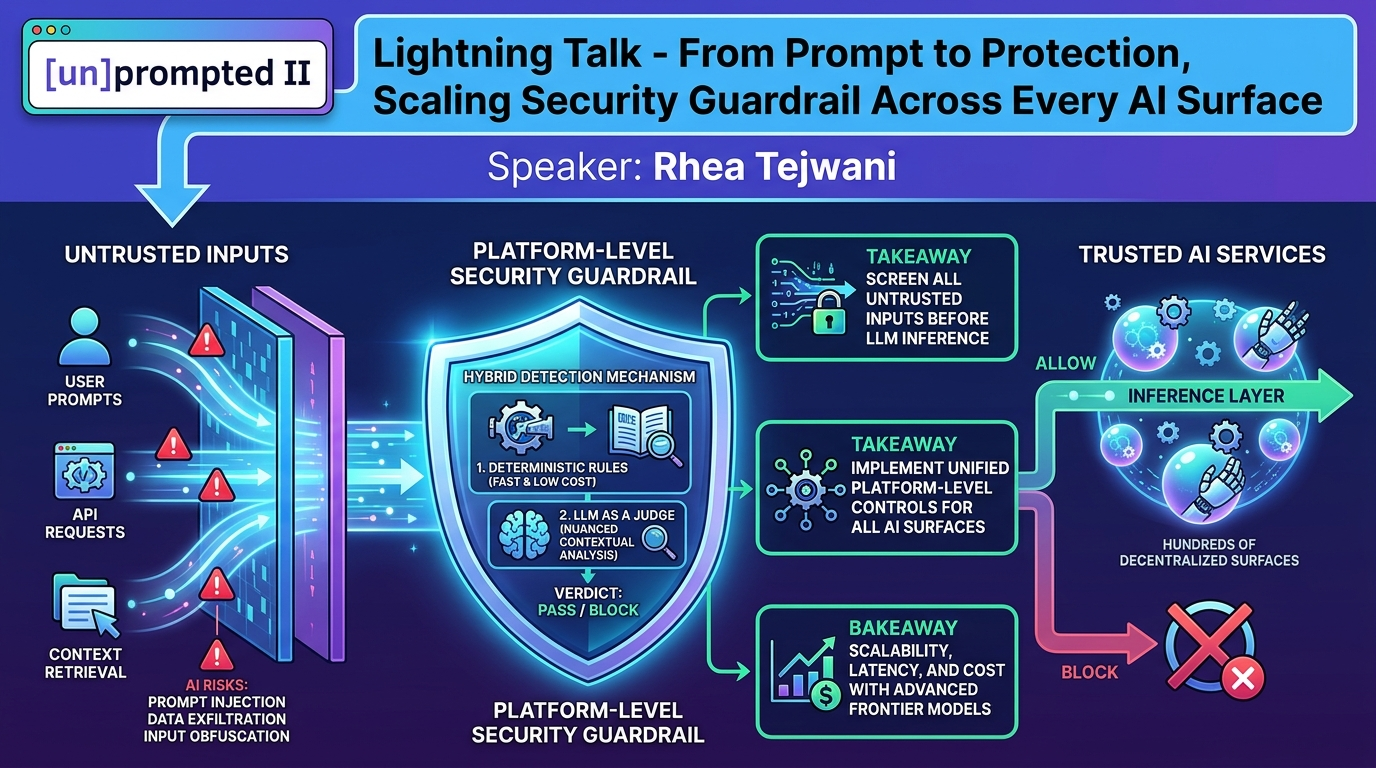
The technical core of Indeed's solution is a platform-level security guardrail designed to operate as an intermediary layer, validating every AI input before it reaches the underlying Large Language Models (LLMs). This architecture ensures that the LLM only ever processes content deemed safe, effectively preventing malicious prompts from influencing its behavior.
The system's architecture can be conceptualized as follows:
- Untrusted Input Ingestion: The process begins with any form of untrusted input. This includes:
- User prompts: Direct text inputs from users interacting with AI surfaces (e.g., chatbots, search interfaces).
- Uploaded documents: Files provided by users that might contain embedded instructions or data for AI processing.
- APIs: Programmatic inputs from other services or external systems interacting with AI functionalities.
- Retrieved context: Data pulled from internal interfaces or tools that might inadvertently contain malicious content if an upstream system was compromised.
- Agent-to-agent messages: In multi-agent systems, communications between AI agents that could be manipulated.
- Security Guardrail Intervention (Pre-Inference Layer): Before any of this untrusted content reaches an LLM for inference, it is routed through the centralized security guardrail. This is the critical "layer before it reaches to the inference level." The guardrail's primary function is to screen these inputs for various AI risks.
- Hybrid Detection Mechanism within the Guardrail: The guardrail employs a sophisticated, multi-stage detection process:
- Deterministic Rules: The initial screening layer consists of deterministic rules. These are typically fast, rule-based checks that look for specific patterns, keywords, hidden characters, or structural anomalies indicative of known prompt injection techniques, data exfiltration attempts, or input obfuscation. These rules provide a rapid first pass, blocking obvious threats with minimal latency and cost.
- LLM as a Judge: For inputs that pass the deterministic rules but require more nuanced evaluation, an LLM is used as a judge. This LLM is specifically tasked with reviewing the content for higher-level filtering. It can analyze the context, intent, and potential implications of a prompt more effectively than rule-based systems. For example, it can discern subtle attempts at social engineering or data disclosure that might not trigger a simple keyword match. This step is crucial for catching more sophisticated attacks.
- Verdict and Processing Flow: Based on the guardrail's analysis, a simple verdict is rendered:
- Passed/Allowed: If the guardrail determines the content is safe and free of risks, it is allowed to proceed.
- Flagged/Blocked: If a risk is detected, the content is flagged, and the request is blocked.
Only requests that receive a "passed" verdict are then forwarded to the appropriate downstream LLM for actual processing. This means the LLM operates "without the knowledge of any system" being in between, ensuring a seamless experience for legitimate users while maintaining robust security.
Optimizations for Scale, Latency, and Cost:
Designing this control for "millions and millions of requests" daily necessitated significant optimization efforts:
- High-Volume Protection: The code path for the guardrail was explicitly optimized for high throughput. This likely involves efficient data handling, parallel processing capabilities, and minimized computational overhead for the deterministic rules.
- Latency Management: A major challenge was ensuring that the guardrail did not introduce unacceptable latency, which would degrade the user experience. This was particularly problematic when using LLMs for judging due to their inherent computational cost.
- Cost Efficiency: Using powerful frontier models for every single request can be prohibitively expensive. This led to experimentation with different architectural patterns.
The Two-Layer Approach Prototype:
Indeed initially prototyped a two-layer approach to balance latency and cost:
- First Layer (Small Language Model - SLM): This layer would utilize a smaller, more cost-effective language model. It would rapidly screen messages and assign a confidence score regarding their safety. If the confidence score was sufficiently high (indicating low risk), the request would be immediately passed, and the response would be returned from this layer, bypassing the more expensive second layer.
- Second Layer (LLM-based Layer): If the SLM's confidence score was not high (indicating potential risk or uncertainty), the request would be escalated to a more powerful, general-purpose LLM for a thorough review. This LLM would then make the final determination.
While this two-layer approach aimed to optimize cost by only invoking the more expensive LLM when necessary, it initially faced latency concerns. The sequential nature of the layers could still introduce delays.
Impact of Frontier Model Advancements:
A significant turning point came with the release of more advanced frontier models, such as those mentioned as GPT 5.6 Luna and GPT 6.0 Luna. These newer models offered improved performance, higher accuracy, and, critically, better cost-efficiency for the scale Indeed needed. These advancements allowed for a more streamlined approach, potentially enabling a single, more capable LLM to perform the judging role effectively without the need for a complex two-layer cascade, or at least making the two-layer approach more performant. This development was key to achieving the desired cost optimization for processing millions of requests while maintaining low latency.
Audit Telemetry:
The system also incorporates mechanisms for audit telemetry to continuously monitor and improve its effectiveness. This includes tracking:
- False positives: Legitimate user requests mistakenly blocked by the guardrail.
- False negatives: Malicious requests that successfully bypass the guardrail.
This data is crucial for refining deterministic rules, improving the LLM judge's performance, and adapting to new attack vectors.
Demo / Proof of Concept
▶ Watch: Two-layer prototype approach and impact of new frontier models (6:00)
While a live demonstration or explicit proof-of-concept tool was not detailed in the lightning talk, Rhea Tejwani extensively described the evaluation and prototyping efforts undertaken at Indeed. The core of their practical work involved building and testing a two-layer approach for their security guardrail. This prototype served as a crucial proof of concept, demonstrating the feasibility of an automated, platform-level input screening system.
The evaluation focused on key metrics such as latency, cost, and the accuracy of detection (false positives and false negatives) when processing millions of requests. The iterative process of evaluating this prototype, identifying its limitations (particularly regarding initial latency), and subsequently leveraging advancements in frontier models like GPT 5.6 Luna and GPT 6.0 Luna to overcome these challenges, effectively served as their "proof of concept" journey. It validated that a scalable, cost-effective, and low-latency security guardrail for AI surfaces was indeed an attainable goal, shifting from theoretical necessity to practical implementation.
Defensive Implications
▶ Watch: Q&A: Handling user messages blocked by the guardrail (8:00)
Rhea Tejwani's talk provides critical defensive implications for organizations grappling with the security of AI-powered applications. Defenders must move beyond ad-hoc, product-specific solutions and embrace a more strategic, centralized approach.
- Adopt a Platform-Level AI Security Strategy: The most paramount implication is the need to implement AI security controls at a platform level, rather than relying on individual product teams. This ensures consistency in protection, reduces development and maintenance overhead, and provides a unified defense posture against emerging AI threats across all applications. Organizations should invest in a dedicated team or function responsible for this overarching AI security strategy.
- Implement Pre-Inference Input Validation: Security teams must design and deploy mechanisms that intercept and validate all user inputs and retrieved context before they reach the LLM for inference. This "shift-left" approach to AI security is crucial, as it prevents malicious prompts from ever interacting with the core AI model, thereby neutralizing threats like prompt injection, data exfiltration, and input obfuscation at the earliest possible stage.
- Employ a Hybrid Detection Methodology: Defenses should integrate both deterministic rules and LLM-based judging. Deterministic rules offer rapid, cost-effective detection for known patterns and obvious attacks, while an LLM as a judge provides the nuanced understanding required to identify more sophisticated, contextual, or novel threats that evade simpler checks. This layered approach enhances overall detection accuracy and resilience.
- Prioritize Scalability, Latency, and Cost in Design: Any AI security solution must be engineered from the ground up to handle high volumes of requests (millions daily) without introducing unacceptable latency or incurring prohibitive costs. Defenders need to meticulously evaluate the performance characteristics of their chosen technologies, optimize code paths, and explore architectural patterns like the two-layer approach to strike the right balance between security, user experience, and financial viability.
- Develop Clear User Feedback Mechanisms: When a request is blocked by the security guardrail, the user experience needs to be managed effectively. While a direct appeal process might be complex, providing a generic, helpful message (e.g., "I cannot help you with this. Please refine your message or upload a separate document") is crucial. Defenders should work with product teams to craft such messages, ensuring users understand why their request was denied without revealing internal security logic.
- Monitor for a Broad Spectrum of AI Risks: Defenders must expand their threat model beyond just prompt injection. Active monitoring and defense strategies should also encompass data exfiltration (preventing sensitive data disclosure), input obfuscation (detecting hidden characters or subtle manipulations), and other emerging AI-specific vulnerabilities. Continuous threat intelligence gathering is essential to stay ahead of evolving attack vectors.
- Leverage Advancements in Frontier Models: The rapid evolution of LLMs, particularly frontier models, presents both challenges and opportunities. Defenders should stay abreast of these advancements, as improvements in model performance, cost-efficiency, and contextual understanding can significantly enhance the capabilities of AI-based security controls. Adapting to and integrating these newer models can lead to more robust and scalable defensive solutions.
- Implement Robust Audit Telemetry: Continuous improvement of the security guardrail relies heavily on comprehensive audit telemetry. Defenders must collect data on false positives and false negatives to refine detection rules, improve LLM judge prompts, and measure the overall effectiveness of their controls. This data-driven approach is vital for maintaining an adaptive and effective AI security posture.
Key Takeaways
- Centralized Protection is Paramount: Enterprises must move beyond fragmented, product-specific security controls for AI and implement a unified, platform-level security guardrail to ensure consistent protection across all AI surfaces.
- Pre-Inference Validation is Essential: All untrusted user inputs and retrieved contexts must be screened before reaching the LLM for inference to prevent malicious prompts from ever being processed.
- Hybrid Detection is Key to Robustness: Effective AI security combines fast, deterministic rules for known threats with an LLM as a judge for nuanced, contextual detection of sophisticated attacks.
- Scale, Latency, and Cost are Design Imperatives: AI security solutions must be engineered for high-volume protection (millions of requests daily) while balancing low latency for user experience and cost-efficiency, especially when utilizing powerful LLMs.
- Frontier Models Drive Feasibility: Advancements in frontier models (e.g., GPT 5.6 Luna, GPT 6.0 Luna) are critical enablers, offering the performance and cost optimization necessary to implement scalable AI security guardrails.
- Comprehensive Threat Modeling is Required: Defenders must expand their focus beyond prompt injection to include data exfiltration, input obfuscation, and other novel AI-specific risks, continuously adapting their defenses.
About the Speaker(s)
Rhea Tejwani is a Principal Security Architect at Indeed, a leading global employment website. In her role, she is at the forefront of designing and implementing robust security architectures, particularly focusing on the challenges presented by emerging technologies like artificial intelligence. Her work involves scaling security guardrails across numerous AI-powered products and services, ensuring the protection of millions of daily requests from threats such as prompt injection, data exfiltration, and input obfuscation. Tejwani's expertise lies in building high-performance, cost-effective security solutions that integrate seamlessly into complex enterprise environments, enabling safe and secure AI adoption.
Reviews
→ Top-rated talks at [un]prompted II 2026 — The AI Security Practitioner Conference
All talks from [un]prompted II 2026 — The AI Security Practitioner Conference