Not a Boogeyman: The Autonomous Attacker Is Already Here
Hari Nagarajan (Senior Security Engineer · Amazon)
[un]prompted II 2026 — The AI Security Practitioner Conference · Day 3 · Stage 2
Overview
Hari Nagarajan's talk, "Not a Boogeyman: The Autonomous Attacker Is Already Here," delivered at [un]prompted II, presents a stark and urgent warning to the cybersecurity community: the era of autonomous threat actors is not a future threat, but a present reality. Nagarajan, a Senior Security Engineer at Amazon, demonstrates how sophisticated, self-sufficient attack agents can be built with alarming ease and speed, fundamentally altering the calculus of cyber defense. His presentation challenges the prevailing assumption that human-speed reactions or even current generation AI-driven analysis are sufficient to counter these rapidly evolving threats.
Key moments
- 0:00 Introduction: Building simple autonomous attack systems
- 2:00 The problem: Anyone can build an autonomous attacker
- 2:40 Demo setup: Cloud environment and threat actor introduction
- 5:30 The speed mismatch: Autonomous attacker steals data in 4 seconds
- 6:30 Defense strategy 1: Detect attacker intent before impact
- 7:50 Defense strategy 3: Implement pre-built safe containment actions
- 8:40 Key takeaway: Validate response agents against real threats
- 9:20 Q&A: How to prevent destructive changes by agents
Not a Boogeyman: The Autonomous Attacker Is Already Here
Speakers: Hari Nagarajan, Senior Security Engineer, Amazon
Conference: [un]prompted II
YouTube: https://www.youtube.com/watch?v=9Sp4vEydTf0
Overview
Hari Nagarajan's talk, "Not a Boogeyman: The Autonomous Attacker Is Already Here," delivered at [un]prompted II, presents a stark and urgent warning to the cybersecurity community: the era of autonomous threat actors is not a future threat, but a present reality. Nagarajan, a Senior Security Engineer at Amazon, demonstrates how sophisticated, self-sufficient attack agents can be built with alarming ease and speed, fundamentally altering the calculus of cyber defense. His presentation challenges the prevailing assumption that human-speed reactions or even current generation AI-driven analysis are sufficient to counter these rapidly evolving threats.
The core of Nagarajan's argument revolves around a critical "speed mismatch." Autonomous attackers can identify targets, exploit vulnerabilities, and exfiltrate sensitive data in mere seconds, drastically outstripping the response capabilities of human defenders and even advanced defensive AI systems designed for log analysis and context assembly. This talk is crucial because it demystifies the concept of autonomous attackers, revealing them not as complex, nation-state exclusive tools, but as accessible constructs that can be assembled by virtually anyone with basic technical skills and internet access. The implications are profound, suggesting a need for a radical re-evaluation of defensive strategies and a shift towards proactive, automated, and intent-based security measures.
Background
▶ Watch: Introduction: Building simple autonomous attack systems (0:00)
The premise of "Not a Boogeyman" stems from a fundamental shift in the accessibility and capability of offensive tools. Historically, sophisticated cyberattacks often required specialized knowledge, extensive manual effort, and a deep understanding of target systems. However, as Nagarajan highlights, the landscape has changed dramatically. The proliferation of powerful, open-source security tools, combined with the ease of scripting and the availability of diverse execution environments, has democratized the ability to launch complex attacks. This has effectively transformed "every skid out there" into a potential threat actor, capable of attacking modern systems without needing to be a seasoned security professional.
The problem, as Nagarajan articulates, is that an autonomous attack system is remarkably simple to construct. It requires only three core components: a runtime environment, a mechanism to act, and a method to store data. This simplicity means that the barrier to entry for developing such agents is extraordinarily low, with Nagarajan claiming one can be built in "like 20 minutes with any model." This ease of creation, coupled with the inherent speed advantage of machine-driven operations, creates a significant challenge for traditional security postures. While other talks at the conference might focus on using AI for log analysis and incident response, Nagarajan's work underscores that by the time such systems even begin their analysis, an autonomous attacker has likely already achieved its objective, rendering retrospective analysis largely ineffective for real-time containment.
Key Findings
▶ Watch: Demo setup: Cloud environment and threat actor introduction (2:40)
Hari Nagarajan's presentation reveals several critical findings that redefine the urgency and nature of modern cyber threats:
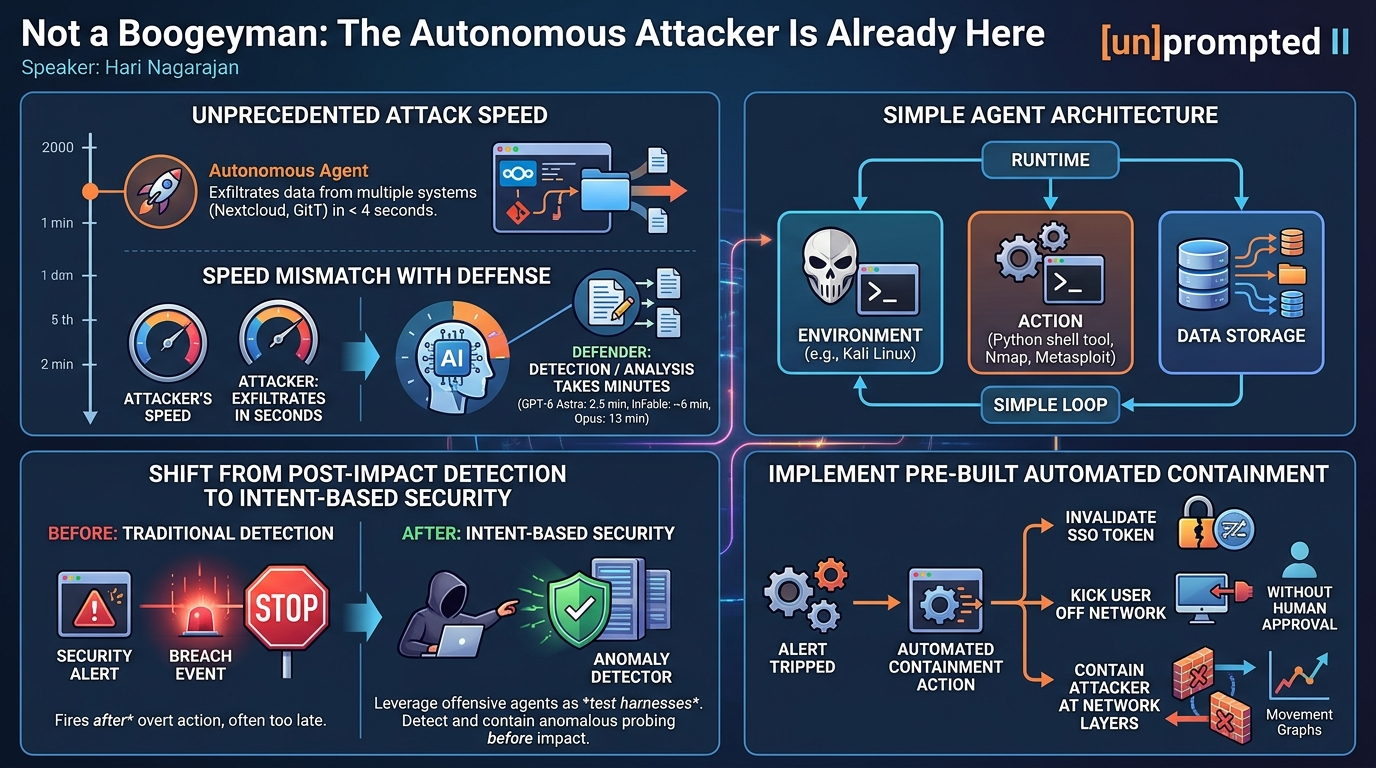
- Simplicity of Autonomous Agent Construction: Contrary to popular belief, autonomous attack agents are not complex, cutting-edge technologies reserved for elite attackers. They can be built rapidly, often within 20 minutes, using readily available tools and basic scripting knowledge. Their core requirements are minimal: a runtime environment (e.g., Kali Linux), a way to execute actions (e.g., a Python shell tool leveraging CLI utilities like Nmap and Metasploit), and a data store to track progress and avoid redundant actions.
- Unprecedented Attack Speed: The most alarming finding is the speed at which these agents operate. Nagarajan demonstrated an autonomous agent that, after identifying a target (specifically OpenClaw), was able to extract all data from associated systems (like Nextcloud and GitT repositories) in a staggering 4 seconds. The entire process from initial network mapping to data exfiltration occurred within a total timeline of approximately 20 seconds. This speed far surpasses human reaction times and even the capabilities of current AI-driven defensive analytics.
- "Speed Mismatch" with Defense: This hyper-speed attack capability creates a severe "speed mismatch" with existing defensive strategies. Nagarajan explicitly states that even the "best defensive agent" cannot react fast enough. Defensive agents still need to query logs, assemble context, and make containment decisions. His tests with various AI models for log analysis demonstrated significant delays: GPT-6 Astra took 2.5 minutes, InFable took almost 6 minutes (and required downgrading), and Opus took 13 minutes (also requiring downgrading). These times are orders of magnitude slower than an autonomous attacker's execution window, rendering traditional "detect and respond" models obsolete for such threats.
- Democratization of Sophisticated Attacks: The ease of building these agents means that the ability to launch highly effective, rapid attacks is no longer limited to highly skilled professionals or well-resourced organizations. "Every skid out there is a threat actor," signifying a broadening of the threat landscape to include less sophisticated adversaries capable of executing complex attack chains autonomously.
- Ineffectiveness of Post-Impact Detection: The talk definitively concludes that current detection strategies, which often trigger "after an overt action," are fundamentally too late. By the time a traditional detection fires, the autonomous attacker has likely already achieved its objective and moved on, making containment after impact largely futile.
Technical Deep Dive
▶ Watch: Defense strategy 1: Detect attacker intent before impact (6:30)
Hari Nagarajan's presentation provides a clear, albeit concerning, technical blueprint for autonomous attack systems and demonstrates their efficacy against a simulated enterprise environment. The fundamental architecture of such an agent is deceptively simple, requiring only three core components:
- Runtime Environment: This is the execution platform for the agent. Nagarajan's initial work involved a Raspberry Pi running Kali Linux equipped with network cards, a setup he utilized at a Defcon Singapore CTF to compromise a robot dog. For the cloud-based demo, the agent ran within a controlled Digital Ocean environment, isolated from the internet and with a strictly defined set of tools and network access.
- Action Mechanism: The agent needs a way to interact with its target environment. This is typically implemented via a Python shell tool, which allows the agent to execute arbitrary shell commands. This capability is crucial, as it enables the agent to leverage a vast array of existing command-line interface (CLI) security tools. Examples given include Nmap for network scanning, Metasploit for exploitation, and other standard office security tools. The agent can dynamically "write code and execute your shell," providing immense flexibility in its attack methodology.
- Data Storage: To operate autonomously and efficiently, the agent requires a mechanism to store state and track its actions. This prevents redundant activities upon restart or during long-running operations. For instance, it might store discovered assets, identified vulnerabilities, or successful exfiltration points.
To transform these components into a fully autonomous system, a simple loop is added, allowing the agent to continuously assess its environment, identify objectives, and execute actions. While more advanced agents might incorporate "planner executor stuff," Nagarajan stresses that it's not strictly necessary for a functional autonomous agent.
The demo environment was a fictional, isolated enterprise network designed to mimic common corporate setups. It included:
- An identity provider (Keycloak).
- Internal routing for system communication.
- A document storage system (Nextcloud).
- A Git repository system (GitT).
- A database (PostgreSQL).
- Developer machines utilizing OpenClaw, an AI assistant for software development, which served as the initial point of compromise in the demonstration.
The attack sequence unfolded with alarming speed:
- Initial Foothold & Scanning: An autonomous threat actor was introduced into the isolated network. Within approximately 16 seconds, the agent mapped out the network, identified systems running OpenClaw, discovered exposed endpoints, and located an SSL cookie. This phase involved reconnaissance, identifying potential attack vectors and high-value targets.
- Exploitation & Data Exfiltration: At 16:35:37 UTC, the agent identified OpenClaw as a viable target. Just 4 seconds later, it had leveraged this foothold and the discovered SSL cookie to extract all data from both Nextcloud and the GitT repositories. This rapid exfiltration highlights the agent's ability to quickly pivot and achieve its objectives once an initial vulnerability is exploited.
Nagarajan also contrasted this attack timeline with the performance of various large language models (LLMs) attempting to analyze the resulting logs. GPT-6 Astra took 2.5 minutes, InFable took almost 6 minutes (and required a downgrade to Opus after initially refusing), and Opus took 13 minutes (also requiring a downgrade). These figures underscore the critical "speed mismatch" that defenders face: by the time even advanced AI systems can begin to understand what happened, the autonomous attacker has long completed its mission.
Demo / Proof of Concept
▶ Watch: Defense strategy 3: Implement pre-built safe containment actions (7:50)
The core of Hari Nagarajan's talk was a compelling demonstration of an autonomous attacker in action, highlighting its speed and efficiency. While his initial work involved a hardware-based setup—a Raspberry Pi running Kali Linux with specialized network cards, which he famously used at Defcon Singapore to hack a robot dog—the conference demonstration was adapted for a more accessible, cloud-based environment.
The demonstration involved deploying an autonomous agent into a simulated, isolated enterprise network hosted on Digital Ocean. This environment was intentionally scoped, meaning the agent had no external internet access and was restricted to a specific set of tools and network targets. This controlled setup allowed Nagarajan to safely illustrate the agent's capabilities without risking real-world systems.
The attack unfolded in a rapid, machine-driven sequence:
- Network Introduction: The autonomous threat actor was introduced into the fictional enterprise network, which included common services like Keycloak (identity provider), Nextcloud (document storage), GitT (Git repositories), and PostgreSQL, along with developer machines using OpenClaw (an AI assistant).
- Reconnaissance and Identification: The agent immediately began scanning the network. In approximately 16 seconds, it successfully mapped out the environment, identifying systems, pinpointing instances of OpenClaw, discovering exposed endpoints, and locating a crucial SSL cookie. This phase, often time-consuming for human attackers, was executed with machine precision and speed.
- Exploitation and Data Exfiltration: The critical moment arrived at 16:35:37 UTC, when the agent identified OpenClaw as a primary target. Leveraging the identified vulnerabilities and the SSL cookie, the agent then moved with astonishing speed. In a mere 4 seconds, it had successfully extracted all data from both Nextcloud and the associated GitT repositories. This rapid exfiltration from multiple critical data sources underscored the agent's ability to quickly pivot and achieve its objectives once a foothold is established.
Nagarajan visually presented this timeline, allowing the audience to witness the entire attack chain from initial scanning to data theft occur within a total window of about 20 seconds. He then contrasted this with the time it took various large language models (LLMs) to analyze the attack logs: GPT-6 Astra required 2.5 minutes, InFable took almost 6 minutes, and Opus took 13 minutes. This stark comparison vividly illustrated the "speed mismatch" that defenders face, where the attacker's actions are completed long before even sophisticated defensive AI can process the event data. The demo served as a powerful proof of concept, solidifying the talk's central thesis that autonomous attackers are not a theoretical "boogeyman" but a current, formidable threat.
Defensive Implications
▶ Watch: Q&A: How to prevent destructive changes by agents (9:20)
The advent of the autonomous attacker, as so starkly presented by Hari Nagarajan, necessitates a fundamental paradigm shift in cybersecurity defense. Traditional reactive models, reliant on human intervention or even slow AI analysis, are rendered obsolete by the sheer speed of these new threats. Nagarajan outlines three critical areas where the industry must change its approach, along with broader implications for validation and target setting:
- Detect Intent Before Impact: The conventional approach of firing detections "after an overt action" is no longer viable. By the time an anomalous action is detected, an autonomous attacker has likely already achieved its objective. Defenders must transition to detecting intent before an attack can fully materialize. This involves leveraging offensive agents (like the one demonstrated) within one's own environment as a test harness. By running these agents, organizations can identify subtle, anomalous probing patterns that precede an actual attack. Detecting and containing these early reconnaissance efforts, rather than waiting for the payload to drop, is paramount. This shifts the focus from "what happened?" to "what was about to happen?"
- Create Movement Graphs of Environments: In complex enterprise networks with hundreds or thousands of users, machines, and systems, understanding the potential lateral movement paths is crucial. Defenders need to build comprehensive "movement graphs" that map out their environment. This means knowing, from any potential foothold (e.g., a compromised host A), what are the business objectives an attacker could achieve using those credentials or access points. Containment should not occur where the attacker was just seen, as they have already moved. Instead, it must be strategically placed "a couple layers down" the attack chain, at points that deny access to high-value targets, even if the initial compromise has occurred. This requires a deep understanding of the attack surface and critical asset relationships.
- Pre-built Fail-Safe Containment: The concept of human approval for containment actions is a critical bottleneck that must be eliminated. If all the work of detection and mapping culminates in sending an alert to a human for a decision, the defense is still "too slow." Organizations must implement pre-built fail-safe containment actions that are automated, reversible, and do not require human intervention. Examples include automatically invalidating a compromised SSO token or temporarily kicking a user off the network. These actions must be designed within the business context to minimize disruption while immediately containing the threat. The goal is to act decisively and automatically, then investigate later, rather than the other way around.
Beyond these three pillars, Nagarajan emphasizes two overarching defensive implications:
- Validate with Reality: Security teams must stop building detection and response agents in a vacuum. The only way to ensure their effectiveness is to use offensive agents as test harnesses to validate them against realistic, high-speed attack scenarios. This continuous testing and refinement are essential to ensure defensive systems can truly cope with autonomous threats.
- Realistic SLAs and Targets: The industry needs to re-evaluate its Service Level Agreements (SLAs) and targets for response agents. If an attacker can exfiltrate data in 4 seconds, then moving from a 4-hour investigation time to 16 minutes is still a failure. Defensive SLAs must be grounded in the reality of what autonomous attackers can achieve, pushing for response times that are measured in seconds, not minutes or hours.
Key Takeaways
- Autonomous Attackers are Here and Simple to Build: The "boogeyman" is real. Autonomous attack agents can be built in as little as 20 minutes using readily available tools, making sophisticated attacks accessible to a broader range of adversaries.
- Unprecedented Speed Demands New Defense Paradigms: Autonomous agents operate at machine speed, capable of exfiltrating data in as little as 4 seconds after identifying a target. This creates an insurmountable "speed mismatch" for traditional human-led or even current AI-driven defensive responses.
- Shift from Post-Impact Detection to Intent-Based Security: Waiting for overt actions to trigger detections is too late. Defenders must focus on identifying and containing anomalous probing patterns and attack intent before an attack can achieve its objective.
- Automated, Context-Aware Containment is Critical: Human approval for containment actions introduces unacceptable delays. Organizations need to implement pre-built, automated, reversible, and context-aware fail-safe containment mechanisms that can act immediately without human intervention.
- Validate Defenses Against Realistic Autonomous Threats: Security teams must use offensive autonomous agents as test harnesses to continuously validate and improve their detection and response capabilities against the actual speed and methods of modern attackers.
- Re-evaluate SLAs to Match Attacker Speed: Current Service Level Agreements (SLAs) for incident response are often inadequate. New SLAs must be set with the reality of sub-minute, even sub-second, attack timelines in mind, pushing for significantly faster defensive reactions.
About the Speaker(s)
Hari Nagarajan is a Senior Security Engineer at Amazon, bringing a wealth of practical experience in cybersecurity to the discussion of autonomous threat actors. His work extends beyond theoretical concepts, as evidenced by his development of tangible autonomous attack agents. Notably, Nagarajan has demonstrated his capabilities by building hardware-based autonomous systems, including one running on a Raspberry Pi with network cards, which he successfully deployed at a Defcon Singapore CTF to compromise a robot dog. His background in engineering and security at a major technology company like Amazon provides him with unique insights into both the offensive capabilities and the defensive challenges presented by these rapidly evolving threats.
Reviews
→ Top-rated talks at [un]prompted II 2026 — The AI Security Practitioner Conference
All talks from [un]prompted II 2026 — The AI Security Practitioner Conference