Lie-Detector for AI-Found Memory Bugs
Shayaun Nejad (Lead Product Security Engineer · Rubrik)
[un]prompted II 2026 — The AI Security Practitioner Conference
Overview
In the rapidly evolving landscape of cybersecurity, the integration of Artificial Intelligence (AI) into vulnerability scanning promises unprecedented efficiency, yet it often grapples with significant challenges related to context, accuracy, and triage. Shayaun Nejad, Lead Product Security Engineer at Rubrik, presented a groundbreaking project at [un]prompted II titled "Lie-Detector for AI-Found Memory Bugs." This talk unveiled a novel, open-source AI-assisted vulnerability scanning harness designed to act as a security analyst's co-pilot, rather than an autonomous system, significantly enhancing the reliability and utility of AI in vulnerability discovery.
Key moments
- 0:00 Introduction: AI scanning challenges and MSF console with AI vision.
- 2:00 Addressing AI context with DFDs and modular scanning strategies.
- 4:00 Live demo: Visualizing codebases, data flows, and components (TUI).
- 6:00 Demonstrating the scan orchestration and unified vulnerability findings view.
- 8:00 Regenerating threat models, asking AI questions, and configuring scans.
- 10:00 Open-source project and call for contributors.
Lie-Detector for AI-Found Memory Bugs
Speakers: Shayaun Nejad, Lead Product Security Engineer, Rubrik
Conference: [un]prompted II
YouTube: https://www.youtube.com/watch?v=bVEJC5ltk30
Overview
In the rapidly evolving landscape of cybersecurity, the integration of Artificial Intelligence (AI) into vulnerability scanning promises unprecedented efficiency, yet it often grapples with significant challenges related to context, accuracy, and triage. Shayaun Nejad, Lead Product Security Engineer at Rubrik, presented a groundbreaking project at [un]prompted II titled "Lie-Detector for AI-Found Memory Bugs." This talk unveiled a novel, open-source AI-assisted vulnerability scanning harness designed to act as a security analyst's co-pilot, rather than an autonomous system, significantly enhancing the reliability and utility of AI in vulnerability discovery.
Nejad's project addresses a critical gap in current AI security tooling: the inability to consistently provide AI agents with sufficient context, leading to misprioritized findings, an abundance of false positives, or the oversight of genuine vulnerabilities. His solution is a modular, terminal-based user interface (TUI) built in Rust, drawing inspiration from the extensibility of MSF console. While the talk title specifically mentions "memory bugs," the presented system offers a comprehensive framework for general vulnerability hunting, with the "lie-detector" aspect referring to its robust triaging capabilities that scrutinize AI-generated findings for accuracy and relevance across various vulnerability types.
The significance of this work lies in its pragmatic approach to leveraging AI. Instead of striving for full automation, Nejad focuses on augmenting human expertise. By orchestrating diverse scanning strategies—ranging from AI agentic scans to traditional deterministic tools like Semgrep and CodeQL—and integrating a sophisticated context management system alongside AI-powered triaging, the harness aims to transform AI from a raw, often unreliable scanner into an indispensable, trustworthy assistant for security engineers. This initiative is not just about finding more bugs; it's about finding the right bugs with higher confidence, ultimately streamlining the vulnerability management pipeline and improving overall software security posture.
Background
▶ Watch: Introduction: AI scanning challenges and MSF console with AI vision. (0:00)
The proliferation of AI and Large Language Models (LLMs) has opened new avenues for automating tedious and complex tasks in software development, including security vulnerability scanning. Initial attempts, often inspired by talks like Kaldini's at a previous [un]prompted conference where Claude was pointed at a codebase to find vulnerabilities, demonstrated the potential. Similarly, open-source initiatives like the Anthropic defense harness have provided foundational methodologies for structuring AI-driven security pipelines, typically broken down into threat modeling, scanning, and triaging phases.
However, despite these advancements, a recurring and significant problem has emerged: the context problem. As Nejad highlighted, when AI agentic systems lack adequate context about a codebase—its architecture, data flows, entry points, or even accepted design risks—their output becomes unreliable. This deficiency leads to a high volume of false positives, misprioritization of genuine issues, and the failure to identify critical vulnerabilities. Managing findings from these ephemeral AI runs, often stored in disparate markdown files, quickly becomes an unmanageable task for security teams, creating more overhead than value.
Existing solutions often fall into two categories: generic AI agents that can struggle with specificity, or highly specialized deterministic scanners that lack the adaptability and exploratory nature of AI. There was a clear need for a system that could bridge this gap, offering both the breadth of AI exploration and the precision of traditional tooling, all while providing the necessary context for AI to operate effectively. Furthermore, the security landscape is dynamic, with new scanning strategies constantly emerging from academia, such as variant analysis (which notably contributed to a significant PHP vulnerability discovery). An ideal system would need to be modular and extensible, allowing for the easy integration of these new techniques without requiring a complete overhaul of the scanning infrastructure. This backdrop of fragmented tools, contextual blind spots, and the administrative burden of managing AI-generated findings set the stage for Nejad's project, aiming to consolidate, contextualize, and validate AI's role in vulnerability hunting.
Key Findings
▶ Watch: Live demo: Visualizing codebases, data flows, and components (TUI). (4:00)
Nejad's research and development efforts culminated in several key findings that underpin the design and effectiveness of his AI-assisted vulnerability scanning harness:
Firstly, the most critical discovery was that context is paramount for AI in vulnerability hunting. Without a comprehensive understanding of the system under scrutiny—encompassing Data Flow Diagrams (DFDs), entry points, component trees, and overall system summaries—AI agents struggle to accurately identify and prioritize vulnerabilities. Providing this detailed context significantly reduces false positives and ensures that AI focuses on relevant areas, acting as a "lie-detector" for its own initial, less informed output.
Secondly, a modular orchestration framework is essential for a robust and future-proof vulnerability scanning pipeline. The talk demonstrated that no single scanning strategy is sufficient. Instead, combining diverse approaches—such as AI agentic scans, IA scans, secret scans, dependency scans, and deterministic tools like Semgrep and CodeQL—yields superior results. The modular design, inspired by MSF console, allows for the seamless integration of new academic strategies, like variant analysis, as they emerge, preventing the need for costly overhauls.
Thirdly, AI-assisted triaging with adversarial reviewers dramatically improves the reliability of findings. By borrowing methodologies from the Anthropic defense harness, Nejad's system employs multiple AI agents (specifically, three adversarial reviewers) to independently assess and validate the initial findings. This multi-agent consensus mechanism acts as a robust filter, sifting out false positives and questionable alerts, thereby building trust in the AI's output and reducing the burden on human analysts.
Fourthly, the necessity of a persistent, unified vulnerability database was a significant finding. Relying on ephemeral markdown files for managing AI-generated findings quickly becomes impractical and unscalable. A dedicated database ensures that context, scan results, and triage decisions are stored persistently, allowing for historical analysis, trend identification, and efficient management of the vulnerability lifecycle across different projects and over time.
Finally, the project underscores that the most effective role for AI in security is as a co-pilot, not an autonomous agent. The system's design emphasizes human-computer interaction, allowing analysts to review, refine, and regenerate AI outputs, ask direct questions, and guide the scanning process. This collaborative model leverages AI's strengths in pattern recognition and code analysis while retaining human analysts' critical thinking and domain expertise, ultimately leading to more accurate and actionable security insights.
Technical Deep Dive
▶ Watch: Demonstrating the scan orchestration and unified vulnerability findings view. (6:00)
Shayaun Nejad's "Lie-Detector for AI-Found Memory Bugs" is architected as a sophisticated, modular harness built in Rust, designed to run as a Terminal User Interface (TUI). This choice of Rust provides performance and memory safety, crucial for security tooling, while the TUI offers a responsive and efficient command-line experience, reminiscent of MSF console – a key inspiration for the project's modularity and user interaction model.
The harness operates through a distinct, yet interconnected, four-phase pipeline: Mapping, Scanning, Triaging, and Exporting.
The Mapping Phase is foundational, focusing on comprehensive context generation. It enables the AI to understand the target codebase before initiating scans. During this phase, the system generates:
- Data Flow Diagrams (DFDs): Visual representations of how data moves through the application, identifying potential sensitive data paths and trust boundaries.
- Component Trees: Hierarchical views of the codebase's structure, breaking down the application into its constituent parts.
- System Summaries: High-level overviews of the application's purpose, technologies used (e.g., "Node app"), and overall architecture.
- Entry Points: Identification of external interaction points, critical for understanding attack surfaces.
Analysts can review these generated artifacts, regenerate them if dissatisfied, provide additional context, or directly query the AI about specific aspects of the threat model. This iterative feedback loop ensures the AI operates with the most accurate and complete understanding of the system. For instance, an analyst could specify a JavaScript-specific search or focus the agent on a recently disclosed CVE relevant to a Node.js application.
The Scanning Phase is where the core vulnerability detection occurs. The harness acts as an orchestrator, launching various scanning modules concurrently. Its modular design allows for the integration of a wide array of strategies:
- AI Agentic Scans: Leveraging LLMs to perform heuristic-based vulnerability identification.
- IA Scans (likely referring to Interactive Application Security Testing or similar AI-driven analysis).
- Secret Scans: Detecting hardcoded credentials or sensitive information.
- Dependency Scans: Identifying vulnerabilities in third-party libraries.
- Deterministic Scans: Incorporating established tools like Semgrep and CodeQL for rule-based and semantic analysis.
- Academic Strategies: The architecture is designed to easily incorporate emerging techniques, such as variant analysis, which was highlighted as crucial in recent PHP vulnerability discoveries.
The system supports concurrent scans with configurable worker counts and allows for multiple sweeps to account for the non-deterministic nature of AI-driven analysis. Users can also edit the prompts fed to the AI agents, fine-tuning their focus and behavior. The underlying infrastructure for model configuration and communication is built on Langraph, enabling integration with various AI models via OAUTH tokens.
The Triaging Phase is the "lie-detector" component, designed to validate and prioritize findings. Drawing heavily from the Anthropic defense harness methodology, it employs three adversarial reviewers—AI agents specifically tasked with scrutinizing the initial findings. These reviewers independently assess the validity and severity of reported vulnerabilities, providing a consensus-driven filter that significantly reduces false positives. The TUI provides a unified findings view, allowing human analysts to quickly ascertain whether an alert is a genuine vulnerability, a false positive, or a potential variant for future hunting.
Throughout these phases, the harness maintains a persistent vulnerability database. This crucial feature addresses the limitations of managing findings through disparate markdown files, providing a centralized, structured repository for all context, scan results, and triage decisions, enabling long-term tracking and analysis.
Demo / Proof of Concept
▶ Watch: Regenerating threat models, asking AI questions, and configuring scans. (8:00)
During the presentation, Shayaun Nejad provided a live demonstration of the TUI interface, showcasing the practical application of his AI-assisted vulnerability scanning harness. While no specific "memory bug" was demonstrated, the walkthrough effectively illustrated the system's capabilities in managing context and orchestrating various scanning processes.
The demonstration began by navigating the dash map phase. Nejad showed how an analyst could interactively explore a codebase's generated context. This included viewing a component tree to understand the application's structure, examining a system summary to grasp its overall purpose and technology stack (e.g., identifying it as a Node.js application), and most importantly, reviewing the Data Flow Diagrams (DFDs). The DFDs provided a high-level visual representation of data movement, from external sources like the internet, through application servers, and onto components like the host file system. Additionally, the interface displayed crucial entry points, giving both the analyst and the AI agents a clear understanding of potential attack surfaces. The ability to regenerate DFDs or provide additional context directly to the AI was also highlighted, demonstrating the iterative nature of the threat modeling process.
Subsequently, Nejad transitioned to the dash scan phase. Here, he showed a pre-run scan of a codebase, listing the different types of scans that had been orchestrated by the harness. This included agentic scans (AI-driven), IA scans, secret scans, and dependency scans. He emphasized that the harness's role is to orchestrate these modules, which could be contributed by the open-source community or custom-built. The demonstration then moved to the findings view, which presented a prioritized list of discovered vulnerabilities, allowing an analyst to quickly review and determine if an entry was a false positive or a candidate for further investigation or variant analysis.
A brief video segment was also played, illustrating the dynamic aspects of the scanning process, particularly the configuration options. This included the ability to reuse repository context, rebuild threat models, regenerate AI-generated artifacts if they didn't meet expectations, and ask direct questions to the AI about the generated threat models via a CLI command. The video also showcased the flexibility of selecting different scanning strategies and configuring the number of concurrent workers for non-deterministic AI scans, allowing for multiple sweeps and permutations of threat models. While not a step-by-step exploit demo, the presentation clearly conveyed the functionality and user experience of the modular harness, proving its potential as a powerful co-piloting tool for security engineers.
Defensive Implications
▶ Watch: Open-source project and call for contributors. (10:00)
The "Lie-Detector for AI-Found Memory Bugs" harness presents several profound defensive implications for organizations striving to enhance their cybersecurity posture. By addressing the core challenges of AI-assisted vulnerability scanning, it empowers security teams to integrate AI more effectively and reliably into their Software Development Life Cycle (SDLC).
Firstly, a significant implication is the reduction of false positive fatigue. Traditional AI vulnerability scanning often floods security analysts with numerous alerts, many of which are irrelevant or incorrect. Nejad's system, through its robust context management (DFDs, entry points) and AI-powered triaging with adversarial reviewers, acts as a crucial filter. This means analysts receive a significantly cleaner, more trustworthy set of findings, allowing them to focus their valuable time on actual threats rather than chasing ghosts.
Secondly, the modular architecture facilitates proactive vulnerability hunting and rapid adoption of new security intelligence. The ability to seamlessly integrate various scanning strategies—from traditional deterministic tools like Semgrep and CodeQL to cutting-edge AI agentic scans and academic methods like variant analysis—means organizations can quickly adapt to emerging threat landscapes. For instance, when a new vulnerability class or exploit technique is discovered (like the PHP vulnerability mentioned, driven by variant analysis), a new module can be integrated into the harness, enabling immediate and targeted scanning across the codebase.
Thirdly, the system establishes a unified view and persistent database for vulnerability management. This is a critical improvement over ad-hoc markdown files. A centralized, structured repository for findings, context, and triage decisions provides a single source of truth, improving tracking, reporting, and remediation efforts. This persistence is invaluable for understanding historical trends, measuring security improvements over time, and ensuring that vulnerabilities are not forgotten or duplicated across different projects.
Fourthly, by enabling human-computer interaction as a co-piloting mechanism, the harness elevates the role of security analysts. Instead of being replaced by AI, analysts are augmented, gaining the ability to guide AI's focus, refine its understanding, and validate its outputs. This collaborative approach enhances the analyst's productivity and expertise, allowing them to perform more in-depth investigations and strategic threat modeling.
Finally, the project promotes a more strategic and context-aware approach to security. By forcing a detailed understanding of the system through DFDs and entry points in the mapping phase, it encourages security teams to think more deeply about their application's architecture and potential attack vectors. This foundational understanding, when fed to the AI, translates into more intelligent scanning and more relevant findings, ultimately leading to more robust and resilient software systems.
Key Takeaways
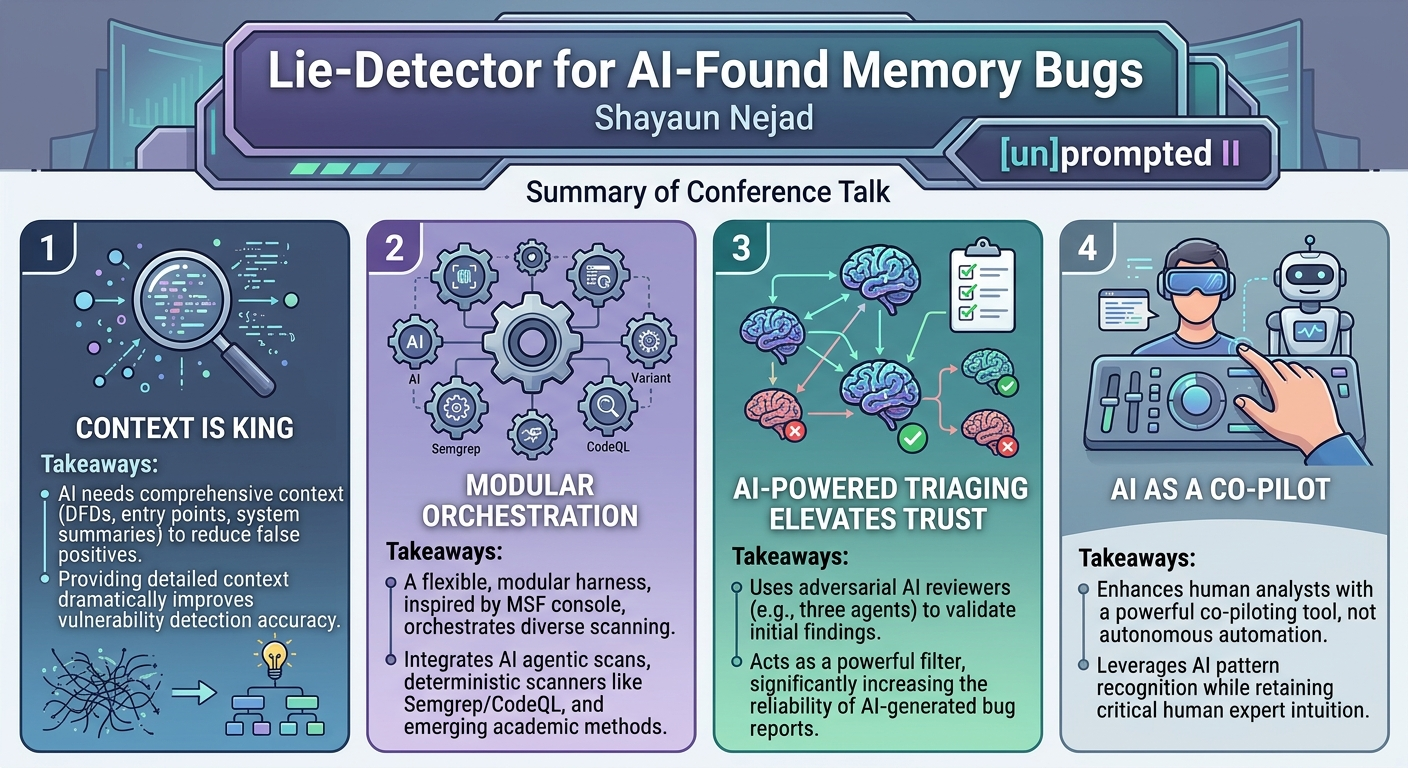
- Context is King for AI: The primary challenge in AI vulnerability scanning is providing sufficient context (DFDs, entry points, system summaries) to AI agents. Addressing this significantly improves accuracy and reduces false positives.
- Modular Orchestration is Essential: A flexible, modular harness, akin to MSF console, is crucial for integrating diverse scanning strategies—AI agentic, deterministic (Semgrep, CodeQL), and emerging academic methods like variant analysis—into a unified workflow.
- AI-Powered Triaging Elevates Trust: Employing AI-driven adversarial reviewers (e.g., three agents) to validate findings from initial scans acts as a "lie-detector," dramatically increasing the reliability and trustworthiness of AI-generated vulnerability reports.
- Persistent Data Management is Non-Negotiable: A unified, persistent database for storing context, scan results, and triage decisions is vital for scalable vulnerability management, overcoming the limitations of ephemeral markdown files.
- AI as a Co-Pilot, Not an Autonomous Agent: The most effective role for AI in security is to augment human analysts, providing a powerful co-piloting tool that enhances human intuition and expertise, rather than attempting full automation.
- Open Source for Community Collaboration: The project is open source and actively seeking contributors, highlighting the speaker's belief in community-driven development for advancing AI-assisted security tooling.
About the Speaker(s)
Shayaun Nejad is a Lead Product Security Engineer at Rubrik. His work on the "Lie-Detector for AI-Found Memory Bugs" project was undertaken outside of his primary professional responsibilities, driven by his direct experiences and observations regarding the challenges of integrating AI into vulnerability scanning within a workplace context. Nejad demonstrates a deep engagement with cutting-edge security research, having also given a talk on variant analysis the day prior to this presentation, underscoring his commitment to advancing the field of application security.
Reviews
→ Top-rated talks at [un]prompted II 2026 — The AI Security Practitioner Conference
All talks from [un]prompted II 2026 — The AI Security Practitioner Conference