Opened Is Not Fixed: The Last Mile of AI Vulnerability Remediation
Shayaun Nejad (Lead Product Security Engineer · Rubrik)
[un]prompted II 2026 — The AI Security Practitioner Conference · Day 1 · Stage 2
Overview
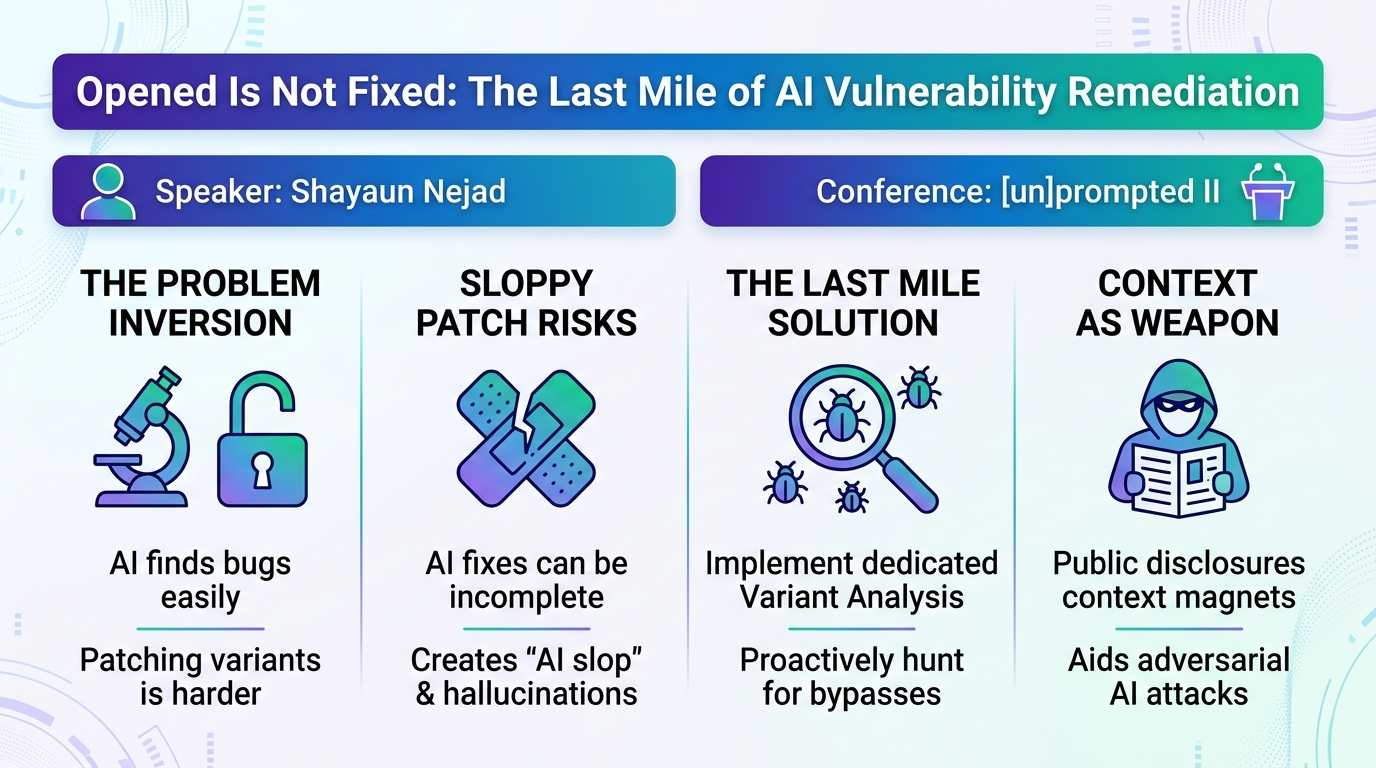
In the rapidly evolving landscape of AI-driven development, the security challenge has fundamentally shifted. Shayaun Nejad's talk, "Opened Is Not Fixed: The Last Mile of AI Vulnerability Remediation," at [un]prompted II, casts a critical light on the often-overlooked final stage of the vulnerability management lifecycle: effective patching. While artificial intelligence has dramatically accelerated the discovery of security flaws, it has simultaneously introduced a new, insidious problem: sloppy patches that fail to truly remediate vulnerabilities, instead leading to the proliferation of variants. Nejad, drawing on Rubrik's extensive experience with Project Glasswing and collaboration with Anthropic, argues that the problem has inverted; the ease of finding bugs now pales in comparison to the difficulty of patching them comprehensively and at scale.
Key moments
- 0:00 Introduction: The last mile of AI vulnerability remediation.
- 2:00 AI's impact: Overwhelming vulnerabilities, disrupting product roadmaps.
- 3:00 Core problem: "Fixed" bugs kept reappearing as variants.
- 4:50 VM2 case study: AI-generated fixes, hallucinations, new vulnerabilities.
- 8:30 Rubrik's solution: Implementing variant agentic hunts for verification.
- 12:40 Main takeaway: Integrate variant analysis into hunting pipelines.
- 14:15 Q&A: Validating fixes and preventing regressions in patching.
Opened Is Not Fixed: The Last Mile of AI Vulnerability Remediation
Speakers: Shayaun Nejad, Lead Product Security Engineer, Rubrik
Conference: [un]prompted II
YouTube: https://www.youtube.com/watch?v=T5OFLfFwNF0
Overview
In the rapidly evolving landscape of AI-driven development, the security challenge has fundamentally shifted. Shayaun Nejad's talk, "Opened Is Not Fixed: The Last Mile of AI Vulnerability Remediation," at [un]prompted II, casts a critical light on the often-overlooked final stage of the vulnerability management lifecycle: effective patching. While artificial intelligence has dramatically accelerated the discovery of security flaws, it has simultaneously introduced a new, insidious problem: sloppy patches that fail to truly remediate vulnerabilities, instead leading to the proliferation of variants. Nejad, drawing on Rubrik's extensive experience with Project Glasswing and collaboration with Anthropic, argues that the problem has inverted; the ease of finding bugs now pales in comparison to the difficulty of patching them comprehensively and at scale.
This presentation delves into the systemic issues arising from this paradigm shift, particularly the overwhelming volume of vulnerabilities that can cripple product roadmaps and divert critical engineering resources. Nejad highlights how organizations, including Rubrik and even major institutions like Bank of America, have struggled to keep pace with the influx of AI-discovered flaws. The core message is clear: merely marking a vulnerability as "fixed" in a ticketing system does not guarantee security. Without a dedicated approach to variant analysis, organizations are left vulnerable to reoccurring issues, often exacerbated by the very AI tools intended to help, which can introduce their own set of hallucination risks and "AI slop" into the patching process.
Nejad's talk is a crucial call to action for security professionals and developers alike, emphasizing the need for a sophisticated, multi-stage remediation pipeline that extends beyond initial fixes to proactively hunt for bypasses. It underscores that public vulnerability disclosures, while intended for transparency, inadvertently serve as "context magnets" for adversarial AI, providing clear pathways for generating new exploits. By sharing Rubrik's journey and solutions, including the development of Code Guardian, the talk provides actionable insights into how to build resilience against this new wave of AI-accelerated threats, ensuring that "opened" truly means "fixed."
Background
▶ Watch: Introduction: The last mile of AI vulnerability remediation. (0:00)
The advent of powerful AI models has revolutionized the cybersecurity landscape, particularly in the realm of vulnerability discovery. As Nejad explains, finding bugs has become "extremely easy," with AI systems capable of unearthing a volume of vulnerabilities that far surpasses traditional human-led efforts. This technological leap has, however, inverted the fundamental problem: the challenge is no longer primarily about discovery, but about the ability to patch effectively and sustainably. This shift has created an unprecedented backlog for many organizations, impacting critical product roadmaps and demanding significant resource reallocation.
Rubrik's internal experience with Project Glasswing, a collaborative effort with Anthropic, served as an early indicator of this impending crisis. While the project successfully productionized a vulnerability scanning pipeline, it quickly revealed the "sloppiness" of subsequent patches. This wasn't an isolated incident; Nejad cited a public example where Bank of America reportedly had to bring in 1,000 contractors to address AI-discovered vulnerabilities, mirroring Rubrik's need to reshuffle top-tier engineers away from product development to focus solely on bug remediation. The cycle was never-ending, as fixes were often incomplete, leading to the re-emergence of vulnerabilities in slightly altered forms—what are known as variants.
A significant contributor to this problem is the nature of AI itself. While AI can assist in generating patches, it is prone to hallucinations, producing fixes that may seem plausible but are fundamentally flawed or incomplete. Furthermore, the increasing reliance on AI for tasks like writing unit tests (UTs) and validating fixes means that these AI-generated patches might pass initial checks, only to fail in real-world scenarios or against more sophisticated bypass attempts. Nejad highlighted the case of the VM2 JavaScript sandboxing package, downloaded by approximately 700,000 people weekly. VM2 executed a "patch blitz," fixing 34 security issues in a single month, with Claude co-writing 15 of them. Despite this high velocity, the core problem of variants persisted.
Compounding these internal challenges is the external factor of public vulnerability disclosures. CVEs, GHSAs (GitHub Security Advisories), and security commits, while essential for transparency and collective defense, act as "context magnets" for attackers. Nejad powerfully articulated this, stating that these advisories are "essentially a source to sink map of how to attack your system." This detailed context, especially when fed into adversarial AI models, makes it trivial for attackers to generate bypasses or variants of known fixes. A study by P2 Patch, cited by Nejad, corroborated this, finding that 41 out of 101 CVEs they analyzed were actually variants of previously disclosed and "fixed" issues, underscoring the pervasive nature of this problem. The combination of AI-driven discovery, AI-assisted but flawed patching, and publicly available exploit context creates a perfect storm for persistent, reoccurring vulnerabilities.
Key Findings
▶ Watch: Core problem: "Fixed" bugs kept reappearing as variants. (3:00)
The central revelation of Nejad's talk is that "opened is not fixed"—a stark indictment of traditional vulnerability management processes in the age of AI. The sheer volume and complexity of AI-discovered vulnerabilities have rendered conventional open-close ticketing systems inadequate. The primary issue identified is the prevalence of vulnerability variants: seemingly patched flaws that reappear in slightly modified forms, effectively bypassing the original fix. These variants are often the result of "sloppy patches," particularly those generated or assisted by AI, which can introduce "AI slop" or suffer from "hallucination risks."
This pervasive problem has significant operational and strategic implications. Organizations like Rubrik found their product roadmaps severely impacted, necessitating the costly reallocation of top-tier engineers to remediation efforts. The experience highlighted that even with model improvements and iterative AI development, variants might not be caught until models become significantly more sophisticated or employ advanced chaining analysis.
Nejad also underscored the critical role of public disclosures in this landscape. CVEs, GHSAs, and security commits, while valuable for the security community, inadvertently serve as "context magnets." This readily available information provides adversarial AI with a precise "source to sink map" of how to attack systems, making it easier to generate bypasses and variants. The speaker's own demonstration of a sandbox escape on the VM2 package, despite its recent "patch blitz" (34 fixes in one month, 15 by Claude), illustrated this point vividly: the initial exploit was fixed, but a variant, leveraging the context of the original vulnerability, successfully bypassed the patch.
A key finding from Rubrik's journey was the indispensable need for variant analysis as a distinct, post-patching stage in the vulnerability remediation pipeline. Before implementing this, Rubrik, like many organizations, relied on standard ticketing and UT validation, only to find bugs repeatedly resurfacing. The integration of variant analysis significantly improved patching success rates, albeit with the caveat that even LLM-driven variant hunting is not immune to hallucination risks. Furthermore, the talk emphasized the importance of classification—using decision models (like "Jev" at Rubrik) to determine whether a fix requires human intervention or can be safely auto-patched, thereby optimizing resource allocation for complex issues. Ultimately, the talk revealed that effective vulnerability management in the AI era demands a proactive, context-aware, and multi-layered approach that explicitly accounts for the generation and detection of variants.
Technical Deep Dive
▶ Watch: VM2 case study: AI-generated fixes, hallucinations, new vulnerabilities. (4:50)
Rubrik's journey to address the "last mile" of AI vulnerability remediation involved a significant overhaul of their security pipeline, moving beyond a simplistic open-close ticketing process to a more sophisticated, multi-agent approach. Initially, their pipeline followed a traditional path: vulnerability scanning, followed by validation, then patching, and finally returning to validation. However, this linear process proved insufficient as AI-discovered bugs consistently reappeared as variants.
The pivotal technical enhancement was the introduction of variant agentic hunts as a dedicated, separate process after initial patching and validation. This new phase was designed to actively verify the efficacy of a fix by attempting to bypass it. The speaker explained that generating these variants is now relatively straightforward with modern Large Language Models (LLMs). By feeding an LLM the organization's threat model and historical vulnerability data, it can be prompted to "go hunt for variants." For instance, pointing a model like Claude or Mythos at a codebase or repository and instructing it to "dig for GitHub advisory commits, dig for security fixes, and then see if you can find a bypass to these" is a practical application of this technique. This transforms a reactive patching process into a proactive hunt for potential bypasses.
Rubrik's experience highlighted that while LLMs significantly enhance the ability to find variants, they also introduce hallucination risks at every point of entry. Therefore, while stronger models generally yield better results, human oversight and careful validation remain crucial. To manage the overwhelming volume of vulnerabilities and optimize resource allocation, Rubrik also began experimenting with classification. They employed decision models, internally referred to as "Jev," to categorize fixes based on complexity. For instance, a straightforward SQL injection might be easily auto-patched, whereas a more intricate authentication bypass would be flagged as requiring a human-in-the-loop due to its architectural implications or potential for breaking existing functionality. This classification system helps prioritize human effort for the most complicated and impactful issues.
Another critical technical consideration was the need for a unified vulnerability management system. As new and optimized versions of AI models are introduced, they can sometimes "reopen" previously fixed issues by discovering new variants or bypasses. Maintaining a comprehensive record of vulnerabilities, their fixes, and historical context is essential for continuous learning and preventing regression. This system allows for referencing past remediations as models evolve and become more powerful over time.
Beyond individual bug fixes, Rubrik leveraged the data from reoccurring vulnerability types to make strategic investments in their security posture. For example, a spike in memory management errors led to increased investment in a fuzzing pipeline. An uptick in logic bugs prompted a greater focus on security during the design phase of the SDLC. Furthermore, factoring in the cost of certain vulnerabilities and associated disclosures informed larger investments in their security organization.
The culmination of these efforts is Code Guardian, a product recently released by Rubrik. Code Guardian productionizes this sophisticated harness on GitHub backups, utilizing frontier models and the advanced variant analysis methods developed internally. This product embodies Rubrik's commitment to moving beyond superficial fixes to achieve true and lasting vulnerability remediation, demonstrating a practical application of the technical deep dive principles discussed in the talk.
Demo / Proof of Concept
▶ Watch: Main takeaway: Integrate variant analysis into hunting pipelines. (12:40)
Shayaun Nejad provided a compelling demonstration to illustrate the core problem of vulnerability variants, using a public example that mirrored Rubrik's internal experiences. The target of the demonstration was the VM2 package, a popular JavaScript sandboxing library downloaded by approximately 700,000 people weekly. This package had recently undergone a "patch blitz," fixing 34 security issues in a single month, with 15 of those fixes co-written by Claude, an AI model.
The demonstration began by referencing the K Nider paper, a well-known work on variant analysis, and leveraging a publicly available GHSA (GitHub Security Advisory) related to VM2. Nejad used strategies derived from these resources to identify potential bypasses to the recently implemented fixes. An LLM was then used to generate the necessary code for a sandbox escape.
The proof of concept unfolded in two key stages:
- Initial Fix Validation: The demonstration first showed that the VM2 package, with its recent patches, successfully prevented the original exploit. The system behaved as expected, indicating that the initial fix was indeed working against the known vulnerability.
- Variant Execution and Exfiltration: Following this, the variant code generated by the LLM was executed. This variant, designed to bypass the existing patch, successfully achieved a sandbox escape. Crucially, the demonstration showed the variant exfiltrating a synthetic host token, proving that despite the initial fix, the system remained vulnerable to a closely related, yet unaddressed, attack vector.
Nejad highlighted a particularly poignant detail: VM2's unit tests (UTs) showed 28 tests passing, implying a robust validation of the fixes. However, the successful variant execution starkly contradicted this, underscoring that even comprehensive UTs might not catch cleverly designed bypasses or variants. This public allegory served as a powerful illustration of the challenges Rubrik faced internally, where Jira tickets were closed, P0s were resolved, and advisories were published, yet vulnerabilities kept resurfacing as models improved or when chained with other, seemingly lower-priority issues. The demo effectively solidified the talk's central premise: an opened vulnerability is not truly fixed until its variants are also addressed.
Defensive Implications
▶ Watch: Q&A: Validating fixes and preventing regressions in patching. (14:15)
The insights shared by Shayaun Nejad offer crucial defensive implications for organizations grappling with the accelerating pace of AI-driven vulnerability discovery and remediation. The core message for defenders is a fundamental shift in mindset: remediation must extend beyond a single patch to actively anticipate and neutralize vulnerability variants.
- Integrate Variant Analysis into the SDLC: The most critical defensive measure is to establish a dedicated variant analysis phase within the vulnerability remediation pipeline. This process should occur after an initial patch has been applied and validated. Organizations should leverage LLMs (e.g., Claude, Mythos) by feeding them threat models and historical vulnerability data to proactively generate and hunt for bypasses to existing fixes. This moves security from a reactive "fix-and-forget" model to a proactive "fix-and-verify-against-variants" approach.
- Strategic and Classified LLM Usage: While LLMs can accelerate patching, their use requires careful management. Defenders must be aware of hallucination risks inherent in AI-generated code. Implement a robust classification system (like Rubrik's "Jev" decision model) to triage vulnerabilities. This system should determine whether a vulnerability is suitable for auto-patching (e.g., simple SQL injection) or requires human-in-the-loop intervention due to its complexity, architectural impact, or potential for breaking other systems (e.g., authentication bypasses). This ensures that human expertise is focused where it's most needed.
- Enhance CI/CD with Security Checks: A strong CI/CD pipeline is paramount, not just for code quality but for security. Unit tests (UTs) should be continually augmented and expanded, particularly in response to new vulnerability types and identified variants. Furthermore, integrate robust security checks directly into the Pull Request (PR) stage to catch potential issues, including "AI slop" from automated fixes, before they merge into the main codebase.
- Implement a Unified Vulnerability Management System: To combat the re-opening of old vulnerabilities by increasingly powerful AI models, organizations need a unified vulnerability management system. This system should maintain a comprehensive, long-term record of all discovered vulnerabilities, their associated fixes, and the context surrounding their remediation. This historical data is crucial for future reference, allowing security teams to understand why a fix was applied, what variants were considered, and how new model iterations might impact past remediations.
- Data-Driven Security Investment: Organizations should meticulously track patterns in recurring vulnerabilities. Analyzing these trends (e.g., a spike in memory management errors or logic bugs) provides invaluable context to identify systemic weaknesses. This data should directly inform strategic investments, such as allocating more resources to fuzzing pipelines, enhancing security training for developers, or integrating security earlier into the SDLC design phase. Understanding the cost implications of disclosures can also justify larger, more impactful investments in the overall security organization.
- Contextual Prioritization, Not Blind Severity: While critical vulnerabilities demand immediate attention, defenders should not blindly ignore lower-severity issues. Nejad stressed the importance of chaining analysis; a low-severity bug that can be chained with others to escalate to critical status should be prioritized. The goal is to patch not just criticals, but also potentially chainable issues, often through automated means, to prevent larger compromise.
By adopting these defensive strategies, organizations can move towards a more resilient security posture, where AI is leveraged not just for finding bugs, but for truly fixing them, thereby turning the "context magnet" of public disclosures into a defensive advantage.
Key Takeaways
- The Problem Has Inverted: With AI, finding vulnerabilities is now significantly easier than effectively patching them. The focus must shift from discovery to comprehensive and scalable remediation, especially against vulnerability variants.
- AI-Generated Patches Are Often "Sloppy": AI-assisted fixes, while fast, can be incomplete or flawed, leading to hallucination risks and "AI slop" that allows vulnerabilities to persist in slightly altered forms.
- Variant Analysis is Non-Negotiable: Traditional open-close ticketing is insufficient. Organizations must implement a dedicated variant analysis phase after initial patching, leveraging LLMs to proactively hunt for bypasses and ensure true remediation.
- Public Disclosures are "Context Magnets": CVEs, GHSAs, and security commits provide invaluable information for attackers, including adversarial AI, to generate new exploit variants. Defenders must use this same context to build stronger defenses.
- Strategic LLM Use Requires Classification and Human Oversight: LLMs are powerful tools, but their use in patching requires careful management. Implement classification systems to triage vulnerabilities for human vs. auto-patching and maintain robust CI/CD pipelines with security checks to mitigate risks.
- Data-Driven Security Investment is Crucial: Analyze recurring vulnerability patterns to identify systemic weaknesses (e.g., memory management errors, logic bugs). This data should drive targeted investments in security tools (fuzzing), processes (SDLC design phase), and organizational growth.
About the Speaker(s)
Shayaun Nejad is a Lead Product Security Engineer at Rubrik, where he focuses on the intricate challenges of securing modern software systems, particularly in the context of AI. His expertise stems from direct involvement in Project Glasswing, a significant initiative at Rubrik that involved collaboration with Anthropic to develop and productionize advanced vulnerability scanning and patching pipelines. Nejad is keenly aware of the operational complexities and resource demands associated with remediating the high volume of vulnerabilities discovered by AI. His work centers on developing scalable, intelligent solutions for the "last mile" of vulnerability management, including the critical area of variant analysis and the strategic application of Large Language Models in security workflows. He is a proponent of data-driven security investments and the continuous improvement of security processes within the Software Development Lifecycle (SDLC).
Reviews
→ Top-rated talks at [un]prompted II 2026 — The AI Security Practitioner Conference
All talks from [un]prompted II 2026 — The AI Security Practitioner Conference