Secure Product Development With Mantis
Nick Galloway (AI for security and security for AI · Google Cloud), Ruchi Shah (Senior Director, Security Engineering · Google Cloud)
[un]prompted II 2026 — The AI Security Practitioner Conference · Day 1 · Stage 2
Overview
In an era defined by accelerating software development cycles and the pervasive integration of Artificial Intelligence, traditional security paradigms are struggling to keep pace. The talk "Secure Product Development With Mantis" by Nick Galloway and Ruchi Shah from Google Cloud addresses this critical challenge head-on, presenting a comprehensive, three-pronged approach to embedding security throughout the entire software development lifecycle (SDLC). The core of their strategy revolves around Mantis, an AI-powered vulnerability scanner, complemented by a proactive "secure by construction" methodology and a fundamental shift in how security context is delivered to developers.
Key moments
- 0:00 Introduction and Mantis's three-pronged approach
- 4:10 Pre-submit checks for preventing vulnerabilities in commits
- 6:50 Using AI to understand and specify complex systems
- 12:00 Shift to secure by design and fixing design flaws
- 14:30 Automating security control assessments with agentic skills
- 16:30 Automating security gates and preventing regressions with Mantis
- 18:50 Lessons learned: challenges with AI scanners and human biases
- 22:00 Adapting security to high-velocity AI development models
Secure Product Development With Mantis
Speakers: Nick Galloway (AI for security and security for AI, Google Cloud), Ruchi Shah (Senior Director, Security Engineering, Google Cloud)
Conference: [un]prompted II
YouTube: https://www.youtube.com/watch?v=F1LOyHZCTOk
Overview
In an era defined by accelerating software development cycles and the pervasive integration of Artificial Intelligence, traditional security paradigms are struggling to keep pace. The talk "Secure Product Development With Mantis" by Nick Galloway and Ruchi Shah from Google Cloud addresses this critical challenge head-on, presenting a comprehensive, three-pronged approach to embedding security throughout the entire software development lifecycle (SDLC). The core of their strategy revolves around Mantis, an AI-powered vulnerability scanner, complemented by a proactive "secure by construction" methodology and a fundamental shift in how security context is delivered to developers.
The speakers contend that relying solely on post-development vulnerability scanning, even with advanced AI, is no longer sufficient. Instead, they advocate for a radical shift left, integrating security checks before code commit, actively rewriting critical software for inherent security, and leveraging AI agents to understand and continuously verify complex systems against evolving specifications. This talk is highly relevant for security professionals, software architects, and development leaders grappling with the implications of high-velocity AI-driven development and the imperative to build resilient systems from inception.
Galloway, who initiated Mantis, emphasizes the astonishing trajectory of AI in vulnerability discovery over the past year, highlighting the flood of vulnerabilities unleashed by this new technology. Shah further elaborates on the necessity of moving beyond point-in-time security reviews to a continuous, embedded model, driven by the foresight that highly capable AI will enable development speeds where ideas can go from conception to launch within a single afternoon, making traditional security gatekeeping untenable.
Background
▶ Watch: Introduction and Mantis's three-pronged approach (0:00)
The landscape of software development has been profoundly altered by the advent of AI, leading to unprecedented velocities in code generation and deployment. Historically, security efforts followed a "shift-left" philosophy, pushing vulnerability discovery and remediation earlier into the SDLC, primarily through design reviews, threat modeling, and static/dynamic application security testing (SAST/DAST). However, as Nick Galloway points out, even with these efforts, the fundamental issue of fixing root causes and preventing vulnerabilities from ever being introduced remains a significant challenge.
The problem is exacerbated by the sheer scale and complexity of modern systems. Galloway boldly claims that "none of us understand our systems" fully, understanding only pieces or outdated abstractions. This lack of a comprehensive, up-to-date understanding makes it difficult to secure systems effectively, as security issues often stem from design flaws and unexpected interactions rather than simple coding errors. Traditional human-driven efforts to create exhaustive system specifications or perform formal verification are tedious, time-consuming, and prone to human error or fatigue, making them impractical at the scale of large organizations like Google.
Ruchi Shah underscores that the most impactful vulnerabilities are typically not coding mistakes but design flaws. Scanners can identify faulty functions, but rarely the underlying system fault. The conventional product development flow—security review at design time, development, testing, fixing bugs before launch, and ongoing vulnerability research—is characterized by "point in time security reviews." While this reduces risk, it does not eliminate it. The impending reality of highly capable AI, enabling rapid development and equally rapid adversarial exploitation, necessitates a fundamental re-evaluation of security integration, moving beyond mere risk reduction to inherent resilience and "secure by design" principles.
Key Findings
▶ Watch: Using AI to understand and specify complex systems (6:50)
The talk outlines several key findings and contributions that redefine secure product development in the age of AI:
- AI for Scalable Vulnerability Discovery (Mantis): AI is exceptionally good at finding vulnerabilities, leading to a "flood" of new discoveries. Mantis, Google Cloud's internal scanner, leverages complex agent architectures (planner, researcher, critics, calibrators) to scale this capability. The open-source ADK version provides a blueprint for others to build similar harnesses.
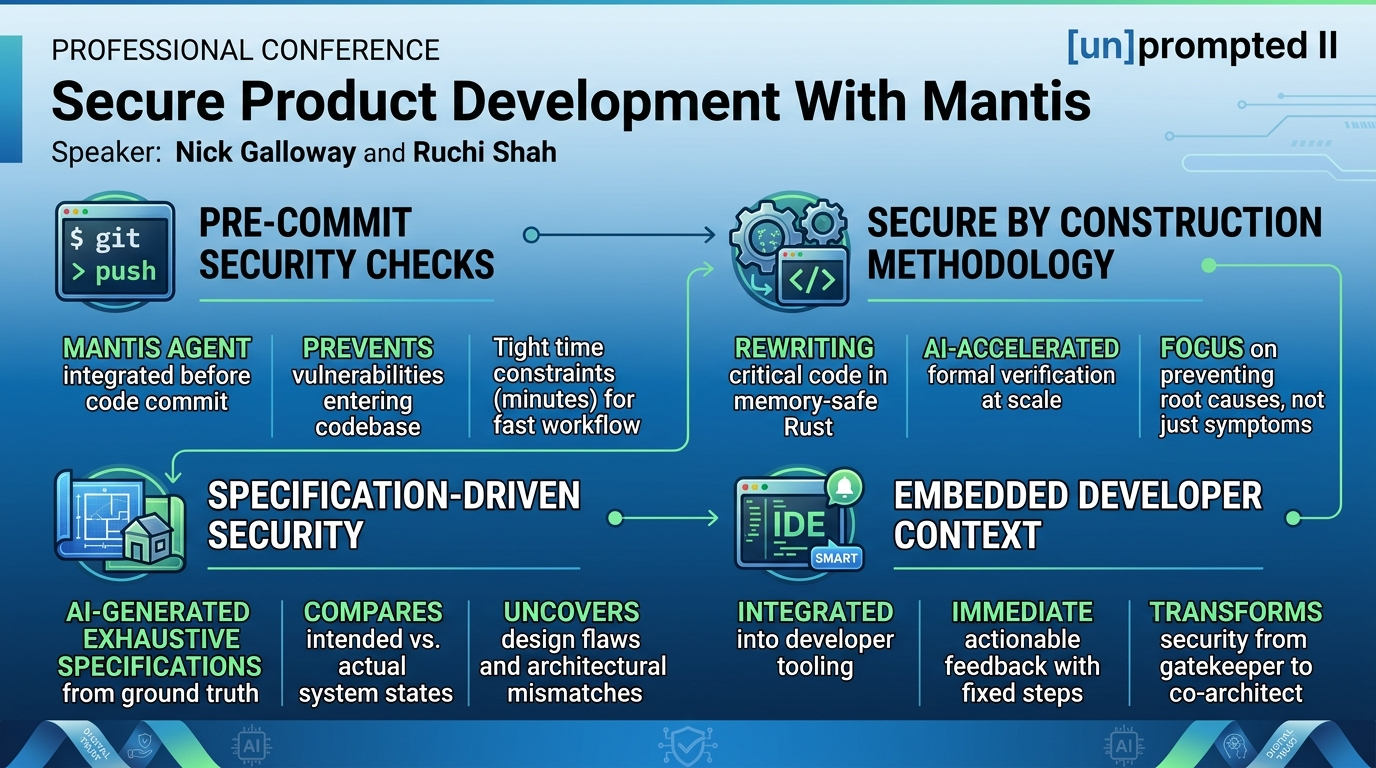
- Pre-Commit Security Checks: Moving beyond periodic deep scans, Mantis is integrated into pre-submit checks within the developer workflow. This prevents vulnerabilities from ever entering the codebase, operating within a tight time constraint (a couple of minutes) to avoid developer friction.
- Secure by Construction: The talk advocates for fixing root causes rather than just symptoms. This involves:
- Rewriting critical software in memory-safe languages like Rust.
- Utilizing AI agents for formal verification of existing code, a task too tedious for humans at scale.
- Employing AI agents to build exhaustive specifications of highly complex systems from "ground truth" data (IAM policies, resources, databases) and then generating understandable abstractions.
- Specification-Driven Security: A crucial innovation is the comparison of an intended specification (derived from design docs, RFCs, threat models) with an actual specification (extracted from ground truth). Mismatches highlight potential vulnerabilities or unexpected system behaviors, forming a continuous audit mechanism.
- Context Engineering for Developers: Recognizing that developers are the "root cause of every vulnerability," the approach emphasizes embedding security requirements and feedback directly into developer tooling, ensuring security context is available at the right place and time. This means agents can provide fixed steps for control weaknesses before code is even uploaded for review.
- Continuous and Embedded Security: Ruchi Shah highlights the shift from point-in-time reviews to a holistic and continuous effort. By collecting security policies and requirements in one place and using agentic skills to automate control assessments, Google Cloud aims for autonomous bug filing, fixing, and verification across production services. This transforms security teams from "late-stage gatekeepers" to "co-architects."
Technical Deep Dive
▶ Watch: Automating security control assessments with agentic skills (14:30)
The technical foundation of Google Cloud's approach rests on Mantis and a sophisticated framework for AI-driven system understanding and secure development.
Mantis: AI-Powered Vulnerability Scanning
Mantis is Google Cloud's internal AI vulnerability scanner, designed for both periodic deep scans and rapid pre-submit checks. Its core strength lies in its LLM integration and agent architecture. The speakers describe a multi-agent system comprising a planner, researcher, critics, and calibrators. This allows for a structured approach to vulnerability discovery: the planner orchestrates the scan, the researcher gathers information, critics evaluate potential findings, and calibrators tune the output. The possibility of consolidating these into "separate turns in a single conversation" for better prompt caching is also explored, indicating ongoing optimization.
A critical aspect of Mantis's utility is the ability to tune its output based on team-specific threat models. For instance, some teams might disregard null pointer dereferences if system resilience handles crashes, while for others, it's a critical issue. This customization ensures that the scanner's findings are actionable and relevant, avoiding alert fatigue from irrelevant false positives.
Mantis was initially open-sourced as a collection of Markdown files demonstrating their methodology, later evolving into an ADK (Agent Development Kit) version with improved scaling, more closely resembling the internal system. The ADK is explicitly presented as a blueprint, encouraging other companies to build their own harnesses and adapt the ideas. The challenge of running Mantis at scale involves standard infrastructure concerns like Kubernetes clusters, databases, and access controls, alongside the complexities of LLM integration.
Shifting to Secure by Construction
Beyond finding bugs, the talk delves into preventing them through secure by construction principles, broken down into three parts:
- Rewriting Critical Software: For small, critical pieces of software like bootloaders or kernel drivers, the strategy involves rewriting them in languages that inherently reduce certain classes of vulnerabilities. Rust is cited as a prime example due to its memory safety guarantees, which eliminate common issues like buffer overflows and use-after-free errors prevalent in C/C++.
- AI-Accelerated Formal Verification: Formal verification, a method of mathematically proving the correctness of algorithms or designs, is traditionally labor-intensive. AI agents, however, can perform this "tedious work" at scale without fatigue. This allows for rigorous assurance of existing codebases, a task previously impractical for human teams.
- Understanding Complex Systems with AI: This is perhaps the most ambitious part. Acknowledging that humans struggle to fully comprehend complex systems, AI agents are tasked with building exhaustive specifications from "ground truth" data. This includes vast datasets like IAM policies, resource configurations, and database schemas. Instead of directly processing "giant billion rows of databases," agents construct queries to extract and summarize this ground truth into deterministic specifications. These specifications can then be abstracted into understandable diagrams, revealing trust boundaries and potential architectural flaws. Initial human sampling confirms the accuracy of these AI-generated specifications.
Specification-Driven Security and Continuous Verification
The refined understanding of systems through AI-generated specifications enables a powerful new security paradigm. The process involves:
- Creating an Intended Specification: AI agents extract this "idealized version" of the system from various sources: design documents, RFCs, meeting notes, human-written threat models, and even code comments. This captures product manager, software engineer, and user expectations.
- Extracting an Actual Specification: This is derived directly from the "ground truth" of the deployed system, as described above.
- Analyzing Mismatches: The core innovation is comparing the intended and actual specifications. Discrepancies often reveal unexpected behaviors or, crucially, vulnerabilities. This continuous analysis allows Google Cloud to identify "surprising mismatches" that may not be explicit vulnerabilities but indicate deviations from expected design, which could lead to security issues.
Embedding Security in the Developer Workflow
The ultimate goal is to embed security directly into the developer's context. By using context engineering, security requirements are presented to developers at the precise moment they are needed. When a code change weakens a security control, an agent immediately flags it and provides "fixed steps" before the change is even uploaded for commit review. This proactive feedback loop is exemplified by tools like Code Mentor in Anti-Gravity, pushing security checks "right in like the code mender." Agents are guided to state their assumptions to maintain focus on security, while humans provide high-level guidance and approve intent changes.
Ruchi Shah details how this translates into the SDLC:
- Ideation to Rollout: RFCs and design documents are used to produce the spec.
- Spec Against Security Bar: The spec is checked against a "security bar," a repository of all security requirements.
- Code Generation: A coding agent uses the spec as context to generate code.
- Pre-Submit Checks: Mantis runs pre-submit checks to prevent new security issues.
- Rollout: Diffs are available for human review.
For legacy (brownfield) systems, specifications are reverse-generated, providing a starting point for continuous enforcement of non-negotiable standards like authentication and data protection for both human and AI developers. This approach transforms security reviews from point-in-time gatekeeping to continuous, embedded assurance, with security invariants holding true despite feature evolution.
Demo / Proof of Concept
▶ Watch: Automating security gates and preventing regressions with Mantis (16:30)
The talk did not feature a live demonstration or a proof of concept of Mantis in action. When asked about the visually generated diagrams, Nick Galloway clarified that they were "totally AI generated slop" and merely examples of what such diagrams could look like. He explicitly stated that the internal tooling for generating these detailed system diagrams is "not open source yet" and is currently "custom to Google," indicating that a public demonstration of this specific capability was not part of the presentation. While Mantis has an open-source ADK version, the intricate system understanding and specification generation capabilities discussed are still under internal development at Google.
Defensive Implications
▶ Watch: Adapting security to high-velocity AI development models (22:00)
The insights from this talk offer profound defensive implications for organizations aiming to secure their software development processes in the AI era:
- Embrace AI for Proactive Vulnerability Management: Organizations should move beyond traditional scanning and actively integrate AI-powered tools like Mantis into their SDLC. This means not just periodic scans but implementing pre-submit checks to catch vulnerabilities before they are committed, significantly reducing the cost and effort of remediation.
- Shift to Secure by Design and Construction: Prioritize rewriting critical components in memory-safe languages (e.g., Rust) where feasible. Invest in or develop AI-driven formal verification tools to mathematically prove the correctness of complex or security-critical code. This moves security from a reactive patching exercise to a proactive, preventative discipline.
- Develop System-Level Understanding with AI: Leverage AI agents to generate exhaustive specifications of complex systems from ground truth data (e.g., IAM policies, cloud resource configurations). This provides an unprecedented level of understanding about system architecture, trust boundaries, and potential attack paths, which is beyond human capacity at scale.
- Implement Specification-Driven Security: Establish a continuous process of comparing intended specifications (from design documents, threat models) with actual specifications (derived from ground truth). Mismatches should trigger immediate investigation, as they often indicate design flaws or unexpected behaviors that could lead to vulnerabilities.
- Embed Security Context Directly into Developer Workflows: Integrate security requirements, policies, and remediation guidance directly into developer tooling. The goal is to provide immediate, actionable feedback on security issues, complete with fixed steps, before code is submitted for review. This "context engineering" empowers developers to build secure code from the outset, rather than being gatekept by security teams later.
- Automate Security Gates and Continuous Enforcement: Automate security control assessments and enforce security invariants throughout the SDLC. This ensures that security policies and non-negotiable standards (like authentication and data protection) are consistently applied, even as features evolve rapidly. Security teams should transition to "co-architects" who define and verify the design, rather than just finding bugs post-development.
- Be Aware of AI-Specific Pitfalls: The speakers highlight two critical issues:
- Human-written threat models can confuse scanners: If a threat model assumes a sandbox, the scanner might dismiss a real sandbox escape. Ensure that threat model assumptions are continuously validated and updated.
- Humans dismissing real AI-found vulnerabilities: Developers might mistakenly attribute real findings to "AI slop." Foster a culture where AI findings are taken seriously and used to improve scanner accuracy.
- Avoid tautological proofs: For those working with formal methods, ensure proofs are not circular, especially when using tools like SMT or Lean.
Key Takeaways
- AI Transforms Vulnerability Discovery: AI-powered scanners like Mantis are becoming a baseline, capable of identifying a "flood" of vulnerabilities at scale, far surpassing traditional methods.
- Shift Left to Pre-Commit Checks: Integrating AI scanners into pre-submit checks prevents vulnerabilities from ever entering the codebase, offering significant cost and security benefits.
- Secure by Construction is Paramount: Beyond finding bugs, focus on preventing them by rewriting critical software in memory-safe languages (e.g., Rust) and leveraging AI for formal verification.
- AI for System Understanding: AI agents can generate exhaustive and understandable specifications of complex systems from "ground truth," enabling the detection of design flaws and architectural mismatches between intended and actual system states.
- Embed Security Throughout the SDLC: Move from point-in-time security reviews to continuous, automated security enforcement, delivering context-aware feedback and remediation steps directly within developer tooling.
- Security Teams as Co-Architects: The role of security shifts from late-stage gatekeepers to co-architects, defining and verifying security invariants and policies from ideation through rollout.
About the Speaker(s)
Nick Galloway is a key figure in the intersection of AI and security at Google Cloud, where he focuses on both leveraging AI for security improvements and securing AI systems themselves. He is the founder of Mantis, Google Cloud's internal AI vulnerability scanner, and has been instrumental in its development and open-sourcing efforts. His work explores cutting-edge applications of AI agent architectures for vulnerability discovery, formal verification, and system understanding.
Ruchi Shah serves as a Senior Director of Security Engineering at Google Cloud. Her expertise lies in transforming product development methodologies to embed security deeply and continuously throughout the software development lifecycle. She advocates for a "secure by design" approach, emphasizing the shift from reactive bug fixing to proactive architectural resilience, particularly in the context of high-velocity, AI-driven development environments. Her insights highlight the organizational and process changes required to make security an inherent part of product creation.
Reviews
→ Top-rated talks at [un]prompted II 2026 — The AI Security Practitioner Conference
All talks from [un]prompted II 2026 — The AI Security Practitioner Conference