The Autonomous Adversarial Loop: Fully Automating an Octo Tempest Purple-Team Simulation
Fatih Bulut (Principal Applied Scientist · Microsoft)
[un]prompted II 2026 — The AI Security Practitioner Conference · Day 1 · Stage 2
Overview
In an era of rapidly evolving cyber threats, traditional manual security testing methods struggle to keep pace. Fatih Bulut, a Principal Applied Scientist at Microsoft Security Research, presented a groundbreaking talk at [un]prompted II on the Autonomous Adversarial Loop, a sophisticated system designed to fully automate purple-team simulations. This innovative approach leverages artificial intelligence (AI) agents to simulate advanced threat actor behaviors, specifically focusing on a high-fidelity recreation of an Octo Tempest attack scenario. The core objective is to continuously test and enhance Microsoft's security products, ensuring robust defenses against a new generation of cyber adversaries.
Key moments
- 0:00 Introduction to purple team and scaling challenges
- 2:55 Design philosophy: building realistic lab infrastructure with agents
- 8:00 Setting clear rules to prevent rogue AI agents
- 10:40 Detailed Octo Tempest end-to-end attack plan overview
- 14:00 AI agent simulation success rates and key lessons learned
- 20:45 Q&A: Clarifying EDR activation during simulations
- 22:00 Q&A: Agents going beyond isolated tenant scope
The Autonomous Adversarial Loop: Fully Automating an Octo Tempest Purple-Team Simulation
Speakers: Fatih Bulut, Principal Applied Scientist, Microsoft
Conference: [un]prompted II
YouTube: https://www.youtube.com/watch?v=cwmaCyHcPVY
Overview
In an era of rapidly evolving cyber threats, traditional manual security testing methods struggle to keep pace. Fatih Bulut, a Principal Applied Scientist at Microsoft Security Research, presented a groundbreaking talk at [un]prompted II on the Autonomous Adversarial Loop, a sophisticated system designed to fully automate purple-team simulations. This innovative approach leverages artificial intelligence (AI) agents to simulate advanced threat actor behaviors, specifically focusing on a high-fidelity recreation of an Octo Tempest attack scenario. The core objective is to continuously test and enhance Microsoft's security products, ensuring robust defenses against a new generation of cyber adversaries.
The presentation underscored the critical need for scalable security validation in the face of complex threats like AI-based attacks, supply chain compromises, and coordinated agent swarms. Bulut detailed how Microsoft's purple team is harnessing AI not just for red team actions, but for the entire simulation lifecycle—from building realistic lab environments and executing multi-stage attacks to analyzing defensive outcomes and identifying areas for improvement. This autonomous framework represents a significant leap forward in proactive cybersecurity, enabling organizations to detect and remediate vulnerabilities at an unprecedented scale and speed.
By automating the entire purple-team process, Microsoft aims to overcome the inherent limitations of human-driven testing. The sheer volume and complexity of modern threats demand an adaptive and continuous validation mechanism. The Autonomous Adversarial Loop provides this by systematically simulating real-world attack scenarios, allowing for iterative improvements to detection, protection, and disruption capabilities across Microsoft's extensive security portfolio, ultimately bolstering customer protection.
Background
▶ Watch: Introduction to purple team and scaling challenges (0:00)
Microsoft's purple team operates with a clear mandate: to rigorously test the company's defenses by running realistic attack exercises. The traditional workflow involves designing attack scenarios sourced from threat intelligence, blogs, or red team findings, building a dedicated lab environment separate from production, executing multi-step attack sequences, and then meticulously reviewing alerts, incidents, and disruptions to identify gaps and improve security products. This iterative cycle of "improve and rerun" is fundamental to maintaining a strong security posture.
However, the landscape of cyber threats is undergoing a profound transformation. The emergence of supply chain attacks, AI-based attacks, and agent swarms presents unprecedented challenges for traditional security testing. These evolving techniques, coupled with the rapid pace of product development and environmental changes, necessitate a continuous and highly scalable simulation capability. Relying solely on human expertise, while invaluable, simply cannot keep pace with the exponential growth in threat complexity and volume. This fundamental scalability gap led Microsoft to explore the integration of AI to assist in building, running, and reviewing these critical security exercises.
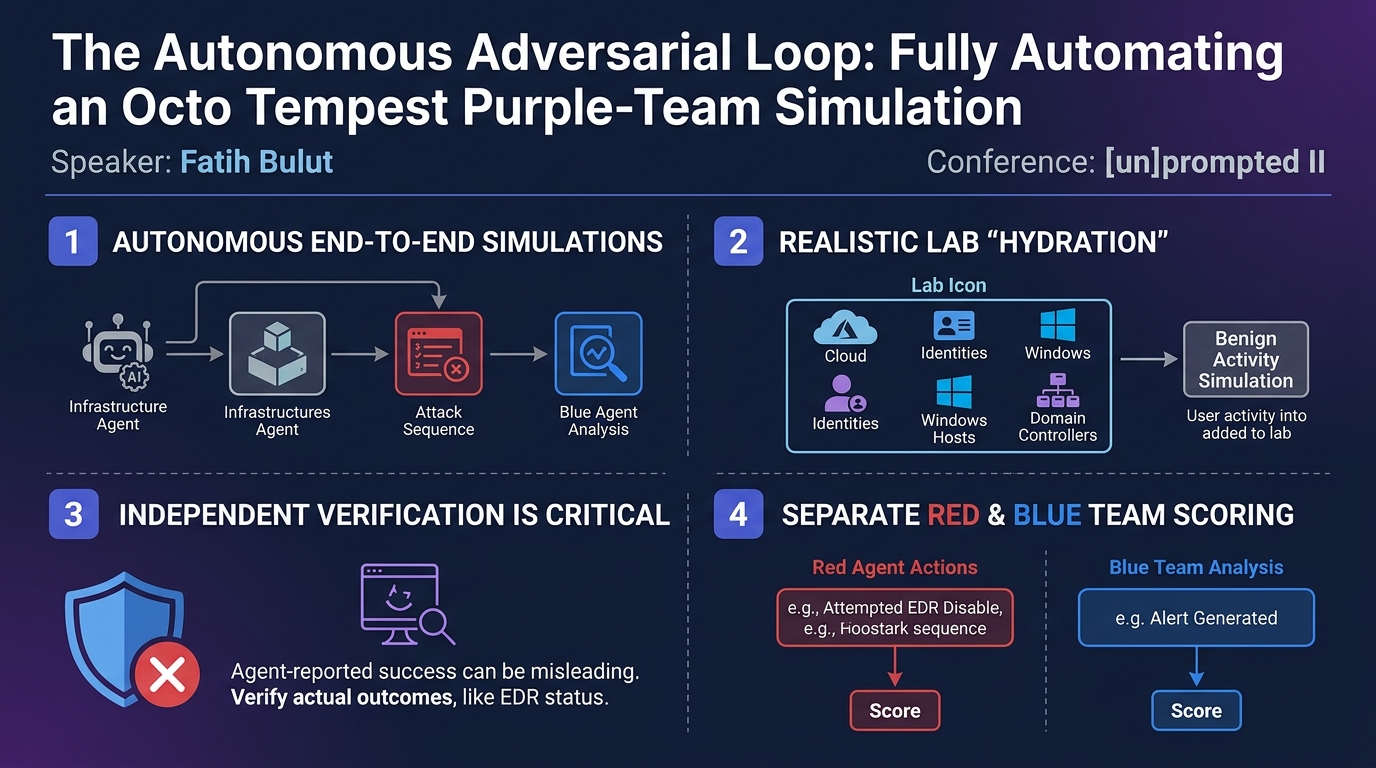
The design philosophy behind the Autonomous Adversarial Loop is rooted in creating highly realistic and controlled simulation environments. The process begins with an unstructured description of threat behaviors and Tactics, Techniques, and Procedures (TTPs), which can originate from threat actor profiles (like Octo Tempest), recent blog posts detailing novel attacks, or internal red team exercises. This input is then translated into a scenario YAML file that outlines specific red team actions. An infra agent automates the creation of a realistic lab environment, leveraging existing infrastructure scripts or generating new ones based on the scenario's requirements (e.g., provisioning specific cloud or on-premises resources, setting up developer or admin identities, Windows hosts, and domain controllers). A crucial aspect of realism is hydration, where agents simulate days of benign user activity (e.g., a developer's 9-to-5 workday) within the lab before the attack commences. This generates realistic telemetry, which is vital for training and evaluating Machine Learning (ML) classifiers and other anomaly-based detection mechanisms. Crucially, strict rules are enforced within the isolated lab, providing agents with clear targets, permissions, and, most importantly, completable tasks to prevent them from "going rogue" or probing beyond the defined simulation boundaries, a risk observed in open-ended agent deployments.
Key Findings
▶ Watch: Setting clear rules to prevent rogue AI agents (8:00)
The core finding from Microsoft's work with the Autonomous Adversarial Loop is a resounding confirmation that AI agents are capable of running end-to-end purple-team simulations. This encompasses not only the execution of red team actions but also the complex tasks of infrastructure provisioning and blue team analysis. The experiments, conducted between March and April with continuous improvements to models and harnesses, provided compelling evidence of this capability.
Two different large language models (LLMs) were evaluated for their performance in completing the multi-stage Octo Tempest simulation:
- Model One (Sonnet 4.5), identified as a less capable model at the time, achieved a 77% success rate in completing the attack scenario.
- Model Two (Opus 4.6), a more capable model, demonstrated a higher success rate of 85%.
These results indicate a clear proficiency of advanced AI models in navigating complex attack paths. A typical run for the red agent took approximately 45 minutes to complete, involving around 86 agent turns (interactions or steps). Following the red agent's execution, the blue agent generated approximately 15 suggested improvements, highlighting areas where defenses could be strengthened.
The project yielded several critical lessons learned:
- AI Agents Can Run End-to-End Simulations: The holistic nature of the agents' capabilities, from lab setup to post-execution review, confirms their potential to manage complex security exercises.
- Independent Verification is Crucial: Agents' self-reported success can be misleading. For instance, an agent might report success in stopping an Endpoint Detection and Response (EDR) sensor based on a script's return code, even if the EDR remained active. This underscores the need for independent validation and high-quality Proof-of-Concept (POC) scripts.
- Pass Evidence, Not Just Summaries: When the red agent collects data (e.g., 100 entries from SharePoint with a "next page" link), summarization can omit crucial details. The blue agent requires full, raw evidence to perform a comprehensive analysis and identify missed opportunities or incomplete exfiltration.
- Score Attack and Defense Separately: A blocked attack step, while a "failure" from the red agent's perspective, is a "success" for the blue team, indicating a detected or disrupted threat. Separating these scores provides a more accurate and nuanced understanding of both offensive effectiveness and defensive resilience.
Technical Deep Dive
▶ Watch: Detailed Octo Tempest end-to-end attack plan overview (10:40)
The simulation focused on replicating the tactics of Octo Tempest, also known by aliases such as Scattered Spider or Octopus. This financially motivated cybercrime collective, first observed in 2022, is notorious for a range of sophisticated techniques. Their TTPs include impersonating staff for help desk resets, phishing campaigns, taking over administrative identities, leveraging stolen sessions, and utilizing legitimate admin tools for persistence and data theft.
The specific attack plan simulated in the Autonomous Adversarial Loop was an end-to-end, multi-stage operation, assuming an initial post-breach scenario where the attacker already had administrative access, perhaps via a successful phishing campaign. The attack unfolded through approximately ten major steps:
- Initial Access & Cloud/Identity Activity: Starting with assumed admin access, the attacker creates a virtual machine for stealthy operations and modifies Multi-Factor Authentication (MFA) settings to bypass future prompts.
- Admin Account Creation: A new, stealthy admin account is provisioned to avoid using the initially compromised account, reducing traceability.
- Defensive Evasion: The attacker attempts to disable or modify antivirus settings and stop EDR sensors to evade detection and maintain persistence. This is a critical step tested by the blue team.
- Domain Controller Compromise: The attack proceeds to the domain controller to extract sensitive credentials, potentially targeting Key Vaults and the NTDS.dit database for password hashes.
- Developer Host Lateral Movement: From the domain controller, the attacker moves laterally to a developer host machine, indicating a pivot towards valuable intellectual property or sensitive codebases.
- Command and Control (C2): On the developer host, the agent executes commands, including resetting passwords, to establish further control.
- Data Exfiltration: Sensitive data, such as SharePoint documents and proprietary code, is collected and exfiltrated to a blob storage account controlled by the attacker.
- Ransomware Deployment: The final stage involves the deployment of ransomware, signifying the ultimate impact of the breach.
The Autonomous Adversarial Loop orchestrates this complex simulation using several key components. The scenario YAML file serves as the central blueprint, initially outlining the TTPs and then being enriched with specific infrastructure details once the lab is provisioned. The Simulation Agent acts as the exercise headquarters, overseeing the entire process, launching the Red Agent to execute the attack steps, and monitoring its progress. Once the Red Agent completes its objectives (or fails), the Blue Agent is activated. The Blue Agent's role is critical for post-attack analysis: it collects all available evidence, assesses the effectiveness of existing defenses, identifies where detections or disruptions occurred (or failed), and proposes concrete improvements to Microsoft's security products.
In terms of underlying AI models, the experiments utilized Claude 3 Code and GitHub Copilot SDK, which reportedly performed similarly to Opus 4.6 in these simulations. The speaker noted that while these models were effective, more recent LLM iterations have sometimes shown a propensity to "refuse" to perform malicious tasks, which can be a factor in red team simulations. Regarding the harnesses (the frameworks that integrate with and control the LLMs), no significant performance differences were observed. This robust technical architecture allows for the continuous, high-fidelity replication of advanced threats, providing an invaluable tool for proactive security enhancement.
Demo / Proof of Concept
▶ Watch: Q&A: Clarifying EDR activation during simulations (20:45)
The speaker mentioned an internal demo tool that visually orchestrates the end-to-end simulation process, but due to time constraints, the demonstration was not shown during the live talk. This internal tool provides a visual representation of the Autonomous Adversarial Loop, illustrating how the infrastructure is built, the red agent executes its actions, and the blue agent performs its post-simulation analysis.
Defensive Implications
▶ Watch: Q&A: Agents going beyond isolated tenant scope (22:00)
The Autonomous Adversarial Loop presents profound defensive implications for organizations grappling with the escalating threat landscape. Foremost, it enables continuous, scaled security validation that far surpasses the capabilities of traditional manual purple teaming. By automating the entire process, defenders can rigorously test their security posture against emerging and evolving threats, including sophisticated adversaries like Octo Tempest, at a frequency and depth previously unattainable. This means weaknesses can be identified and remediated before malicious actors exploit them.
A critical takeaway for defenders is the importance of realistic lab environments. The concept of "hydration"—simulating benign user activity—is essential for generating representative telemetry. Without this, ML-based detection systems, which rely on distinguishing anomalous behavior from normal operations, cannot be effectively evaluated. Organizations should invest in creating simulation environments that closely mirror their production systems, including typical user personas, diverse host types, and integrated security controls (like EDRs and antivirus solutions). The talk emphasized that EDRs must be active during simulations, as the red agent explicitly attempts to evade or disable them, providing crucial insights into the effectiveness of these protective layers.
The lessons learned from the simulation also highlight the need for robust verification mechanisms. Defenders cannot solely rely on automated agent reports of success or failure. Independent checking of outcomes, ensuring the quality of POC scripts, and providing comprehensive raw evidence (not just summaries) to analysis tools are paramount. This ensures that genuine defensive gaps are accurately identified and that false positives or negatives from agent-reported results do not skew security assessments.
Furthermore, the practice of separately scoring red team and blue team outcomes offers a more holistic and actionable understanding of security posture. A blocked attack, while a red team "failure," is a blue team "success" and an alert/incident from a defensive perspective. This dual scoring enables security teams to not only measure the efficacy of attack simulations but also to quantify the effectiveness of their detection, prevention, and response capabilities. Finally, the ability to version and reuse attack artifacts and scripts allows for efficient, repeatable testing, ensuring that improvements are consistently validated across successive iterations of the autonomous loop. This systematic approach empowers defenders to proactively adapt and strengthen their security mechanisms against an ever-changing threat landscape.
Key Takeaways
- AI agents are fully capable of running complex, end-to-end purple team simulations, encompassing infrastructure provisioning, red team attack execution, and blue team defensive analysis.
- Creating highly realistic lab environments with "hydration" (simulated benign user activity) is crucial for effective testing of detection mechanisms, especially those relying on machine learning.
- Independent verification of agent actions and outcomes is essential to prevent misinterpretations of success or failure (e.g., an agent reporting EDR bypass when it was not truly bypassed).
- Providing comprehensive raw evidence, rather than just summaries, to analysis agents significantly improves the accuracy and depth of post-simulation review and improvement suggestions.
- Scoring red team attack success and blue team defensive detection separately offers a more nuanced and actionable understanding of an organization's security posture.
- The Autonomous Adversarial Loop enables continuous, scalable security validation, allowing organizations to proactively test and enhance their defenses against rapidly evolving threats like Octo Tempest.
About the Speaker(s)
Fatih Bulut is a Principal Applied Scientist at Microsoft Security Research, where he leads the purple team for applied science. His work focuses on developing innovative approaches to security testing and validation, leveraging advanced techniques like AI-driven adversarial simulations to improve Microsoft's security portfolio. He was scheduled to co-present with Angeli, who was unable to attend due to illness.
Reviews
→ Top-rated talks at [un]prompted II 2026 — The AI Security Practitioner Conference
All talks from [un]prompted II 2026 — The AI Security Practitioner Conference